






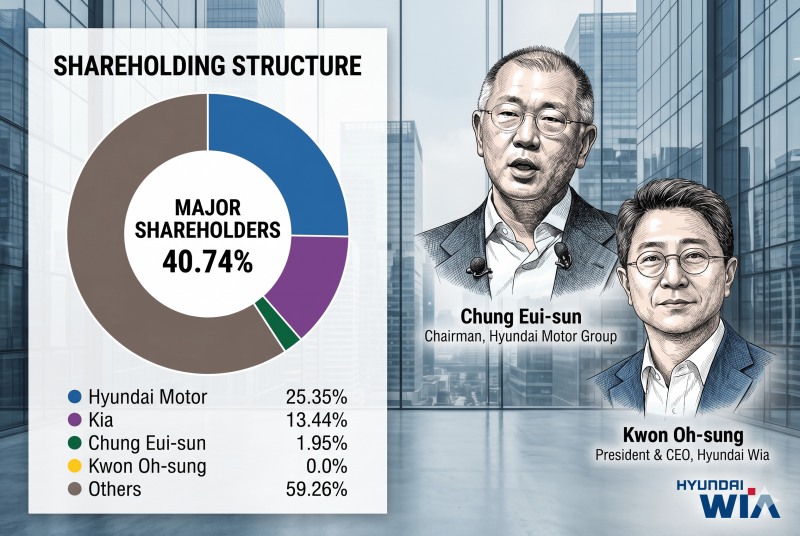
Recreated with generative AI based on Korea Financial Times content / Source = Korea Financial Times Data Plaform 'The Compass', DART (Data Analysis, Retrieval and Transfer System)
이미지 확대보기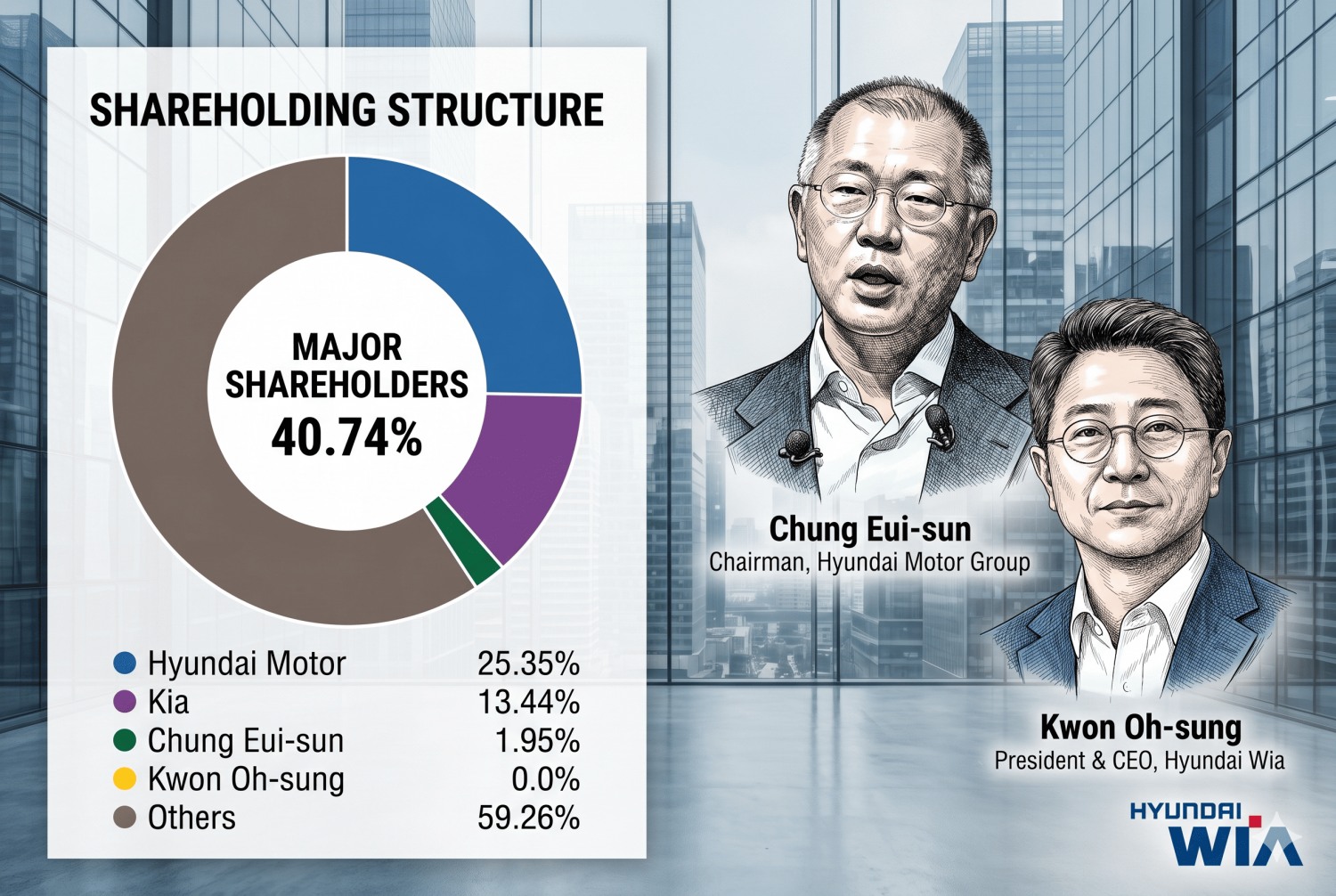
Industry observers interpret this as a business restructuring in line with Hyundai Motor Group's strategy of vertical integration. At the same time, some view it as groundwork for succession—enabling Hyundai Wia's transformation into a robotics-based electrification company while expanding the value of Chairman Chung Eui-sun's equity holdings.
Hyundai Wia Shifts Toward Electrification and Robotics Valuation Amid Group Strategy
As Hyundai Motor Group's automotive parts affiliate, Hyundai Wia has handled vehicle engines, drive modules, and machine-tool operations. From 2000, it made a full-scale entry into the naval gun mass-production market. It is currently the only company that produces naval guns for navy vessels as well as for the K2 tank and the K9 self-propelled howitzer.Hyundai Wia's stock has also been on a roll, climbing about 51% over the past year on the back of the group's electrification performance and a booming defense business. Even so, Hyundai Wia is now in the midst of a business restructuring aligned with Hyundai Motor Group's expansion into electrification and robotics.
In particular, beginning with last year's sale of its machine-tool business—the company's founding operation—for KRW 340 billion, it is this year reviewing the sale of its defense division to Hyundai Rotem amid the group's drive to vertically integrate its defense operations.
The void is being filled with electrification parts businesses such as thermal management solutions and robotics operations such as collaborative robots. Hyundai Wia is currently going through local administrative procedures for a next-generation auto parts plant to be newly built in the Martin region of Slovakia. Earlier, this past March, Hyundai Wia announced the acquisition of the site, which had been vacated by a Danish company.
At this base, Hyundai Wia will establish a production and assembly system for drive shafts incorporating EV cooling modules and constant velocity (CV) joints. With this new plant, Hyundai Wia's production capacity will expand about 62.5%, from the existing level of 800,000 EVs per year to 1.3 million units. Through this, the company intends to strengthen new businesses such as electrification parts and thermal management solutions while securing customers in the European market.
Alongside this, the company is also focused on its other key future driver—robotics—and on expanding its smart factory business through it. Hyundai Wia launched its mobile robot brand "H-Motion" this year and is expanding its lineup of collaborative robots and logistics robots. Its existing parking robots are also undergoing technological advances, including the ability to move vehicles weighing up to 3.4 tons.
NVIDIA's Huang Visits Hyundai HQ, Hails "Hyundai's Time" in the Age of Physical AIHyundai Motor Group Chairman Mulls Deepening Boston Dynamics IPO DilemmaShareholder Returns or Succession Strategy? The Dual Purpose Behind Hyundai Motor and Kia's Payout PoliciesHyundai Motor Faces Massive Union Bonus Demand Exceeding Dividends Amid Heavy Tech InvestmentsHyundai Motor Shifts Gear: From Automaker to Advanced Mobility Company
Hyundai Wia has recently been focusing on securing talent as well, conducting intensive recruitment of new employees in fields such as mobility parts, thermal management, and robotics.
A Hyundai Wia official said, "We are carrying out this recruitment to further strengthen our competitiveness in core business areas such as integrated thermal management systems, mobility parts, and robotics," adding, "Together with new talent, we will strive to become a company recognized for its technological capabilities in the global market."
Industry observers view this restructuring at Hyundai Wia as part of Hyundai Motor Group's reorganization of its business lines. By consolidating defense operations scattered across various affiliates around Hyundai Rotem, the group is building a vertically integrated structure to strengthen its business response.
At the same time, the strategy is for Hyundai Wia to move beyond being an electric-vehicle parts supplier, clarify its role under the group's electrification-parts and robotics strategy, and attempt a valuation shift into a robotics-centered mobility company.
One business community official noted, "Not only Hyundai Wia but Hyundai Motor Group affiliates as a whole have recently been showing a trend of business restructuring—centering on future businesses such as electrification and robotics while selling off non-core operations," adding, "Hyundai Wia, too, appears to be working to simplify its diversified business divisions and clarify its role as the group's electrification and robotics affiliate."
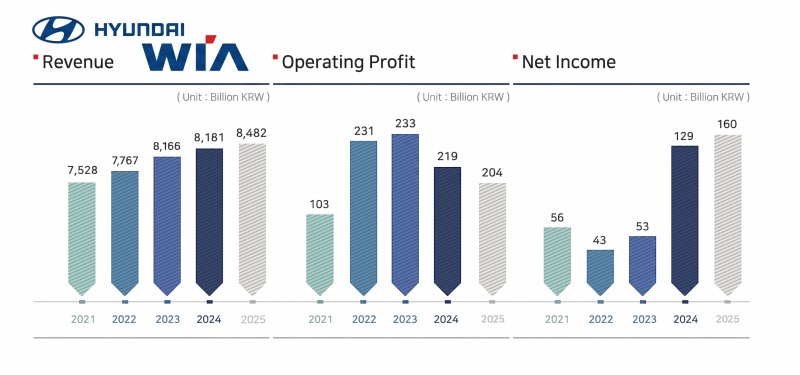
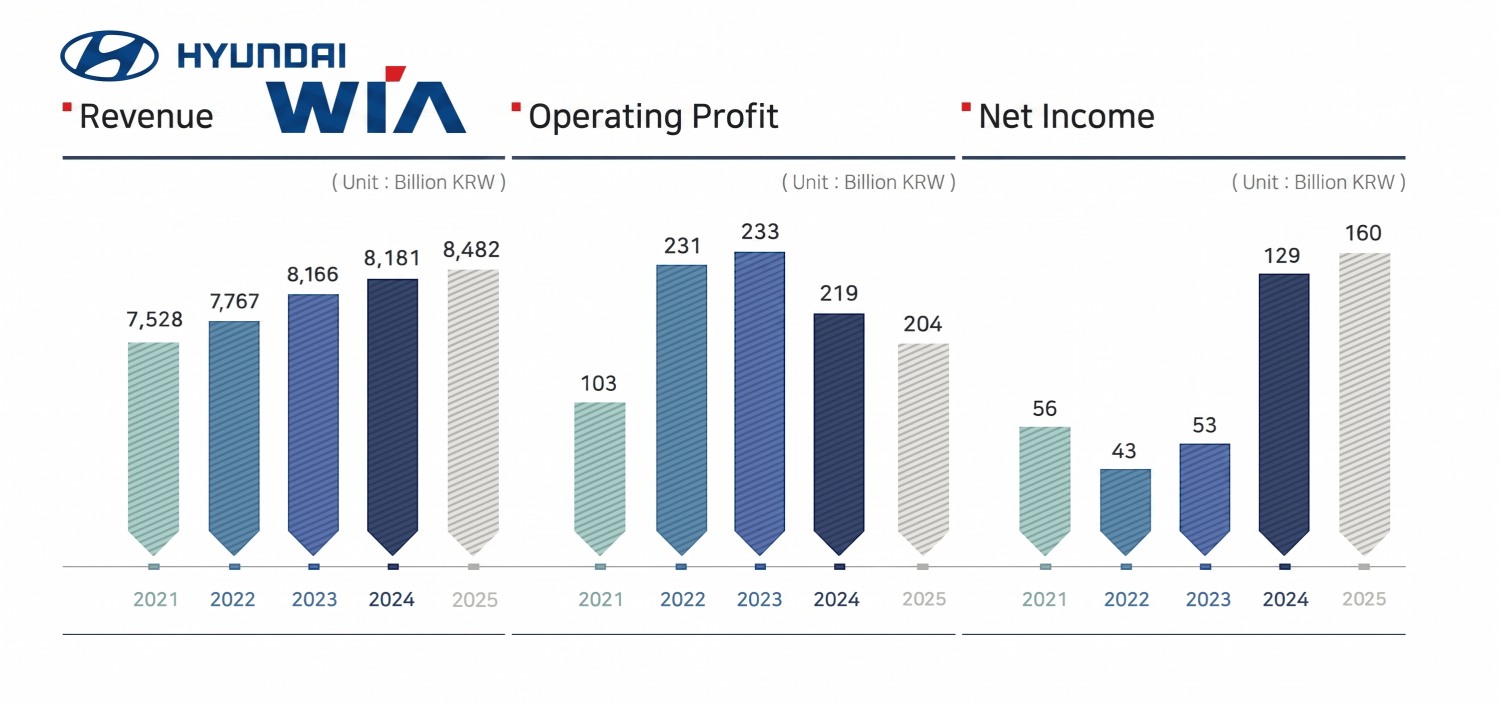
Hyundai Wia's Valuation Shift Within Chung Eui-sun's Succession Calculus
Industry watchers are also paying attention to the connection between Hyundai Wia's valuation shift toward an electrification-parts and robotics company and matters such as Chairman Chung Eui-sun's succession funds and future governance restructuring.Chairman Chung Eui-sun currently holds a 1.95% stake in Hyundai Wia. While the size of the stake alone is not large, it is a holding that consistently comes up whenever there is talk of unwinding Hyundai Motor Group's circular shareholding structure and securing succession funds.
Indeed, Hyundai Wia is one of Chairman Chung Eui-sun's sources of funds, paying dividends every year. Hyundai Wia's dividend per share has also risen each year—from KRW 700 in 2022 to KRW 850 in 2023, KRW 1,100 in 2024, and KRW 1,200 in 2025. As of last year, the dividends Chairman Chung Eui-sun received from Hyundai Wia amounted to about KRW 637.31 million.
If, as Chairman Chung Eui-sun intends, Hyundai Wia comes to be recognized as an electrification-parts and robotics company—handling EV thermal management and the like—its share value is expected to rise further. In fact, Hyundai Wia is classified not only as a Hyundai Motor Group defense stock but also as a robotics stock. After Hyundai Motor Group unveiled its humanoid "Atlas" at CES this past January, Hyundai Wia's stock climbed 53.7% over roughly three months.
It is true that this group business restructuring carries more weight as a pragmatically driven reorganization of the group's business lines than as groundwork for Chairman Chung Eui-sun's succession. Still, if Hyundai Wia is re-rated as Chairman Chung Eui-sun calculates, it could serve as a handy supplement in the future succession process and in raising funds.
One business community official said, "Whether large or small, the affiliate shares Chairman Chung Eui-sun holds are always of interest in terms of how they might be utilized when discussing succession scenarios," adding, "If Hyundai Wia's restructuring produces a quantum jump in both corporate-value re-rating and earnings, then for Chairman Chung Eui-sun it would be a case of catching two rabbits at once."
That said, it is expected to take some time before the outcomes and results of Hyundai Wia's restructuring can be confirmed. The electrification parts and robotics businesses Hyundai Wia is pursuing involve large-scale investments such as facility spending, but they are not yet at a stage where performance such as profitability can be expected.
On top of this, if the defense business is actually sold to Hyundai Rotem, part of the very material that had been driving up the company's value will disappear. In fact, Hyundai Wia's stock fell for four consecutive days starting on the 15th of last month—when the review of the defense business sale was first reported—dropping about 27%. On the 11th, the stock was also trading down about 3% from the previous day, in the KRW 70,600 range.
Kim JaeHun (rlqm93@fntimes.com)












![SK바이오사이언스 안재용, ‘적자 터널’ 닫고 3연임 열까 [CEO 임기보고서]](https://cfnimage.commutil.kr/phpwas/restmb_setimgmake.php?pp=006&w=69&h=45&m=5&simg=202610231027190082807fd637f543112168227135.jpg&nmt=18)


![[그래픽 뉴스] ‘순대’가 경제용어라고? 순(純)대외자산, 한국의 진짜 해외자산은 얼마일까?](https://cfnimage.commutil.kr/phpwas/restmb_setimgmake.php?pp=006&w=298&h=298&m=1&simg=202609021356075202de68fcbb3512411124362_0.jpg&nmt=18)
![[그래픽 뉴스] ISA 대개편! 나에게 유리한 계좌는?](https://cfnimage.commutil.kr/phpwas/restmb_setimgmake.php?pp=006&w=298&h=298&m=1&simg=202608041713155615de68fcbb3512411124362_0.jpg&nmt=18)
![[그래픽 뉴스] 미국 증시 새로운 키워드 'MANGOS'](https://cfnimage.commutil.kr/phpwas/restmb_setimgmake.php?pp=006&w=298&h=298&m=1&simg=202607291740382069de68fcbb3512411124362_0.jpg&nmt=18)

![[그래픽 뉴스] 은퇴후 30년 부모님 세대의 생존전략](https://cfnimage.commutil.kr/phpwas/restmb_setimgmake.php?pp=006&w=298&h=298&m=1&simg=202606301704439153de68fcbb3512411124362_0.jpg&nmt=18)
![[신간] 장애가 가르쳐준 삶의 의미...목진석 9단 아버지 목이균씨의 자서전](https://cfnimage.commutil.kr/phpwas/restmb_setimgmake.php?pp=006&w=81&h=123&m=5&simg=20261023093852062530f8caa4a5ce12411124362.jpg&nmt=18)
![[신간]은퇴연옥…김경록의 은퇴 후 삶의 나침반](https://cfnimage.commutil.kr/phpwas/restmb_setimgmake.php?pp=006&w=81&h=123&m=5&simg=20260414140833047280f8caa4a5ce12411124362.jpg&nmt=18)
![[안현정 서평] 플랫폼의 영지에서 ‘미학적 주권’을 선포하라...'K가 죽어야 K가 산다' 장준환 著](https://cfnimage.commutil.kr/phpwas/restmb_setimgmake.php?pp=006&w=81&h=123&m=5&simg=20260527121426063220c1c16452b012411124362.jpg&nmt=18)
![[서평] 추세 매매의 대가들...추세추종 투자전략의 대가 14인 인터뷰](https://cfnimage.commutil.kr/phpwas/restmb_setimgmake.php?pp=006&w=81&h=123&m=5&simg=2023102410444004986c1c16452b0175114235199.jpg&nmt=18)


![[머니무브 2026] “지금 사도 될까?” 답이 안 보인다면…하반기 투자, 4명의 전문가에게 물어보세요](https://cfnimage.commutil.kr/phpwas/restmb_setimgmake.php?pp=006&w=89&h=45&m=1&simg=202609151044050355302a735e27af12411124362.jpg&nmt=18)
![[AD] ‘PBV 라인업 확장’ 기아, 9월 독일서 ‘PV7’ 첫 공개](https://cfnimage.commutil.kr/phpwas/restmb_setimgmake.php?pp=006&w=89&h=45&m=1&simg=2026083111010602815074925877361231180222.jpg&nmt=18)
![[AD] 제네시스, 럭셔리 경험 더한 ‘2027 GV70’‧‘GV70 그래파이트’ 출시](https://cfnimage.commutil.kr/phpwas/restmb_setimgmake.php?pp=006&w=89&h=45&m=1&simg=20260702143546085600749258773622211122717.jpg&nmt=18)