






As the group celebrates its 40th anniversary this year, it stands at a critical juncture for a quantum leap. This is because challenges persist, including the impact of U.S. tariffs continuing from last year, the EV chasm, and intensifying competition in future mobility such as autonomous driving and SDV (Software-Defined Vehicles).
Chairman Chung Eui-sun plans to defend sales volume and profitability by expanding local U.S. production and broadening the electrification lineup including hybrids (HEV) this year. In the future mobility sector, the group will invest USD 26 billion over approximately four years to enhance technological capabilities and accelerate commercialization.
According to Hyundai Motor Group, combined U.S. sales of Hyundai Motor and Kia last year reached 1,836,172 units, up 7.5% year-over-year, recording the highest sales ever. The group has continued its streak of breaking all-time sales records for five consecutive years since approximately 1.48 million units in 2021.
Notably, last year's U.S. sales for Hyundai Motor and Kia showed balanced growth across brands, including Genesis as well as eco-friendly electrification lineups encompassing EVs and HEVs.
Genesis sold 82,331 units in the U.S. last year, up 9.8% year-over-year.
This marks another record-breaking achievement following last year. The eco-friendly electrification lineup also recorded its highest ever at 434,725 units sold last year, up 25.5% year-over-year.
HEV sales, for which demand has increased due to the recent EV chasm, also achieved all-time high sales of 331,023 units.
'Chung Eui-sun Declares Robot Management Era'... Hyundai Motor Group to Lead Robotics Age with 'Physical AI''We Can't Fall Behind in Robotics'... Hyundai Motor Group's Humanoid 'Atlas' Takes the Stage“Harsh Tariffs Hit Hyundai Motor: Despite Record Q3 Revenue, Operating Profit Drops 29.2%”Hyundai Motor Group 'Chung Eui-sun era' 5 years ②: 'Bold strategist' Chung Eui-sun to break through with KRW 112 trillion investment over next 5 yearsHyundai Motor Group 'Chung Eui-sun era' 5 years ①: 'Disruptive innovation leadership' powers global Big3
This signifies that Hyundai Motor Group has established itself as a top-tier brand with global-level technology and competitiveness in luxury and electrification. Recalling the early days of U.S. entry when it was stigmatized as "cheap cars, Hyundai," this represents remarkable growth over approximately 40 years.

Create an English graphic using Gemini based on the original graphic produced by Korea Financial Times
이미지 확대보기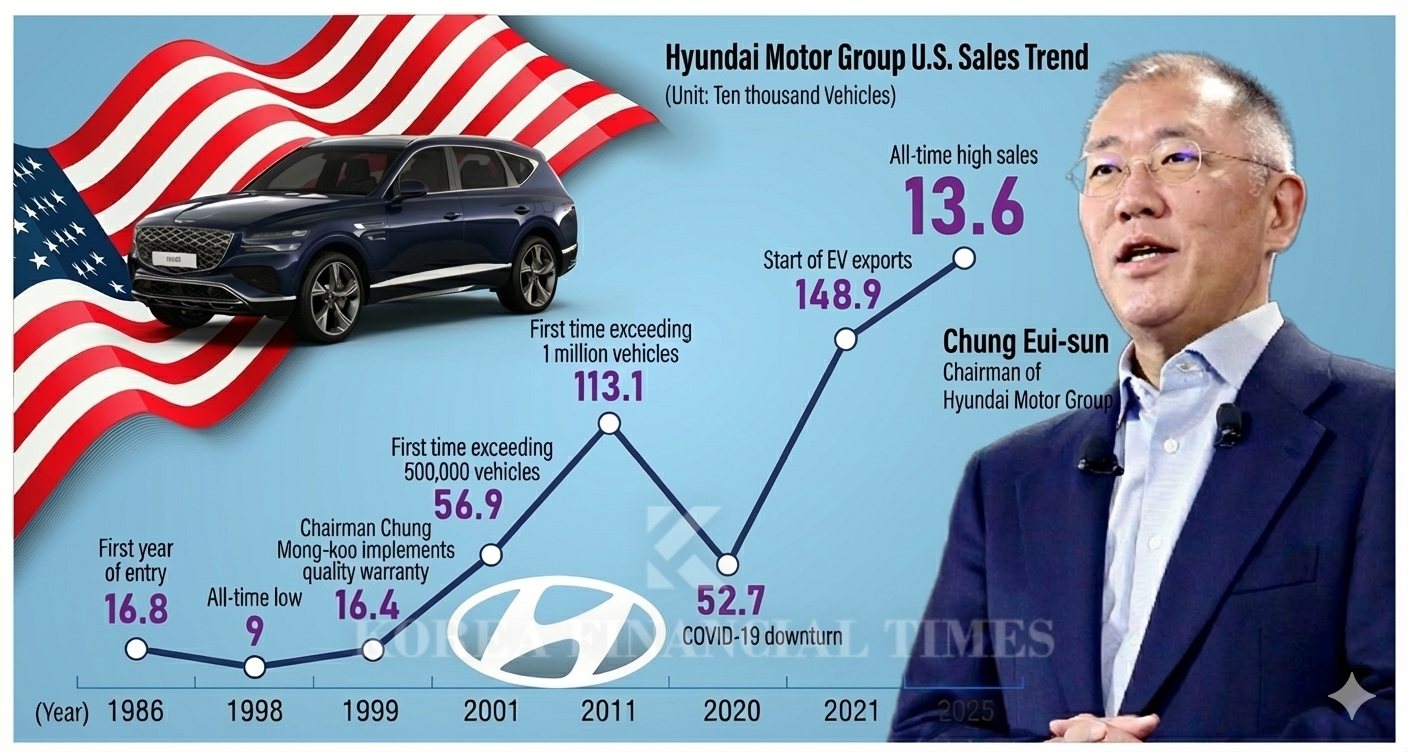
From Pioneer Chung Ju-yung's Challenge to the Excel Export Success
Hyundai Motor Group began local sales in 1986 by first exporting the Excel, produced at the Ulsan plant, to the United States. The Excel was the successor model to the Pony, the first vehicle independently produced by Hyundai Motor Group.Hyundai Motor Group's U.S. entry was rooted in the late Chairman Chung Ju-yung's pioneering spirit. He compared the nation to the human body, emphasizing that "roads are like blood vessels and automobiles are the blood flowing through those vessels." Based on the confidence gained from building highways amid the ruins of the Korean War, his determination to succeed in the automotive industry was stronger than anyone else's.
The Excel established its presence in the U.S. market by leveraging price competitiveness at about half the level of competing vehicles in its class. With 170,000 units sold in the first year and 260,000 the following year, it imprinted the Hyundai Motor Group name in the U.S. market.
However, despite its low price, the Excel failed to sustain its momentum due to frequent breakdowns and quality issues. As a nascent company, Hyundai Motor Group faced difficulties due to technological competitiveness issues and inadequate local service infrastructure.
Chung Mong-koo's Quality Management and the "10-Year/100,000-Mile Warranty" Gamble
Hyundai Motor Group's U.S. challenge reignited during Honorary Chairman Chung Mong-koo's era. In particular, Chairman Chung Mong-koo made a bold move with the "10-year/100,000-mile warranty" while putting "quality management" at the forefront. Considering that U.S. companies like GM and Ford offered 3-year/36,000-mile warranties and Japan's Toyota provided 5-year/60,000-mile coverage at the time, this was a groundbreaking policy.Thanks to this, Hyundai Motor Group succeeded in restoring local consumer trust. In fact, Hyundai Motor Group remained in the bottom tier among approximately 30 brands in JD Power surveys until the 1990s, but in the 2000s when Chairman Chung Mong-koo took the helm, it leaped to mid-tier status at around 15th place.
In 2005, Chairman Chung Mong-koo also devoted efforts to establishing a local production system by launching Hyundai Motor's first U.S. production facility, the Alabama plant. This move is evaluated as having laid the groundwork for Hyundai Motor Group to take another leap forward in the United States.
Chung Eui-sun's Global Strategy and the Quantum Leap Challenge
Following Chairman Chung Mong-koo, Chairman Chung Eui-sun, who leads Hyundai Motor Group, has grown Hyundai Motor into a complete global top-tier automaker through swift responses to global trend changes. He has not only enhanced the group's image through Genesis but also completed a high-value-added product-centered portfolio including SUVs and electrification lineups that have now become mainstream.As he commemorates the 40th anniversary of U.S. entry this year, Chairman Chung Eui-sun is aiming for another quantum leap. However, significant challenges lie ahead. In particular, there is an assessment that the eco-friendly electrification and future mobility strategies on which Chairman Chung Eui-sun has focused are now facing a full-scale test.
First, this year in the U.S., in addition to the tariff impacts continuing from last year, the EV subsidy policy that ended in October last year and the EV chasm are requiring automakers to reorganize their electrification strategies.
Hyundai Motor Group is first accelerating expansion of local U.S. production.
To this end, the group plans to speed up operations at its two U.S. production facilities: the Alabama plant and Hyundai Motor Group Metaplant America (HMGMA). In particular, the group plans to expand HMGMA's annual production capacity, which can produce both EVs and hybrids on mixed lines, from the current 300,000 units to 500,000 units by 2028.
Along with this, the group will expand its lineup based on electrification powertrain technology covering all areas including HEV, local strategic EVs, and extended-range electric vehicles (EREV).
By 2030, the group will establish a lineup of more than 18 HEV models and expand local U.S. production to pursue achievement of 5.55 million global vehicle sales. The policy is to actively expand local investments for this purpose.
Genesis plans to launch the group's first rear-wheel drive (RWD)-based luxury hybrid vehicle and subsequently pursue development of reasonably priced entry-level hybrids.
In particular, Hyundai Motor began introducing next-generation hybrid systems starting with the Palisade launched in the U.S. last year and plans to provide improved driving performance and fuel efficiency by expanding this application.
Additionally, the company plans to present consumers with diverse electrification experiences such as "Stay mode," which allows electricity use without engine ignition by utilizing high-voltage hybrid batteries, and V2L (Vehicle To Load) functionality.
Competitiveness in future mobility such as autonomous driving and SDV is also a major concern. The U.S. is the largest battleground, home to autonomous driving competitors including Tesla, Google's Waymo, and Amazon-affiliated Zoox.
Hyundai Motor Group also has the headquarters of Motional and other autonomous driving specialist affiliates based in the United States.
As Tesla recently began commercializing Level 3 "FSD (Full Self-Driving Supervised)," Hyundai Motor Group faces urgent pressure. Hyundai Motor plans to unveil an SDV pacecar equipped with the latest autonomous driving technology mid-year and announce specific commercialization plans.
Along with this, autonomous driving affiliate Motional is also accelerating commercialization of autonomous driving-based "robotaxis" locally in the U.S. Motional, together with Hyundai Motor Group, recently showcased a robotaxi developed based on the IONIQ 5 at CES 2026 held in the United States.
The IONIQ 5 robotaxi is Motional's first commercial driverless autonomous vehicle and is scheduled to be fully deployed this year in ride-hailing services for general passengers in Las Vegas, U.S.
The IONIQ 5 robotaxi incorporates autonomous driving technology jointly developed by Hyundai Motor Group and Motional, which is known to be at Level 4 according to Society of Automotive Engineers (SAE) standards. Level 4 means that the vehicle's automated system perceives and judges situations to drive, and the vehicle can respond on its own without driver intervention even in emergencies.
Meanwhile, Chairman Chung Eui-sun stated that the group will invest USD 26 billion in the U.S. market and expand cooperation with leading U.S. companies in future new technology fields such as AI and autonomous driving.
Additionally, from this year through 2030, the company plans to accelerate future technology research by making an unprecedented maximum investment totaling KRW 125.2 trillion domestically.
Kim JaeHun (rlqm93@fntimes.com)










![[기자수첩] 보험사 품는 사모펀드, 대주주 심사 재고해야](https://cfnimage.commutil.kr/phpwas/restmb_setimgmake.php?pp=006&w=69&h=45&m=5&simg=20260913173909069220ed56b8e1f814379898.jpg&nmt=18)
![[Z-스코어 기업가치 바로 보기] 차입이냐 자기자본이냐…LG엔솔 vs 삼성SDI ‘명암ʼ](https://cfnimage.commutil.kr/phpwas/restmb_setimgmake.php?pp=006&w=69&h=45&m=5&simg=20260912004753014480dd55077bc212411124362.jpg&nmt=18)


![[그래픽 뉴스] ‘순대’가 경제용어라고? 순(純)대외자산, 한국의 진짜 해외자산은 얼마일까?](https://cfnimage.commutil.kr/phpwas/restmb_setimgmake.php?pp=006&w=298&h=298&m=1&simg=202609021356075202de68fcbb3512411124362_0.jpg&nmt=18)
![[그래픽 뉴스] ISA 대개편! 나에게 유리한 계좌는?](https://cfnimage.commutil.kr/phpwas/restmb_setimgmake.php?pp=006&w=298&h=298&m=1&simg=202608041713155615de68fcbb3512411124362_0.jpg&nmt=18)
![[그래픽 뉴스] 미국 증시 새로운 키워드 'MANGOS'](https://cfnimage.commutil.kr/phpwas/restmb_setimgmake.php?pp=006&w=298&h=298&m=1&simg=202607291740382069de68fcbb3512411124362_0.jpg&nmt=18)
![[그래픽 뉴스] 은퇴후 30년 부모님 세대의 생존전략](https://cfnimage.commutil.kr/phpwas/restmb_setimgmake.php?pp=006&w=298&h=298&m=1&simg=202606301704439153de68fcbb3512411124362_0.jpg&nmt=18)
![[신간]은퇴연옥…김경록의 은퇴 후 삶의 나침반](https://cfnimage.commutil.kr/phpwas/restmb_setimgmake.php?pp=006&w=81&h=123&m=5&simg=20260414140833047280f8caa4a5ce12411124362.jpg&nmt=18)
![[신간] 물처럼 흐르고 원칙으로 서다…김용환의 통찰을 담다](https://cfnimage.commutil.kr/phpwas/restmb_setimgmake.php?pp=006&w=81&h=123&m=5&simg=20260409114249027860f8caa4a5ce12411124362.jpg&nmt=18)
![[안현정 서평] 플랫폼의 영지에서 ‘미학적 주권’을 선포하라...'K가 죽어야 K가 산다' 장준환 著](https://cfnimage.commutil.kr/phpwas/restmb_setimgmake.php?pp=006&w=81&h=123&m=5&simg=20260527121426063220c1c16452b012411124362.jpg&nmt=18)
![[서평] 추세 매매의 대가들...추세추종 투자전략의 대가 14인 인터뷰](https://cfnimage.commutil.kr/phpwas/restmb_setimgmake.php?pp=006&w=81&h=123&m=5&simg=2023102410444004986c1c16452b0175114235199.jpg&nmt=18)


![[머니무브 2026] “지금 사도 될까?” 답이 안 보인다면…하반기 투자, 4명의 전문가에게 물어보세요](https://cfnimage.commutil.kr/phpwas/restmb_setimgmake.php?pp=006&w=89&h=45&m=1&simg=202609151044050355302a735e27af12411124362.jpg&nmt=18)
![[AD] ‘PBV 라인업 확장’ 기아, 9월 독일서 ‘PV7’ 첫 공개](https://cfnimage.commutil.kr/phpwas/restmb_setimgmake.php?pp=006&w=89&h=45&m=1&simg=2026083111010602815074925877361231180222.jpg&nmt=18)
![[AD] 제네시스, 럭셔리 경험 더한 ‘2027 GV70’‧‘GV70 그래파이트’ 출시](https://cfnimage.commutil.kr/phpwas/restmb_setimgmake.php?pp=006&w=89&h=45&m=1&simg=20260702143546085600749258773622211122717.jpg&nmt=18)
![[AD] 개소세 혜택 종료…현대차, ‘썸머 페스타’로 고객 부담 완화](https://cfnimage.commutil.kr/phpwas/restmb_setimgmake.php?pp=006&w=89&h=45&m=1&simg=20260702142355004830749258773622211122717.jpg&nmt=18)
![[AD] 기아 ‘디 올 뉴 셀토스’, 인도 타임스 드라이브 어워즈서 ‘올해의 SUV’ 선정](https://cfnimage.commutil.kr/phpwas/restmb_setimgmake.php?pp=006&w=89&h=45&m=1&simg=202605071156400590007492587736124111243152.jpg&nmt=18)