





Chung Eui-sun, Chairman of Hyundai Motor Group, marks his fifth anniversary of appointment on the 14th. However, the management environment facing Chairman Chung remains a series of uncertainties. US tariff policy, a longer-than-expected electric vehicle chasm (temporary demand slowdown), and competition in future mobility commercialisation cannot be overlooked.
Industry observers assess this as a time when Chairman Chung's bold strategic approach will shine once again. This stems from forward-thinking foresight demonstrated immediately after his appointment, not only in electric vehicles but also in hybrid, robotics, hydrogen mobility, and ICT. Chairman Chung plans to execute large-scale investments over the next five years to address uncertainty and prepare for future mobility.
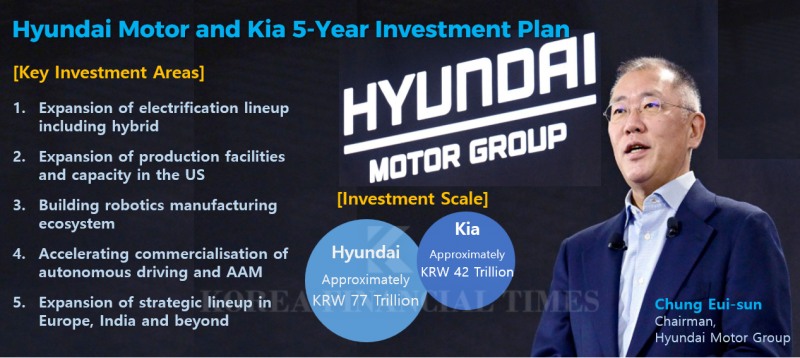
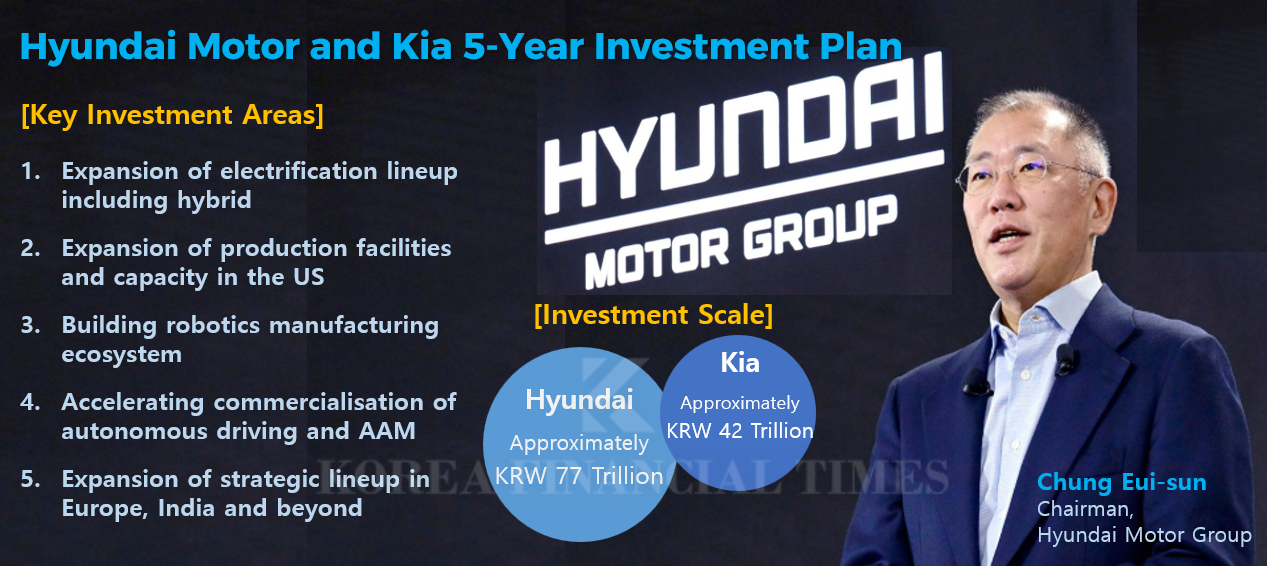
According to Hyundai Motor and Kia, the two companies plan to invest approximately KRW 112 trillion over the next five years to solidify their position as global tier-one mobility companies. Hyundai Motor will allocate approximately KRW 77.3 trillion, while Kia will invest approximately KRW 42 trillion respectively.
Both companies plan to strengthen business competitiveness in electrification, software, robotics, AI, and AAM (advanced air mobility) through research and development (R&D) investment, capital expenditure (CAPEX), and strategic investment.
The most critical challenge is responding to US tariffs. The US has imposed 25 percent tariffs on automotive exports to the US since April. Though the Korean government agreed to a 15 percent tariff reduction, the specific implementation timeline remains unclear. Japanese and EU automakers are already receiving 15 percent tariff treatment, pressuring Hyundai Motor Group.
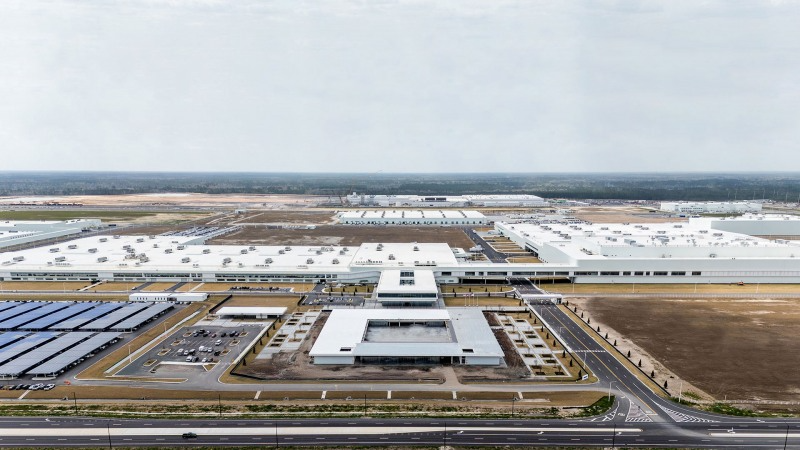
Chairman Chung's answer involves expanding local production and strengthening hybrid lineups. To this end, he announced in August plans to invest approximately USD 26 billion in the US market over the next four years to enhance local production and business competitiveness. This adds USD 5 billion to the USD 21 billion investment plan announced jointly with US President Trump in March.

Hyundai Motor Group 'Chung Eui-sun era' 5 years ①: 'Disruptive innovation leadership' powers global Big3Chung Eui-sun's 10 Years of Passion for Hyundai N : High-Performance Brand Eyes the Electric Vehicle EraInheritance Tax for Chung Mong-koo Totals KRW 2.3 Trillion… Chung Eui-sun Takes It Head-On in His Own Way"Investing Despite Trillion-KRW Losses"... Chung Eui-sun's New Business '3 Picks'Hyundai Motor Group Chairman Chung Eui-sun to Receive Salary from Kia Starting This Year
Additionally, the company will expand hybrid offerings to over 18 models covering entry, mid-size, full-size, and luxury segments by 2030, capitalising on rebound benefits concentrated in hybrid amid the electric vehicle chasm, actively responding to market demand changes. This means establishing more than double the current hybrid lineup.
GENESIS, showing strong growth potential in the US market, will launch Hyundai Motor Group's first rear-wheel-drive (RWD) based and the brand's first luxury hybrid vehicle next year. Subsequently, the company plans to develop an entry-level hybrid with reasonable pricing.
European market strategy, emerging as an alternative to the US market, will also strengthen. Hyundai Motor will launch 'IONIQ 3' next year in the European market to lead recovery and popularisation of electric vehicle demand. IONIQ 3 is an entirely new electric vehicle featuring next-generation infotainment systems.
Kia will expand its electrification lineup next year with the compact electric SUV 'EV2'. This year, Kia demonstrated results by boosting sales in the European market with EV3 and EV4 leading the charge. Alongside this, the company will strengthen global commercial vehicle market strategy with PBV (purpose-built vehicle) 'PV5' and others.
Chairman Chung will also begin full-scale acceleration of three future businesses he has prioritised: robotics, autonomous driving, and AAM. Currently, these businesses are handled by Boston Dynamics (robotics), Podi2dot, Motional (autonomous driving), and Supernal (AAM) respectively. Chairman Chung has invested trillions of won in establishing foundations for these three new ventures since his appointment.
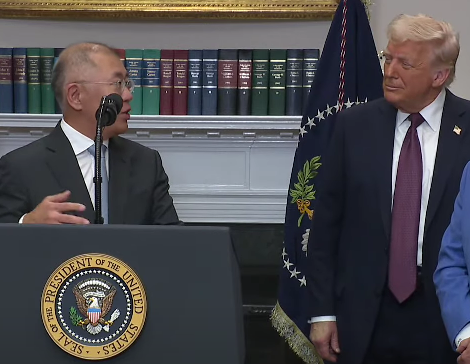
In March, Chairman Chung Eui-sun (left) announced investment plans for the U.S. with President Trump at the White House.
First, Chairman Chung plans to establish a new robot production facility with annual capacity of 30,000 units to serve as a hub for the robotics ecosystem within the US. Through this plan, local subsidiaries such as Boston Dynamics and Motional, which handle robotics and autonomous driving, will accelerate commercialisation.
Supernal unveiled its electric vertical take-off and landing aircraft (eVTOL) 'S-A2' in early last year and is conducting test operations. Supernal plans to formally launch the S-A2 at the Los Angeles Olympics in summer 2028 and produce 100 to 200 units annually.
Meanwhile, Chairman Chung is executing large-scale investments domestically as well. Hyundai Motor Group will invest record KRW 24.3 trillion this year to strengthen future competitiveness centred on Korea as a mobility innovation hub. This represents a more than 19 percent increase compared to KRW 20.4 trillion in 2024.
Specifically, the company will execute research and development (R&D) investment of KRW 11.5 trillion, operating investment of KRW 12 trillion, and strategic investment of KRW 800 billion respectively.
Particularly, large-scale investment will be made in constructing dedicated EV factories. Kia's Hwaseong EVO Plant will be completed in the second half of this year, beginning full-scale production of customer-customised PBV electric vehicles. At Hyundai Motor's Ulsan dedicated EV factory, targeted for operations in the first half of 2026, the company plans to mass-produce various vehicle types beginning with large-size SUV electric models.
Kim JaeHun (rlqm93@fntimes.com)










![기관 '주성엔지니어링'·외인 '알테오젠'·개인 '알테오젠' 1위 [주간 코스닥 순매수- 2026년 9월7일~9월11일]](https://cfnimage.commutil.kr/phpwas/restmb_setimgmake.php?pp=006&w=69&h=45&m=5&simg=20260912015140019820179ad4390711823512161.jpg&nmt=18)

![12개월 최고 연 7.00%…카카오뱅크 '우리아이적금' [이주의 은행 적금금리-9월 3주]](https://cfnimage.commutil.kr/phpwas/restmb_setimgmake.php?pp=006&w=69&h=45&m=5&simg=202609111245270848705e6e69892f222110224112.jpg&nmt=18)
![12개월 최고 연 3.85%…경남은행 'The든든예금(시즌2)' [이주의 은행 예금금리-9월 3주]](https://cfnimage.commutil.kr/phpwas/restmb_setimgmake.php?pp=006&w=69&h=45&m=5&simg=202609111227290077405e6e69892f222110224112.jpg&nmt=18)
![12개월 최고 연 4.02%…참저축은행 e-회전정기예금[이주의 저축은행 예금금리-9월 2주]](https://cfnimage.commutil.kr/phpwas/restmb_setimgmake.php?pp=006&w=69&h=45&m=5&simg=202609130113300929407c96e797801121481643.jpg&nmt=18)


![[그래픽 뉴스] ‘순대’가 경제용어라고? 순(純)대외자산, 한국의 진짜 해외자산은 얼마일까?](https://cfnimage.commutil.kr/phpwas/restmb_setimgmake.php?pp=006&w=298&h=298&m=1&simg=202609021356075202de68fcbb3512411124362_0.jpg&nmt=18)
![[그래픽 뉴스] ISA 대개편! 나에게 유리한 계좌는?](https://cfnimage.commutil.kr/phpwas/restmb_setimgmake.php?pp=006&w=298&h=298&m=1&simg=202608041713155615de68fcbb3512411124362_0.jpg&nmt=18)
![[그래픽 뉴스] 미국 증시 새로운 키워드 'MANGOS'](https://cfnimage.commutil.kr/phpwas/restmb_setimgmake.php?pp=006&w=298&h=298&m=1&simg=202607291740382069de68fcbb3512411124362_0.jpg&nmt=18)

![[그래픽 뉴스] 은퇴후 30년 부모님 세대의 생존전략](https://cfnimage.commutil.kr/phpwas/restmb_setimgmake.php?pp=006&w=298&h=298&m=1&simg=202606301704439153de68fcbb3512411124362_0.jpg&nmt=18)
![[신간]은퇴연옥…김경록의 은퇴 후 삶의 나침반](https://cfnimage.commutil.kr/phpwas/restmb_setimgmake.php?pp=006&w=81&h=123&m=5&simg=20260414140833047280f8caa4a5ce12411124362.jpg&nmt=18)
![[신간] 물처럼 흐르고 원칙으로 서다…김용환의 통찰을 담다](https://cfnimage.commutil.kr/phpwas/restmb_setimgmake.php?pp=006&w=81&h=123&m=5&simg=20260409114249027860f8caa4a5ce12411124362.jpg&nmt=18)
![[안현정 서평] 플랫폼의 영지에서 ‘미학적 주권’을 선포하라...'K가 죽어야 K가 산다' 장준환 著](https://cfnimage.commutil.kr/phpwas/restmb_setimgmake.php?pp=006&w=81&h=123&m=5&simg=20260527121426063220c1c16452b012411124362.jpg&nmt=18)
![[서평] 추세 매매의 대가들...추세추종 투자전략의 대가 14인 인터뷰](https://cfnimage.commutil.kr/phpwas/restmb_setimgmake.php?pp=006&w=81&h=123&m=5&simg=2023102410444004986c1c16452b0175114235199.jpg&nmt=18)


![[AD] ‘PBV 라인업 확장’ 기아, 9월 독일서 ‘PV7’ 첫 공개](https://cfnimage.commutil.kr/phpwas/restmb_setimgmake.php?pp=006&w=89&h=45&m=1&simg=2026083111010602815074925877361231180222.jpg&nmt=18)
![[AD] 제네시스, 럭셔리 경험 더한 ‘2027 GV70’‧‘GV70 그래파이트’ 출시](https://cfnimage.commutil.kr/phpwas/restmb_setimgmake.php?pp=006&w=89&h=45&m=1&simg=20260702143546085600749258773622211122717.jpg&nmt=18)
![[AD] 개소세 혜택 종료…현대차, ‘썸머 페스타’로 고객 부담 완화](https://cfnimage.commutil.kr/phpwas/restmb_setimgmake.php?pp=006&w=89&h=45&m=1&simg=20260702142355004830749258773622211122717.jpg&nmt=18)
![[AD] 기아 ‘디 올 뉴 셀토스’, 인도 타임스 드라이브 어워즈서 ‘올해의 SUV’ 선정](https://cfnimage.commutil.kr/phpwas/restmb_setimgmake.php?pp=006&w=89&h=45&m=1&simg=202605071156400590007492587736124111243152.jpg&nmt=18)
![[AD]‘그랜저 잡자’ 기아, 상품성 더한 ‘The 2027 K8’ 출시](https://cfnimage.commutil.kr/phpwas/restmb_setimgmake.php?pp=006&w=89&h=45&m=1&simg=2026042110193702730074925877361211627527.jpg&nmt=18)