






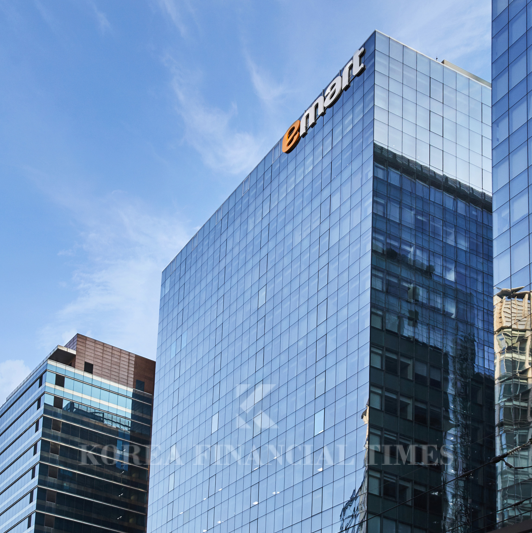
E-Mart's warehouse discount store Traders has seen significant growth. /Photo courtesy of E-Mart
According to E-Mart on the 11th, Traders showed notable growth last year. Its annual operating profit (on a standalone basis) surged 59% year-over-year (YoY) to KRW 92.4 billion, while revenue increased by 5.2% to KRW 3.5495 trillion. The number of customers also grew by 4.8% compared to the previous year.
During the same period, E-Mart's hypermarket division’s revenue fell 3.5% YoY to KRW 11.6665 trillion. Its operating profit, which stood at KRW 92.8 billion a year earlier, plummeted by more than KRW 100 billion, resulting in an operating loss of KRW 19.9 billion. This loss was largely due to the reflection of one-time expenses, such as retirement provisions and voluntary retirement compensation, amounting to KRW 103.6 billion. Considering these factors, Traders’ growth stands out. Although the scale differs, Traders also recorded one-time expenses of KRW 16 billion.
As e-commerce and SSMs (super supermarkets) erode the customer base of hypermarkets, Traders has emerged as a major contributor to E-Mart's performance.
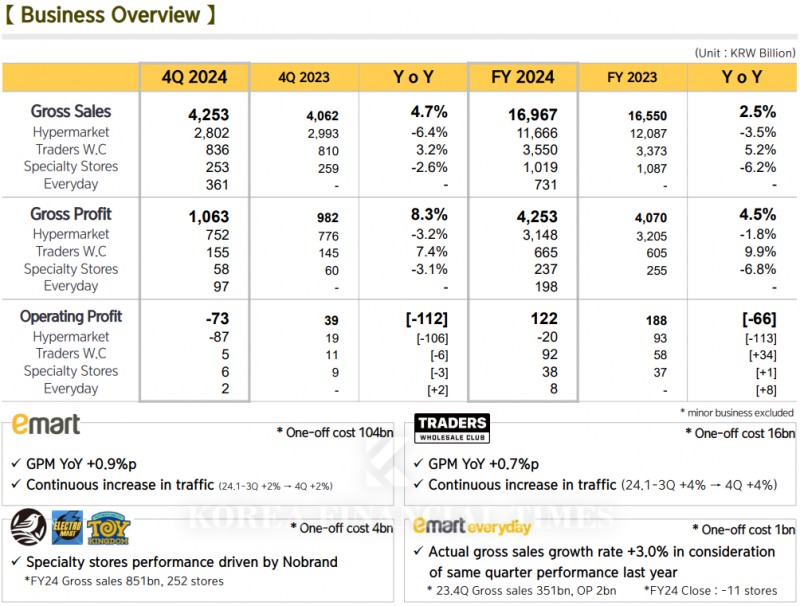
Looking at quarterly performance, Traders posted revenue of KRW 915.7 billion and an operating profit of KRW 30.6 billion in Q1 2024 (on a standalone basis), marking YoY increases of 11.9% and 313.5%, respectively. In Q2, revenue grew 3.9% to KRW 832.6 billion, while operating profit jumped 65.4% to KRW 22 billion.
For Q3, revenue increased by 2.3% to KRW 965.2 billion, and operating profit rose 30% to KRW 34.4 billion. Finally, in Q4 2023, revenue increased by 3.2% to KRW 836 billion, while operating profit declined 52.7% to KRW 5.2 billion.
Regarding Traders' growth, E-Mart explained, "In an era of high inflation, Traders’ value-for-money bulk products and differentiated product offerings have aligned with consumer needs, leading to increased customer traffic."
Chairman Chung Yong-jin purchases all shares of Executive Chairman Lee Myung-hee… Total stake 28.56%Distribution CEO's Key Message for 2025... Shin Dong-bin's 'Constitution Improvement', Chung Yong-jin's 'Main Business', Chung Ji-seon's 'Cooperation'[2024 Retail Review - Hypermarkets] 'Shaken' by Consumption Recession & Strength of SSM... E-Mart did Well Through Main Business Reinforcement‘Price destruction, strengthening of main business’ Chung Yong-jin’s ‘emergency management’… E-Mart achieves highest performance in Q3‘Three Chairmen Under One Roof...’ Under General Chairman Lee Myung-hee, Chung Yong-jin of ‘E-Mart’ and Chung Yoo-kyung of ‘Shinsegae’
Especially, T-Café continues to attract foot traffic to offline stores by regularly introducing new menu items. The buzz around its affordability draws customers to the café, leading to additional purchases at Traders and creating a spillover effect.
Another key advantage of Traders is its accessibility and ease of entry compared to other warehouse-style discount stores. Traders has the largest number of stores among domestic and international warehouse-style retailers in Korea, with 22 locations as of last year.
In comparison, Costco, the U.S. warehouse retailer operating in Korea, has 19 locations, while Lotte Mart’s warehouse-style discount store, Max, operates six locations nationwide. Additionally, unlike Costco, which requires a membership card for entry, Traders allows customers to shop without any membership fees, offering a competitive edge.
Recently, Costco announced a membership fee hike of up to 15.2% in Korea, fueling expectations that Traders may benefit from customers switching stores. This marks the first increase in seven years since 2017, and the rate is significantly higher than the 8.3% hike in the U.S. and Canada or the 9% increase in Japan. As a result, some expect a substantial number of Costco members to leave.
Meanwhile, E-Mart’s domestic competitor, Max, has not announced any new store openings since launching its Changwon Jungang branch in 2022.
E-Mart plans to capitalize on this momentum by expanding Traders’ store network. Following the opening of Traders Magok this month, the company is preparing to launch a new Guwol store in the second half of the year. An E-Mart representative stated, "Along with expanding our presence, we will further strengthen our competitive edge in the market."
Park seulgi (seulgi@fntimes.com)











![[르포] 1100평 한 층서 '협업', 보안데이터 하루 '10억 건'…하나금융의 진화](https://cfnimage.commutil.kr/phpwas/restmb_setimgmake.php?pp=006&w=69&h=45&m=5&simg=202609301743410358601b5a2213792211381469.jpg&nmt=18)


![[그래픽 뉴스] ‘순대’가 경제용어라고? 순(純)대외자산, 한국의 진짜 해외자산은 얼마일까?](https://cfnimage.commutil.kr/phpwas/restmb_setimgmake.php?pp=006&w=298&h=298&m=1&simg=202609021356075202de68fcbb3512411124362_0.jpg&nmt=18)
![[그래픽 뉴스] ISA 대개편! 나에게 유리한 계좌는?](https://cfnimage.commutil.kr/phpwas/restmb_setimgmake.php?pp=006&w=298&h=298&m=1&simg=202608041713155615de68fcbb3512411124362_0.jpg&nmt=18)
![[그래픽 뉴스] 미국 증시 새로운 키워드 'MANGOS'](https://cfnimage.commutil.kr/phpwas/restmb_setimgmake.php?pp=006&w=298&h=298&m=1&simg=202607291740382069de68fcbb3512411124362_0.jpg&nmt=18)

![[그래픽 뉴스] 은퇴후 30년 부모님 세대의 생존전략](https://cfnimage.commutil.kr/phpwas/restmb_setimgmake.php?pp=006&w=298&h=298&m=1&simg=202606301704439153de68fcbb3512411124362_0.jpg&nmt=18)
![[신간]은퇴연옥…김경록의 은퇴 후 삶의 나침반](https://cfnimage.commutil.kr/phpwas/restmb_setimgmake.php?pp=006&w=81&h=123&m=5&simg=20260414140833047280f8caa4a5ce12411124362.jpg&nmt=18)
![[신간] 물처럼 흐르고 원칙으로 서다…김용환의 통찰을 담다](https://cfnimage.commutil.kr/phpwas/restmb_setimgmake.php?pp=006&w=81&h=123&m=5&simg=20260409114249027860f8caa4a5ce12411124362.jpg&nmt=18)
![[안현정 서평] 플랫폼의 영지에서 ‘미학적 주권’을 선포하라...'K가 죽어야 K가 산다' 장준환 著](https://cfnimage.commutil.kr/phpwas/restmb_setimgmake.php?pp=006&w=81&h=123&m=5&simg=20260527121426063220c1c16452b012411124362.jpg&nmt=18)
![[서평] 추세 매매의 대가들...추세추종 투자전략의 대가 14인 인터뷰](https://cfnimage.commutil.kr/phpwas/restmb_setimgmake.php?pp=006&w=81&h=123&m=5&simg=2023102410444004986c1c16452b0175114235199.jpg&nmt=18)


![[머니무브 2026] “지금 사도 될까?” 답이 안 보인다면…하반기 투자, 4명의 전문가에게 물어보세요](https://cfnimage.commutil.kr/phpwas/restmb_setimgmake.php?pp=006&w=89&h=45&m=1&simg=202609151044050355302a735e27af12411124362.jpg&nmt=18)
![[AD] ‘PBV 라인업 확장’ 기아, 9월 독일서 ‘PV7’ 첫 공개](https://cfnimage.commutil.kr/phpwas/restmb_setimgmake.php?pp=006&w=89&h=45&m=1&simg=2026083111010602815074925877361231180222.jpg&nmt=18)
![[AD] 제네시스, 럭셔리 경험 더한 ‘2027 GV70’‧‘GV70 그래파이트’ 출시](https://cfnimage.commutil.kr/phpwas/restmb_setimgmake.php?pp=006&w=89&h=45&m=1&simg=20260702143546085600749258773622211122717.jpg&nmt=18)
![[AD] 개소세 혜택 종료…현대차, ‘썸머 페스타’로 고객 부담 완화](https://cfnimage.commutil.kr/phpwas/restmb_setimgmake.php?pp=006&w=89&h=45&m=1&simg=20260702142355004830749258773622211122717.jpg&nmt=18)