








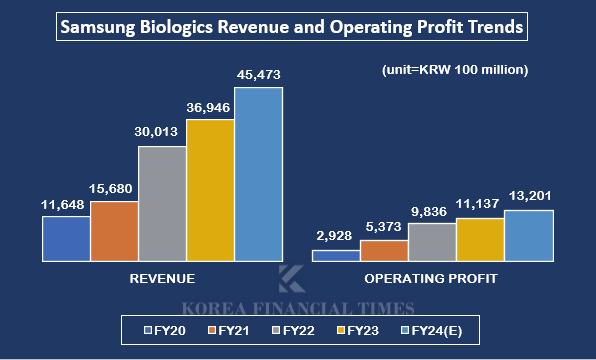
According to Samsung Biologics on the 23rd, the company achieved consolidated revenue of KRW 4.5473 trillion and operating profit of KRW 1.3201 trillion last year, marking year-on-year growth of 23% and 19%, respectively. In Q4 alone, the company posted its highest-ever quarterly performance with a 17% increase in revenue. Following its milestone of exceeding KRW 3 trillion in annual revenue in 2022, Samsung Biologics has once again taken a significant leap forward.
The company’s growth trajectory has been steep. In just eight years since its IPO in 2016, when its revenue was only KRW 294.6 billion, Samsung Biologics has achieved an astonishing growth rate of over 1,400%. This translates to an average annual growth rate of 48%.
Behind this success lies the company's "overwhelming production capacity." All three of its initial plants operated at full capacity last year, with its fourth plant also contributing significantly to revenue growth as its operational rate increased. The fourth plant, which began full-scale operations in June 2023, played a major role in driving revenue.
High-quality standards also played a critical role. Currently, Samsung Biologics counts 17 of the top 20 global pharmaceutical companies as clients. Last year, the company won three large contracts worth KRW 1 trillion out of a total of KRW 5.4035 trillion in annual orders, and all three were with global pharmaceutical companies. A company representative said, "We are strengthening partnerships with global clients based on our superior quality competitiveness.“
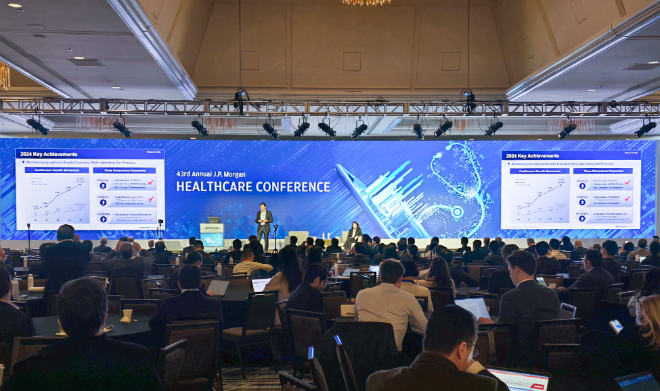
John Lim, CEO of Samsung Biologics, delivers a corporate presentation at the Grand Ballroom, the main venue of the JPMorgan Healthcare Conference (JPMHC) in San Francisco, U.S., on the 14th (local time)./Photo=Samsung Biologics
이미지 확대보기
Samsung Biologics plans to continue to expanding its scale this year as part of its 'unrivaled capacity' strategy. This April, its fifth plant, with a production capacity of 180,000 liters, is set to begin operations. Once operational, Samsung Biologics’ total production capacity will reach 784,000 liters. For comparison, Celltrion, another Korean CDMO (contract development and manufacturing organization), currently operates at a total capacity of approximately 250,000 liters.
The company has already laid out a long-term plan to expand production capacity to eight plants. This year, Samsung Biologics plans to present investment proposals for constructing a sixth plant to its board of directors. When the sixth plant is completed in 2027, the company’s capacity will increase by an additional 180,000 liters, reaching a total of 964,000 liters. When all eight plants are completed in 2032, the company will have a total capacity of 1.32 million liters, nearly double the capacity of Switzerland's Lonza (780,000 liters) and Japan's Fujifilm (750,000 liters), which are among the top three global CDMOs alongside Samsung Biologics.
K-PharmaBio, Will 20 Years of R&D See the Light?… Expectations for 10th FDA and 1 Trillion Blockbuster Increase↑Overseas is the answer?... Yuhan Corp. · GC Bio, etc. Pharmabio industry, Q3 profits soar on 'global' rideCelltrion Enters CDMO… “Achieving KRW 3 Trillion in Sales by 2031”'COVID-19 bad times over' Youngjin Pharmaceuticals' operating profit soars 180% last year...'What's the secret to its rapid growth?GC Group's 3 generations making their presence felt...'uncle-nephew' is gone, 'cousin management' is coming
While there are concerns about 'excessive facilities', the company is not simply increasing its size. It is also applying the super-gap formula in various ways in terms of technology, such as securing new modalities and investing in biotech ventures. The plan is to increase technological prowess as the company grows in size, and to easily obtain orders proportional to its production capacity.
Particular emphasis will be placed on emerging modalities, such as antibody-drug conjugates (ADCs) and cell and gene therapies (CGTs), as these areas are expected to grow significantly. As part of this, Samsung Biologics, along with Samsung C&T and Samsung Bioepis, has established the 'Samsung Life Science Fund' to invest in promising biotech companies. Last year, the fund provided financial support to companies such as BrickBio, Latus Bio, Generate Biomedicines, and Flagship Pioneering, a startup venture capital firm.
The company is also accelerating its portfolio expansion. In 2024, Samsung Biologics launched five new technology platforms and customized service packages, boosting its competitiveness in contract development (CDO). Additionally, in December 2024, the company completed a dedicated ADC production facility and aims to establish an ADC drug product (DP) production line by Q1 2027.
Samsung Biologics has set a revenue target of KRW 5.5705 trillion for 2025. Already, on January 14, the company secured a massive KRW 2 trillion contract with a European pharmaceutical company, marking its largest contract to date at $1.41 billion (approximately KRW 2.0747 trillion). Furthermore, the potential benefits of U.S. policies under a second Trump administration—such as measures to curb Chinese competitors and support biosimilars—may present additional growth opportunities for Samsung Biologics.
A company representative remarked, "We will continue to work closely with our clients to ensure the rapid and stable supply of medicines," adding, "We plan to accelerate our three-pronged strategy of expanding production capacity, diversifying our portfolio, and strengthening global hubs to sustain our growth momentum.“
Meanwhile, on a standalone basis, Samsung Biologics recorded KRW 3.4971 trillion in annual revenue and KRW 1.3214 trillion in operating profit last year. Its subsidiary, Samsung Bioepis, posted revenue of KRW 1.5377 trillion and operating profit of KRW 435.4 billion during the same period.
Kim Nayoung, Korea Finacial Times (steaming@fntimes.com)











![[머니무브 2026 주요 연사에게 미리 듣는다] 코스피 급등 뒤 찾아온 흔들림… 이승우 센터장이 말하는 ‘다음 신호’](https://cfnimage.commutil.kr/phpwas/restmb_setimgmake.php?pp=006&w=69&h=45&m=5&simg=202609081629420013902a735e27af12411124362.jpg&nmt=18)

![[DQN] 정진완號 우리은행, 총자산 증가에도 RWA 2%대 통제···RoRWA 개선 ‘관건’ [은행권 RWA 대해부]](https://cfnimage.commutil.kr/phpwas/restmb_setimgmake.php?pp=006&w=69&h=45&m=5&simg=20260907171447064830b4a7c6999c121131189150.jpg&nmt=18)


![[그래픽 뉴스] ‘순대’가 경제용어라고? 순(純)대외자산, 한국의 진짜 해외자산은 얼마일까?](https://cfnimage.commutil.kr/phpwas/restmb_setimgmake.php?pp=006&w=298&h=298&m=1&simg=202609021356075202de68fcbb3512411124362_0.jpg&nmt=18)
![[그래픽 뉴스] ISA 대개편! 나에게 유리한 계좌는?](https://cfnimage.commutil.kr/phpwas/restmb_setimgmake.php?pp=006&w=298&h=298&m=1&simg=202608041713155615de68fcbb3512411124362_0.jpg&nmt=18)
![[그래픽 뉴스] 미국 증시 새로운 키워드 'MANGOS'](https://cfnimage.commutil.kr/phpwas/restmb_setimgmake.php?pp=006&w=298&h=298&m=1&simg=202607291740382069de68fcbb3512411124362_0.jpg&nmt=18)

![[그래픽 뉴스] 은퇴후 30년 부모님 세대의 생존전략](https://cfnimage.commutil.kr/phpwas/restmb_setimgmake.php?pp=006&w=298&h=298&m=1&simg=202606301704439153de68fcbb3512411124362_0.jpg&nmt=18)
![[신간]은퇴연옥…김경록의 은퇴 후 삶의 나침반](https://cfnimage.commutil.kr/phpwas/restmb_setimgmake.php?pp=006&w=81&h=123&m=5&simg=20260414140833047280f8caa4a5ce12411124362.jpg&nmt=18)
![[신간] 물처럼 흐르고 원칙으로 서다…김용환의 통찰을 담다](https://cfnimage.commutil.kr/phpwas/restmb_setimgmake.php?pp=006&w=81&h=123&m=5&simg=20260409114249027860f8caa4a5ce12411124362.jpg&nmt=18)
![[안현정 서평] 플랫폼의 영지에서 ‘미학적 주권’을 선포하라...'K가 죽어야 K가 산다' 장준환 著](https://cfnimage.commutil.kr/phpwas/restmb_setimgmake.php?pp=006&w=81&h=123&m=5&simg=20260527121426063220c1c16452b012411124362.jpg&nmt=18)
![[서평] 추세 매매의 대가들...추세추종 투자전략의 대가 14인 인터뷰](https://cfnimage.commutil.kr/phpwas/restmb_setimgmake.php?pp=006&w=81&h=123&m=5&simg=2023102410444004986c1c16452b0175114235199.jpg&nmt=18)


![[AD] ‘PBV 라인업 확장’ 기아, 9월 독일서 ‘PV7’ 첫 공개](https://cfnimage.commutil.kr/phpwas/restmb_setimgmake.php?pp=006&w=89&h=45&m=1&simg=2026083111010602815074925877361231180222.jpg&nmt=18)
![[AD] 제네시스, 럭셔리 경험 더한 ‘2027 GV70’‧‘GV70 그래파이트’ 출시](https://cfnimage.commutil.kr/phpwas/restmb_setimgmake.php?pp=006&w=89&h=45&m=1&simg=20260702143546085600749258773622211122717.jpg&nmt=18)
![[AD] 개소세 혜택 종료…현대차, ‘썸머 페스타’로 고객 부담 완화](https://cfnimage.commutil.kr/phpwas/restmb_setimgmake.php?pp=006&w=89&h=45&m=1&simg=20260702142355004830749258773622211122717.jpg&nmt=18)
![[AD] 기아 ‘디 올 뉴 셀토스’, 인도 타임스 드라이브 어워즈서 ‘올해의 SUV’ 선정](https://cfnimage.commutil.kr/phpwas/restmb_setimgmake.php?pp=006&w=89&h=45&m=1&simg=202605071156400590007492587736124111243152.jpg&nmt=18)
![[AD]‘그랜저 잡자’ 기아, 상품성 더한 ‘The 2027 K8’ 출시](https://cfnimage.commutil.kr/phpwas/restmb_setimgmake.php?pp=006&w=89&h=45&m=1&simg=2026042110193702730074925877361211627527.jpg&nmt=18)