






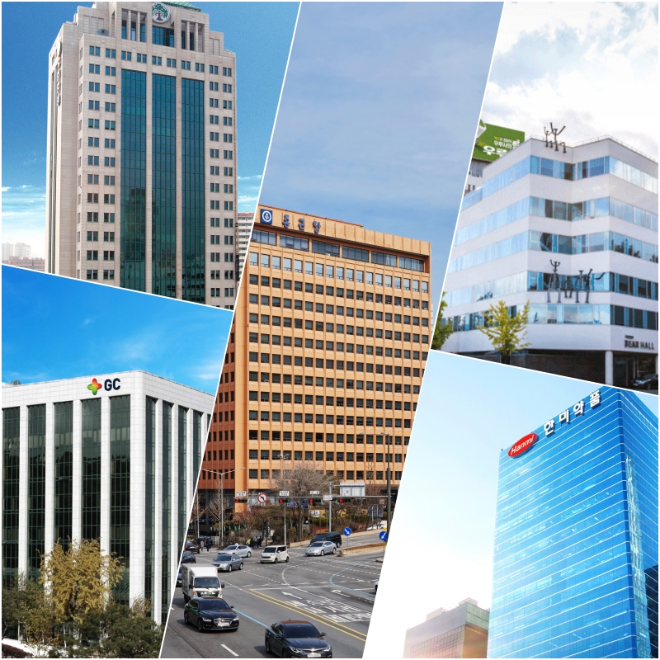
Headquarters of Yuhan Corporation, GC Bio, Daewoong Pharmaceutical, Chong Kun Dang, and Hanmi Pharmaceutical. /Photo courtesy of each company
이미지 확대보기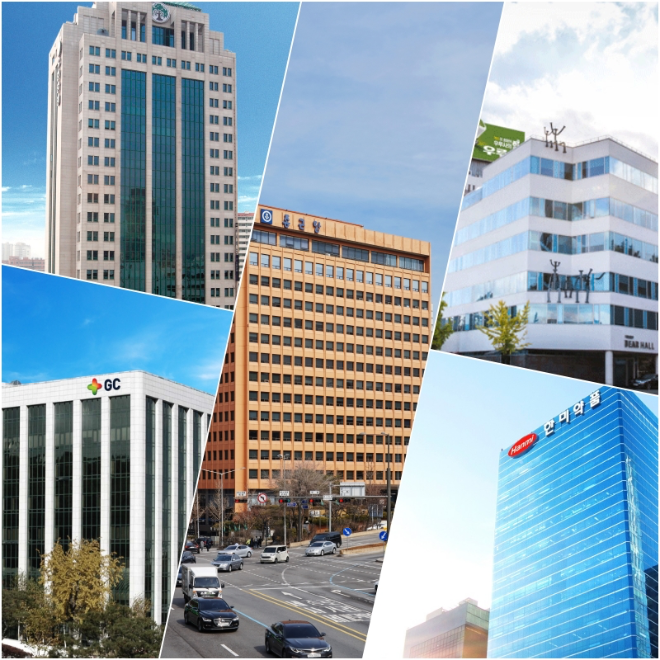
According to our report on the 4th, traditional pharmaceutical companies such as Yuhan Corporation, GC Biopharma, Daewoong Pharmaceutical, and Chong Kun Dang have shown performance overseas and received favorable report cards (tentative) for the third quarter of this year.
First, Yuhan Corporation benefited most from the ‘power of globalization’. The company's third-quarter revenue and operating profit were KRW 116.3 billion and KRW 47.6 billion, respectively, up 24.8 % and 689.9 % year-on-year. Both revenue and operating profit were the highest ever recorded on a quarterly basis.
This was largely due to lung cancer drug 'Leclaza'. The company received a $60 million (about KRW 804 million) milestone payment from Janssen Biotech in August after successfully securing U.S. Food and Drug Administration (FDA) approval for 'Leclaza'. The company had previously signed a $1.255 billion (KRW 1.6 trillion) deal in 2018 to transfer 'Leclaza' to Janssen. Even though the performance of its existing main business, prescription drugs, was sluggish, 'Leclaza'’s overseas earnings filled the gap.
GC Biopharma, which struggled in the first half of the year, also shed its deficit tag with the US launch of its blood product ‘Aliglo’. GC Biopharma’s sales (consolidated basis) in the third quarter of this year increased 5.8% year-on-year to KRW 464.9 billion. Operating profit for the same period increased 20.8% to KRW 39.6 billion.
GC Biopharma was unable to avoid deficits in the first half of the year due to the medical strike and the launch of Aliglo. However, it seems that it has entered a period of full-scale performance recovery as the sales of Aliglo, which received FDA approval in July and settled in the US, are reflected starting in the third quarter.
Daewoong Pharmaceutical’s sales and operating profit also jumped significantly. The company’s sales and operating profit (separate basis) in the third quarter increased 4.26% and 20.32% year-on-year to KRW 315.9 billion and KRW 41.1 billion, respectively.
The botulinum toxin product ‘Nabota’ and the gastroesophageal reflux treatment ‘Pexuclu’ played a leading role. Nabota is so popular that it is ranked second in the botulinum toxin market in the United States. The 34th domestic new drug, 'Pexuclu', was also launched simultaneously in three Central and South American countries, Mexico, Chile, and Ecuador, in August. At the time, Park Sung-soo, CEO of Daewoong Pharmaceutical, expressed a strong will to advance into the global market for Pexuclu, saying, “We will introduce it to 100 countries by 2027.”
Chong Kun Dang recorded separate sales of KRW 408.5 billion and operating profit of KRW 25.2 billion in the third quarter of this year. Sales increased by 3.1% year-on-year, but operating profit decreased by 52.5%. This is because the contract for HK Innoen’s gastroesophageal reflux disease treatment ‘K-Cap’, which records annual prescriptions of KRW 100 billion, has ended.
What is notable is the growth of its affiliate Chong Kun Dang Bio. Chong Kun Dang Bio recorded sales of KRW 43.9 billion and operating profit of KRW 2.6 billion in the third quarter, successfully turning a profit compared to the same period last year. The company has been consistently in the black since the first quarter of this year, and this is due to the expansion of exports of raw pharmaceutical ingredients and finished products.
Hanmi Pharmaceutical is the only one among the top five pharmaceutical companies to see a decrease in both sales and operating profit compared to the same period last year. Consolidated sales for the third quarter of this year decreased by 0.7% year-on-year to KRW 362.1 billion. Operating profit fell 11.4% to KRW 51 billion.
In particular, the decline of Beijing Hanmi Pharmaceutical, a local Chinese corporation, is notable. Beijing Hanmi Pharmaceutical recorded sales of KRW 84.3 billion and operating profit of KRW 15 billion in the third quarter. These figures are 9.7% and 42.4% decreases, respectively, from the same period last year. ‘The number of business days decreased, and physical environmental factors such as natural disasters in China slowed down sales,’ said a Hanmi Pharmaceutical representative.
In addition, they added that they plan to rebound by targeting the global market. Hanmi Pharmaceutical emphasized, “We will present about 10 innovative new drug research results for cancer, obesity, and rare diseases at various global academic conferences in the second half of this year,” and “In particular, we plan to unveil a ‘new concept obesity treatment’ that simultaneously achieves weight loss and muscle gain for the first time at the American Society for the Study of Obesity in November.”
Meanwhile, according to the Korea Biotechnology Industry Organization, the global pharmaceutical market size as of last year was 1.61 trillion dollars (approximately KRW 2,150 trillion). In comparison, Korea’s market size was only 23 billion dollars (KRW 29.86 trillion). The U.S. accounted for more than 40% of the global market at 600 billion dollars (KRW 825.3 trillion).
A pharmaceutical and biotechnology industry official said, “The domestic pharmaceutical market is already saturated, and it is also very small compared to the U.S. in terms of size,” and “For continued growth, targeting global markets such as the U.S. is essential.”
Kim Nayoung, Korea Finacial Times (steaming@fntimes.com)











![유한양행, 영업익 35%↑ 예고…‘수장 교체기’ 실탄 다진다 [5대 제약사 3Q 실적 ①]](https://cfnimage.commutil.kr/phpwas/restmb_setimgmake.php?pp=006&w=69&h=45&m=5&simg=202610021114080076807fd637f543112168227135.jpg&nmt=18)
![서초구 '래미안원베일리' 44평, 9억 오른 94억원에 거래 [일일 신고가]](https://cfnimage.commutil.kr/phpwas/restmb_setimgmake.php?pp=006&w=69&h=45&m=5&simg=2025053017540607971e41d7fc6c2183101242202.jpg&nmt=18)


![[THE COMPASS] 한화오션, 수주잔고 증가 불구 주가 짓누르는 ‘무배당 기조’](https://cfnimage.commutil.kr/phpwas/restmb_setimgmake.php?pp=006&w=69&h=45&m=5&simg=20261002141710004730a837df649412411124362.jpg&nmt=18)


![[그래픽 뉴스] ‘순대’가 경제용어라고? 순(純)대외자산, 한국의 진짜 해외자산은 얼마일까?](https://cfnimage.commutil.kr/phpwas/restmb_setimgmake.php?pp=006&w=298&h=298&m=1&simg=202609021356075202de68fcbb3512411124362_0.jpg&nmt=18)
![[그래픽 뉴스] ISA 대개편! 나에게 유리한 계좌는?](https://cfnimage.commutil.kr/phpwas/restmb_setimgmake.php?pp=006&w=298&h=298&m=1&simg=202608041713155615de68fcbb3512411124362_0.jpg&nmt=18)
![[그래픽 뉴스] 미국 증시 새로운 키워드 'MANGOS'](https://cfnimage.commutil.kr/phpwas/restmb_setimgmake.php?pp=006&w=298&h=298&m=1&simg=202607291740382069de68fcbb3512411124362_0.jpg&nmt=18)

![[그래픽 뉴스] 은퇴후 30년 부모님 세대의 생존전략](https://cfnimage.commutil.kr/phpwas/restmb_setimgmake.php?pp=006&w=298&h=298&m=1&simg=202606301704439153de68fcbb3512411124362_0.jpg&nmt=18)
![[신간]은퇴연옥…김경록의 은퇴 후 삶의 나침반](https://cfnimage.commutil.kr/phpwas/restmb_setimgmake.php?pp=006&w=81&h=123&m=5&simg=20260414140833047280f8caa4a5ce12411124362.jpg&nmt=18)
![[신간] 물처럼 흐르고 원칙으로 서다…김용환의 통찰을 담다](https://cfnimage.commutil.kr/phpwas/restmb_setimgmake.php?pp=006&w=81&h=123&m=5&simg=20260409114249027860f8caa4a5ce12411124362.jpg&nmt=18)
![[안현정 서평] 플랫폼의 영지에서 ‘미학적 주권’을 선포하라...'K가 죽어야 K가 산다' 장준환 著](https://cfnimage.commutil.kr/phpwas/restmb_setimgmake.php?pp=006&w=81&h=123&m=5&simg=20260527121426063220c1c16452b012411124362.jpg&nmt=18)
![[서평] 추세 매매의 대가들...추세추종 투자전략의 대가 14인 인터뷰](https://cfnimage.commutil.kr/phpwas/restmb_setimgmake.php?pp=006&w=81&h=123&m=5&simg=2023102410444004986c1c16452b0175114235199.jpg&nmt=18)


![[머니무브 2026] “지금 사도 될까?” 답이 안 보인다면…하반기 투자, 4명의 전문가에게 물어보세요](https://cfnimage.commutil.kr/phpwas/restmb_setimgmake.php?pp=006&w=89&h=45&m=1&simg=202609151044050355302a735e27af12411124362.jpg&nmt=18)
![[AD] ‘PBV 라인업 확장’ 기아, 9월 독일서 ‘PV7’ 첫 공개](https://cfnimage.commutil.kr/phpwas/restmb_setimgmake.php?pp=006&w=89&h=45&m=1&simg=2026083111010602815074925877361231180222.jpg&nmt=18)
![[AD] 제네시스, 럭셔리 경험 더한 ‘2027 GV70’‧‘GV70 그래파이트’ 출시](https://cfnimage.commutil.kr/phpwas/restmb_setimgmake.php?pp=006&w=89&h=45&m=1&simg=20260702143546085600749258773622211122717.jpg&nmt=18)