






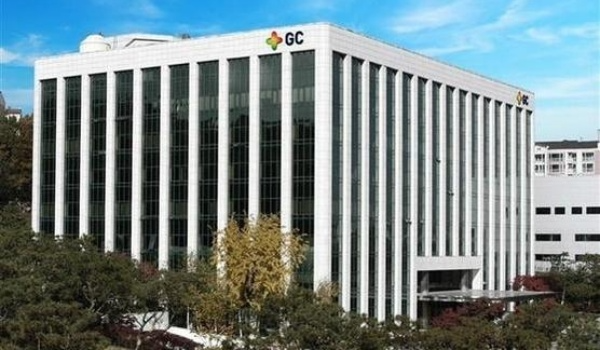
GC Green Cross office building./Photo=GC Green Cross
According to the pharmaceutical industry on the 23rd, the Green Cross Group is recently starting the 'owner's third generation' management in earnest through the regular executive personnel reshuffle in 2025. This is because GC Group Chairman Heo Il-seop's eldest son, Heo Jin-seong, in charge of GC Strategy 1, has been promoted to the head of the business management headquarters (executive director). He was appointed as the chief financial officer (CFO) of the holding company, GC Green Cross Holdings, changing his position from strategy to finance. It has been eight years since a member of the GC Group's owner family was promoted.
Executive director, Heo Jin-seong will be responsible for the overall management of the group, including not only accounting, but also investment, financing, and M&A.
There are voices in the industry saying that this personnel change is the beginning for GC Group's management succession. The current GC Group is jointly managed by an uncle and nephew. After the passing of GC Group Chairman Heo Young-seop in 2009, GC Holdings has been led by his younger brother, Chairman Heo Il-seop.
In 2015, the second son of former Chairman Heo Young-seop, Heo Eun-cheol, became the CEO of GC Green Cross, a key affiliate, and the uncle-nephew joint management began. Then, in 2017, former Chairman Heo’s third son, Heo Yong-jun, also entered the board of directors of Green Cross Holdings and became co-CEO with his uncle, Chairman Heo Il-seop.
There had been many speculations that if Chairman Heo Il-seop stepped down from management, the management of the brothers would begin, but the emergence of new headquarters director Heo Jin-seong has given strength to the possibility of cousin management. In particular, as the head of the management headquarters, which Executive Director Heo Jin-seong took on, was a key position that President Heo Yong-jun held just before he became CEO, Executive Director Heo Jin-seong could succeed Chairman Heo Il-seop in the future. Chairman Heo Il-seop was born in 1954, so it would not be strange for him to be considering succession.
In addition, Chairman Huh Il-seop's second son, Huh Jin-hoon, is also working as the head of the Aliglo team at the Global Business Headquarters at GC Green cross. He is in charge of the global business of 'Aliglo', an immunoglobulin product that has emerged as GC Green Cross's next-generation growth engine. However, he was born in 1991, so he is different in job title from other third-generation members born in the 1970s and 1980s.
Looking at the shareholding structure, all four third-generation owners have a strong presence. Chairman Huh Il-seop is the largest shareholder of Green Cross Holdings, holding 12.20%. He is followed by ▲President Huh Yong-joon with 2.91%, ▲President Huh Eun-cheol with 2.63%, ▲Executive Director Huh Jin-seong with 0.77%, and ▲ Huh Jin-hoon with 0.72%. Although Chairman He's eldest and youngest sons have lower stakes than their cousins, but that could change depending on how Mr. He handles his stake in the future.
K-PharmaBio, Will 20 Years of R&D See the Light?… Expectations for 10th FDA and 1 Trillion Blockbuster Increase↑Overseas is the answer?... Yuhan Corp. · GC Bio, etc. Pharmabio industry, Q3 profits soar on 'global' rideCelltrion Enters CDMO… “Achieving KRW 3 Trillion in Sales by 2031”What is the strategy of Celltrion Chairman Seo Jung-jin, who created the '1 trillion blockbuster', to achieve 'KRW 10 trillion in sales within 3 years'?
Some in the market are speculating that the cousins may compete for shares in the future. However, the prevailing opinion is that GC Group will continue to show the same stability it has shown in its uncle-nephew management for more than a decade.
An industry insider explained, “The pharmaceutical industry calls GC Group ‘beautiful management’,” and “The pharmaceutical industry is an industry dominated by owner management, so there is a certain amount of management dispute, but GC Group, on the contrary, is showing balanced joint management.” He added, “Even if the system changes to cousin management, it will show the same beautiful management as it does now.”
Kim Nayoung, Korea Finacial Times (steaming@fntimes.com)











![이성훈 LH 사장 다주택·대출 규제 발언 도마…여야 의원 잇단 지적 [2026 국감]](https://cfnimage.commutil.kr/phpwas/restmb_setimgmake.php?pp=006&w=69&h=45&m=5&simg=20261012163012026870048b718333218159227151.jpg&nmt=18)


![[그래픽 뉴스] ‘순대’가 경제용어라고? 순(純)대외자산, 한국의 진짜 해외자산은 얼마일까?](https://cfnimage.commutil.kr/phpwas/restmb_setimgmake.php?pp=006&w=298&h=298&m=1&simg=202609021356075202de68fcbb3512411124362_0.jpg&nmt=18)
![[그래픽 뉴스] ISA 대개편! 나에게 유리한 계좌는?](https://cfnimage.commutil.kr/phpwas/restmb_setimgmake.php?pp=006&w=298&h=298&m=1&simg=202608041713155615de68fcbb3512411124362_0.jpg&nmt=18)
![[그래픽 뉴스] 미국 증시 새로운 키워드 'MANGOS'](https://cfnimage.commutil.kr/phpwas/restmb_setimgmake.php?pp=006&w=298&h=298&m=1&simg=202607291740382069de68fcbb3512411124362_0.jpg&nmt=18)

![[그래픽 뉴스] 은퇴후 30년 부모님 세대의 생존전략](https://cfnimage.commutil.kr/phpwas/restmb_setimgmake.php?pp=006&w=298&h=298&m=1&simg=202606301704439153de68fcbb3512411124362_0.jpg&nmt=18)
![[신간]은퇴연옥…김경록의 은퇴 후 삶의 나침반](https://cfnimage.commutil.kr/phpwas/restmb_setimgmake.php?pp=006&w=81&h=123&m=5&simg=20260414140833047280f8caa4a5ce12411124362.jpg&nmt=18)
![[신간] 물처럼 흐르고 원칙으로 서다…김용환의 통찰을 담다](https://cfnimage.commutil.kr/phpwas/restmb_setimgmake.php?pp=006&w=81&h=123&m=5&simg=20260409114249027860f8caa4a5ce12411124362.jpg&nmt=18)
![[안현정 서평] 플랫폼의 영지에서 ‘미학적 주권’을 선포하라...'K가 죽어야 K가 산다' 장준환 著](https://cfnimage.commutil.kr/phpwas/restmb_setimgmake.php?pp=006&w=81&h=123&m=5&simg=20260527121426063220c1c16452b012411124362.jpg&nmt=18)
![[서평] 추세 매매의 대가들...추세추종 투자전략의 대가 14인 인터뷰](https://cfnimage.commutil.kr/phpwas/restmb_setimgmake.php?pp=006&w=81&h=123&m=5&simg=2023102410444004986c1c16452b0175114235199.jpg&nmt=18)


![[머니무브 2026] “지금 사도 될까?” 답이 안 보인다면…하반기 투자, 4명의 전문가에게 물어보세요](https://cfnimage.commutil.kr/phpwas/restmb_setimgmake.php?pp=006&w=89&h=45&m=1&simg=202609151044050355302a735e27af12411124362.jpg&nmt=18)
![[AD] ‘PBV 라인업 확장’ 기아, 9월 독일서 ‘PV7’ 첫 공개](https://cfnimage.commutil.kr/phpwas/restmb_setimgmake.php?pp=006&w=89&h=45&m=1&simg=2026083111010602815074925877361231180222.jpg&nmt=18)
![[AD] 제네시스, 럭셔리 경험 더한 ‘2027 GV70’‧‘GV70 그래파이트’ 출시](https://cfnimage.commutil.kr/phpwas/restmb_setimgmake.php?pp=006&w=89&h=45&m=1&simg=20260702143546085600749258773622211122717.jpg&nmt=18)