






Hanwha Group has completed the third-generation succession. The group’s structure allows control over all affiliates by dominating Hanwha Corporation, the de facto holding company. This year, there have been changes in the shareholding structure of Hanwha Corporation.
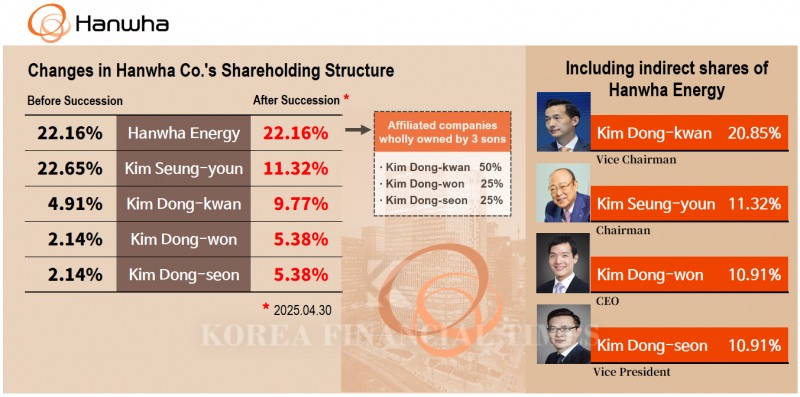
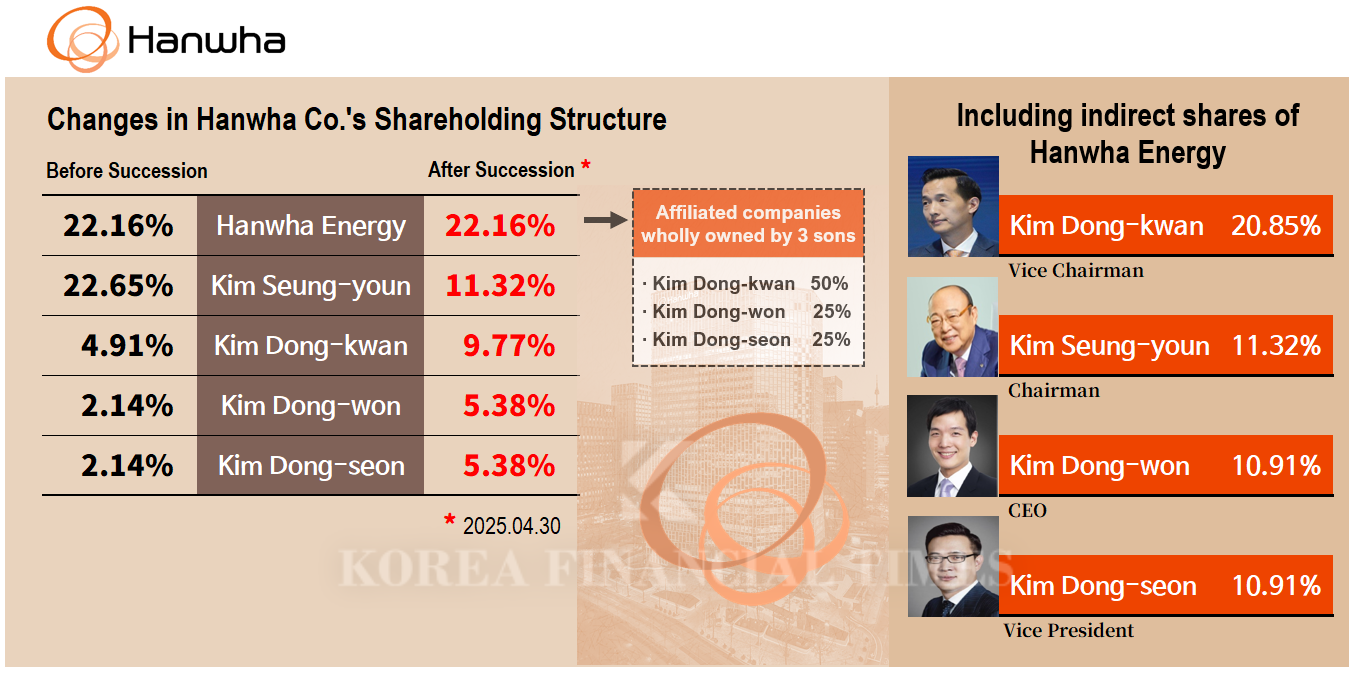
In March, right after Hanwha Aerospace decided on a paid-in capital increase, Chairman Kim Seung-youn donated half of his Hanwha Corporation shares to his three sons (Dong-kwan, Dong-won, and Dong-seon). He transferred 4.86% to Vice Chairman Kim Dong-kwan and 3.23% each to President Kim Dong-won and Executive Vice President Kim Dong-seon.
As a result, the three brothers’ respective stakes in Hanwha Corporation rose to 9.77%, 5.38%, and 5.38%. Chairman Kim Seung-youn’s stake decreased to 11.32%.
Currently, the largest shareholder of Hanwha Corporation is Hanwha Energy (22.16%).
Hanwha Energy is 100% owned by the three brothers. The eldest, Vice Chairman Kim Dong-kwan, holds 50%, while President Kim Dong-won and Executive Vice President Kim Dong-seon each own 25%.
Calculating the indirect stake in Hanwha Corporation held through Hanwha Energy, Dong-kwan holds 11.08%, and Dong-won and Dong-seon each hold 5.54%.
Including these indirect holdings, Vice Chairman Kim Dong-kwan’s total stake rises to 20.85%, making him the largest shareholder of Hanwha Corporation. Dong-won and Dong-seon’s stakes each increase to 10.91%. In addition, Vice Chairman Kim Dong-kwan has received 770,992 Hanwha Corporation restricted stock units (RSUs), equivalent to about 1.03%, as performance bonuses from 2020 to the present. This is why it is considered that the third-generation succession has effectively been completed.
Hanwha Ocean Turns Profitable... Why Is Its Credit Rating Still BBB+?Hanwha’s Kim Seung-youn and Kim Dong-kwan: Will the Father-Son 'Parallel Theory' Be Completed?Hanwha Aerospace’s Kim Dong-kwan Partners with Coulter to Target the U.S. Defense MarketHanwha’s Third Son Kim Dong-seon Shuts Down SNS, Launches New Businesses
With this, Hanwha Group has become the only major conglomerate in Korea to have completed management succession to a 1980s-born heir. Vice Chairman Kim Dong-kwan was born in 1983 and is 42 years old this year.
Jeong Ki-sun, born in 1982 and known as a close friend in the business community, is still awaiting succession as Senior Vice Chairman of HD Hyundai. Lee Kyu-ho, Vice Chairman of Kolon Group, born in 1984, is also far from completing succession.
Shin Yoo-yeol, Executive Vice President of Lotte Group and eldest son of Chairman Shin Dong-bin, was born in 1986, but his stake in Lotte Holdings is only 0.02%.
The estimated gift tax the three brothers must pay due to this share transfer is around KRW 230.5 billion. Vice Chairman Kim Dong-kwan needs to raise about KRW 98.9 billion. Since the share transaction took place on April 30, the gift tax will be calculated based on the average share price for two months before and after the transaction date. While it should be calculated based on the average closing price from February 1 to June 30 this year, the calculation was made using the average closing price of KRW 54,742 from May 2 to May 30.
Vice Chairman Kim Dong-kwan can pay the gift tax in installments over up to six payments across five years. Each payment would be about KRW 16 billion to KRW 20 billion.
Last year, his total compensation was KRW 9.199 billion. He received KRW 3.083 billion from Hanwha Solutions and KRW 3.058 billion each from Hanwha Aerospace and Hanwha Corporation. His salary from Hanwha Ocean, where he serves as a non-executive director, was not disclosed as it was less than KRW 500 million.
The 2024 year-end dividend is estimated to be about KRW 2.9 billion. He received KRW 2.9 billion from Hanwha Corporation and KRW 15.96 million from Hanwha Aerospace. The total of his compensation and dividends is KRW 12.1 billion, but he is still short by KRW 4 billion to KRW 8 billion to cover the gift tax.
He may also take out additional stock-backed loans using his Hanwha Corporation shares as collateral. Currently, 1.3 million Hanwha Corporation shares are already pledged as collateral with Korea Securities Finance Corporation.
Since 2023, he has also deposited 343,000 shares inherited from his late mother, Seo Young-min, as tax collateral at the Jongno Tax Office.
He may also utilize his shares in Hanwha Energy, which is unlisted.
The investment banking industry values Hanwha Energy at KRW 4 trillion to KRW 5 trillion. If Vice Chairman Kim Dong-kwan uses his 50% stake as collateral, the value of his shares would be about KRW 2 trillion to KRW 2.5 trillion, which could also be used to secure loans.
Shin Haeju (hjs0509@fntimes.com)











![[THE COMPASS] 한미사이언스 경영권 분쟁, 신동국이 주도하는 ‘종식’ 게임](https://cfnimage.commutil.kr/phpwas/restmb_setimgmake.php?pp=006&w=69&h=45&m=5&simg=20261008122108000710a837df649412411124362.jpg&nmt=18)

![영업익 53% 뛴다는데…대웅제약 몸값 누르는 두 가지 변수 [5대 제약사 3Q 실적 ④]](https://cfnimage.commutil.kr/phpwas/restmb_setimgmake.php?pp=006&w=69&h=45&m=5&simg=202610081106100618007fd637f543112168227135.jpg&nmt=18)

![GA 설계사 과잉 환수 지적에…최병채 인카금융서비스 회장 "120% 환수 조항, 비정상 계약 막기 위한 조치" [2026 국감]](https://cfnimage.commutil.kr/phpwas/restmb_setimgmake.php?pp=006&w=69&h=45&m=5&simg=202610081635270972708a55064dd1124111243152.jpg&nmt=18)


![[그래픽 뉴스] ‘순대’가 경제용어라고? 순(純)대외자산, 한국의 진짜 해외자산은 얼마일까?](https://cfnimage.commutil.kr/phpwas/restmb_setimgmake.php?pp=006&w=298&h=298&m=1&simg=202609021356075202de68fcbb3512411124362_0.jpg&nmt=18)
![[그래픽 뉴스] ISA 대개편! 나에게 유리한 계좌는?](https://cfnimage.commutil.kr/phpwas/restmb_setimgmake.php?pp=006&w=298&h=298&m=1&simg=202608041713155615de68fcbb3512411124362_0.jpg&nmt=18)
![[그래픽 뉴스] 미국 증시 새로운 키워드 'MANGOS'](https://cfnimage.commutil.kr/phpwas/restmb_setimgmake.php?pp=006&w=298&h=298&m=1&simg=202607291740382069de68fcbb3512411124362_0.jpg&nmt=18)

![[그래픽 뉴스] 은퇴후 30년 부모님 세대의 생존전략](https://cfnimage.commutil.kr/phpwas/restmb_setimgmake.php?pp=006&w=298&h=298&m=1&simg=202606301704439153de68fcbb3512411124362_0.jpg&nmt=18)
![[신간]은퇴연옥…김경록의 은퇴 후 삶의 나침반](https://cfnimage.commutil.kr/phpwas/restmb_setimgmake.php?pp=006&w=81&h=123&m=5&simg=20260414140833047280f8caa4a5ce12411124362.jpg&nmt=18)
![[신간] 물처럼 흐르고 원칙으로 서다…김용환의 통찰을 담다](https://cfnimage.commutil.kr/phpwas/restmb_setimgmake.php?pp=006&w=81&h=123&m=5&simg=20260409114249027860f8caa4a5ce12411124362.jpg&nmt=18)
![[안현정 서평] 플랫폼의 영지에서 ‘미학적 주권’을 선포하라...'K가 죽어야 K가 산다' 장준환 著](https://cfnimage.commutil.kr/phpwas/restmb_setimgmake.php?pp=006&w=81&h=123&m=5&simg=20260527121426063220c1c16452b012411124362.jpg&nmt=18)
![[서평] 추세 매매의 대가들...추세추종 투자전략의 대가 14인 인터뷰](https://cfnimage.commutil.kr/phpwas/restmb_setimgmake.php?pp=006&w=81&h=123&m=5&simg=2023102410444004986c1c16452b0175114235199.jpg&nmt=18)


![[머니무브 2026] “지금 사도 될까?” 답이 안 보인다면…하반기 투자, 4명의 전문가에게 물어보세요](https://cfnimage.commutil.kr/phpwas/restmb_setimgmake.php?pp=006&w=89&h=45&m=1&simg=202609151044050355302a735e27af12411124362.jpg&nmt=18)
![[AD] ‘PBV 라인업 확장’ 기아, 9월 독일서 ‘PV7’ 첫 공개](https://cfnimage.commutil.kr/phpwas/restmb_setimgmake.php?pp=006&w=89&h=45&m=1&simg=2026083111010602815074925877361231180222.jpg&nmt=18)
![[AD] 제네시스, 럭셔리 경험 더한 ‘2027 GV70’‧‘GV70 그래파이트’ 출시](https://cfnimage.commutil.kr/phpwas/restmb_setimgmake.php?pp=006&w=89&h=45&m=1&simg=20260702143546085600749258773622211122717.jpg&nmt=18)