





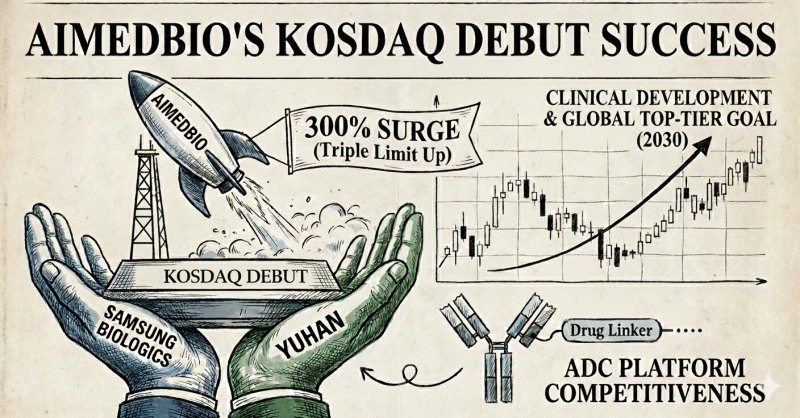

According to the industry on December 8, AIMEDBIO entered the KOSDAQ market on December 4. The company closed its first trading day at the upper price limit of KRW 44,000, up 300% from the offering price of KRW 11,000. On December 5, the second trading day, it also jumped to the price limit, closing at KRW 57,200, up 30% from the previous day.
AIMEDBIO attracted high interest during its Initial Public Offering (IPO) demand forecasting. A total of 2,414 domestic and foreign institutional investors applied for 3,240,623,000 shares, recording a competition ratio of approximately 672 to 1. Based on total participation quantity, 99.9% offered prices above the top of the band. Additionally, 1,935 (80.2%) of the 2,414 institutions participating in demand forecasting pledged mandatory holding.
The company was established in 2018 by Professor Nam Do-hyun, an expert in brain diseases who researched brain tumors as a neurosurgeon at Samsung Medical Center, as a spin-off from Samsung Medical Center.
AIMEDBIO develops antibody-drug conjugate (ADC) candidates through its 'P-ADC platform.' This platform can consistently perform from target discovery to antibody development, linker-payload optimization, and preclinical validation.
Samsung Life Science Fund (SVIC 54 and 63), jointly invested by Samsung C&T, Samsung Biologics, and Samsung Bioepis, participated as a strategic investor (SI) in AIMEDBIO. SVIC 54 was invested by Samsung C&T and Samsung Biologics, while 63 was invested by Samsung Bioepis. This is the first case of Samsung Life Science Fund investing in a domestic company.
As of the end of last year, SVIC 54 held KRW 3.5 billion in Redeemable Convertible Preferred Stock (RCPS) and KRW 1.8 billion in Convertible Preferred Stock (CPS). Fund 63 also holds RCPS (KRW 0.8 billion) and CPS (KRW 0.4 billion).
Samsung Biologics, along with equity investment, conducts joint research on ADC toolbox development with AIMEDBIO. The company plans to collaborate in various areas, including performing Contract Development Organization (CDO) tasks for monoclonal antibody-based atopic dermatitis and dementia treatments (AMB001).
ABL Bio Positioned as Next KOSDAQ Biotech Leader on Platform Technology Strength"Sales Up, Profits Down": Which Drugmakers Are Failing to Cash In?Hanmi Pharm pursues performance rebound through technology transfer and indication expansionCJ Bio Shifts Survival Strategy : 'From New Drug-Only Focus to Diversified Revenue Streams'
Yuhan invested KRW 3 billion in AIMEDBIO in 2021 to acquire 1,179,709 common shares (3.0% stake), followed by an additional KRW 1 billion investment last year to secure 390,000 redeemable convertible preferred shares (1% stake). A company official explained the reason for investing in AIMEDBIO as "strategic investment through open innovation."
Before listing, AIMEDBIO succeeded in technology transfer of preclinical-stage ADC candidates developed through the P-ADC platform. The company transferred technology for FGFR3 (Fibroblast Growth Factor Receptor 3) targeted therapeutic 'AMB302' to U.S.-based Biohaven in December last year.
In January this year, it signed a technology transfer option contract with SK Plasma for 'AMB030,' a candidate for refractory cancer treatment. Subsequently, in October, it successfully contracted to transfer ADC candidates to Germany's Boehringer Ingelheim for KRW 1.4 trillion, achieving total technology transfer results exceeding KRW 3 trillion in the pre-listing stage alone. Based on technology transfer contract results, it successfully turned to operating profit in the second half of last year and continued operating profit in the first half of this year.
Huh Nam-gu, CEO of AIMEDBIO, said, "With listing as an opportunity, we will break away from a technology transfer-centered structure and expand into a biotech with clinical development capabilities," adding, "Our goal is to leap forward as a global top-tier ADC company by 2030."
Yang Hyunwoo (yhw@fntimes.com)











![[그래픽 뉴스] ‘순대’가 경제용어라고? 순(純)대외자산, 한국의 진짜 해외자산은 얼마일까?](https://cfnimage.commutil.kr/phpwas/restmb_setimgmake.php?pp=006&w=298&h=298&m=1&simg=202609021356075202de68fcbb3512411124362_0.jpg&nmt=18)
![[그래픽 뉴스] ISA 대개편! 나에게 유리한 계좌는?](https://cfnimage.commutil.kr/phpwas/restmb_setimgmake.php?pp=006&w=298&h=298&m=1&simg=202608041713155615de68fcbb3512411124362_0.jpg&nmt=18)
![[그래픽 뉴스] 미국 증시 새로운 키워드 'MANGOS'](https://cfnimage.commutil.kr/phpwas/restmb_setimgmake.php?pp=006&w=298&h=298&m=1&simg=202607291740382069de68fcbb3512411124362_0.jpg&nmt=18)

![[그래픽 뉴스] 은퇴후 30년 부모님 세대의 생존전략](https://cfnimage.commutil.kr/phpwas/restmb_setimgmake.php?pp=006&w=298&h=298&m=1&simg=202606301704439153de68fcbb3512411124362_0.jpg&nmt=18)
![[신간]은퇴연옥…김경록의 은퇴 후 삶의 나침반](https://cfnimage.commutil.kr/phpwas/restmb_setimgmake.php?pp=006&w=81&h=123&m=5&simg=20260414140833047280f8caa4a5ce12411124362.jpg&nmt=18)
![[신간] 물처럼 흐르고 원칙으로 서다…김용환의 통찰을 담다](https://cfnimage.commutil.kr/phpwas/restmb_setimgmake.php?pp=006&w=81&h=123&m=5&simg=20260409114249027860f8caa4a5ce12411124362.jpg&nmt=18)
![[안현정 서평] 플랫폼의 영지에서 ‘미학적 주권’을 선포하라...'K가 죽어야 K가 산다' 장준환 著](https://cfnimage.commutil.kr/phpwas/restmb_setimgmake.php?pp=006&w=81&h=123&m=5&simg=20260527121426063220c1c16452b012411124362.jpg&nmt=18)
![[서평] 추세 매매의 대가들...추세추종 투자전략의 대가 14인 인터뷰](https://cfnimage.commutil.kr/phpwas/restmb_setimgmake.php?pp=006&w=81&h=123&m=5&simg=2023102410444004986c1c16452b0175114235199.jpg&nmt=18)


![[머니무브 2026] “지금 사도 될까?” 답이 안 보인다면…하반기 투자, 4명의 전문가에게 물어보세요](https://cfnimage.commutil.kr/phpwas/restmb_setimgmake.php?pp=006&w=89&h=45&m=1&simg=202609151044050355302a735e27af12411124362.jpg&nmt=18)
![[AD] ‘PBV 라인업 확장’ 기아, 9월 독일서 ‘PV7’ 첫 공개](https://cfnimage.commutil.kr/phpwas/restmb_setimgmake.php?pp=006&w=89&h=45&m=1&simg=2026083111010602815074925877361231180222.jpg&nmt=18)
![[AD] 제네시스, 럭셔리 경험 더한 ‘2027 GV70’‧‘GV70 그래파이트’ 출시](https://cfnimage.commutil.kr/phpwas/restmb_setimgmake.php?pp=006&w=89&h=45&m=1&simg=20260702143546085600749258773622211122717.jpg&nmt=18)
![[AD] 개소세 혜택 종료…현대차, ‘썸머 페스타’로 고객 부담 완화](https://cfnimage.commutil.kr/phpwas/restmb_setimgmake.php?pp=006&w=89&h=45&m=1&simg=20260702142355004830749258773622211122717.jpg&nmt=18)