







Amid this, industry attention is focused on whether Samsung Electronics will equip its new Galaxy series with its own application processor (AP), the ‘Exynos’. As APs are core components of smartphones and their prices have continued to rise recently, the burden of manufacturing costs is increasing.
Equipping the Exynos is essential to reduce cost pressures and to revive the struggling System LSI Division, but concerns remain due to its still unsatisfactory performance.
For now, Samsung Electronics plans to install the new ‘Exynos 2500’ in the ‘Galaxy Z Flip 7’, which is scheduled for release in July. The company aims to accumulate mass production experience with this model and gradually enhance competitiveness.
The System LSI Division at Samsung Electronics began mass production of the new Exynos 2500 in the first quarter of this year and supplied it to the MX Division.
These chips will be installed in the Galaxy Z Flip 7, set for launch in July. However, it is known that the Galaxy Z Fold 7, which will be released together, will not feature the Exynos 2500.
The installation of the Exynos 2500 in the Galaxy Z Flip 7 is expected to mark a major turning point for both the MX Division’s profitability defense and the rebound of the underperforming System LSI Division.
This year, Samsung Electronics anticipates that its mainstay memory semiconductor business will see improved results in the second half, making the smartphone business-another pillar of profitability-more important than ever.
Samsung Electronics 'Trapped in the KRW 50,000 Swamp'... "Vows to Secure Competitiveness in AI and Robotics""Samsung Electronics Bets Big on HBM: Completed Sample Supply of Improved HBM3E, to Be Reflected in Q2 Earnings"SKT's 'A dot' vs. LG U+'s 'ixi-O'... The Battle for AI Ecosystem Expansion Begins'Semiconductor Variables Pour In'—Samsung Confident in Responding with Global Supply Chain Management CapabilitiesSamsung Electronics' New CFO Park Soon-chul...Breaking through uncertainty 'special assignment'
In the first quarter of this year, Samsung Electronics recorded an operating profit of KRW 6.7 trillion. While the DS Division, responsible for semiconductors, posted weak results, the DX Division, buoyed by the success of the Galaxy S25 series, led the performance with KRW 4.7 trillion in operating profit.
As the DS Division’s recovery is expected after the second quarter, maintaining profitability in the DX Division is critical. However, in the second quarter, the effects of the Galaxy S25 series are expected to diminish, and tariffs may impact profitability, making defense uncertain.
President Roh Tae-moon, who leads the DX Division, has opted for the early launch of new models to defend profitability. By releasing products earlier than competitors, he aims to continually capture the ‘new product effect’.
Indeed, the Galaxy Z Flip 7 and Fold 7 series, launching in July, will be released about a month earlier than their predecessors. Additionally, the ‘Galaxy S25 Edge’, a slim model initially expected in the second half of the year, will be unveiled on the 13th.
However, with the exception of the Galaxy Z Flip 7, the failure to equip Exynos in all new Galaxy smartphones is deepening President Roh Tae-moon’s concerns about profitability.
In fact, Samsung Electronics had planned to equip the Galaxy S25 series with Exynos this year, but persistent issues with low performance and yield rates disrupted these plans.
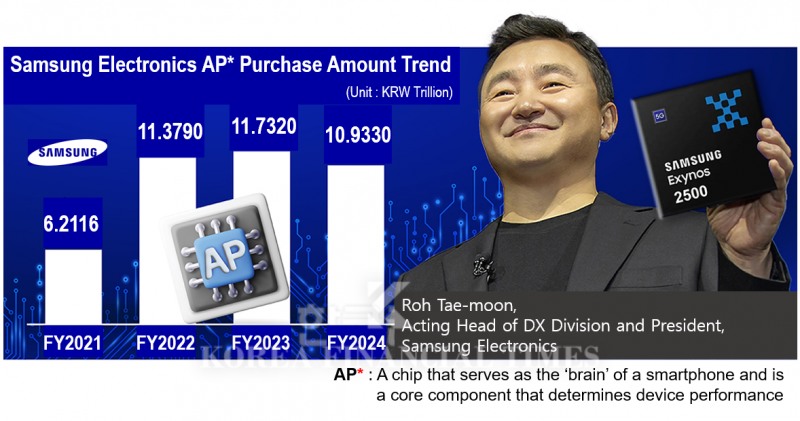
The AP is the ‘brain’ of the smartphone and a core component that determines device performance.
It accounts for around 20% of device manufacturing costs, making it a key factor in smartphone price competitiveness. Especially with the advent of the AI smartphone era, demand for high-performance APs is rising, and prices are increasing accordingly.
Samsung Electronics has so far installed Exynos in its own smartphones as standard, while using Qualcomm’s ‘Snapdragon’ for premium products. However, after performance controversies with the Exynos 2200 in the Galaxy S22 in 2022, Exynos was excluded from all subsequent Galaxy smartphone series, including the Galaxy Z Fold/Flip 4 and Galaxy S23.
Last year, the world’s first AI smartphone, the Galaxy S24 series, featured the new Exynos 2400 in some models, but the Exynos was again excluded from the Galaxy Z Fold/Flip 6 released in the second half, failing to create a turnaround.
Due to the sluggish performance of Exynos, the profitability burden on the MX Division, which handles smartphones, is also increasing.
According to Samsung Electronics’ business report, the MX Division’s AP purchase amount was about KRW 6 trillion in 2021, when Exynos was used in parallel, but surged to about KRW 11 trillion in 2022, and slightly decreased to about KRW 10.9 trillion last year. This was thanks to cost-saving efforts such as using MediaTek APs instead of Qualcomm in some tablet lineups.
Given that the MX Division’s sales last year were about KRW 114 trillion, the AP purchase ratio reached 10%. Last year, Samsung Electronics froze smartphone consumer prices despite price hikes from AP manufacturers like Qualcomm, further worsening profitability. The MX Division’s operating profit last year was about KRW 10 trillion, down about KRW 3 trillion from the previous year.
For this reason, there have been rumors in the industry that Samsung Electronics may transfer the Exynos development team from the LSI Division to the MX Division. An industry insider said, “It is understood that an internal review conducted by Samsung Electronics earlier this year found that communication and coordination between divisions during Exynos production were inadequate,” and “There are rumors that transferring Exynos development to the MX Division, which handles smartphones, could improve completeness and competitiveness.”
In fact, Apple, a competitor of Samsung Electronics, designs AP chips directly within the division responsible for smartphones to reduce manufacturing costs. However, it is known that this plan faces internal disagreements at Samsung and is unlikely to materialize.
Kim JaeHun (rlqm93@fntimes.com)











![기관 '주성엔지니어링'·외인 '알테오젠'·개인 '알테오젠' 1위 [주간 코스닥 순매수- 2026년 9월7일~9월11일]](https://cfnimage.commutil.kr/phpwas/restmb_setimgmake.php?pp=006&w=69&h=45&m=5&simg=20260912015140019820179ad4390711823512161.jpg&nmt=18)
![12개월 최고 연 7.00%…카카오뱅크 '우리아이적금' [이주의 은행 적금금리-9월 3주]](https://cfnimage.commutil.kr/phpwas/restmb_setimgmake.php?pp=006&w=69&h=45&m=5&simg=202609111245270848705e6e69892f222110224112.jpg&nmt=18)
![12개월 최고 연 3.85%…경남은행 'The든든예금(시즌2)' [이주의 은행 예금금리-9월 3주]](https://cfnimage.commutil.kr/phpwas/restmb_setimgmake.php?pp=006&w=69&h=45&m=5&simg=202609111227290077405e6e69892f222110224112.jpg&nmt=18)
![12개월 최고 연 4.02%…참저축은행 e-회전정기예금[이주의 저축은행 예금금리-9월 2주]](https://cfnimage.commutil.kr/phpwas/restmb_setimgmake.php?pp=006&w=69&h=45&m=5&simg=202609130113300929407c96e797801121481643.jpg&nmt=18)
![24개월 최고 연 7.00%…케이뱅크 '마이키즈 적금' [이주의 은행 적금금리-9월 3주]](https://cfnimage.commutil.kr/phpwas/restmb_setimgmake.php?pp=006&w=69&h=45&m=5&simg=202609111246470932005e6e69892f222110224112.jpg&nmt=18)


![[그래픽 뉴스] ‘순대’가 경제용어라고? 순(純)대외자산, 한국의 진짜 해외자산은 얼마일까?](https://cfnimage.commutil.kr/phpwas/restmb_setimgmake.php?pp=006&w=298&h=298&m=1&simg=202609021356075202de68fcbb3512411124362_0.jpg&nmt=18)
![[그래픽 뉴스] ISA 대개편! 나에게 유리한 계좌는?](https://cfnimage.commutil.kr/phpwas/restmb_setimgmake.php?pp=006&w=298&h=298&m=1&simg=202608041713155615de68fcbb3512411124362_0.jpg&nmt=18)
![[그래픽 뉴스] 미국 증시 새로운 키워드 'MANGOS'](https://cfnimage.commutil.kr/phpwas/restmb_setimgmake.php?pp=006&w=298&h=298&m=1&simg=202607291740382069de68fcbb3512411124362_0.jpg&nmt=18)

![[그래픽 뉴스] 은퇴후 30년 부모님 세대의 생존전략](https://cfnimage.commutil.kr/phpwas/restmb_setimgmake.php?pp=006&w=298&h=298&m=1&simg=202606301704439153de68fcbb3512411124362_0.jpg&nmt=18)
![[신간]은퇴연옥…김경록의 은퇴 후 삶의 나침반](https://cfnimage.commutil.kr/phpwas/restmb_setimgmake.php?pp=006&w=81&h=123&m=5&simg=20260414140833047280f8caa4a5ce12411124362.jpg&nmt=18)
![[신간] 물처럼 흐르고 원칙으로 서다…김용환의 통찰을 담다](https://cfnimage.commutil.kr/phpwas/restmb_setimgmake.php?pp=006&w=81&h=123&m=5&simg=20260409114249027860f8caa4a5ce12411124362.jpg&nmt=18)
![[안현정 서평] 플랫폼의 영지에서 ‘미학적 주권’을 선포하라...'K가 죽어야 K가 산다' 장준환 著](https://cfnimage.commutil.kr/phpwas/restmb_setimgmake.php?pp=006&w=81&h=123&m=5&simg=20260527121426063220c1c16452b012411124362.jpg&nmt=18)
![[서평] 추세 매매의 대가들...추세추종 투자전략의 대가 14인 인터뷰](https://cfnimage.commutil.kr/phpwas/restmb_setimgmake.php?pp=006&w=81&h=123&m=5&simg=2023102410444004986c1c16452b0175114235199.jpg&nmt=18)


![[AD] ‘PBV 라인업 확장’ 기아, 9월 독일서 ‘PV7’ 첫 공개](https://cfnimage.commutil.kr/phpwas/restmb_setimgmake.php?pp=006&w=89&h=45&m=1&simg=2026083111010602815074925877361231180222.jpg&nmt=18)
![[AD] 제네시스, 럭셔리 경험 더한 ‘2027 GV70’‧‘GV70 그래파이트’ 출시](https://cfnimage.commutil.kr/phpwas/restmb_setimgmake.php?pp=006&w=89&h=45&m=1&simg=20260702143546085600749258773622211122717.jpg&nmt=18)
![[AD] 개소세 혜택 종료…현대차, ‘썸머 페스타’로 고객 부담 완화](https://cfnimage.commutil.kr/phpwas/restmb_setimgmake.php?pp=006&w=89&h=45&m=1&simg=20260702142355004830749258773622211122717.jpg&nmt=18)
![[AD] 기아 ‘디 올 뉴 셀토스’, 인도 타임스 드라이브 어워즈서 ‘올해의 SUV’ 선정](https://cfnimage.commutil.kr/phpwas/restmb_setimgmake.php?pp=006&w=89&h=45&m=1&simg=202605071156400590007492587736124111243152.jpg&nmt=18)
![[AD]‘그랜저 잡자’ 기아, 상품성 더한 ‘The 2027 K8’ 출시](https://cfnimage.commutil.kr/phpwas/restmb_setimgmake.php?pp=006&w=89&h=45&m=1&simg=2026042110193702730074925877361211627527.jpg&nmt=18)