




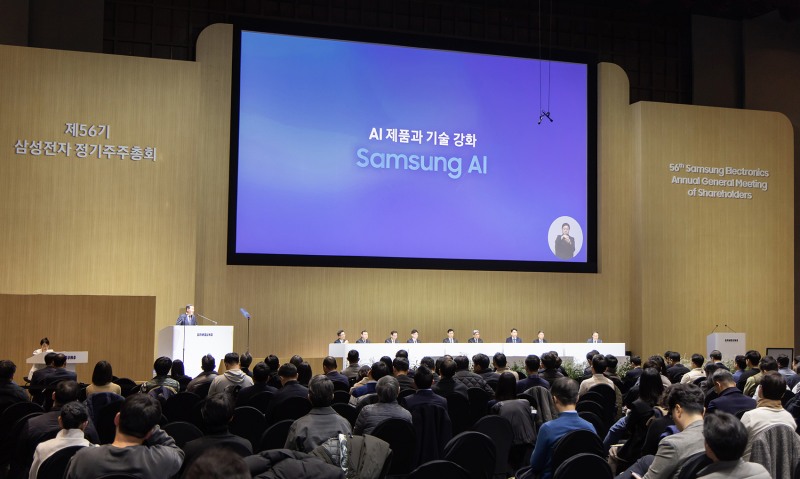
The scene of Samsung Electronics' 56th Annual General Meeting of Shareholders held at the Suwon Convention Center on the 19th. / Photo: Samsung Electronics
이미지 확대보기
Samsung Electronics held its 56th Annual General Meeting on March 19 at the Suwon Convention Center in Gyeonggi Province. In addition to voting on major agenda items, the company continued its "Dialogue with Shareholders" from last year, explaining business strategies for each division to shareholders.
Last year, Samsung Electronics faced a crisis of historic proportions, struggling in its core semiconductor business and other major operations. According to Samsung Electronics' 2024 business report, the company's DRAM market share fell from 42.2% in 2023 to 41.5% last year. Smartphone market share decreased from 19.7% to 18.3%, and TV market share dropped from 30.1% to 28.3% during the same period.
The poor performance of the semiconductor business, which significantly impacts Samsung Electronics' stock price, was particularly painful. Last year, Samsung Electronics lost to SK hynix in the competition for "HBM" (High Bandwidth Memory), a key product in next-generation AI memory, resulting in an operating profit reversal for the first time in history. As a result, the stock price, which was in the KRW 80,000 range in March last year, fell to the KRW 50,000 range and has continued to struggle.
At the shareholders' meeting, complaints from shareholders were rampant, with comments such as "Samsung Electronics' management seems unable to keep up with future trends" and "The current stock price has been stuck in the KRW 50,000 range for a long time; please explain clear measures for stock price recovery." Some shareholders even mentioned the competitor SK hynix, stating, "SK hynix keeps rising while Samsung Electronics keeps falling. This is the reality."
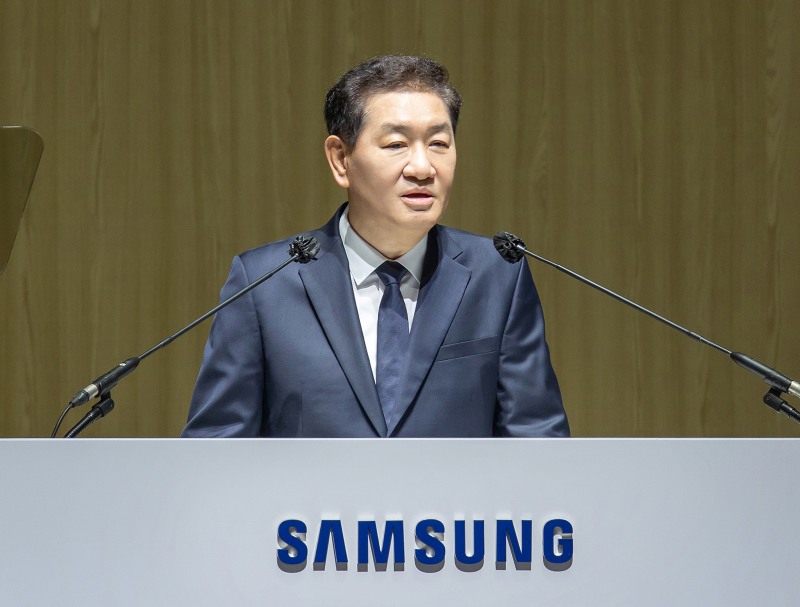
Samsung Electronics Vice Chairman Han Jong-hee introduces business strategy to shareholders at the company's annual general meeting on the 19th. / Photo: Samsung Electronics
이미지 확대보기
Vice Chairman Han Jong-hee, who chaired the shareholders' meeting, said, "I am very sorry for disappointing our shareholders last year. As we expect the semiconductor market and IT demand to recover this year, we will do our best to enhance shareholder value by actively responding to AI memory and expanding sales of AI-equipped smartphones to achieve solid performance."
He added, "We will lay the foundation for a rebound in existing businesses through ultra-gap technology leadership and continue to take on new challenges in various areas such as robotics, medtech, and next-generation semiconductors to secure new growth engines for the future created by AI industry growth."
'Semiconductor Variables Pour In'—Samsung Confident in Responding with Global Supply Chain Management CapabilitiesSamsung Beats TSMC and Apple in the US... No. 1 in Patent Registrations for 3 Consecutive Years'Humanoid Pioneer' Oh Jun-ho Tasked with Nurturing Samsung Electronics' Future Robot BusinessSamsung Electronics' New CFO Park Soon-chul...Breaking through uncertainty 'special assignment'“Exynos, Trust only you”, Samsung Electronics to fight back
"Samsung Electronics plans to pay annual dividends of KRW 9.8 trillion to enhance shareholder value," Han said. "We completed the cancellation of KRW 3 trillion worth of treasury stocks acquired in the first phase over the past three months in February, and we are faithfully proceeding with the second phase of KRW 3 trillion treasury stock repurchase. We will continue to do our best in shareholder-centric management."
He continued, "As management, I sincerely apologize for not showing sufficient results in large-scale M&As that shareholders expect. We fully recognize the importance of M&As and have been pursuing them in various areas to secure growth engines. We will pursue meaningful M&As and produce tangible results."
In the subsequent agenda deliberation and voting, all items were approved without any significant issues. The agenda items included ▲approval of financial statements ▲appointment of four outside directors (Kim Jun-sung, Huh Eun-nyeong, Yoo Myung-hee, Lee Hyuk-jae) ▲appointment of three internal directors (Jeon Young-hyun, Roh Tae-moon, Song Jae-hyuk) ▲appointment of two audit committee members (Shin Je-yoon, Yoo Myung-hee) ▲approval of director remuneration limits.
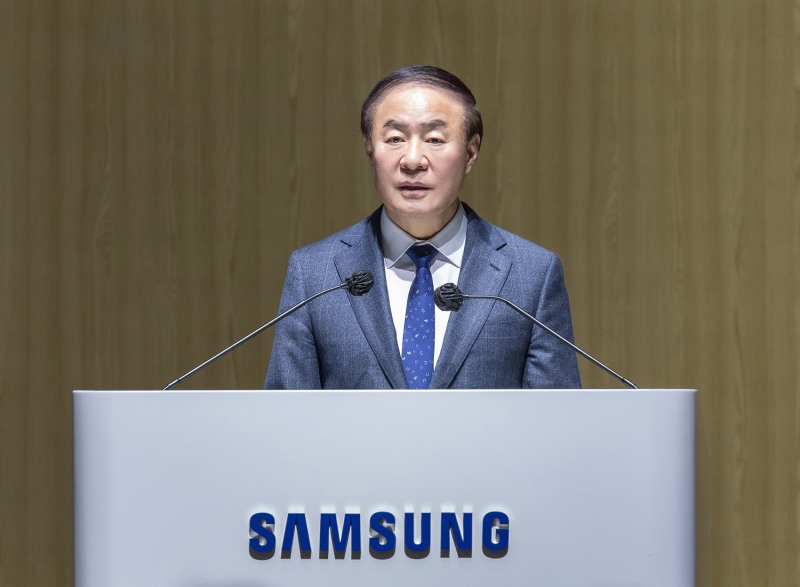
Samsung Electronics Vice Chairman Jeon Young-hyun introduces the company's semiconductor business strategy for the year at the company's annual general meeting on the 19th. / Photo: Samsung Electronics
이미지 확대보기
After the agenda voting, Vice Chairmen Han Jong-hee and Jeon Young-hyun shared the 2025 business strategies for Samsung Electronics' DX and DS divisions with shareholders and held a separate Q&A session. Samsung Electronics' management listened to shareholders' opinions and introduced this year's business strategies.
The semiconductor division attracted the most interest from shareholders. They raised questions and criticisms about HBM yield issues and the foundry business. In particular, some shareholders continued to criticize management regarding the HBM yield problem.
Vice Chairman Jeon Young-hyun said, "I believe Samsung Electronics' stock price performance is largely determined by semiconductor performance. I apologize once again for causing concern to shareholders due to the stock price decline resulting from poor semiconductor performance."
He emphasized, "I think the main reason for the stock price decline is that our market competitiveness has fallen due to somewhat inadequate initial response in the HBM market. We will not repeat last year's mistakes in the competition for next-generation products such as HBM4 (6th generation) and customized HBM. We plan to accelerate the transition to the AI memory market and actively respond to customer demand.
Along with this, the company plans to lead the semiconductor market by establishing strategies tailored to the characteristics of each business division. For memory, it will secure competitiveness in next-generation AI products through timely development of HBM based on advanced processes and actively respond to market requirements by expanding the lineup of high-performance, high-capacity SSDs (Solid State Drives).
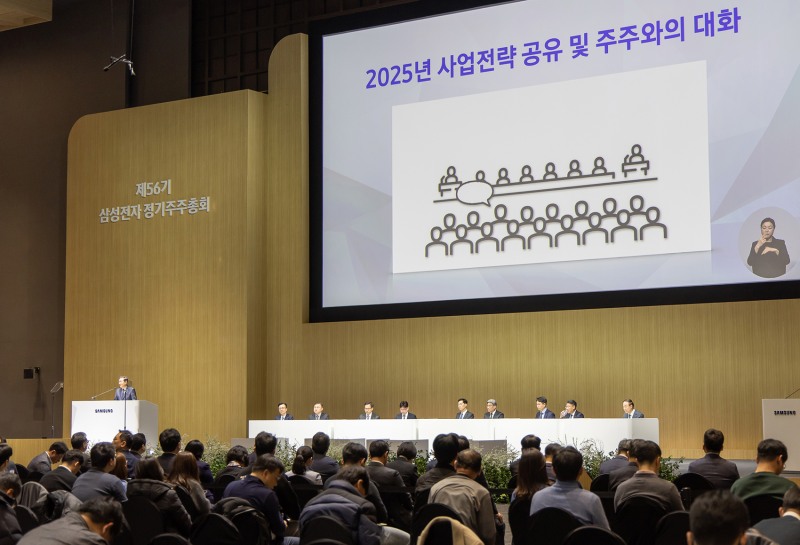
The scene of Samsung Electronics' shareholders' meeting on the 19th. / Photo: Samsung Electronics
이미지 확대보기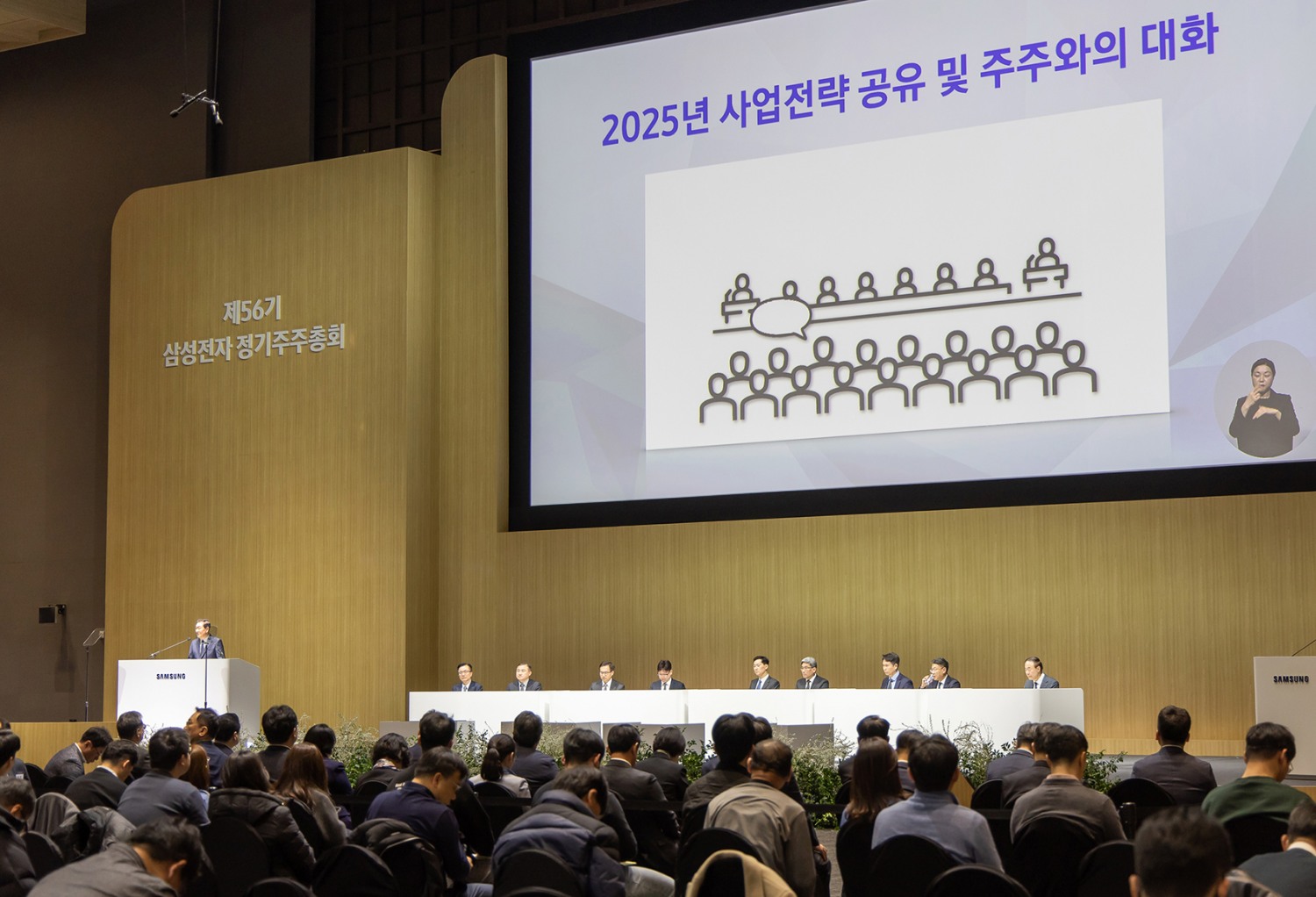
Additionally, the company will respond to market weakness in the first half of the year by accelerating the transition to advanced processes and expanding sales of server-centered products to maximize sales and profitability. In foundry, the plan is to improve customer satisfaction by securing business competitiveness based on customer service-oriented thinking.
In particular, to build customer-centric design infrastructure, the company will proactively prepare application-specific IPs (Intellectual Property) and improve design capabilities. It also plans to improve its profit structure through yield improvement and cost reduction.
The System LSI business division will pursue business stabilization for stable growth by strengthening product competitiveness. For SoC (System on Chip), the focus will be on maximizing performance for next-generation flagship smartphone adoption. For image sensors, the company will expand market share based on high-pixel competitiveness, securing new customers and entering new markets. Furthermore, to enhance solution competitiveness, the company will pursue display IC technology differentiation and expansion of the power management IC business.
Vice Chairman Jeon emphasized, "We will continue to invest in facilities and R&D to strengthen future growth, with a particular focus on bold investments in research and development. By concentrating on enhancing growth potential and profitability, we plan to build a foundation for sustainable growth in any environment and continue to grow our business based on differentiated products and technology leadership."
Kim JaeHun (rlqm93@fntimes.com)









![서초구 '아크로리버파크' 34평, 10억 오른 74억원에 거래 [일일 신고가]](https://cfnimage.commutil.kr/phpwas/restmb_setimgmake.php?pp=006&w=69&h=45&m=5&simg=20260624115142011110dd55077bc212411124362.jpg&nmt=18)

![동대문구 '전농우성' 32평, 3.9억 떨어진 6.1억원에 거래 [일일 하락가]](https://cfnimage.commutil.kr/phpwas/restmb_setimgmake.php?pp=006&w=69&h=45&m=5&simg=20260727083903035290b372994c951245313551.jpg&nmt=18)


![[그래픽 뉴스] ‘순대’가 경제용어라고? 순(純)대외자산, 한국의 진짜 해외자산은 얼마일까?](https://cfnimage.commutil.kr/phpwas/restmb_setimgmake.php?pp=006&w=298&h=298&m=1&simg=202609021356075202de68fcbb3512411124362_0.jpg&nmt=18)
![[그래픽 뉴스] ISA 대개편! 나에게 유리한 계좌는?](https://cfnimage.commutil.kr/phpwas/restmb_setimgmake.php?pp=006&w=298&h=298&m=1&simg=202608041713155615de68fcbb3512411124362_0.jpg&nmt=18)
![[그래픽 뉴스] 미국 증시 새로운 키워드 'MANGOS'](https://cfnimage.commutil.kr/phpwas/restmb_setimgmake.php?pp=006&w=298&h=298&m=1&simg=202607291740382069de68fcbb3512411124362_0.jpg&nmt=18)
![[그래픽 뉴스] 은퇴후 30년 부모님 세대의 생존전략](https://cfnimage.commutil.kr/phpwas/restmb_setimgmake.php?pp=006&w=298&h=298&m=1&simg=202606301704439153de68fcbb3512411124362_0.jpg&nmt=18)
![[신간]은퇴연옥…김경록의 은퇴 후 삶의 나침반](https://cfnimage.commutil.kr/phpwas/restmb_setimgmake.php?pp=006&w=81&h=123&m=5&simg=20260414140833047280f8caa4a5ce12411124362.jpg&nmt=18)
![[신간] 물처럼 흐르고 원칙으로 서다…김용환의 통찰을 담다](https://cfnimage.commutil.kr/phpwas/restmb_setimgmake.php?pp=006&w=81&h=123&m=5&simg=20260409114249027860f8caa4a5ce12411124362.jpg&nmt=18)
![[안현정 서평] 플랫폼의 영지에서 ‘미학적 주권’을 선포하라...'K가 죽어야 K가 산다' 장준환 著](https://cfnimage.commutil.kr/phpwas/restmb_setimgmake.php?pp=006&w=81&h=123&m=5&simg=20260527121426063220c1c16452b012411124362.jpg&nmt=18)
![[서평] 추세 매매의 대가들...추세추종 투자전략의 대가 14인 인터뷰](https://cfnimage.commutil.kr/phpwas/restmb_setimgmake.php?pp=006&w=81&h=123&m=5&simg=2023102410444004986c1c16452b0175114235199.jpg&nmt=18)


![[머니무브 2026] “지금 사도 될까?” 답이 안 보인다면…하반기 투자, 4명의 전문가에게 물어보세요](https://cfnimage.commutil.kr/phpwas/restmb_setimgmake.php?pp=006&w=89&h=45&m=1&simg=202609151044050355302a735e27af12411124362.jpg&nmt=18)
![[AD] ‘PBV 라인업 확장’ 기아, 9월 독일서 ‘PV7’ 첫 공개](https://cfnimage.commutil.kr/phpwas/restmb_setimgmake.php?pp=006&w=89&h=45&m=1&simg=2026083111010602815074925877361231180222.jpg&nmt=18)
![[AD] 제네시스, 럭셔리 경험 더한 ‘2027 GV70’‧‘GV70 그래파이트’ 출시](https://cfnimage.commutil.kr/phpwas/restmb_setimgmake.php?pp=006&w=89&h=45&m=1&simg=20260702143546085600749258773622211122717.jpg&nmt=18)
![[AD] 개소세 혜택 종료…현대차, ‘썸머 페스타’로 고객 부담 완화](https://cfnimage.commutil.kr/phpwas/restmb_setimgmake.php?pp=006&w=89&h=45&m=1&simg=20260702142355004830749258773622211122717.jpg&nmt=18)