



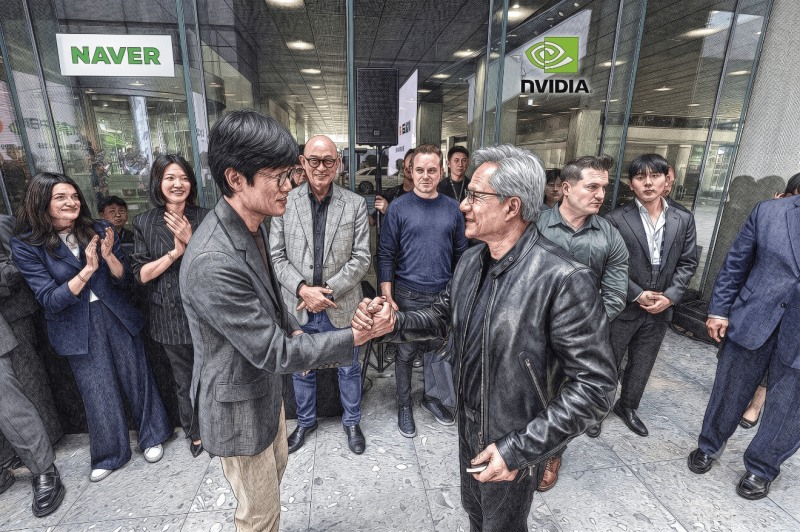
On June 8, Nvidia CEO Jensen Huang visited NAVER's headquarters "1784" in Bundang-gu, Seongnam, Gyeonggi Province, and met with Lee Hae-jin, NAVER's Global Investment Officer (GIO) and chairman of the board. / Created using generative AI based on an original photo provided by NAVER to aid understanding of the article.
이미지 확대보기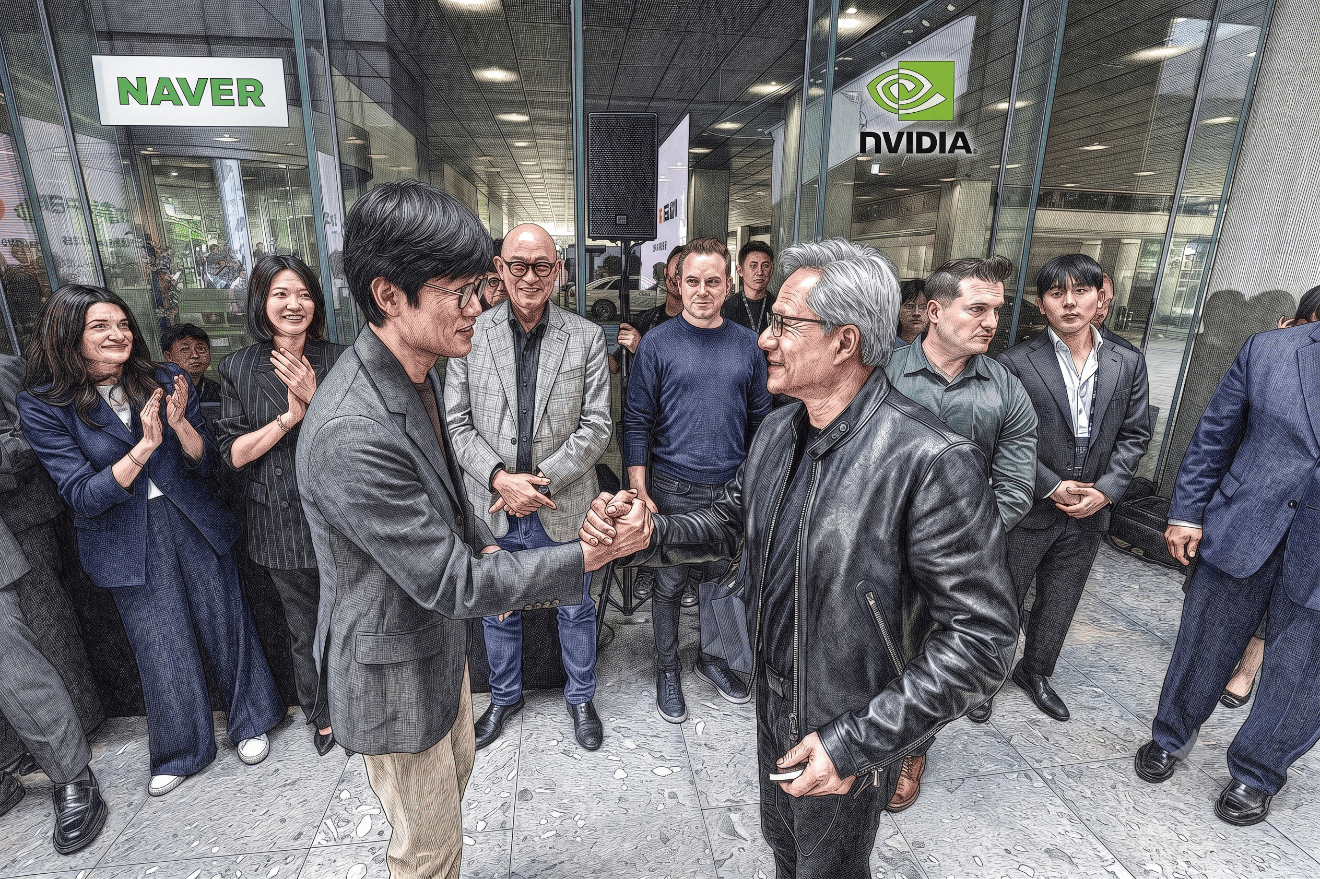
Stock Whipsawed by Huang's Visit: A Sharp Drop After the Boost
According to the Korea Exchange, NAVER shares closed at KRW 227,000 on June 10. That represents a decline of roughly 25% from the intraday high (KRW 304,000) recorded on June 1.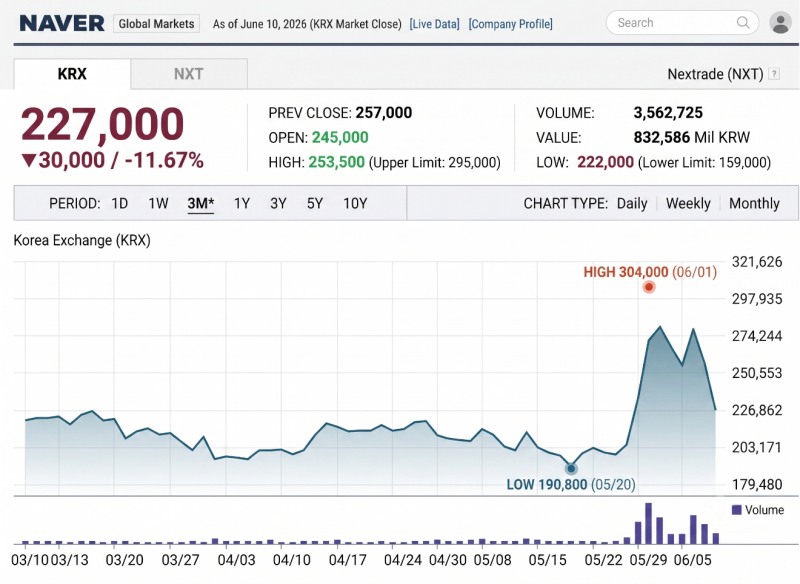
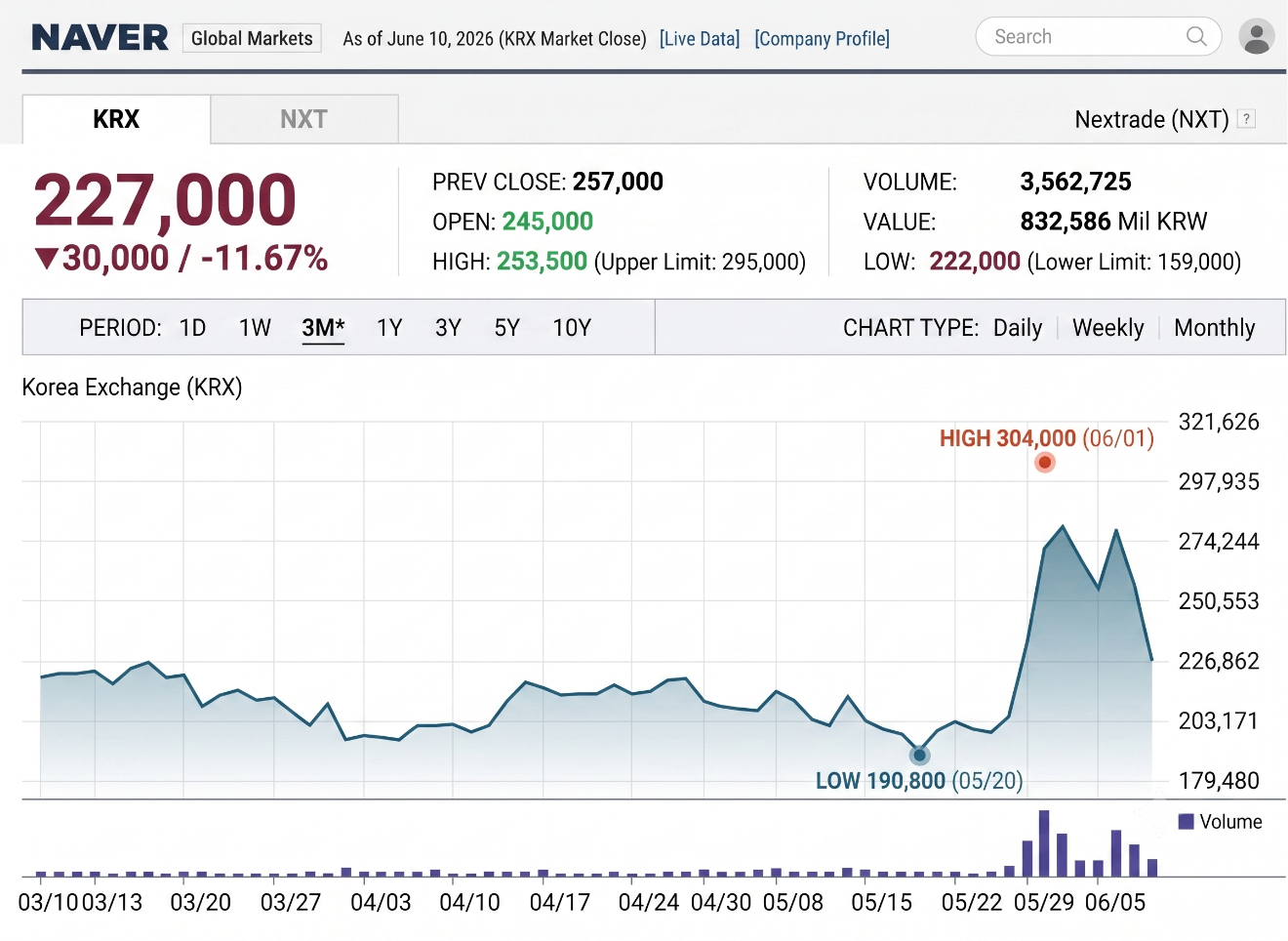
The boost then peaked on June 8, when Huang personally visited NAVER's headquarters "1784" and joined hands with Lee Hae-jin, NAVER's Global Investment Officer (GIO) and chairman of the board. Notably, that day—amid a global semiconductor shock—NAVER was the only stock among the top 30 by market capitalization to surge, jumping 12.91%.
However, this strength reversed in just one day. On June 9, NAVER shares closed at KRW 257,000, down about 8% from the previous day's close (KRW 279,000).
Investment banks (IB) and securities analysts characterize NAVER's recent volatility as the result of a complex collision in the market between the blueprint of "securing mid-to-long-term growth" and profit-taking pressure stemming from the "disappearance of short-term catalysts."
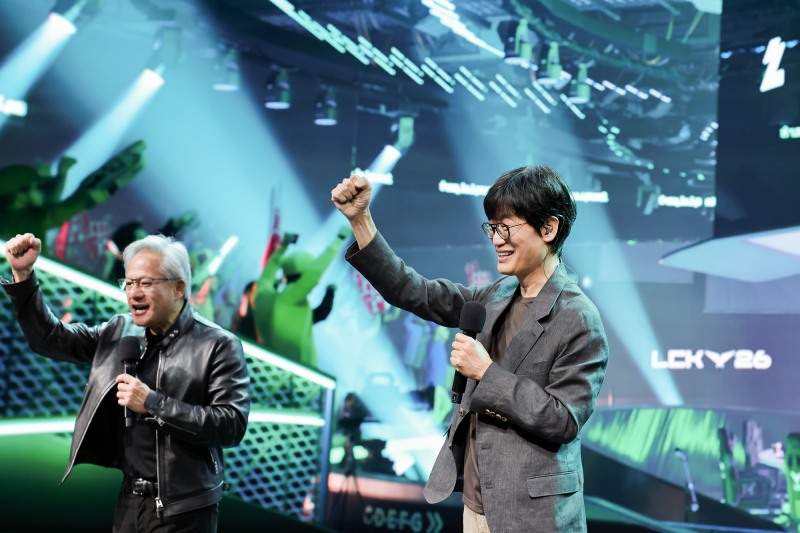
On June 8, Nvidia CEO Jensen Huang appeared with Lee Hae-jin, NAVER's Global Investment Officer (GIO) and chairman of the board, at a special CHZZK live event held on the Vision Stage of NAVER's 1784 headquarters. / Photo: NAVER
이미지 확대보기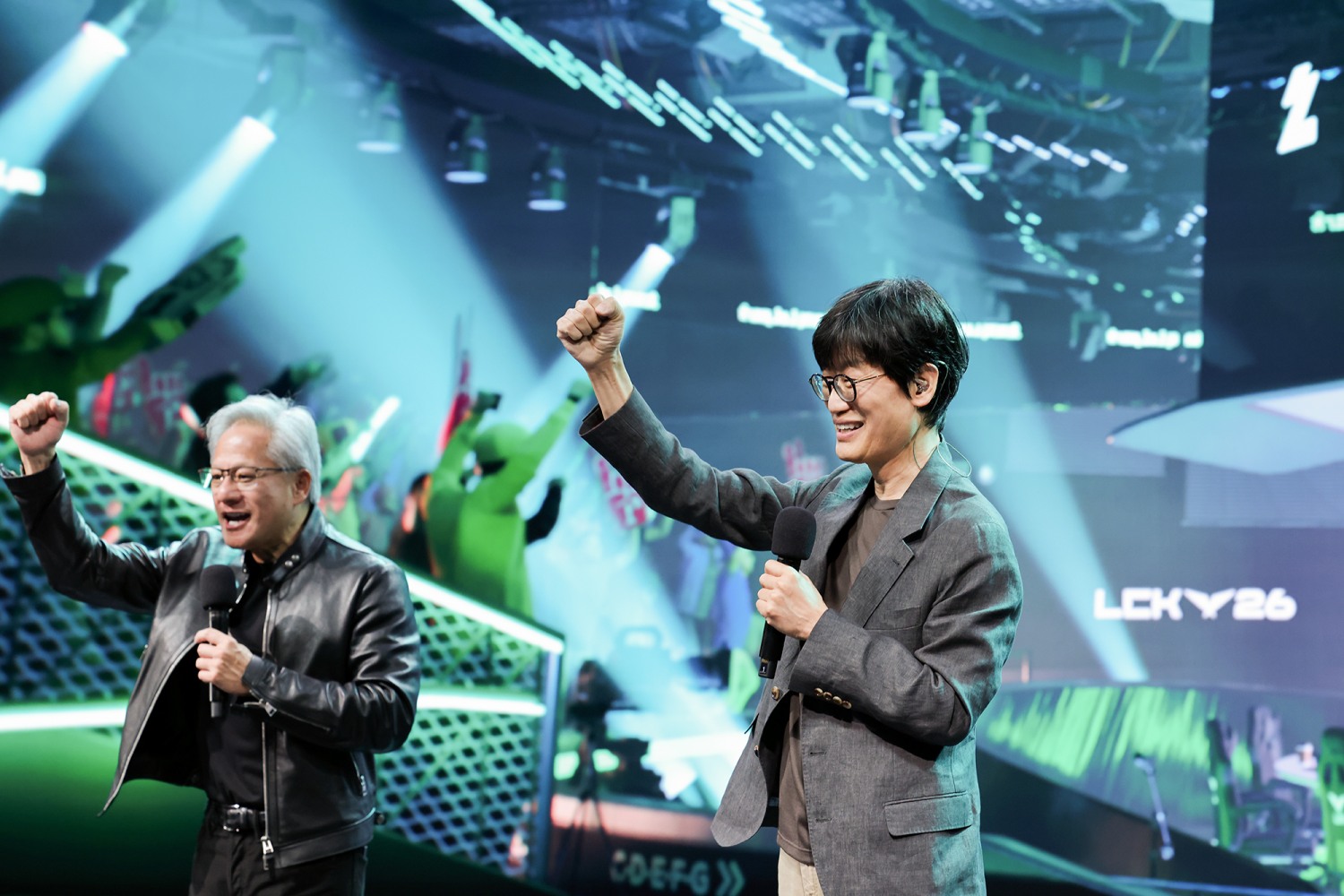
In fact, the securities industry maintains a still-positive assessment of NAVER's mid-to-long-term top-line growth. The reasoning is that the gigawatt (GW)-scale AI factory roadmap being pursued in partnership with Nvidia will elevate NAVER's business-to-business (B2B) competitiveness by another notch.
Immediately after NAVER's major announcement, leading brokerages collectively raised their target prices for the company. DS Securities presented the highest target at KRW 450,000, while Hana, Shinyoung, and Daol Investment & Securities each forecast KRW 400,000, and Kyobo Securities KRW 390,000.
Lee Jun-ho, a researcher at Hana Securities, analyzed that "this announcement secured the growth potential that had been a drag on NAVER's stock," adding that "through the partnership with Nvidia and its entry into the neocloud business, the company's fundamental character is expected to completely transform."
Apart from this long-term blueprint, however, analysts say that from a short-term investment perspective, a technical trading pattern aligned with the end of Huang's visit came into play. As the stock showed signs of short-term overheating immediately after the partnership announcement, the explanation is that once Huang wrapped up his schedule and headed to the airport, individual and institutional investors perceived this as the exhaustion of the catalyst and dumped profit-taking shares.
'Han Seong-sook Era Risks' Put on the National Assembly's Examination Table
Behind the stock's collapse within a single day—despite the boost of the Nvidia alliance—lies the governance uncertainty from the tenure of former NAVER CEO Han Seong-sook (currently a prime minister nominee), which has resurfaced amid the National Assembly confirmation-hearing turmoil.The risks from Han's tenure, which the market had raised sporadically until now, have coalesced into a single keyword—"governance and compliance failure"—as the National Assembly scrutiny phase arrives, encouraging foreign and institutional investors to exit as shareholders.

(From left) Han Seong-sook, prime minister nominee, and Choi In-hyuk, head of NAVER's Tech Business division. / Photo: Ministry of SMEs and Startups, NAVER
이미지 확대보기
According to the Korea Exchange, on June 8 alone—when the boost from Huang's visit peaked—institutions and foreigners net-purchased 1,427,219 shares and 325,140 shares respectively, driving the stock higher.
On June 9, however, foreigners dumped 260,772 shares and institutions 113,937 shares all at once as profit-taking and risk-averse volume. As a result, the foreign ownership ratio fell from 34.92% on June 8 to 34.55% on June 9.
The first thing weighing it down is judicial risk. The third-party bribery trial—in which NAVER allegedly provided KRW 3.9 billion in sponsorship to Seongnam FC in exchange for tangible and intangible favors such as building-construction permits for its headquarters—is still ongoing. This is analyzed as a factor that continuously imposes uncertainty on the credibility of the company's compliance management.
On top of this, controversy over the poor handling of the 2021 workplace harassment scandal has also resurfaced. Han stated at a past confirmation hearing that "taking responsibility for the incident, we completely replaced the management."
However, the conduct of Choi In-hyuk, the former NAVER Chief Operating Officer (COO) who resigned at the time from a line of operational responsibility, came under scrutiny once again during the personnel-vetting process. Choi was found to have retained the position of head of the Connect Foundation, a NAVER public-interest foundation, even after his resignation. Furthermore, last year he returned as head of NAVER's Tech Business division, drawing criticism over the effectiveness of the personnel overhaul carried out at the time.
'Former Senior Secretary Ha Jung-woo External Advisory' Controversy Reignites
The controversy over the external activities of Ha Jung-woo, former Senior Presidential Secretary for AI Future Planning at the Blue House (and former head of NAVER's AI Center), which emerged during a recent by-election confirmation hearing, is also being criticized as being of a piece with the loose internal-control posture of that previous management era.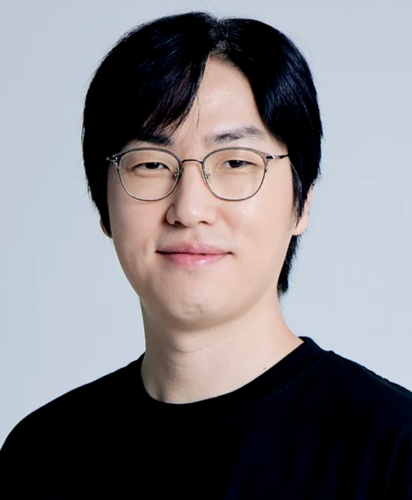
Ha Jung-woo, former Senior Presidential Secretary for AI Future Planning at the Blue House. / Photo: NAVER Cloud
The revelation that Ha—a high-level AI talent within NAVER at the time—served as an advisor to AI startup Upstage during his tenure and acquired 10,000 unlisted shares became a catalyst prompting the market to re-examine NAVER's core talent-management and compliance-control systems.
Ha's side explained that he "received prior permission from an internal organizational head," but the industry is raising questions about a structure that officially permits receiving equity in an AI startup that could become a potential competitor, in light of company rules and conflict-of-interest prevention principles.
At a time when global big-tech companies are staking everything on securing core AI talent and technology security, the risk of core talent attrition or support for competitors—coupled with concerns about the competitiveness of NAVER's own large language model (LLM) "HyperCLOVA X"—is becoming a factor that caps the stock's upside.
One securities-industry official forecast that "while the Nvidia partnership has laid the groundwork for mid-to-long-term fundamental improvement, until NAVER completely clears away the internal governance and personnel risks accumulated under the past regime and restores trust—amid expanded volatility across the KOSPI as a whole—it will be difficult to avoid a stock environment of confirmation-hearing-linked volatility for the time being."
Jeong Chaeyun (chaeyun@fntimes.com)