






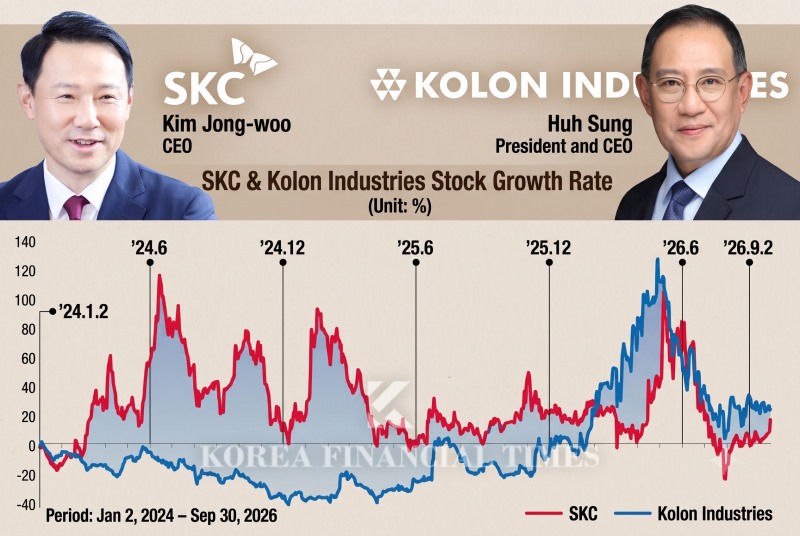
This infographic, originally published by Korea Financial Times, has been reconstructed using generative AI.
이미지 확대보기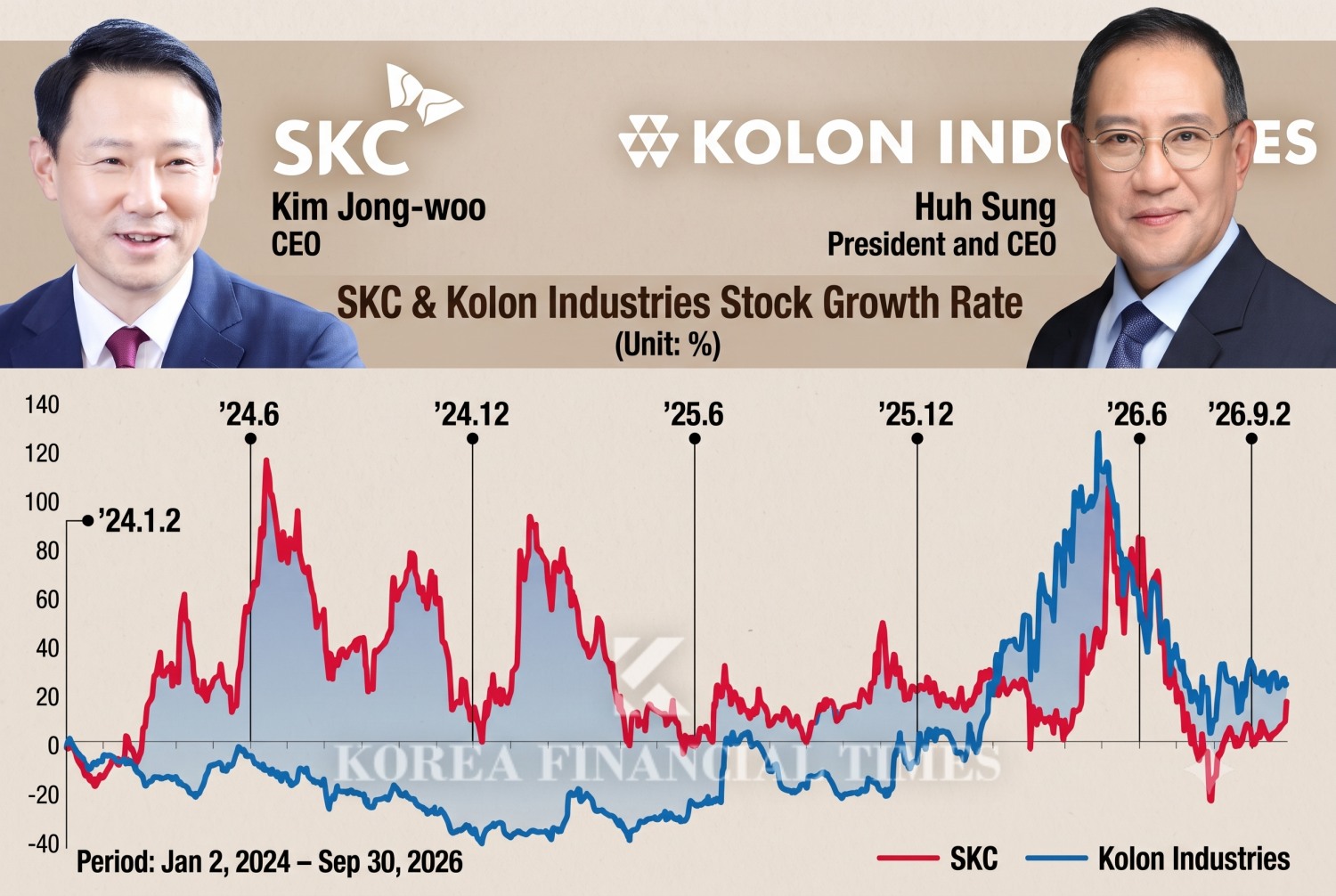
Korea Financial Times calculated the total shareholder return (TSR) of the two companies over the roughly two years and nine months from January 2, 2024 to September 30, 2026. The results came to 67% for Kolon Industries and 22% for SKC.
TSR is a metric that shows the total return earned by shareholders by reflecting both share price changes and dividend yield over a given period. If KRW 10 million had been invested in each company on January 2, 2024, the holding would be worth about KRW 16.7 million for Kolon Industries and about KRW 12.2 million for SKC as of September 30, 2026.
The annual breakdown makes the trend clearer. Kolon Industries rebounded from -35% in 2024 to 72% in 2025 and 30% in 2026. SKC recorded 18% in 2024, -5% in 2025 and 8% in 2026. SKC was ahead through 2024, but Kolon Industries overtook it last year.
Two Companies That Look Alike, but Aren’t
The two companies have quite different business structures. In the first half of this year, the chemicals division accounted for the largest share of SKC’s sales at about 52%, followed by secondary battery materials at 42% and semiconductor materials at about 12%. In chemicals, its main products are downstream propylene oxide-based products.At Kolon Industries, industrial materials account for about 45% of total sales, with tire cord and aramid as core products. The chemicals division makes up about 30%, including petroleum resins. The fashion business, which handles apparel and accessories, accounts for about 23%.
Few of their businesses overlap, but both companies have shifted their center of gravity from legacy chemical and film businesses to high-value-added materials and growth industries. The difference was largely in how they restructured.
SKC sold off existing businesses and concentrated resources on growth industries.
"Turned to a Millstone by the Chasm": SK's EV Trio — When Will Normalization Come?SK's Holding Subsidiaries Diverge: SK Discovery Falls Behind the PackSK On Builds Non-Chinese LFP Supply Chain With POSCO Future M, L&FDoosan Fuel Cell's Biggest Order Comes With Its Biggest LossDe-Risking From China: LG Energy Solution Secures US Lithium Supply Through 2039
Copper foil is a representative example. In June 2019, SKC decided to enter the copper foil business, a key electric vehicle battery material, and acquired a 100% stake in copper foil maker KCFT for KRW 1.2 trillion.
It also expanded its semiconductor materials business. In 2023, SKC completed its acquisition of ISC, a global semiconductor test solutions company, and raised its stake to 45%. By linking it with its existing semiconductor business, SKC reshaped its business structure around high-value-added materials and components.
It also moved quickly to wind down legacy operations. In 2024, SKC sold its film business to Hahn & Company for KRW 1.6 trillion. In 2023, the film business had posted sales of KRW 1.1319 trillion and operating profit of KRW 68.9 billion.
Kolon Industries, by contrast, kept its existing businesses while raising the share of high-value-added products.
Its film business is a case in point. When its commodity film business struggled amid oversupply from China, the company considered a sale but ultimately set up a joint venture with SK Microworks. Kolon Industries holds an 18% stake in the joint venture and decided to continue the business focused on high-value-added products.
It also expanded aramid capacity. In December last year, Kolon Industries invested KRW 300 billion in its Gumi plant in North Gyeongsang Province to expand aramid production facilities, doubling total production capacity. However, the aramid business posted weak results amid a sluggish market.
This year, it is widening its footprint into semiconductor materials. Kolon Industries is moving in earnest to expand production of mPPO for semiconductors. mPPO is a low-dielectric material that reduces electrical signal loss in circuit boards, and a high-performance copper clad laminate (CCL) material used in AI accelerators and 6G communications devices.
How Foldable Materials Made the Difference
The two companies’ choices also diverged in foldable materials. Kolon Industries built mass-production facilities for colorless polyimide (CPI) in 2018 and began mass production in 2019. CPI is a transparent film used in the cover windows of foldable displays and was considered a key material in the early foldable phone market.But the market mood shifted when Samsung Electronics switched the cover window material for its foldable phones from CPI to ultra-thin glass (UTG). Samsung applied CPI to the Galaxy Fold launched in 2019, but first used UTG in the Galaxy Z Flip in 2020. UTG was also used in the Galaxy Z Fold2, released the same year, in place of the CPI used in its predecessor.
In response, SKC sold its 27.03% stake in SKC Kolon PI in 2020 and exited the polyimide (PI) business. Kolon Industries kept the CPI business it had built separately.
Kolon Industries’ CPI business later got a new opening. As Apple prepared to launch its first foldable iPhone, applying CPI to the topmost protective film alongside UTG came under discussion.
In its second-quarter earnings announcement this year, Kolon Industries said its CPI utilization rate had risen considerably, partly reflecting the winning of new overseas customers. It expects full-capacity operation in the third quarter and anticipates annual sales of KRW 200 billion to KRW 300 billion.
Kolon Industries’ share price has rebounded since last year. In addition to new CPI customers and higher utilization, improved earnings in industrial materials and chemicals, along with expectations for high-value-added businesses such as aramid and mPPO, were reflected in the stock.
SKC, on the other hand, has seen its investment burden grow from its business transformation. After copper foil and semiconductor materials, it continued large-scale investment in glass substrates, raising the weight of its growth businesses.
This year in particular, investment increased in Absolics, its U.S. subsidiary in charge of the glass substrate business. Growth expectations have risen, but the business is still at the stage of customer evaluation and technology validation, so its contribution to earnings is limited. The combination of heavy investment and delayed earnings conversion appears to be why SKC’s share price this year lagged behind that of Kolon Industries.
Gwak Horyung (horr@fntimes.com)











![송파구 '헬리오시티' 18평, 7.6억 오른 26.9억원에 거래 [일일 신고가]](https://cfnimage.commutil.kr/phpwas/restmb_setimgmake.php?pp=006&w=69&h=45&m=5&simg=20260624115142011110dd55077bc212411124362.jpg&nmt=18)
![정진완號 우리은행, 해킹 피해 없었던 배경은…ODS·WON인증·LTE망 '3중 방어' [금융안전망 점검]](https://cfnimage.commutil.kr/phpwas/restmb_setimgmake.php?pp=006&w=69&h=45&m=5&simg=202610070935040020701b5a22137921110452210.jpg&nmt=18)
![신한·KB·하나 잇단 해킹…국감 도마 오른 은행장들, 연임에도 영향 갈까 [은행은 지금]](https://cfnimage.commutil.kr/phpwas/restmb_setimgmake.php?pp=006&w=69&h=45&m=5&simg=202610061253420516405e6e69892f222110224119.jpg&nmt=18)
![종근당, 매출 늘어도 마진 정체…‘실속 챙기기’ 관건 [5대 제약사 3Q 실적 ③]](https://cfnimage.commutil.kr/phpwas/restmb_setimgmake.php?pp=006&w=69&h=45&m=5&simg=202610071044530880407fd637f54312411124362.jpg&nmt=18)


![[그래픽 뉴스] ‘순대’가 경제용어라고? 순(純)대외자산, 한국의 진짜 해외자산은 얼마일까?](https://cfnimage.commutil.kr/phpwas/restmb_setimgmake.php?pp=006&w=298&h=298&m=1&simg=202609021356075202de68fcbb3512411124362_0.jpg&nmt=18)
![[그래픽 뉴스] ISA 대개편! 나에게 유리한 계좌는?](https://cfnimage.commutil.kr/phpwas/restmb_setimgmake.php?pp=006&w=298&h=298&m=1&simg=202608041713155615de68fcbb3512411124362_0.jpg&nmt=18)
![[그래픽 뉴스] 미국 증시 새로운 키워드 'MANGOS'](https://cfnimage.commutil.kr/phpwas/restmb_setimgmake.php?pp=006&w=298&h=298&m=1&simg=202607291740382069de68fcbb3512411124362_0.jpg&nmt=18)

![[그래픽 뉴스] 은퇴후 30년 부모님 세대의 생존전략](https://cfnimage.commutil.kr/phpwas/restmb_setimgmake.php?pp=006&w=298&h=298&m=1&simg=202606301704439153de68fcbb3512411124362_0.jpg&nmt=18)
![[신간]은퇴연옥…김경록의 은퇴 후 삶의 나침반](https://cfnimage.commutil.kr/phpwas/restmb_setimgmake.php?pp=006&w=81&h=123&m=5&simg=20260414140833047280f8caa4a5ce12411124362.jpg&nmt=18)
![[신간] 물처럼 흐르고 원칙으로 서다…김용환의 통찰을 담다](https://cfnimage.commutil.kr/phpwas/restmb_setimgmake.php?pp=006&w=81&h=123&m=5&simg=20260409114249027860f8caa4a5ce12411124362.jpg&nmt=18)
![[안현정 서평] 플랫폼의 영지에서 ‘미학적 주권’을 선포하라...'K가 죽어야 K가 산다' 장준환 著](https://cfnimage.commutil.kr/phpwas/restmb_setimgmake.php?pp=006&w=81&h=123&m=5&simg=20260527121426063220c1c16452b012411124362.jpg&nmt=18)
![[서평] 추세 매매의 대가들...추세추종 투자전략의 대가 14인 인터뷰](https://cfnimage.commutil.kr/phpwas/restmb_setimgmake.php?pp=006&w=81&h=123&m=5&simg=2023102410444004986c1c16452b0175114235199.jpg&nmt=18)


![[머니무브 2026] “지금 사도 될까?” 답이 안 보인다면…하반기 투자, 4명의 전문가에게 물어보세요](https://cfnimage.commutil.kr/phpwas/restmb_setimgmake.php?pp=006&w=89&h=45&m=1&simg=202609151044050355302a735e27af12411124362.jpg&nmt=18)
![[AD] ‘PBV 라인업 확장’ 기아, 9월 독일서 ‘PV7’ 첫 공개](https://cfnimage.commutil.kr/phpwas/restmb_setimgmake.php?pp=006&w=89&h=45&m=1&simg=2026083111010602815074925877361231180222.jpg&nmt=18)
![[AD] 제네시스, 럭셔리 경험 더한 ‘2027 GV70’‧‘GV70 그래파이트’ 출시](https://cfnimage.commutil.kr/phpwas/restmb_setimgmake.php?pp=006&w=89&h=45&m=1&simg=20260702143546085600749258773622211122717.jpg&nmt=18)