






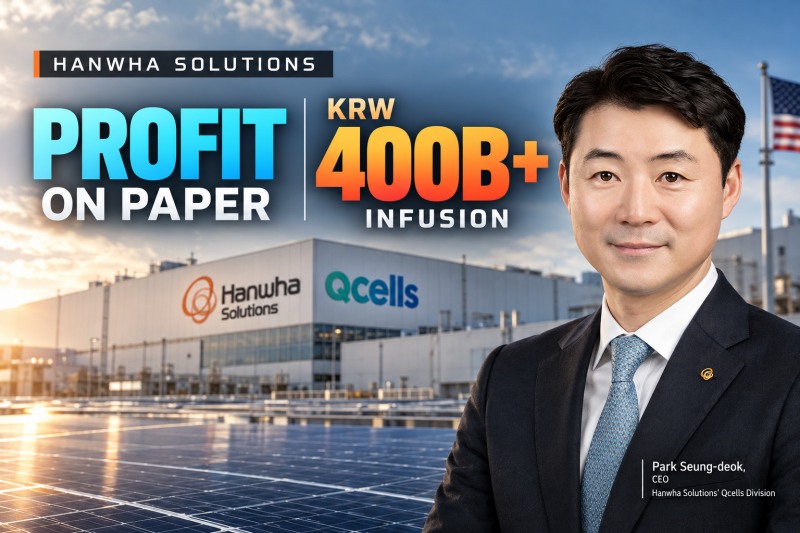
What is behind this? Much of the U.S. unit’s profit comes from tax credits, and the plant needs cash to keep running until those credits are converted into cash. For Hanwha Solutions, which cut the size of its capital increase in half this year, it is one more burden.
Profitable on paper, loss-making at the plant
Hanwha Solutions recently disclosed that its U.S. subsidiary Hanwha Qcells USA has decided on a paid-in capital increase worth USD 298.368 million (approx. KRW 405.8 billion). The increase will be carried out without issuing new shares, with the existing shareholder topping up capital, and the entire amount will be used for working capital.Hanwha Qcells USA operates a solar module plant in Dalton, Georgia. As of the end of last year, its total assets stood at KRW 6.564 trillion, equal to 19.8% of Hanwha Solutions’ consolidated assets.
On the surface, the U.S. solar business is profitable. Hanwha Qcells America Holdings, the intermediate holding company overseeing the U.S. entities, reported consolidated operating profit of KRW 499.3 billion and net profit of KRW 383.9 billion in the first half of this year. Hanwha Solutions as a whole also stayed in the black with second-quarter operating profit of KRW 306.5 billion, and its renewable energy division posted operating profit of KRW 166.4 billion.
A large part of those earnings comes from U.S. government tax credits. Under the U.S. Inflation Reduction Act (IRA), companies that manufacture solar components in the United States receive the Advanced Manufacturing Production Credit (AMPC), which reduces their taxes in proportion to output.
Hanwha Solutions accounts for this amount by deducting it from cost of goods sold. AMPC included in the renewable energy division’s second-quarter operating profit came to KRW 214 billion. Simply excluding that amount, the division’s operating result works out to a loss of about KRW 47.6 billion.
Looking at module manufacturing alone, the loss is even more pronounced. Samsung Securities and KB Securities estimated the module manufacturing segment’s third-quarter operating loss at KRW 127.3 billion and KRW 173 billion, respectively. For last year as a whole, the two brokerages put the segment’s operating loss at KRW 622 billion and KRW 611.2 billion, respectively. AMPC offsets a large share of the costs incurred in running the plant, creating a profit on the books.
New '3% Rule' on Duplicate Listings Puts HD Hyundai Robotics, LS Essex in the CrosshairsOnce Samsung's Cash Cow, Galaxy Now Teeters on the Brink of a LossHanwha Solutions Trims Rights Offering Size, Shares Rebound — But KRW 600 Billion Shortfall RemainsHanwha Solutions' Rights Offering Controversy Stands in Sharp Contrast to Hanwha Energy — the Third-Generation's 'Cash Cow'
Plant operations have not been smooth either. From the end of last year through early this year, production was disrupted as delays in U.S. customs clearance of imported cells forced about 1,000 employees at the Georgia plant onto unpaid leave. The later normal operations resumed, the less output qualified for tax credits and the less cash the company had on hand.
Tax credits monetized later…parent bridges the timing gap
The problem is that tax credits recorded on the books do not immediately turn into cash. Because AMPC is a tax credit, it cannot be cashed in right away even after it is booked as accounting profit.Hanwha Solutions is monetizing it early by transferring the credits to third parties. But this creates a timing gap. The plant continually needs cash for raw material purchases and labor costs, whereas transfer proceeds arrive only after a transaction is completed.
Hanwha Solutions has moved to narrow this gap. In June, it monetized AMPC worth USD 220.3 million ahead of schedule, combining USD 120.3 million for last year and USD 100 million for this year. In effect, it preemptively monetized even this year’s tax credits.
In the second quarter alone, Hanwha Solutions provided performance guarantees for nine tax credit transfer deals with U.S. financial institutions and companies. Under these contracts, the parent takes on the representations-and-warranties obligations demanded by the buyers of the tax credits.
The larger the tax credits, the heavier this gap weighs. With the Cartersville, Georgia, plant starting cell mass production in July, Hanwha Solutions has established a system to produce everything in the United States, from ingots and wafers to cells and modules. As production stages increase, so does the AMPC it can receive.
Samsung Securities projects that Hanwha Solutions’ AMPC will grow to KRW 231 billion in the third quarter and KRW 264 billion in the fourth. This means that the larger the profit booked on the ledger, the more working capital may be needed before converting it into cash.
Even so, the shortfall in working capital is ultimately being filled by the parent. Hanwha Qcells USA already issued about KRW 400 billion worth of redeemable convertible preferred shares (RCPS) to an external special purpose company (SPC) in March.
In June, the U.S. engineering, procurement and construction (EPC) entity issued KRW 300 billion of RCPS.
On the surface, both look like outside investment, but in both cases Hanwha Solutions entered into a price return swap (PRS) contract with the investors. If the proceeds from later disposing of the preferred shares fall short of a reference amount, Hanwha Solutions covers the difference. Even with outside investment, the risk of loss stays with the parent. The board resolution on the March RCPS issuance came one day before Hanwha Solutions resolved on its own parent-level capital increase.
Sales rise, cell costs climb…funding needs grow further
Working capital needs are expected to grow further in the second half. First, sales volumes are rising quickly. KB Securities estimates that Hanwha Solutions’ module sales volume will increase from 1.3GW in the second quarter to 3.0GW in the fourth. As sales grow, so does the money tied up in inventory and trade receivables.Cost pressure compounds this. The Dalton plant buys cells and assembles them into modules, and until now it has brought in those cells from Korean plants. Under Section 232 of the Trade Expansion Act, the U.S. government will apply a minimum import price (MIP) to imported solar components starting December 4. The MIP for cells is 22 cents per watt, which is above market prices. Korean-made cells face a combined 15% tariff, including existing tariffs and the additional Section 232 tariffs.
Industry observers expect the selling price of U.S.-made modules to rise as well, which would ultimately improve profitability. But until higher selling prices show up in earnings, cash goes out first to buy cells. According to estimates, the U.S. module market price is projected to rise from USD 0.30 per watt in the second quarter to USD 0.36 in the fourth. The effect of higher prices will be reflected in earnings in earnest only after the fourth quarter.
Moreover, this capital increase comes as the parent’s own financial improvement is far from complete. In March, Hanwha Solutions pursued a KRW 2.4 trillion paid-in capital increase but faced backlash over using shareholders’ money to repay debt.
In the end, the amount actually raised was set at KRW 1.1713 trillion, about half the original plan, and funds earmarked for debt repayment were cut from KRW 1.4899 trillion to KRW 263.6 billion. The finalized proceeds were allocated solely to facility investment of KRW 907.7 billion and debt repayment of KRW 263.6 billion, with no separate line item for working capital for the U.S. entities. The company has also set a target of lowering its consolidated debt ratio, which stood at 196.3% at the end of last year, to the 150% range by the end of this year.
Against this backdrop, financial support for the U.S. entities has been provided on several occasions. Hanwha Solutions invested about KRW 800 billion in the U.S. entities in five rounds from July 2023 through last December. This year, it also newly provided debt guarantees for borrowings from Kookmin Bank’s New York branch (KRW 747.3 billion) and the Export-Import Bank of Korea (KRW 515.6 billion).
Ultimately, the key is how quickly the book profit can be turned into cash flow. Only if the pace of AMPC monetization and the second-half rise in selling prices coincide can the U.S. entities cover their own working capital without parent support.
Roh Woo-ho, an analyst at Meritz Securities, said, “Hanwha Qcells is evolving into a stage of improved profitability and cash flow generation, driven by the premium on U.S.-produced selling prices and AMPC subsidies.” He also pointed to the pace of cash-flow-based net debt reduction as a key variable for further gains in corporate value.
Jung Jina (urzinnie@fntimes.com)











![12개월 최고 연 6.00%…BNK저축은행 'BNK동행적금'[이주의 저축은행 적금금리-10월 2주]](https://cfnimage.commutil.kr/phpwas/restmb_setimgmake.php?pp=006&w=69&h=45&m=5&simg=202610110103170668607c96e797801121481643.jpg&nmt=18)
![12개월 최고 연 4.10%…OK저축은행 'OK e-안심앱플러스정기예금6'[이주의 저축은행 예금금리-10월 2주]](https://cfnimage.commutil.kr/phpwas/restmb_setimgmake.php?pp=006&w=69&h=45&m=5&simg=202610110051040059207c96e797801121481643.jpg&nmt=18)
![24개월 최고 연 4.10%…OK저축은행 'OK e-안심앱플러스정기예금6'[이주의 저축은행 예금금리-10월 2주]](https://cfnimage.commutil.kr/phpwas/restmb_setimgmake.php?pp=006&w=69&h=45&m=5&simg=202610110057520407907c96e797801121481643.jpg&nmt=18)


![[그래픽 뉴스] ‘순대’가 경제용어라고? 순(純)대외자산, 한국의 진짜 해외자산은 얼마일까?](https://cfnimage.commutil.kr/phpwas/restmb_setimgmake.php?pp=006&w=298&h=298&m=1&simg=202609021356075202de68fcbb3512411124362_0.jpg&nmt=18)
![[그래픽 뉴스] ISA 대개편! 나에게 유리한 계좌는?](https://cfnimage.commutil.kr/phpwas/restmb_setimgmake.php?pp=006&w=298&h=298&m=1&simg=202608041713155615de68fcbb3512411124362_0.jpg&nmt=18)
![[그래픽 뉴스] 미국 증시 새로운 키워드 'MANGOS'](https://cfnimage.commutil.kr/phpwas/restmb_setimgmake.php?pp=006&w=298&h=298&m=1&simg=202607291740382069de68fcbb3512411124362_0.jpg&nmt=18)

![[그래픽 뉴스] 은퇴후 30년 부모님 세대의 생존전략](https://cfnimage.commutil.kr/phpwas/restmb_setimgmake.php?pp=006&w=298&h=298&m=1&simg=202606301704439153de68fcbb3512411124362_0.jpg&nmt=18)
![[신간]은퇴연옥…김경록의 은퇴 후 삶의 나침반](https://cfnimage.commutil.kr/phpwas/restmb_setimgmake.php?pp=006&w=81&h=123&m=5&simg=20260414140833047280f8caa4a5ce12411124362.jpg&nmt=18)
![[신간] 물처럼 흐르고 원칙으로 서다…김용환의 통찰을 담다](https://cfnimage.commutil.kr/phpwas/restmb_setimgmake.php?pp=006&w=81&h=123&m=5&simg=20260409114249027860f8caa4a5ce12411124362.jpg&nmt=18)
![[안현정 서평] 플랫폼의 영지에서 ‘미학적 주권’을 선포하라...'K가 죽어야 K가 산다' 장준환 著](https://cfnimage.commutil.kr/phpwas/restmb_setimgmake.php?pp=006&w=81&h=123&m=5&simg=20260527121426063220c1c16452b012411124362.jpg&nmt=18)
![[서평] 추세 매매의 대가들...추세추종 투자전략의 대가 14인 인터뷰](https://cfnimage.commutil.kr/phpwas/restmb_setimgmake.php?pp=006&w=81&h=123&m=5&simg=2023102410444004986c1c16452b0175114235199.jpg&nmt=18)


![[머니무브 2026] “지금 사도 될까?” 답이 안 보인다면…하반기 투자, 4명의 전문가에게 물어보세요](https://cfnimage.commutil.kr/phpwas/restmb_setimgmake.php?pp=006&w=89&h=45&m=1&simg=202609151044050355302a735e27af12411124362.jpg&nmt=18)
![[AD] ‘PBV 라인업 확장’ 기아, 9월 독일서 ‘PV7’ 첫 공개](https://cfnimage.commutil.kr/phpwas/restmb_setimgmake.php?pp=006&w=89&h=45&m=1&simg=2026083111010602815074925877361231180222.jpg&nmt=18)
![[AD] 제네시스, 럭셔리 경험 더한 ‘2027 GV70’‧‘GV70 그래파이트’ 출시](https://cfnimage.commutil.kr/phpwas/restmb_setimgmake.php?pp=006&w=89&h=45&m=1&simg=20260702143546085600749258773622211122717.jpg&nmt=18)