






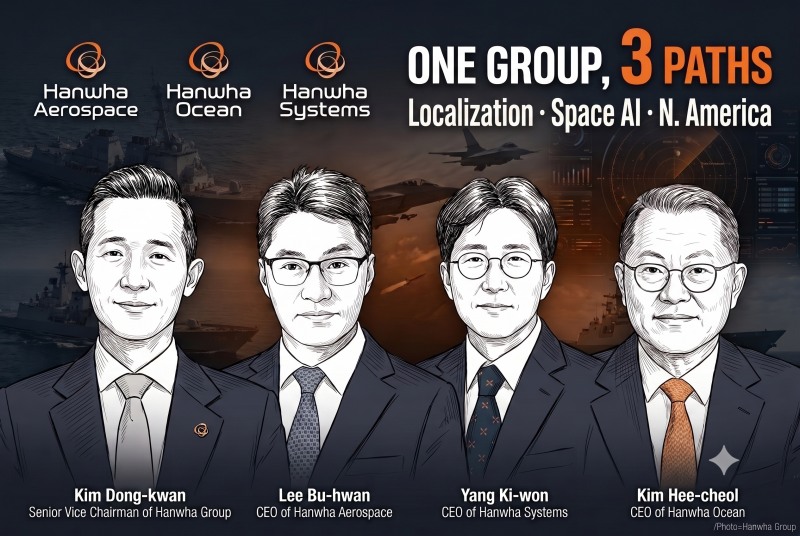
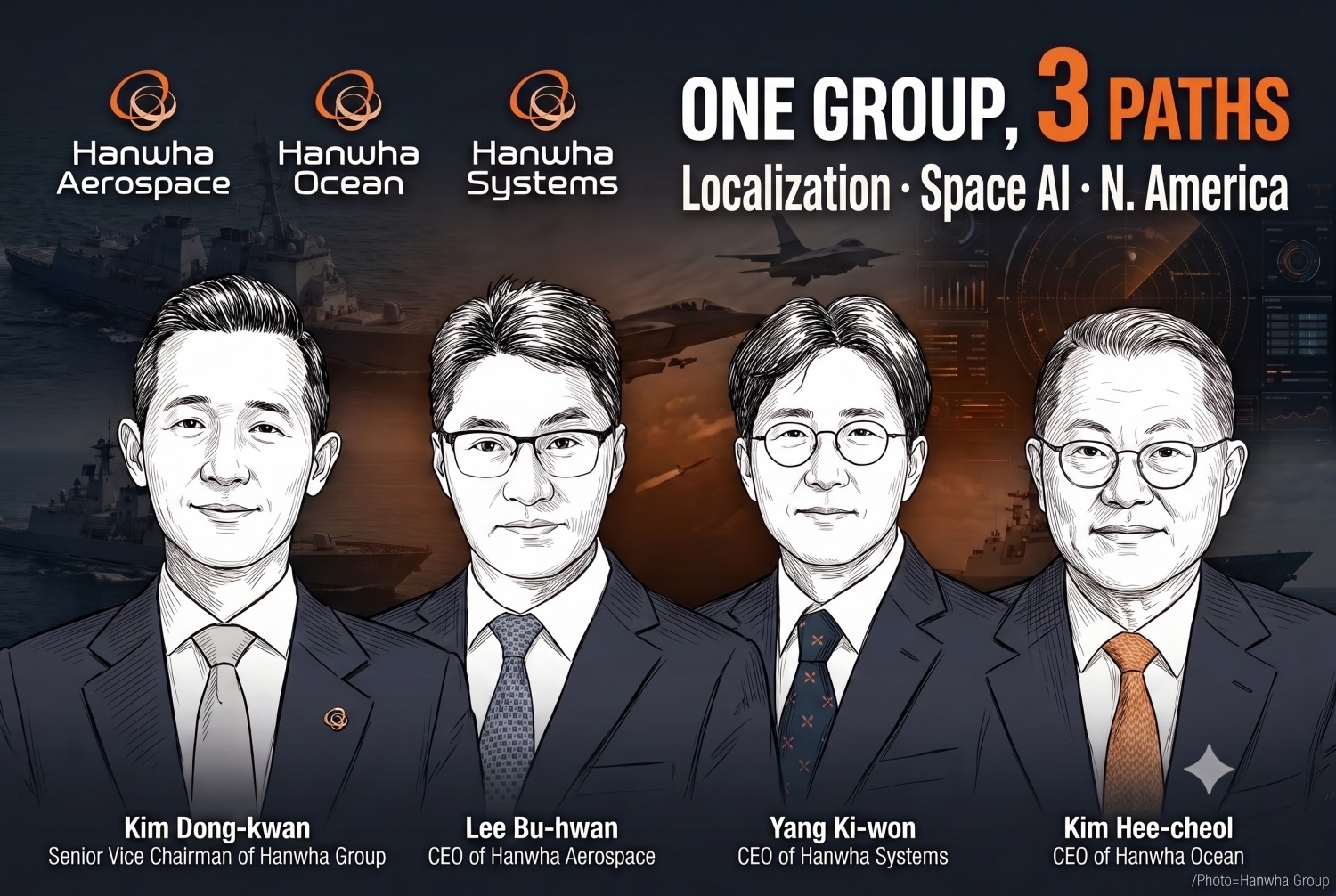
Hanwha Aerospace has shifted its weight to overseas local production, Hanwha Systems to space and artificial intelligence (AI), and Hanwha Ocean to North America. With CEO appointments and equity restructuring among affiliates layered on top, roles within the group’s defense businesses are becoming more differentiated.
From market leadership and exports to “localization” and “AX”
According to Hanwha Group on Oct. 12, Hanwha Aerospace, Hanwha Ocean and Hanwha Systems carried out their 2027 regular executive reshuffles on Oct. 1. They named 16, 15 and 5 new executives, respectively.All of the defense affiliates set a different reshuffle direction from last year. Hanwha Aerospace made last year’s personnel moves to secure market-leading products, but this year put forward “executing global business and localization expansion strategy.” Hanwha Ocean shifted from “stabilizing multi-yard manufacturing” to “stabilizing the North American manufacturing system.” Hanwha Systems moved from “strengthening export competitiveness” to “expanding AX (AI transformation) business.”
Hanwha Aerospace entrusts localization to CEO who headed European unit
This division of roles can be seen in the CEO appointments made earlier. Lee Bu-hwan, named CEO of Hanwha Aerospace last month, is an expert in ground weapon systems research and development (R&D) and overseas business who previously served as head of the company’s European subsidiary and head of the PGM Division. After entrusting the top post to someone who led overseas operations, the company put “localization” front and center in this reshuffle as well.In February, Hanwha Aerospace broke ground in Romania on “H-ACE Europe,” a production facility for K9 self-propelled howitzers and K10 armored ammunition resupply vehicles, setting a target of raising the localization rate to as much as 80%. Last month it signed an export contract with Croatia worth approx. KRW 641.1 billion, including 18 Chunmoo multiple rocket launchers. Under the deal, the two sides also agreed to pursue mid- to long-term localization cooperation, including building a local maintenance, repair and overhaul (MRO) base.
Behind this is a trend of European countries demanding local production and technology transfer as conditions for arms purchases. As equipment sales alone make it harder to keep winning orders, analysts say the ability to build and service weapons locally is becoming a condition of competitiveness.
Securing follow-on orders remains a challenge, however. Hanwha Aerospace lost a project to supply 298 infantry fighting vehicles (IFVs) to Romania to Germany’s Rheinmetall in May. It now needs to use its local plant as a base in key export markets such as Romania to sustain volumes beyond the K9 and K10.
Hanwha Aerospace's New Playbook: Pairing Weapons Deals with Energy Supply"Hanwha's Youngest Son Promoted, Puts New Holding Company to the Test"Behind KAI's KRW 26 Trillion Backlog: Three Years of Cash BurnHD Hyundai vs. Hanwha Ocean: The Battle for Thailand's Frigate ContractHanwha Robotics Gets KRW 23 Billion Lifeline as Kim Dong-seon Doubles Down
Hanwha Systems appoints “business development expert,” expanding into space and AX
While Hanwha Aerospace chose an overseas-field expert to lead, Hanwha Systems appointed a business development expert as CEO.Yang Ki-won, CEO of Hanwha Systems, is a new-business-model specialist whose posts included head of the Business Development Office at Hanwha Chemical, CEO of the Global Division at Hanwha Corporation, and CEO of Hanwha Impact. He built his career in business development and strategic planning rather than in the defense or space businesses themselves.
The market Hanwha Systems is focused on is space. By 2040, it plans to invest about KRW 20 trillion in space areas including very low Earth orbit (VLEO) synthetic aperture radar (SAR) satellites, space AI data centers and a low Earth orbit (LEO) satellite communications network.
To that end, the company hired experienced staff for its space business division in the hundreds in August, and last month unveiled a “space AI solution” that uses AI to analyze imagery from satellites currently in operation. Liquidity secured from disposing of its Philly Shipyard stake is to be used to pursue future businesses such as space and AI.
The challenge is to convert this large-scale space investment into actual business results. Having secured investment capacity through the stake sale, Hanwha Systems must show the market when its satellite and space AI businesses will begin to turn a profit.
Hanwha Ocean takes aim at North American market
Hanwha Ocean, the only one of the three defense affiliates whose CEO was not replaced this year, revealed its direction for next year through the executive reshuffle.Through this reshuffle, Hanwha Ocean aims to stabilize its North American manufacturing system and strengthen support functions as its global business expands. Of the 15 executives promoted, 9 are in business management and support, outnumbering the 6 in research, design and production. This is read as part of the same context.
Alongside “North America,” the company also put forward “manufacturing and AX innovation.” Even under the same AX label, Hanwha Ocean’s focus is on innovating production processes, while Hanwha Systems’ is closer to commercializing AI combined with defense and space.
Hanwha Ocean’s North American base is Philly Shipyard. Hanwha Ocean acquired Philly Shipyard together with Hanwha Systems in December 2024, and will remain a major shareholder after this equity restructuring.
In March, Hanwha Philly Shipyard, together with Hanwha Defense USA, took part in the conceptual design of the U.S. Navy’s Next Generation Logistics Ship (NGLS) as a subcontractor to VARD. It was the shipyard’s first foray into a U.S. Navy project since the acquisition.
Delivering tangible order wins in North America remains a challenge, however. In July, Hanwha Ocean suffered a setback when it lost the preferred bidder position for Canada’s Patrol Submarine Project (CPSP) to Germany’s TKMS. This reshuffle, which put “North America” up front, came three months later, and is interpreted as reflecting the outcome of that bidding contest.
Affiliate role clarification accompanies reorganization of U.S. shipbuilding and defense
The shift in reshuffle direction is linked to the equity restructuring among affiliates carried out at the same time. HS USA Holdings, Hanwha Systems’ U.S. subsidiary, will dispose of its entire 60% stake in Philly Shipyard on the 31st for USD 237.6 million.The purpose of the disposal is to secure liquidity to pursue its new business strategy. A joint venture funded 50% each by Hanwha Defense USA and Hanwha Futureproof, both U.S. subsidiaries of Hanwha Aerospace, is set to acquire the stake.
In April, Hanwha Systems also secured KRW 1.7 trillion in liquidity by signing a price return swap (PRS) contract based on its 4.5% stake in Hanwha Ocean. It is, in effect, unwinding shipbuilding-related holdings to build up investment capacity for future businesses.
Conversely, Hanwha Aerospace appears to be increasing its weight in U.S. shipbuilding and defense, following its expansion in overseas ground defense.
Jung Jina (urzinnie@fntimes.com)











![1차 이전서 2차 재배치까지…금융위 세종행으로 이어진 지방이전 바람 [금융권 지방이전①]](https://cfnimage.commutil.kr/phpwas/restmb_setimgmake.php?pp=006&w=69&h=45&m=5&simg=202610131556010336205e6e69892f21123588253.jpg&nmt=18)


![[THE COMPASS] '가파른 주가 하락' 한화M&S, 김동선 지배력 확대…계열사 재편에 쏠리는 눈](https://cfnimage.commutil.kr/phpwas/restmb_setimgmake.php?pp=006&w=69&h=45&m=5&simg=20261014115837016780a837df649412411124362.jpg&nmt=18)
![롯데손보 신한금융 시너지는…자본 건전성 제고 기대·보유계약 수익성은 요원 [보험사 M&A 지형도]](https://cfnimage.commutil.kr/phpwas/restmb_setimgmake.php?pp=006&w=69&h=45&m=5&simg=20260806154148002660ed56b8e1f8219248180215.jpg&nmt=18)


![[그래픽 뉴스] ‘순대’가 경제용어라고? 순(純)대외자산, 한국의 진짜 해외자산은 얼마일까?](https://cfnimage.commutil.kr/phpwas/restmb_setimgmake.php?pp=006&w=298&h=298&m=1&simg=202609021356075202de68fcbb3512411124362_0.jpg&nmt=18)
![[그래픽 뉴스] ISA 대개편! 나에게 유리한 계좌는?](https://cfnimage.commutil.kr/phpwas/restmb_setimgmake.php?pp=006&w=298&h=298&m=1&simg=202608041713155615de68fcbb3512411124362_0.jpg&nmt=18)
![[그래픽 뉴스] 미국 증시 새로운 키워드 'MANGOS'](https://cfnimage.commutil.kr/phpwas/restmb_setimgmake.php?pp=006&w=298&h=298&m=1&simg=202607291740382069de68fcbb3512411124362_0.jpg&nmt=18)

![[그래픽 뉴스] 은퇴후 30년 부모님 세대의 생존전략](https://cfnimage.commutil.kr/phpwas/restmb_setimgmake.php?pp=006&w=298&h=298&m=1&simg=202606301704439153de68fcbb3512411124362_0.jpg&nmt=18)
![[신간]은퇴연옥…김경록의 은퇴 후 삶의 나침반](https://cfnimage.commutil.kr/phpwas/restmb_setimgmake.php?pp=006&w=81&h=123&m=5&simg=20260414140833047280f8caa4a5ce12411124362.jpg&nmt=18)
![[신간] 물처럼 흐르고 원칙으로 서다…김용환의 통찰을 담다](https://cfnimage.commutil.kr/phpwas/restmb_setimgmake.php?pp=006&w=81&h=123&m=5&simg=20260409114249027860f8caa4a5ce12411124362.jpg&nmt=18)
![[안현정 서평] 플랫폼의 영지에서 ‘미학적 주권’을 선포하라...'K가 죽어야 K가 산다' 장준환 著](https://cfnimage.commutil.kr/phpwas/restmb_setimgmake.php?pp=006&w=81&h=123&m=5&simg=20260527121426063220c1c16452b012411124362.jpg&nmt=18)
![[서평] 추세 매매의 대가들...추세추종 투자전략의 대가 14인 인터뷰](https://cfnimage.commutil.kr/phpwas/restmb_setimgmake.php?pp=006&w=81&h=123&m=5&simg=2023102410444004986c1c16452b0175114235199.jpg&nmt=18)


![[머니무브 2026] “지금 사도 될까?” 답이 안 보인다면…하반기 투자, 4명의 전문가에게 물어보세요](https://cfnimage.commutil.kr/phpwas/restmb_setimgmake.php?pp=006&w=89&h=45&m=1&simg=202609151044050355302a735e27af12411124362.jpg&nmt=18)
![[AD] ‘PBV 라인업 확장’ 기아, 9월 독일서 ‘PV7’ 첫 공개](https://cfnimage.commutil.kr/phpwas/restmb_setimgmake.php?pp=006&w=89&h=45&m=1&simg=2026083111010602815074925877361231180222.jpg&nmt=18)
![[AD] 제네시스, 럭셔리 경험 더한 ‘2027 GV70’‧‘GV70 그래파이트’ 출시](https://cfnimage.commutil.kr/phpwas/restmb_setimgmake.php?pp=006&w=89&h=45&m=1&simg=20260702143546085600749258773622211122717.jpg&nmt=18)