






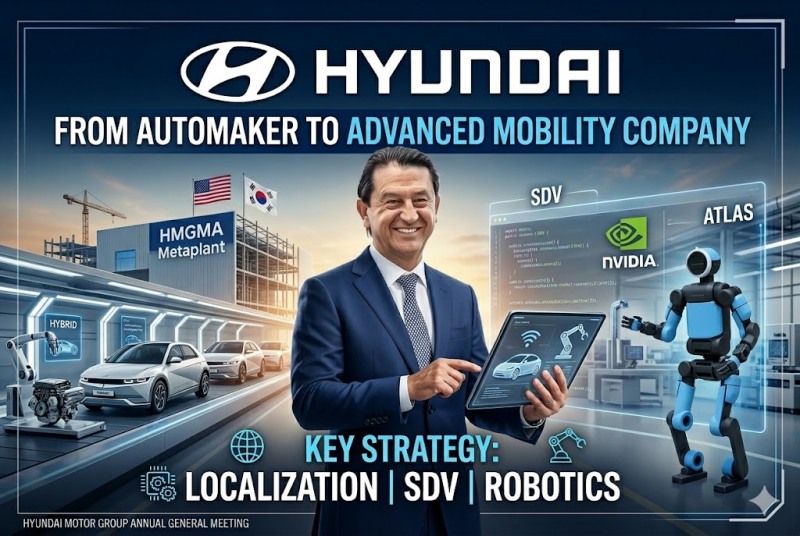
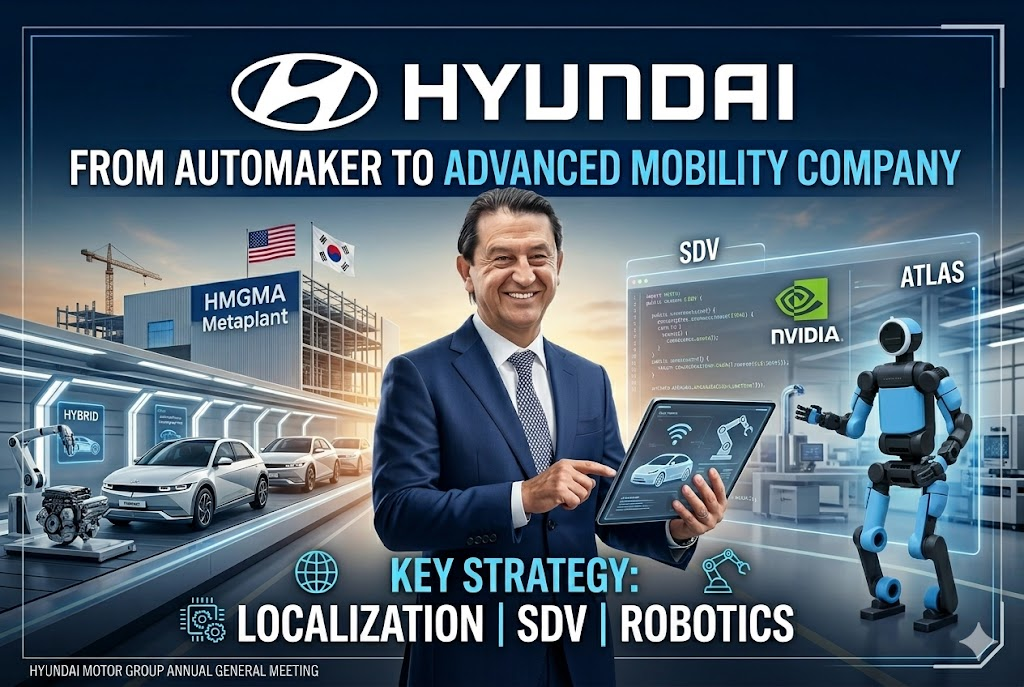
Despite heightened uncertainty stemming from tariff pressures and a high foreign exchange environment, Hyundai Motor reaffirmed its commitment to proceeding without delay with the KRW 125 trillion investment plan announced last year, as part of its ongoing effort to strengthen business competitiveness.
Muñoz: "We Will Strengthen Global Local Production System This Year"
Hyundai Motor held its 58th Annual General Meeting (AGM) on Thursday at the Grand Hall on the second floor of the company's headquarters west building.At this year's AGM, President and CEO José Muñoz delivered opening remarks to shareholders, as he did last year. Unlike last year, however, Muñoz also assumed the role of chairman, overseeing the entire proceedings including the formal opening of the meeting and the approval of agenda items.
Hyundai Motor equipped the AGM venue with real-time simultaneous interpretation receivers, ensuring that shareholders in attendance could follow Muñoz's remarks without difficulty and communicate freely with foreign directors.
"Last year, despite uncertainty, we sold 4.14 million vehicles globally and recorded an all-time high annual revenue of KRW 186 trillion, a 6.3% increase year-on-year, achieving strong results in both sales and financial performance," Muñoz said.
To sustain this growth trajectory in 2025, Muñoz outlined plans to strengthen localization strategies — particularly in North America — and to expand the global new vehicle lineup.
"This year, our new U.S. plant, Hyundai Motor Group Metaplant America (HMGMA), will begin full-scale operations, and hybrid vehicle production in the United States will commence," he said. "We will establish new production bases in India, Saudi Arabia, and Vietnam to build a local production system that brings us closer to our customers and allows us to manufacture more vehicles near where they live."
'Chung Eui-sun Declares Robot Management Era'... Hyundai Motor Group to Lead Robotics Age with 'Physical AI' [KFT Topic]Six Years Locked Away: What Will Hyundai Steel Decide on Its Treasury Shares at This AGM?Robot Joints, 80%-a-Year Growth: Hyundai Mobis, Samsung Electro-Mechanics Lead Korea's Actuator Rush [K-Humanoid Wars ④]Beyond Atlas: Hyundai Bets on Collaborative Robots to Pave Way for Humanoid FutureTesla's Humanoid Rival Has Arrived — Boston Dynamics Eyes $70 Billion Valuation [K-Humanoid Wars, Part 1]
He added, "By 2030, we plan to expand the group's global production capacity by 1.2 million units annually, reinforcing our structural competitiveness against trade risks."
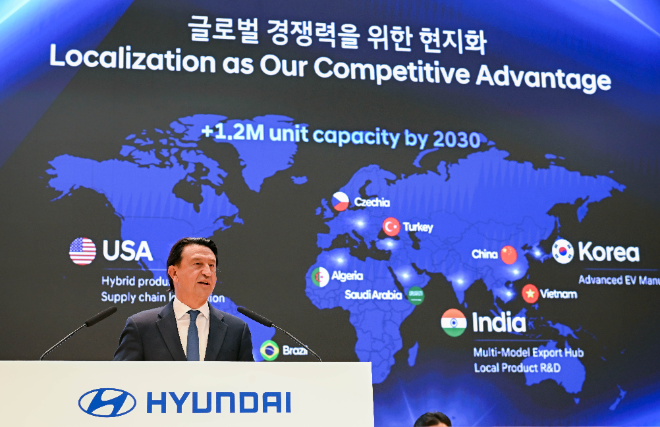
Hyundai Motor President and CEO José Muñoz presents the company's business vision at the Annual General Meeting on Thursday. / Photo = Hyundai Motor
이미지 확대보기
Hyundai Motor also plans to strengthen region-specific product strategies tailored to the diverse needs of global customers.
"In China, under the 'In China, For China, To Global' strategy, we plan to launch 20 new models over the next five years," Muñoz said. "Following the unveiling of the dedicated electric vehicle Elexio SUV last year, we will launch a new sedan EV this year. In Europe, we will introduce a total of five models including the Ioniq 3, and in India, we will launch 10 locally tailored strategic models over the next 10 years."
"Beyond an Automaker — Toward an Advanced Mobility Company"
Muñoz also signaled an accelerated push into future business transformation, centering on software and robotics as the engines of long-term competitiveness."Under a new leadership structure, we are advancing the Pleos technology platform," he said. "In particular, we will accelerate the development of autonomous driving technology to deliver innovative driving experiences across a broader range of vehicles."
He further emphasized that "collaboration with NVIDIA, investment in 42dot and Motional, the partnership with Waymo, and the establishment of an AI data center in Korea are all key initiatives to secure our technological edge."
In robotics, preparations are well underway to deploy Boston Dynamics' Atlas in actual production environments. Hyundai Motor plans to build a robot production system capable of manufacturing 30,000 units annually by 2028.
"A new era is already at hand — where AI robots work alongside humans in smart factories, where vehicles think and move on their own, and where the boundaries between automobiles, technology, and intelligence disappear," Muñoz said. "The KRW 125 trillion investment announced last year to strengthen our future industrial competitiveness will continue."
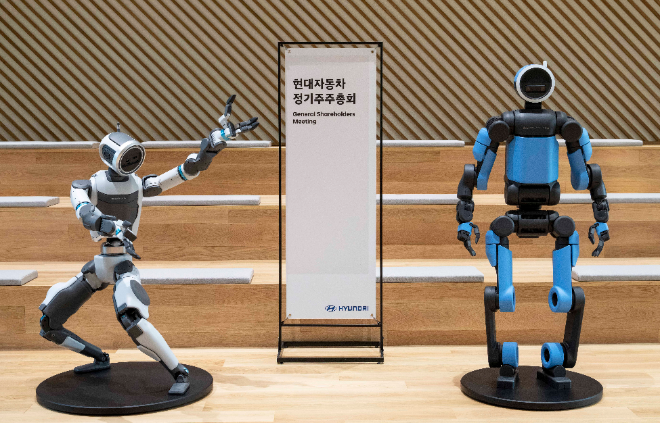
The humanoid robot 'Atlas' on display at the entrance of Hyundai Motor's Annual General Meeting on Thursday. / Photo = Hyundai Motor
이미지 확대보기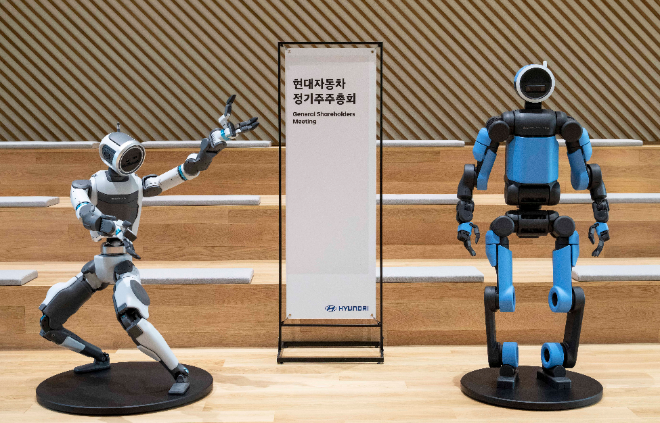
Autonomous Driving Technology and Atlas Introduced to Shareholders
Hyundai Motor used the AGM as an opportunity to actively showcase its future technological capabilities, not only presenting its autonomous driving development progress to shareholders but also displaying the Atlas robot at the venue entrance.Yoo Ji-han, Executive Vice President and head of Hyundai Motor's Autonomous Driving Development Center, delivered a shareholder briefing on the theme of "The Future of Hyundai Motor Smart Driving," sharing the company's autonomous driving technology roadmap — including its Vehicle OS, High-Performance Vehicle Computer (HPVC), and electrical/electronic (E/E) architecture innovations — with a focus on the rationale for the SDV transition and the core technology framework.
"Our goal is to realize an SDV transition that allows vehicle functions to be continuously updated, just like a smartphone," Yoo said. "We are pursuing the development of technology that collects data necessary for autonomous driving, continuously enhances AI through an automated model training system, ensures system stability based on functional safety and redundancy, and integrates perception, decision-making, and control into a single unified process."
Hyundai Motor is pursuing a strategy of accelerating the internalization of autonomous driving technology by dramatically enhancing its data processing capabilities and AI model sophistication through the adoption of external platforms. Global partnerships — including next-generation autonomous driving technology collaboration with NVIDIA and Level 4 robotaxi development undertaken jointly with Motional — are also playing a significant role in advancing technical maturity.
One shareholder in attendance remarked, "Even amid a rapidly changing external environment, Hyundai Motor has secured future growth engines through bold investments in AI, hydrogen, and robotics. I sincerely ask that the company continue to make every effort to develop into a world-class global enterprise where shareholders can invest with confidence."
Kim JaeHun (rlqm93@fntimes.com)











![[기자수첩] 보험사 품는 사모펀드, 대주주 심사 재고해야](https://cfnimage.commutil.kr/phpwas/restmb_setimgmake.php?pp=006&w=69&h=45&m=5&simg=20260913173909069220ed56b8e1f814379898.jpg&nmt=18)
![[Z-스코어 기업가치 바로 보기] 차입이냐 자기자본이냐…LG엔솔 vs 삼성SDI ‘명암ʼ](https://cfnimage.commutil.kr/phpwas/restmb_setimgmake.php?pp=006&w=69&h=45&m=5&simg=20260912004753014480dd55077bc212411124362.jpg&nmt=18)


![[그래픽 뉴스] ‘순대’가 경제용어라고? 순(純)대외자산, 한국의 진짜 해외자산은 얼마일까?](https://cfnimage.commutil.kr/phpwas/restmb_setimgmake.php?pp=006&w=298&h=298&m=1&simg=202609021356075202de68fcbb3512411124362_0.jpg&nmt=18)
![[그래픽 뉴스] ISA 대개편! 나에게 유리한 계좌는?](https://cfnimage.commutil.kr/phpwas/restmb_setimgmake.php?pp=006&w=298&h=298&m=1&simg=202608041713155615de68fcbb3512411124362_0.jpg&nmt=18)
![[그래픽 뉴스] 미국 증시 새로운 키워드 'MANGOS'](https://cfnimage.commutil.kr/phpwas/restmb_setimgmake.php?pp=006&w=298&h=298&m=1&simg=202607291740382069de68fcbb3512411124362_0.jpg&nmt=18)

![[그래픽 뉴스] 은퇴후 30년 부모님 세대의 생존전략](https://cfnimage.commutil.kr/phpwas/restmb_setimgmake.php?pp=006&w=298&h=298&m=1&simg=202606301704439153de68fcbb3512411124362_0.jpg&nmt=18)
![[신간]은퇴연옥…김경록의 은퇴 후 삶의 나침반](https://cfnimage.commutil.kr/phpwas/restmb_setimgmake.php?pp=006&w=81&h=123&m=5&simg=20260414140833047280f8caa4a5ce12411124362.jpg&nmt=18)
![[신간] 물처럼 흐르고 원칙으로 서다…김용환의 통찰을 담다](https://cfnimage.commutil.kr/phpwas/restmb_setimgmake.php?pp=006&w=81&h=123&m=5&simg=20260409114249027860f8caa4a5ce12411124362.jpg&nmt=18)
![[안현정 서평] 플랫폼의 영지에서 ‘미학적 주권’을 선포하라...'K가 죽어야 K가 산다' 장준환 著](https://cfnimage.commutil.kr/phpwas/restmb_setimgmake.php?pp=006&w=81&h=123&m=5&simg=20260527121426063220c1c16452b012411124362.jpg&nmt=18)
![[서평] 추세 매매의 대가들...추세추종 투자전략의 대가 14인 인터뷰](https://cfnimage.commutil.kr/phpwas/restmb_setimgmake.php?pp=006&w=81&h=123&m=5&simg=2023102410444004986c1c16452b0175114235199.jpg&nmt=18)


![[머니무브 2026] “지금 사도 될까?” 답이 안 보인다면…하반기 투자, 4명의 전문가에게 물어보세요](https://cfnimage.commutil.kr/phpwas/restmb_setimgmake.php?pp=006&w=89&h=45&m=1&simg=202609151044050355302a735e27af12411124362.jpg&nmt=18)
![[AD] ‘PBV 라인업 확장’ 기아, 9월 독일서 ‘PV7’ 첫 공개](https://cfnimage.commutil.kr/phpwas/restmb_setimgmake.php?pp=006&w=89&h=45&m=1&simg=2026083111010602815074925877361231180222.jpg&nmt=18)
![[AD] 제네시스, 럭셔리 경험 더한 ‘2027 GV70’‧‘GV70 그래파이트’ 출시](https://cfnimage.commutil.kr/phpwas/restmb_setimgmake.php?pp=006&w=89&h=45&m=1&simg=20260702143546085600749258773622211122717.jpg&nmt=18)
![[AD] 개소세 혜택 종료…현대차, ‘썸머 페스타’로 고객 부담 완화](https://cfnimage.commutil.kr/phpwas/restmb_setimgmake.php?pp=006&w=89&h=45&m=1&simg=20260702142355004830749258773622211122717.jpg&nmt=18)
![[AD] 기아 ‘디 올 뉴 셀토스’, 인도 타임스 드라이브 어워즈서 ‘올해의 SUV’ 선정](https://cfnimage.commutil.kr/phpwas/restmb_setimgmake.php?pp=006&w=89&h=45&m=1&simg=202605071156400590007492587736124111243152.jpg&nmt=18)