






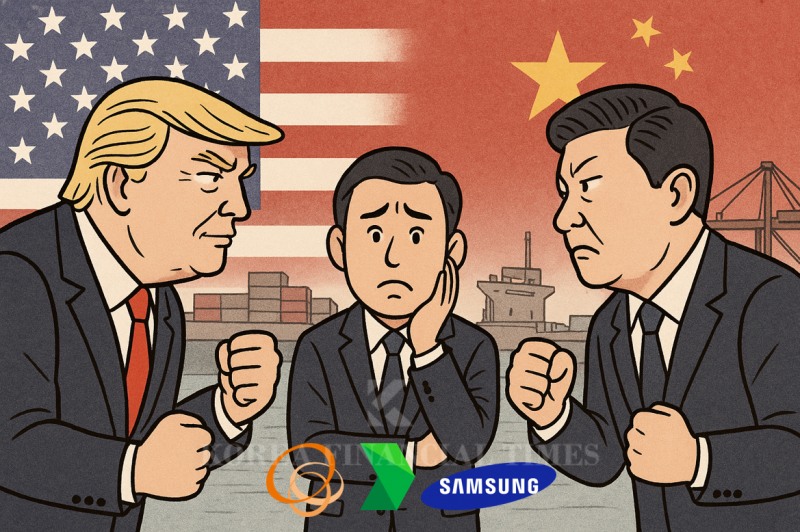
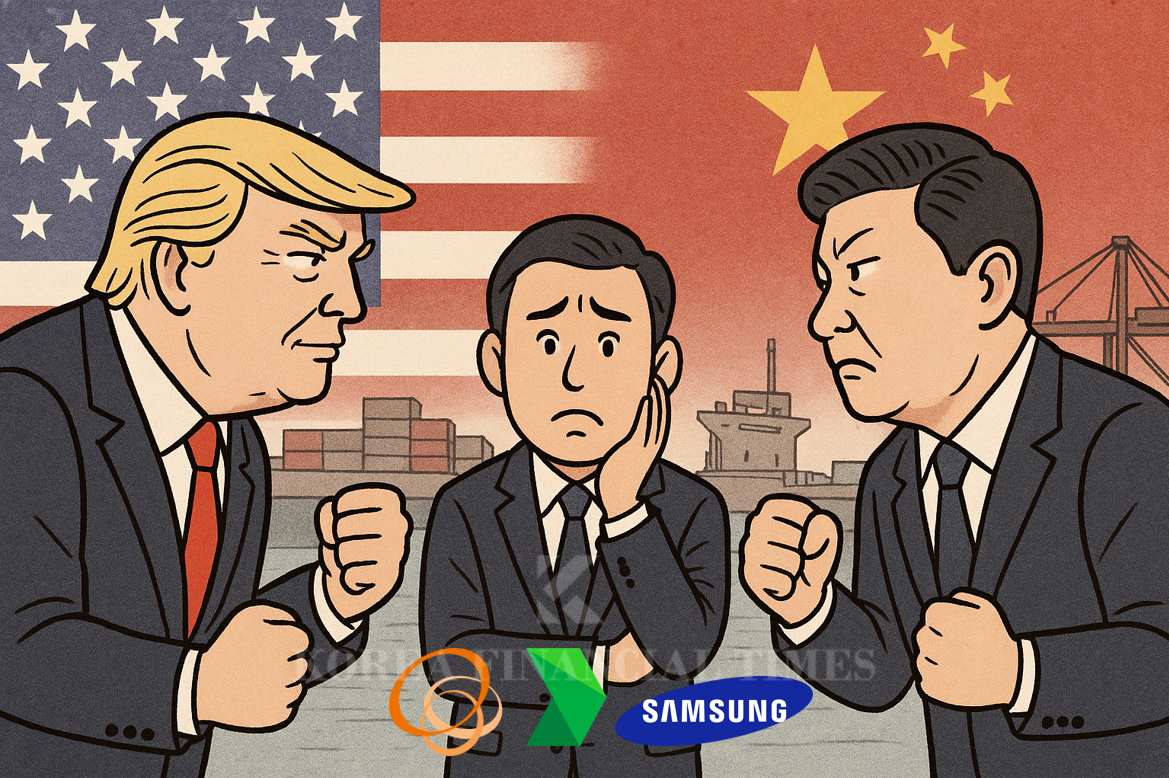
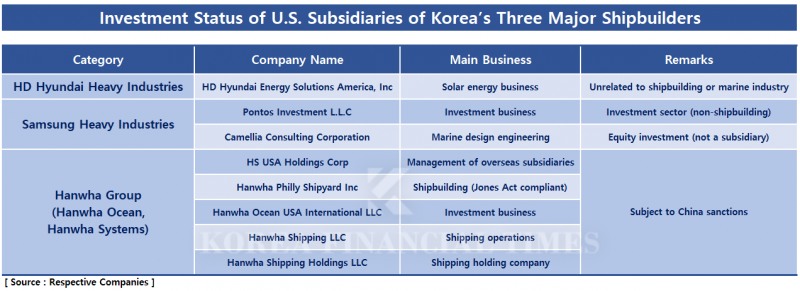
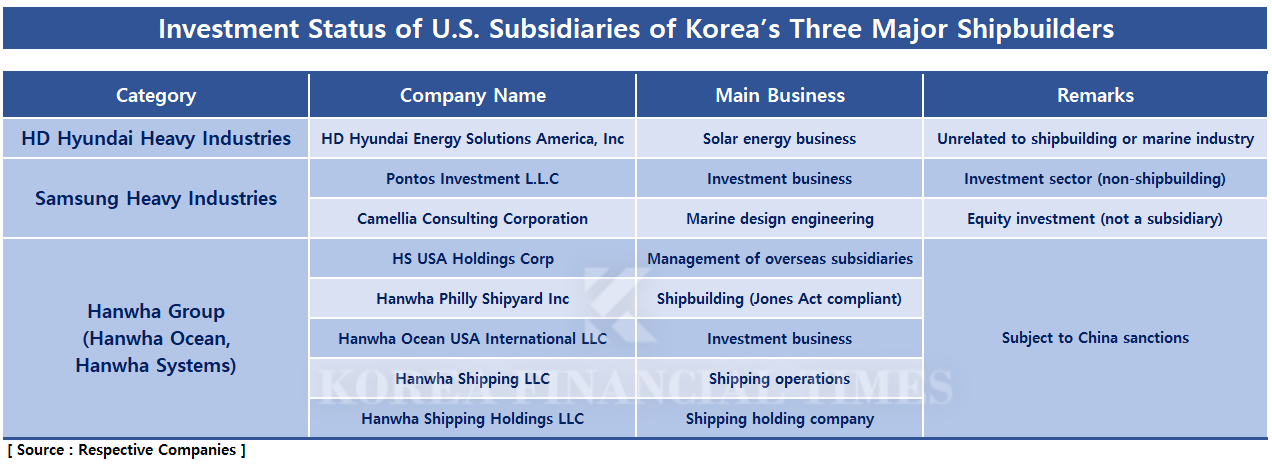
HD Korea Shipbuilding & Offshore Engineering, the intermediate holding company for HD Hyundai's shipbuilding division, has two US subsidiaries: HD Hyundai Energy Solutions America, Inc and Pontos Investment L.L.C.
HD Hyundai Energy Solutions America operates solar power businesses, while Pontos Investment is an investment company. Both lack direct connections to shipbuilding and offshore operations, reducing the likelihood of Chinese sanctions.
Samsung Heavy Industries holds a partial stake in US marine design engineering firm Camellia Consulting Corporation, but it is not a subsidiary. Since the company is not under direct control, Samsung Heavy effectively has no US shipbuilding-related entities.
In contrast, five Hanwha Group shipbuilding and offshore affiliates received Chinese sanctions yesterday. All forms of transactions, cooperation, and exchange activities with Chinese organisations or individuals are prohibited. China's Ministry of Commerce invoked the Anti-Foreign Sanctions Law, determining these companies threatened Chinese sovereignty, security, and development interests.
Sanctioned entities include HS USA Holdings Corp, Hanwha Philly Shipyard Inc, Hanwha Ocean USA International LLC, Hanwha Shipping LLC, and Hanwha Shipping Holdings LLC.
HS USA Holdings is a US subsidiary wholly owned by Hanwha Systems, managing overseas subsidiaries. HS USA Holdings owns 60 percent of Hanwha Philly Shipyard. Hanwha Ocean USA International, fully funded by Hanwha Ocean, operates investment businesses in the US. Hanwha Shipping and Hanwha Shipping Holdings are Hanwha Ocean's grandson and great-grandson companies respectively.
The 10 medium-range petroleum and chemical product carriers (MR P/C) and three feeder container ships under construction at Hanwha Philly Shipyard are all vessels for operations centred on American coastal routes. Under the US Jones Act, they are used solely for domestic US transportation and do not utilise Chinese labour, technology, materials, or financing.
While shipbuilders sometimes purchase Chinese thick plates (steel), vessels ordered by Hanwha Philly Shipyard use thick plates sourced from the US, Canada, and Mexico instead of Chinese materials, eliminating impact.
Lee Ji-ni, analyst at Daishin Securities, explained: "The likelihood of expanded sanctions on thick plates is low because it becomes a chicken game for both China and Korea. With China's economic stimulus measures weak, Korean shipbuilders serve as reliable purchasers for Chinese steelmakers. If sanctions expand, Chinese steel companies would suffer damage comparable to Korean shipyards."
Hanwha Shipping also has no business connections with China, having placed orders only with Hanwha Philly Shipyard and Hanwha Ocean.
Hanwha Ocean and Hanwha Systems also appear unlikely to face significant sanctions impact, as neither operates direct businesses within the US. China's Ministry of Commerce announcement made no mention of sanctions on parent companies.
Kang Kyung-tae, analyst at Korea Investment & Securities, analysed: "This measure represents backlash against the US decision to impose port fees on China-related vessels, and dissatisfaction with Korean companies assisting US shipbuilding revival as the largest competitor in global shipbuilding."
Lee Dong-hean, research fellow at Shinhan Investment & Securities, noted: "Chinese shipyards' order backlogs have surged dramatically over the past three years, and according to shipowners' requirements, they cannot manufacture all vessels without assistance from Korean shipbuilding industries such as engines."
However, some raise concerns about potential expansion of Chinese sanctions across Korea's shipbuilding industry.
Lee Jae-hyuk, analyst at LS Securities, projected: "We need to consider the possibility of additional China-originated sanctions expanding to domestic and Japanese shipyards cooperating with the US Navy. If sanctions expand, they will create potential negative impacts on domestic shipyard commercial vessel order activities."
He added: "We need to closely monitor the possibility of expanding concerns among global shipowners regarding orders for Korean-built vessels."
Indeed, following the US Trade Representative's (USTR) announcement of maritime sanctions against China, major container shipping companies including Japan's Ocean Network Express (ONE) and Germany's Hapag-Lloyd examined switching orders from Chinese to Korean shipyards.
A shipbuilding industry official stated: "We view these sanctions as warning measures and are closely monitoring the situation."
Shin Haeju (hjs0509@fntimes.com)











![‘삼전닉스ʼ에 가린 반도체주…주성엔지니어링 ‘질주ʼ·리노공업 ‘주춤ʼ [정답은 TSR]](https://cfnimage.commutil.kr/phpwas/restmb_setimgmake.php?pp=006&w=69&h=45&m=5&simg=20260918223152079000dd55077bc212411124362.jpg&nmt=18)
![스틱벤처스 정보라, 네오사피엔스 IPO 잰걸음 ‘딥테크 투자 강화ʼ [VC 2026 하반기 프리뷰 (7)]](https://cfnimage.commutil.kr/phpwas/restmb_setimgmake.php?pp=006&w=69&h=45&m=5&simg=20260918221427079140dd55077bc212411124362.jpg&nmt=18)
![12개월 최고 연 4.01%…동양저축은행 '정기예금'[이주의 저축은행 예금금리-9월 3주]](https://cfnimage.commutil.kr/phpwas/restmb_setimgmake.php?pp=006&w=69&h=45&m=5&simg=202609202303210200807c96e797801121481643.jpg&nmt=18)
![12개월 최고 연 6.50%…애큐온저축은행 '처음만난적금'[이주의 저축은행 적금금리-9월 3주]](https://cfnimage.commutil.kr/phpwas/restmb_setimgmake.php?pp=006&w=69&h=45&m=5&simg=202609202310220168307c96e797801121481643.jpg&nmt=18)
![24개월 최고 연 3.95%…고려저축은행 '회전정기예금'[이주의 저축은행 예금금리-9월 3주]](https://cfnimage.commutil.kr/phpwas/restmb_setimgmake.php?pp=006&w=69&h=45&m=5&simg=202609202307340498607c96e797801121481643.jpg&nmt=18)


![[그래픽 뉴스] ‘순대’가 경제용어라고? 순(純)대외자산, 한국의 진짜 해외자산은 얼마일까?](https://cfnimage.commutil.kr/phpwas/restmb_setimgmake.php?pp=006&w=298&h=298&m=1&simg=202609021356075202de68fcbb3512411124362_0.jpg&nmt=18)
![[그래픽 뉴스] ISA 대개편! 나에게 유리한 계좌는?](https://cfnimage.commutil.kr/phpwas/restmb_setimgmake.php?pp=006&w=298&h=298&m=1&simg=202608041713155615de68fcbb3512411124362_0.jpg&nmt=18)
![[그래픽 뉴스] 미국 증시 새로운 키워드 'MANGOS'](https://cfnimage.commutil.kr/phpwas/restmb_setimgmake.php?pp=006&w=298&h=298&m=1&simg=202607291740382069de68fcbb3512411124362_0.jpg&nmt=18)

![[그래픽 뉴스] 은퇴후 30년 부모님 세대의 생존전략](https://cfnimage.commutil.kr/phpwas/restmb_setimgmake.php?pp=006&w=298&h=298&m=1&simg=202606301704439153de68fcbb3512411124362_0.jpg&nmt=18)
![[신간]은퇴연옥…김경록의 은퇴 후 삶의 나침반](https://cfnimage.commutil.kr/phpwas/restmb_setimgmake.php?pp=006&w=81&h=123&m=5&simg=20260414140833047280f8caa4a5ce12411124362.jpg&nmt=18)
![[신간] 물처럼 흐르고 원칙으로 서다…김용환의 통찰을 담다](https://cfnimage.commutil.kr/phpwas/restmb_setimgmake.php?pp=006&w=81&h=123&m=5&simg=20260409114249027860f8caa4a5ce12411124362.jpg&nmt=18)
![[안현정 서평] 플랫폼의 영지에서 ‘미학적 주권’을 선포하라...'K가 죽어야 K가 산다' 장준환 著](https://cfnimage.commutil.kr/phpwas/restmb_setimgmake.php?pp=006&w=81&h=123&m=5&simg=20260527121426063220c1c16452b012411124362.jpg&nmt=18)
![[서평] 추세 매매의 대가들...추세추종 투자전략의 대가 14인 인터뷰](https://cfnimage.commutil.kr/phpwas/restmb_setimgmake.php?pp=006&w=81&h=123&m=5&simg=2023102410444004986c1c16452b0175114235199.jpg&nmt=18)


![[머니무브 2026] “지금 사도 될까?” 답이 안 보인다면…하반기 투자, 4명의 전문가에게 물어보세요](https://cfnimage.commutil.kr/phpwas/restmb_setimgmake.php?pp=006&w=89&h=45&m=1&simg=202609151044050355302a735e27af12411124362.jpg&nmt=18)
![[AD] ‘PBV 라인업 확장’ 기아, 9월 독일서 ‘PV7’ 첫 공개](https://cfnimage.commutil.kr/phpwas/restmb_setimgmake.php?pp=006&w=89&h=45&m=1&simg=2026083111010602815074925877361231180222.jpg&nmt=18)
![[AD] 제네시스, 럭셔리 경험 더한 ‘2027 GV70’‧‘GV70 그래파이트’ 출시](https://cfnimage.commutil.kr/phpwas/restmb_setimgmake.php?pp=006&w=89&h=45&m=1&simg=20260702143546085600749258773622211122717.jpg&nmt=18)
![[AD] 개소세 혜택 종료…현대차, ‘썸머 페스타’로 고객 부담 완화](https://cfnimage.commutil.kr/phpwas/restmb_setimgmake.php?pp=006&w=89&h=45&m=1&simg=20260702142355004830749258773622211122717.jpg&nmt=18)
![[AD] 기아 ‘디 올 뉴 셀토스’, 인도 타임스 드라이브 어워즈서 ‘올해의 SUV’ 선정](https://cfnimage.commutil.kr/phpwas/restmb_setimgmake.php?pp=006&w=89&h=45&m=1&simg=202605071156400590007492587736124111243152.jpg&nmt=18)