







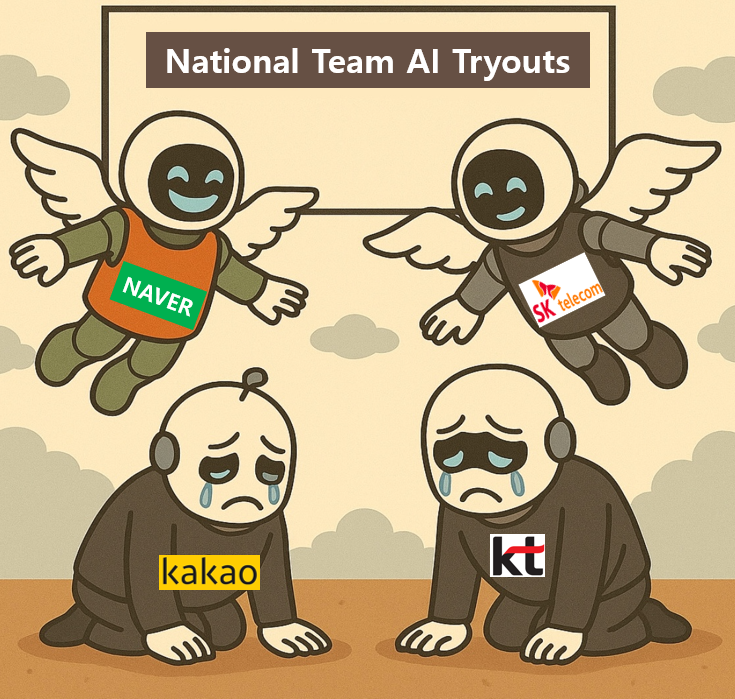
Moreover, in contrast to the government’s emphasis on independent AI technology, both firms’ collaborations with global big tech companies appeared to have worked against them in the final assessments.
On August 4, the Ministry of Science and ICT announced that out of 15 participating teams in the ‘Domestic AI Foundation Model Project’, five elite teams were shortlisted following written and presentation evaluations.
The final five are Naver Cloud, Upstage, SK Telecom, NC AI, and LG AI Research Institute.
The exclusion of Kakao and KT, initially seen as frontrunners, sent ripples through the industry.
An industry insider explained, “The government focused on impact potential and contribution plans as key evaluation criteria. Both Kakao and KT have independent LLMs and have open-sourced them, yet ultimately fell short on user experience.”

Kakao CEO Chung Shina introduces the new AI service brand “Kanana” at the developer conference if(kakao), held at Kakao AI Campus in Yongin on October 22 last year. / Photo courtesy of Kakao
이미지 확대보기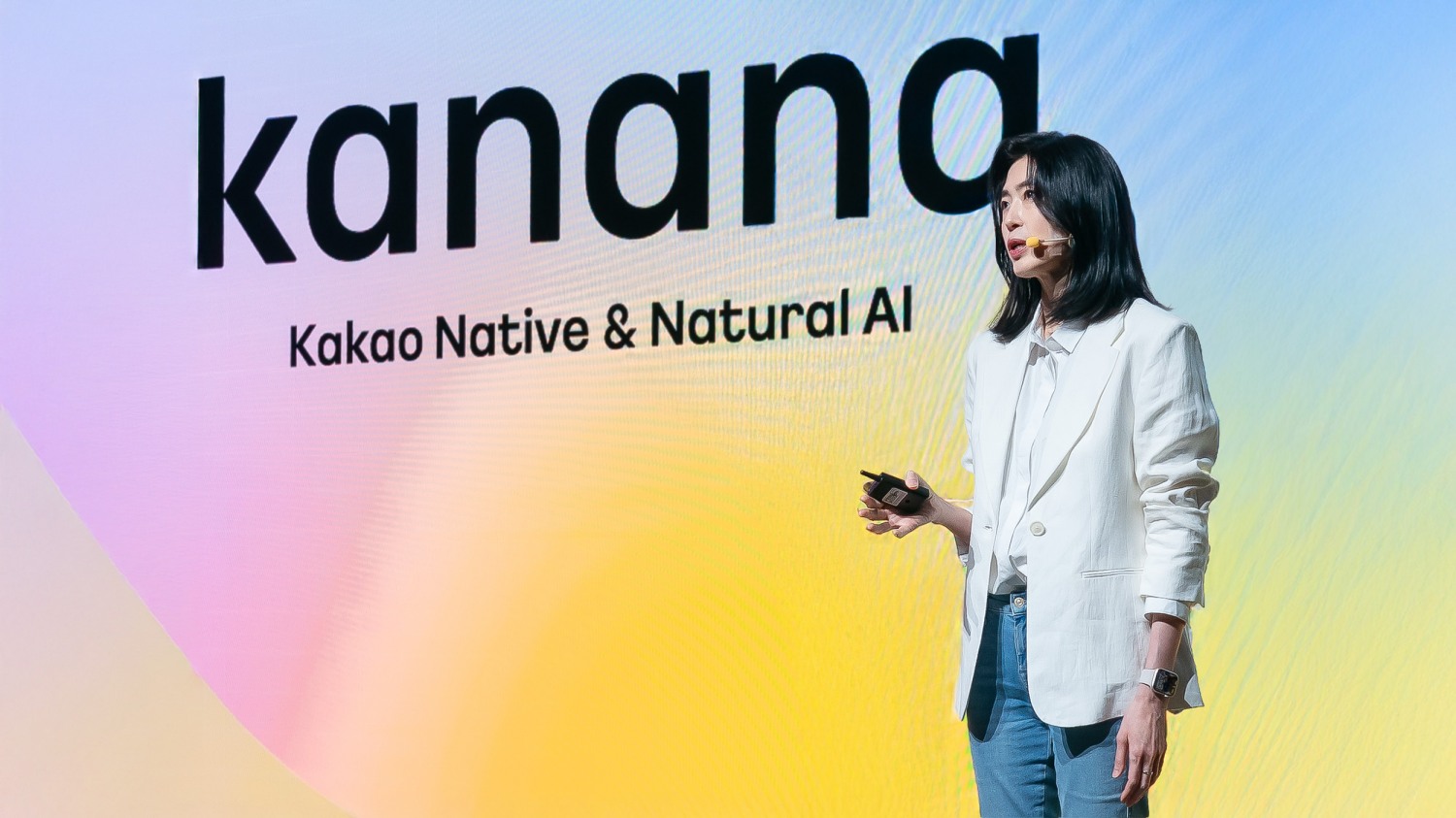
Kakao unveiled its AI model Kanana at its developer conference ‘if (kakao AI) 2024’ last October, alongside a declaration to evolve into an AI-native company.
Kakao Grapples with Growing Legal Risks... Pinning Hopes on AI Growth‘AI-Focused’ SK Group to Build Korea’s Largest Data Center with AmazonNaver Cloud, “Inference AI is Essential to Sovereign Strategy… Launch Set for First Half of This Year”KT Accelerates 'AX Accelerator' with Korean AI ServicesSK Telecom's Profitability at Risk Amid State-Driven Tariff Cuts and Free AI Demands
By contrast, Naver leverages its proprietary LLM ‘HyperCLOVA X’ to power a broad spectrum of consumer services including search, the Whale browser, and shopping platforms, leading domestic AI innovation. It is also conducting sovereign AI projects in markets such as Thailand and the Middle East.
KT was similarly critiqued for its limited experience in business-to-consumer (B2C) applications. Last July 23, KT announced the formation of an ‘AI One Team’ spanning academia, industry, and research institutes, based on its ‘Mid:Um’ AI model, aiming to broaden AI accessibility nationwide and spearhead AI transformation in the public sector.
Despite multiple public sector AI deployments—including police body cams—and AI platform projects such as a KRW 14.5 billion Supreme Court judicial support system and a KRW 13.1 billion generative AI project for Gyeonggi Province, KT's ‘Mid:Um’ series lacks expansion into consumer-facing AI products. Notably, unlike SK Telecom’s AI assistant ‘A.0’ and LG Uplus’s ‘IXI.O’, KT has yet to launch any AI agent model.

KT announced that it will release the open source of its self-developed language model “Mid:Um 2.0,” embodying the philosophy of ‘Korean AI,’ via the AI developer platform Hugging Face on July 3. Pictured are KT researchers testing Mid:Um 2.0 at the KT Umyeon Research Center in Seocho-gu. / Photo courtesy of KT
이미지 확대보기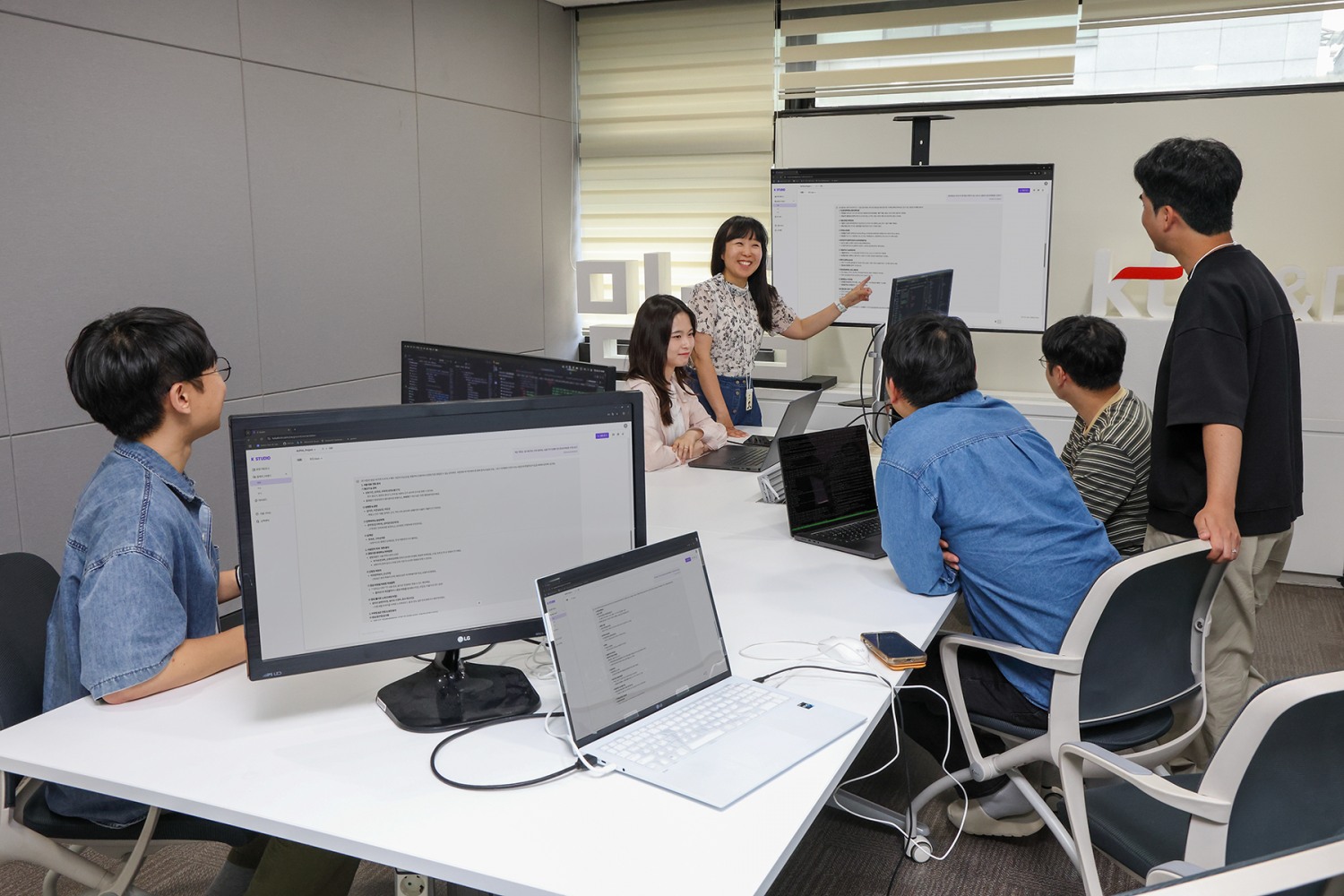
As a result, KT stands as the only major telecom operator excluded from the government programme. SK Telecom, on the other hand, formed a strategic consortium with entities such as Krafton, 42dot, Rebellion, Liner, SelectStar, Seoul National University, and KAIST, successfully securing its spot. LG Uplus collaborates through the LG AI Research Institute consortium.
Industry sources also point to a shared disadvantage for Kakao and KT in their emphasis on partnerships with foreign big tech firms. The Ministry of Science and ICT closely evaluated whether participants adhered to the core principle of sovereign AI—a domestically controlled AI ecosystem. The project’s overarching goal is to develop indigenous LLMs to underpin such sovereign AI platforms.
In February, Kakao announced a strategic alliance with OpenAI to jointly develop AI technologies and new products, including AI agents capable of autonomous decision-making and action on behalf of users. Last month, CEO Chung Shina revealed in a Forbes Asia interview that the service launch is scheduled for November.
Similarly, KT has emphasized collaboration with global giants, including a September 2023 deal with Microsoft worth KRW 2.4 trillion. Maintaining partnerships with Microsoft and OpenAI, KT pursues a dual strategy combining external alliances and continuous advancement of its proprietary AI models.
In March at Mobile World Congress (MWC), KT CEO Kim Young-seop addressed concerns over potential over-reliance on Microsoft’s AI strategy, stating: “If we are behind in capability, catching up quickly is necessary. To avoid dependence, we must create and deploy our own models in-field—even if it looks challenging.”
The five shortlisted elite teams will receive combined government support estimated at KRW 210 billion, covering data, GPUs, and human resources.
By year-end, the Ministry aims to reduce the number of supported teams from five to four through a first evaluation phase based on developed AI foundation models. The project will continue with a survival competition, eliminating one team every six months until final two remain by 2027.
Minister of Science and ICT, Bae Kyung-hoon, commented, “This bold challenge marks a beginning and a starting point for ‘AI for all’. The government will actively support the leap forward of Korean AI companies and institutions and the expansion of the sovereign AI ecosystem.”
Jeong Chaeyun (chaeyun@fntimes.com)










![SK바이오사이언스 안재용, ‘적자 터널’ 닫고 3연임 열까 [CEO 임기보고서]](https://cfnimage.commutil.kr/phpwas/restmb_setimgmake.php?pp=006&w=69&h=45&m=5&simg=202610231027190082807fd637f543112168227135.jpg&nmt=18)


![[그래픽 뉴스] ‘순대’가 경제용어라고? 순(純)대외자산, 한국의 진짜 해외자산은 얼마일까?](https://cfnimage.commutil.kr/phpwas/restmb_setimgmake.php?pp=006&w=298&h=298&m=1&simg=202609021356075202de68fcbb3512411124362_0.jpg&nmt=18)
![[그래픽 뉴스] ISA 대개편! 나에게 유리한 계좌는?](https://cfnimage.commutil.kr/phpwas/restmb_setimgmake.php?pp=006&w=298&h=298&m=1&simg=202608041713155615de68fcbb3512411124362_0.jpg&nmt=18)
![[그래픽 뉴스] 미국 증시 새로운 키워드 'MANGOS'](https://cfnimage.commutil.kr/phpwas/restmb_setimgmake.php?pp=006&w=298&h=298&m=1&simg=202607291740382069de68fcbb3512411124362_0.jpg&nmt=18)
![[그래픽 뉴스] 은퇴후 30년 부모님 세대의 생존전략](https://cfnimage.commutil.kr/phpwas/restmb_setimgmake.php?pp=006&w=298&h=298&m=1&simg=202606301704439153de68fcbb3512411124362_0.jpg&nmt=18)
![[신간] 장애가 가르쳐준 삶의 의미...목진석 9단 아버지 목이균씨의 자서전](https://cfnimage.commutil.kr/phpwas/restmb_setimgmake.php?pp=006&w=81&h=123&m=5&simg=20261023093852062530f8caa4a5ce12411124362.jpg&nmt=18)
![[신간]은퇴연옥…김경록의 은퇴 후 삶의 나침반](https://cfnimage.commutil.kr/phpwas/restmb_setimgmake.php?pp=006&w=81&h=123&m=5&simg=20260414140833047280f8caa4a5ce12411124362.jpg&nmt=18)
![[안현정 서평] 플랫폼의 영지에서 ‘미학적 주권’을 선포하라...'K가 죽어야 K가 산다' 장준환 著](https://cfnimage.commutil.kr/phpwas/restmb_setimgmake.php?pp=006&w=81&h=123&m=5&simg=20260527121426063220c1c16452b012411124362.jpg&nmt=18)
![[서평] 추세 매매의 대가들...추세추종 투자전략의 대가 14인 인터뷰](https://cfnimage.commutil.kr/phpwas/restmb_setimgmake.php?pp=006&w=81&h=123&m=5&simg=2023102410444004986c1c16452b0175114235199.jpg&nmt=18)


![[머니무브 2026] “지금 사도 될까?” 답이 안 보인다면…하반기 투자, 4명의 전문가에게 물어보세요](https://cfnimage.commutil.kr/phpwas/restmb_setimgmake.php?pp=006&w=89&h=45&m=1&simg=202609151044050355302a735e27af12411124362.jpg&nmt=18)
![[AD] ‘PBV 라인업 확장’ 기아, 9월 독일서 ‘PV7’ 첫 공개](https://cfnimage.commutil.kr/phpwas/restmb_setimgmake.php?pp=006&w=89&h=45&m=1&simg=2026083111010602815074925877361231180222.jpg&nmt=18)
![[AD] 제네시스, 럭셔리 경험 더한 ‘2027 GV70’‧‘GV70 그래파이트’ 출시](https://cfnimage.commutil.kr/phpwas/restmb_setimgmake.php?pp=006&w=89&h=45&m=1&simg=20260702143546085600749258773622211122717.jpg&nmt=18)