







Hyundai Motor Group, Korea’s leading automaker, has also begun to expand its used car business in earnest. Both Hyundai Motor Company and Kia have added “real estate development” to their new business objectives, signaling their intention to expand in the used car sector. This move is interpreted as a step beyond their previous focus on online certified used car businesses, laying the groundwork for large-scale used car sales and collection facilities.
Hyundai Motor Company added real estate development to its business objectives at its regular shareholders’ meeting last year, while Kia did the same at its meeting this year.
After launching its online certified used car business at the end of 2023, Hyundai Motor Company established massive reconditioning centers in Yongin, Gyeonggi Province, and Yangsan, South Gyeongsang Province, and opened a center in Gunsan, North Jeolla Province, in August last year.
At the regular shareholders’ meeting in March, Kia President Song Ho-seon explained the addition of new business objectives, stating, “This is to develop new business sites such as integrated flagship stores for vehicle purchase, maintenance, service, and brand experience for customers.”
Another Hyundai Motor Group affiliate, Hyundai Glovis, is also expanding its used car purchasing service nationwide this year. Through its own platform, “Autobell,” it is collaborating with car-sharing company SOCAR to dispatch professional evaluation consultants to the customer’s desired time and place, providing vehicle inspection and purchasing services.
The reason Hyundai Motor Company and Kia are expanding their used car businesses is that the used car market has already surpassed the new car market in size. Especially as more consumers seek practical value amid economic downturns, attention is shifting to used cars with similar specifications at relatively lower prices.
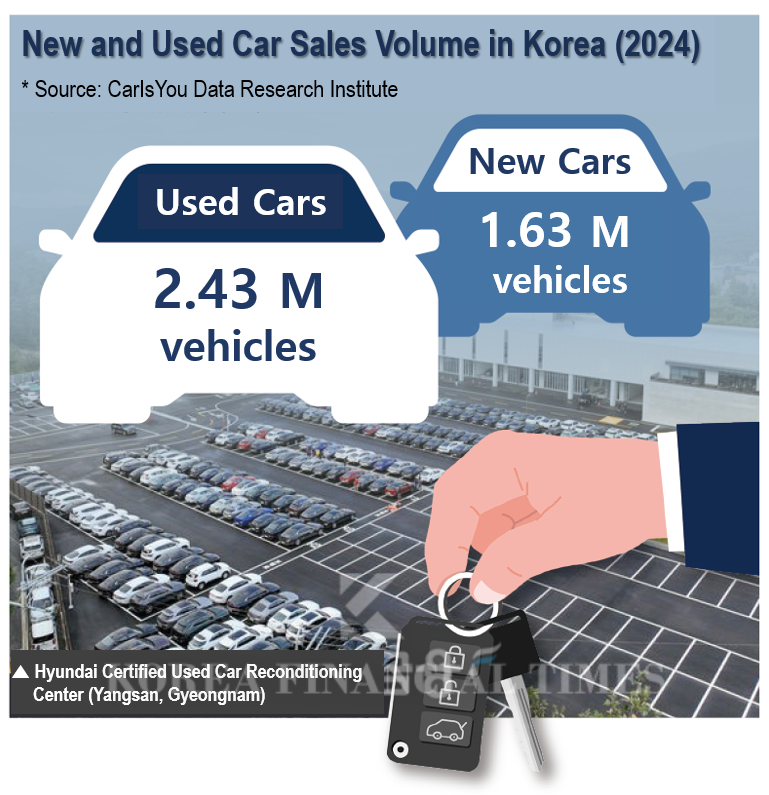
According to automotive data platform Carisyou Data Research Institute, the number of used car transactions in Korea last year was 2.43 million units, far exceeding the 1.63 million new car transactions.
The image of the used car market is also changing significantly. Traditionally, the used car market was notorious as a classic “lemon market.”
A lemon market refers to a market where sellers monopolize information such as vehicle mileage and condition, resulting in severe information asymmetry for consumers. In such a structure, if sellers provide inaccurate product information, consumers inevitably suffer losses.
For this reason, there has long been strong demand among consumers for conglomerates to enter the market. When Hyundai Motor Company and Kia began to enter the used car market in earnest, online communities were filled with comments such as, “Used car dealers who have deceived consumers are in trouble now,” and “Even if it’s a bit more expensive, I’ll trust and use a conglomerate’s used car.”
After the ban on conglomerate entry into the used car market was lifted in 2022, Hyundai Motor Company and Kia entered the market at the end of 2023. At the time, both companies stated, “We are preparing to enter the used car market with consumer protection and trust enhancement as our top priorities,” and explained, “We will improve the overall quality and performance of used cars, enhance market trust, and promote various collaborations with the existing used car industry so that the used car industry can expand beyond sales to new business areas.”
However, out of consideration for small used car businesses, they initially sold only certified used cars online-vehicles within five years of release and under 100,000 kilometers in mileage. Additionally, to minimize the impact on small dealers, the government recommended that Hyundai Motor Company maintain a 4.1% market share and Kia a 2.9% share in the used car market.
Due to these limitations, Hyundai Motor Company and Kia found it difficult to aggressively expand in the used car market, but with the lifting of these regulations this month, they are now able to expand their used car businesses.
Meanwhile, not only Hyundai Motor Company and Kia but also other domestic automakers such as KG Mobility, as well as imported car companies including the German “Big Three” (Mercedes-Benz, BMW, Audi), are actively seeking to increase their market share.
New competitors are also emerging.
Recently, BYD, a Chinese company focusing on electric vehicles, announced its entry into the Korean used car market this year by establishing a new subsidiary. With competitively priced electric vehicles as its main offering, the company aims to capture a niche market with high cost-effectiveness.
Not only automakers but also rental car companies are intensifying competition in the used car market.
Lotte Rental, Korea’s largest rental car company, opened its first used car sales center in Gangseo-gu, Seoul, in November last year, followed by a second center in Bucheon, Gyeonggi Province, last month. Lotte Rental stated, “We plan to open additional centers in the Seoul metropolitan area in the first half of this year,” and set a target of selling 9,000 used cars this year, with a goal of 43,000 annual sales by 2028.
SK Rent-a-Car has also chosen the used car business as an expansion strategy. In July, SK Rent-a-Car will open its first used car auction house for dealers in Cheonan, South Chungcheong Province. Imported car dealer Kolon Mobility plans to launch online sales of imported used cars, including BMW, Volvo, and Audi, in the third quarter of this year, leveraging its imported car infrastructure.
Kim JaeHun (rlqm93@fntimes.com)










![[르포] 1100평 한 층서 '협업', 보안데이터 하루 '10억 건'…하나금융의 진화](https://cfnimage.commutil.kr/phpwas/restmb_setimgmake.php?pp=006&w=69&h=45&m=5&simg=202609301743410358601b5a2213792211381469.jpg&nmt=18)


![[그래픽 뉴스] ‘순대’가 경제용어라고? 순(純)대외자산, 한국의 진짜 해외자산은 얼마일까?](https://cfnimage.commutil.kr/phpwas/restmb_setimgmake.php?pp=006&w=298&h=298&m=1&simg=202609021356075202de68fcbb3512411124362_0.jpg&nmt=18)
![[그래픽 뉴스] ISA 대개편! 나에게 유리한 계좌는?](https://cfnimage.commutil.kr/phpwas/restmb_setimgmake.php?pp=006&w=298&h=298&m=1&simg=202608041713155615de68fcbb3512411124362_0.jpg&nmt=18)
![[그래픽 뉴스] 미국 증시 새로운 키워드 'MANGOS'](https://cfnimage.commutil.kr/phpwas/restmb_setimgmake.php?pp=006&w=298&h=298&m=1&simg=202607291740382069de68fcbb3512411124362_0.jpg&nmt=18)

![[그래픽 뉴스] 은퇴후 30년 부모님 세대의 생존전략](https://cfnimage.commutil.kr/phpwas/restmb_setimgmake.php?pp=006&w=298&h=298&m=1&simg=202606301704439153de68fcbb3512411124362_0.jpg&nmt=18)
![[신간]은퇴연옥…김경록의 은퇴 후 삶의 나침반](https://cfnimage.commutil.kr/phpwas/restmb_setimgmake.php?pp=006&w=81&h=123&m=5&simg=20260414140833047280f8caa4a5ce12411124362.jpg&nmt=18)
![[신간] 물처럼 흐르고 원칙으로 서다…김용환의 통찰을 담다](https://cfnimage.commutil.kr/phpwas/restmb_setimgmake.php?pp=006&w=81&h=123&m=5&simg=20260409114249027860f8caa4a5ce12411124362.jpg&nmt=18)
![[안현정 서평] 플랫폼의 영지에서 ‘미학적 주권’을 선포하라...'K가 죽어야 K가 산다' 장준환 著](https://cfnimage.commutil.kr/phpwas/restmb_setimgmake.php?pp=006&w=81&h=123&m=5&simg=20260527121426063220c1c16452b012411124362.jpg&nmt=18)
![[서평] 추세 매매의 대가들...추세추종 투자전략의 대가 14인 인터뷰](https://cfnimage.commutil.kr/phpwas/restmb_setimgmake.php?pp=006&w=81&h=123&m=5&simg=2023102410444004986c1c16452b0175114235199.jpg&nmt=18)


![[머니무브 2026] “지금 사도 될까?” 답이 안 보인다면…하반기 투자, 4명의 전문가에게 물어보세요](https://cfnimage.commutil.kr/phpwas/restmb_setimgmake.php?pp=006&w=89&h=45&m=1&simg=202609151044050355302a735e27af12411124362.jpg&nmt=18)
![[AD] ‘PBV 라인업 확장’ 기아, 9월 독일서 ‘PV7’ 첫 공개](https://cfnimage.commutil.kr/phpwas/restmb_setimgmake.php?pp=006&w=89&h=45&m=1&simg=2026083111010602815074925877361231180222.jpg&nmt=18)
![[AD] 제네시스, 럭셔리 경험 더한 ‘2027 GV70’‧‘GV70 그래파이트’ 출시](https://cfnimage.commutil.kr/phpwas/restmb_setimgmake.php?pp=006&w=89&h=45&m=1&simg=20260702143546085600749258773622211122717.jpg&nmt=18)
![[AD] 개소세 혜택 종료…현대차, ‘썸머 페스타’로 고객 부담 완화](https://cfnimage.commutil.kr/phpwas/restmb_setimgmake.php?pp=006&w=89&h=45&m=1&simg=20260702142355004830749258773622211122717.jpg&nmt=18)