






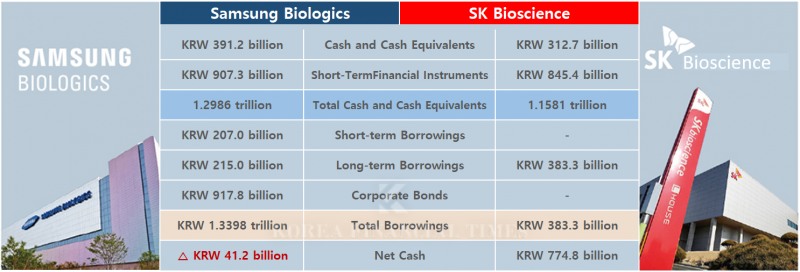
Comparison of Cash and Cash Equivalents and Borrowings of Samsung Biologics and SK Bioscience in 2024 (Consolidated Basis)
이미지 확대보기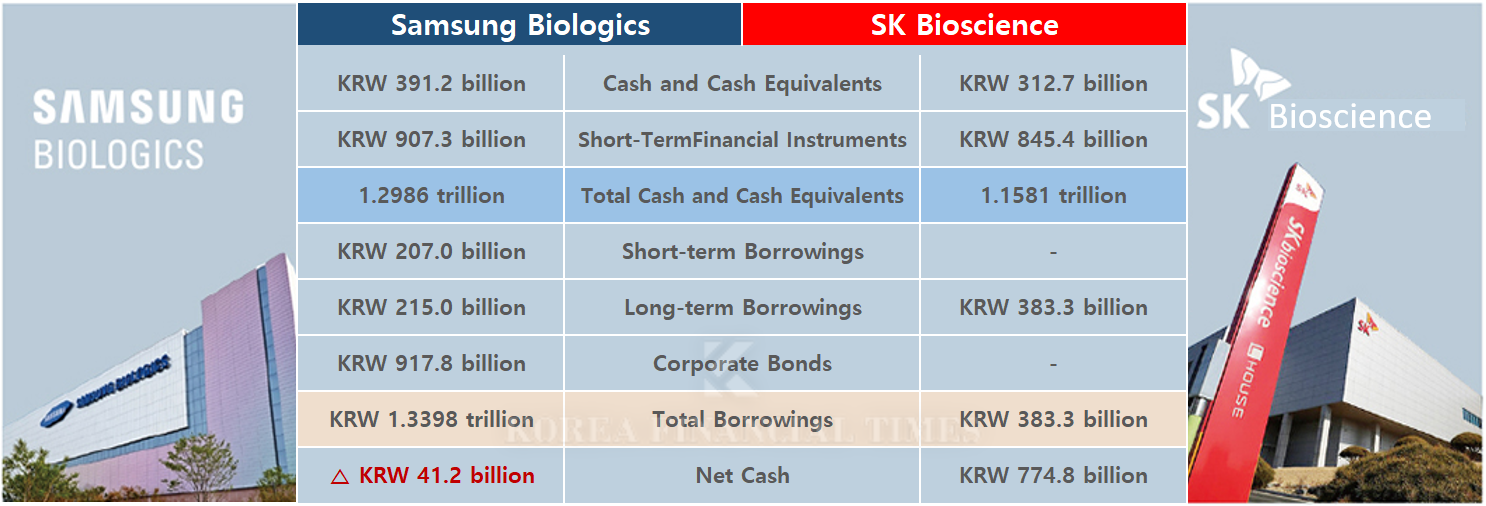
◇ Samsung Biologics Surpasses KRW 1 Trillion in Cash Assets
According to a Financial Supervisory Service disclosure on May 6, 2025, Samsung Biologics held KRW 1.2986 trillion in total cash and cash equivalents at the end of last year, comprising KRW 391.2 billion in cash and cash equivalents and KRW 907.3 billion in short-term financial instruments.This represents a decrease of about KRW 700 billion from the previous year, when the company held KRW 2.018 trillion in cash assets (KRW 367.9 billion in cash and KRW 1.65 trillion in short-term financial products). The reduction reflects efforts to improve the company’s financial structure. Samsung Biologics repaid approximately KRW 800 billion in borrowings and bonds in 2024, lowering its debt ratio to 59%.
Despite a smaller cash reserve, investment appetite increased. The company spent KRW 2.0012 trillion on facility investments, including CDMO plants, a 155.8% increase from KRW 782.2 billion in 2023.
Last month, Samsung Biologics began full-scale operations of its 180,000-liter Plant 5, raising total production capacity to 784,000 liters-the largest globally. The company plans to invest a total of KRW 7.5 trillion by 2032 to build its second Bio Campus (Plants 5–8), expanding capacity to 1.324 million liters. Internal discussions are also underway to establish dedicated production facilities for new modalities such as antibody-drug conjugates (ADC).
Strong cash flow underpins this investment drive. Samsung Biologics generated KRW 1.9604 trillion in cash from operating activities in 2024. While borrowings and bonds totaled KRW 1.3398 trillion, resulting in net debt of KRW 41.2 billion, operating cash flow comfortably covers liabilities.
This contrasts sharply with the domestic biotech sector’s funding squeeze. Venture capital data from The VC shows that investment deals in Korea’s bio, medical, and healthcare sectors dropped from 522 in 2021 to 225 last year, with investment amounts shrinking from KRW 3.7358 trillion to KRW 1.0934 trillion.
An industry insider commented, “Unlike other biotech firms, Samsung Biologics has a stable revenue base and cash flow. It is one of the rare companies that can withstand increased depreciation expenses from expanded facility investments such as Plant 5.”
◇ SK Bioscience Tops in Net Cash, Ready for M&A Expansion
SK Bioscience also boasts a strong cash position, with KRW 1.1581 trillion in cash and cash equivalents last year, up 11.1% from KRW 1.2741 trillion at the end of 2023.Notably, SK Bioscience’s net cash position is KRW 774.8 billion after deducting total borrowings of KRW 383.3 billion.
While Samsung Biologics leads in cash assets among KOSPI-listed biotech firms, SK Bioscience ranks first in net cash. The company accumulated substantial cash during the COVID-19 pandemic, generating billions in operating profit centered on its vaccine business. It also raised KRW 1.5 trillion through an initial public offering (IPO) in 2021.
With ample financial resources, SK Bioscience is actively pursuing business diversification and future growth through mergers and acquisitions (M&A).
SK Bioscience acquired the German CDMO company IDT Biologika for KRW 356.4 billion in June last year. In October, it purchased a controlling stake in U.S. biotech company PinA BioSolutions for KRW 4.1 billion. The company is also moving quickly to secure next-generation technologies, including a conditional acquisition of U.S.-based Sunflower’s shares.
SK Bioscience plans to continue investing in promising global biotech companies.
A company spokesperson stated, “We will secure competitiveness through investments and M&A in promising companies with excellent technologies, laying the foundation for a full-scale leap as a global company.”
Kim Nayoung, Korea Finacial Times (steaming@fntimes.com)












![“3조 신화 넘어 4조 시대로”…박주형, 신세계 성장판 넓혔다 [CEO 임기보고서]](https://cfnimage.commutil.kr/phpwas/restmb_setimgmake.php?pp=006&w=69&h=45&m=5&simg=20261021155541058600dd55077bc212411124362.jpg&nmt=18)


![[현장] ‘1만원 에어프라이어’ 실화?…다이소 잡으러 나선 이마트 ‘와우샵’](https://cfnimage.commutil.kr/phpwas/restmb_setimgmake.php?pp=006&w=69&h=45&m=5&simg=20261022144754079030b5b890e35c211234199164.jpg&nmt=18)


![[그래픽 뉴스] ‘순대’가 경제용어라고? 순(純)대외자산, 한국의 진짜 해외자산은 얼마일까?](https://cfnimage.commutil.kr/phpwas/restmb_setimgmake.php?pp=006&w=298&h=298&m=1&simg=202609021356075202de68fcbb3512411124362_0.jpg&nmt=18)
![[그래픽 뉴스] ISA 대개편! 나에게 유리한 계좌는?](https://cfnimage.commutil.kr/phpwas/restmb_setimgmake.php?pp=006&w=298&h=298&m=1&simg=202608041713155615de68fcbb3512411124362_0.jpg&nmt=18)
![[그래픽 뉴스] 미국 증시 새로운 키워드 'MANGOS'](https://cfnimage.commutil.kr/phpwas/restmb_setimgmake.php?pp=006&w=298&h=298&m=1&simg=202607291740382069de68fcbb3512411124362_0.jpg&nmt=18)

![[그래픽 뉴스] 은퇴후 30년 부모님 세대의 생존전략](https://cfnimage.commutil.kr/phpwas/restmb_setimgmake.php?pp=006&w=298&h=298&m=1&simg=202606301704439153de68fcbb3512411124362_0.jpg&nmt=18)
![[신간]은퇴연옥…김경록의 은퇴 후 삶의 나침반](https://cfnimage.commutil.kr/phpwas/restmb_setimgmake.php?pp=006&w=81&h=123&m=5&simg=20260414140833047280f8caa4a5ce12411124362.jpg&nmt=18)
![[신간] 물처럼 흐르고 원칙으로 서다…김용환의 통찰을 담다](https://cfnimage.commutil.kr/phpwas/restmb_setimgmake.php?pp=006&w=81&h=123&m=5&simg=20260409114249027860f8caa4a5ce12411124362.jpg&nmt=18)
![[안현정 서평] 플랫폼의 영지에서 ‘미학적 주권’을 선포하라...'K가 죽어야 K가 산다' 장준환 著](https://cfnimage.commutil.kr/phpwas/restmb_setimgmake.php?pp=006&w=81&h=123&m=5&simg=20260527121426063220c1c16452b012411124362.jpg&nmt=18)
![[서평] 추세 매매의 대가들...추세추종 투자전략의 대가 14인 인터뷰](https://cfnimage.commutil.kr/phpwas/restmb_setimgmake.php?pp=006&w=81&h=123&m=5&simg=2023102410444004986c1c16452b0175114235199.jpg&nmt=18)


![[머니무브 2026] “지금 사도 될까?” 답이 안 보인다면…하반기 투자, 4명의 전문가에게 물어보세요](https://cfnimage.commutil.kr/phpwas/restmb_setimgmake.php?pp=006&w=89&h=45&m=1&simg=202609151044050355302a735e27af12411124362.jpg&nmt=18)
![[AD] ‘PBV 라인업 확장’ 기아, 9월 독일서 ‘PV7’ 첫 공개](https://cfnimage.commutil.kr/phpwas/restmb_setimgmake.php?pp=006&w=89&h=45&m=1&simg=2026083111010602815074925877361231180222.jpg&nmt=18)
![[AD] 제네시스, 럭셔리 경험 더한 ‘2027 GV70’‧‘GV70 그래파이트’ 출시](https://cfnimage.commutil.kr/phpwas/restmb_setimgmake.php?pp=006&w=89&h=45&m=1&simg=20260702143546085600749258773622211122717.jpg&nmt=18)