






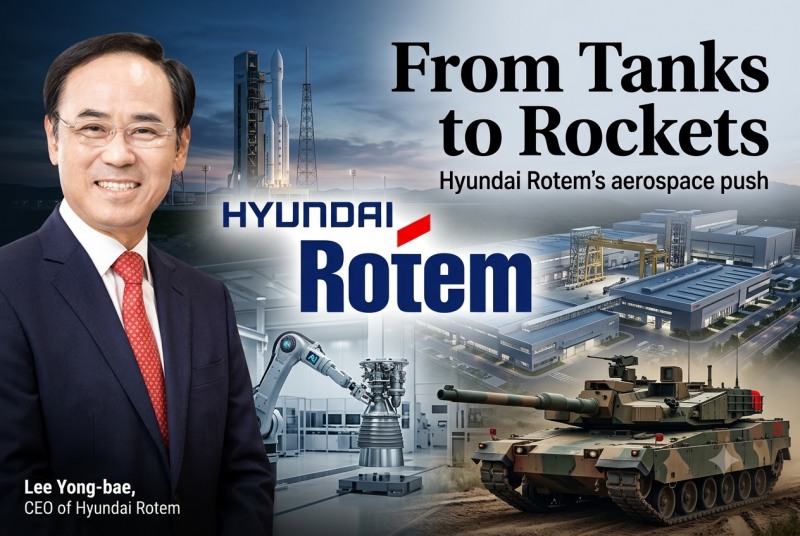
Its adoption of Hyundai Motor Company's artificial intelligence (AI) smart factory technology is the first step toward turning that vision into actual production. To move an aerospace business that has remained at the R&D stage into mass production, the company must first secure safety and quality in propulsion processes, where the risk of accidents is highest.
AI-Driven Automation of Propulsion Processes... Ahead of the "Muju Base"
Hyundai Rotem recently signed a comprehensive technology cooperation memorandum of understanding (MOU) with Hyundai Motor to improve safety through automation at production sites. The two companies will cooperate on introducing automation systems at Hyundai Rotem's aerospace facilities.The centerpiece of the aerospace restructuring is Muju in North Jeolla Province. In March, Hyundai Rotem signed an investment agreement with North Jeolla Special Self-Governing Province and Muju County to build an integrated aerospace production base on a 760,330-square-meter site (about 230,000 pyeong) in Muju County, investing about KRW 300 billion in phases through 2034.
The Muju base is planned as a facility that handles the entire process in one place, from R&D and prototype production to testing, verification and mass production. Production buildings, equipment, dormitories and a training center will be built on the site. The project was designated a government "investment-leading district" in June, making it eligible for up to KRW 10 billion in state funding for infrastructure development.
The latest agreement was also pursued with the Muju base in mind. However, Hyundai Rotem said the cooperation is still at an early stage and that the Muju base will not be completed for several years, so the scope of application may be expanded depending on circumstances.
A smart factory is a plant in which AI and automated equipment monitor and control production processes on their own. Hyundai Rotem plans to apply this technology to the highest-risk tasks in producing aerospace products, including ducted ramjet engines, hypersonic engines and methane engines for reusable launch vehicles.
A ducted ramjet is an engine that flies at supersonic speed, taking in air to burn fuel, and is regarded as a next-generation propulsion system for guided missiles.
Hyundai Sales Slump at Home and Abroad... What's Causing the 'Sharp Decline'?Hyundai Wia Bets on Robots and EVs—With an Eye on SuccessionLIG D&A, Hanwha Systems Enter Full-Scale Rivalry as Defense AI Battle Reaches the BoardroomFrom Autonomous Vehicles to Defense Tech: GenGenAI's Quest to Solve the Data Problem [Rising Stars of K-Defense]Hanwha Aerospace's New Playbook: Pairing Weapons Deals with Energy Supply
Hyundai Rotem is testing the performance and manufacturing processes of its ducted ramjet engines at its propulsion test facility in Seosan, South Chungcheong Province. Until now, the engines were being verified at test facilities. The company now needs a production system that can build them repeatedly.
Safety is the top priority the company wants to secure through this adoption. "Aerospace products involve many risky processes such as combustion testing, so safety was the foremost consideration in this agreement," a Hyundai Rotem official said. Rather than automating the entire process, the company will apply smart factory technology only to certain hazardous processes to protect on-site workers. It also took into account that a safety accident could disrupt the development and production schedules of advanced aerospace products.
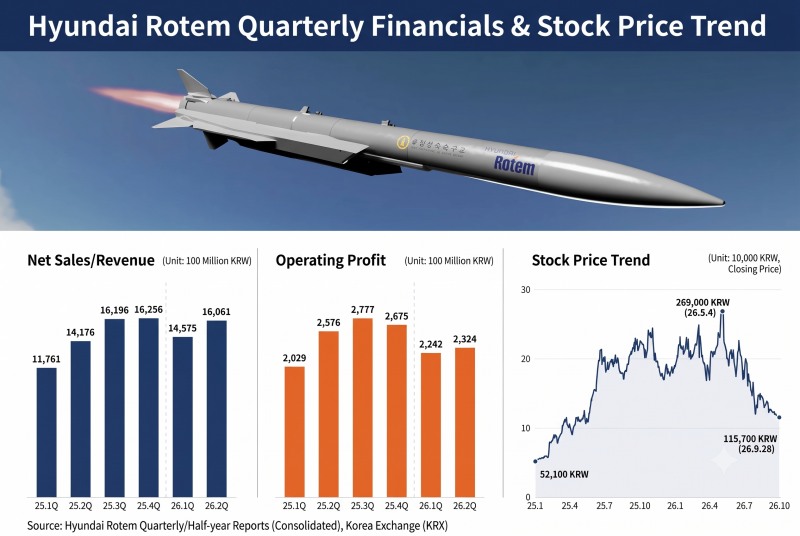
Chart: Hyundai Rotem quarterly earnings and share price trend. / Source: Financial Supervisory Service Data Analysis, Retrieval and Transfer System (DART), Naver Pay Securities / * AI generated
이미지 확대보기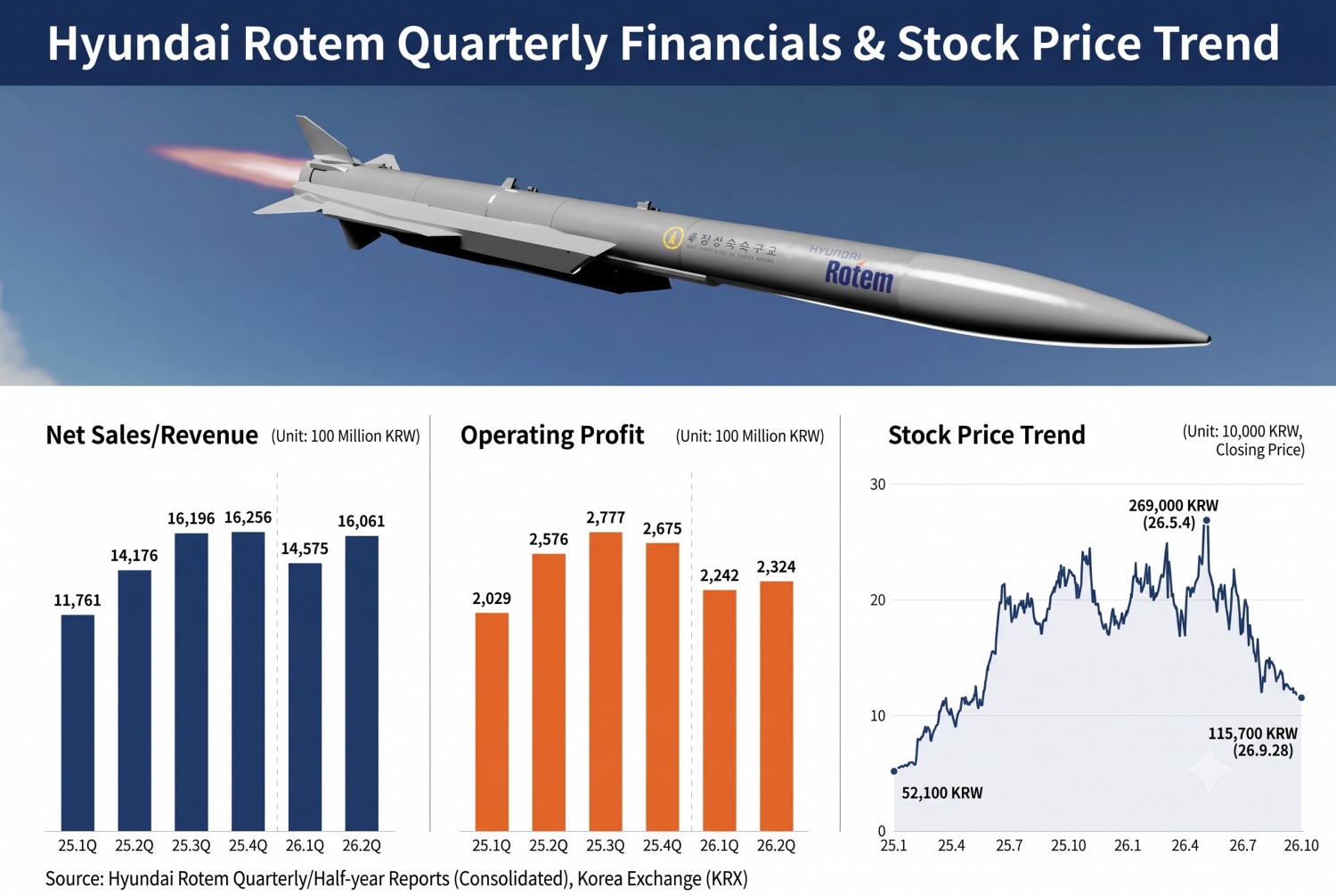
Exports Account for 70.6% of Defense Segment Sales... Reinvestment in Aerospace
Behind Hyundai Rotem's push to invest in aerospace is an earnings structure concentrated in ground weapon systems such as the K2 tank.Of Hyundai Rotem's consolidated operating profit of KRW 456.6 billion in the first half of this year, the AD&RH (Aerospace, Defense, Robotics and Hydrogen) segment accounted for KRW 444.8 billion, or 97.4%. The segment's main product is the K2 tank, and 70.6% of the segment's sales came from exports.
Aerospace remains at the domestic R&D project stage, and the hydrogen business is focused on building domestic infrastructure, so export revenue effectively comes from ground weapons such as the K2 tank. According to IBK Investment & Securities, the defense segment's operating margin rose from 5.1% in 2021 to 25.6% in the first half of this year, following the K2 exports to Poland.
Dependence on a single product means earnings and corporate value can swing depending on the timing of export contracts. That pattern is visible in recent quarterly results. In the third quarter of last year, Hyundai Rotem posted revenue of KRW 1.6196 trillion and operating profit of KRW 277.7 billion, its best quarterly results since its founding. Operating profit rose 102.1% from a year earlier.
The growth rate of operating profit then slowed quickly. In the fourth quarter of last year, revenue was KRW 1.6256 trillion and operating profit was KRW 267.4 billion, with operating profit up 65.4% year on year. In the first quarter of this year, revenue was KRW 1.4575 trillion and operating profit was KRW 224.2 billion, a rise of only 10.5%. In the second quarter, revenue grew 13.3% to KRW 1.606 trillion, but operating profit fell 9.7% to KRW 232.4 billion.
IBK Investment & Securities attributed the decline in operating profit to the high base effect from the highly profitable first Poland K2 contract and to a growing share of domestic business. The AD&RH segment's order backlog also fell by nearly KRW 700 billion in six months, from KRW 10.5181 trillion at the end of last year to KRW 9.8197 trillion at the end of June.
Still, the company has ample capacity to reinvest. As receivables from Poland were collected, cash and cash equivalents at the end of June stood at KRW 2.5273 trillion, up by more than KRW 1.6 trillion from KRW 908.4 billion at the start of the year. Hyundai Rotem plans to invest more than KRW 1.8 trillion in defense facilities, unmanned technology and new aerospace ventures.
The direction is also evident in its organizational restructuring. This year, Hyundai Rotem reorganized its previous three-division structure of defense, rail and plant into AD&RH, RS (Rail Solutions) and EP (Eco Plant), placing "Aerospace" at the very front of the defense segment's name.
Growing Space Market... Korea AeroSpace Administration Budget Up 47.2%
The market is also expanding toward aerospace. Hyundai Rotem said interest in future industries such as aerospace, along with unmanned systems, is growing at home and abroad, and it expects technological advances and rising market demand in the defense industry.Government investment is also increasing rapidly. The Korea AeroSpace Administration's proposed budget for next year is KRW 1.6491 trillion, up 47.2% from this year and the largest since the agency's launch. Of that, the budget for next-generation launch vehicle development, including reusable launch vehicles, more than doubles from KRW 120.4 billion this year to KRW 291.6 billion next year.
Having built up aerospace engine technology for nearly 30 years since taking part in developing Korea's first liquid-propellant rocket in the 1990s, Hyundai Rotem plans to use the Muju base as a hub to move beyond ground-weapon-centered defense and become a comprehensive defense contractor that also covers aerospace.
Jung Jina (urzinnie@fntimes.com)











![용산구 '나인원한남' 100평, 43억 오른 263억원에 거래 [일일 신고가]](https://cfnimage.commutil.kr/phpwas/restmb_setimgmake.php?pp=006&w=69&h=45&m=5&simg=2025060416323304606e41d7fc6c21182356594.jpg&nmt=18)


![[그래픽 뉴스] ‘순대’가 경제용어라고? 순(純)대외자산, 한국의 진짜 해외자산은 얼마일까?](https://cfnimage.commutil.kr/phpwas/restmb_setimgmake.php?pp=006&w=298&h=298&m=1&simg=202609021356075202de68fcbb3512411124362_0.jpg&nmt=18)
![[그래픽 뉴스] ISA 대개편! 나에게 유리한 계좌는?](https://cfnimage.commutil.kr/phpwas/restmb_setimgmake.php?pp=006&w=298&h=298&m=1&simg=202608041713155615de68fcbb3512411124362_0.jpg&nmt=18)
![[그래픽 뉴스] 미국 증시 새로운 키워드 'MANGOS'](https://cfnimage.commutil.kr/phpwas/restmb_setimgmake.php?pp=006&w=298&h=298&m=1&simg=202607291740382069de68fcbb3512411124362_0.jpg&nmt=18)

![[그래픽 뉴스] 은퇴후 30년 부모님 세대의 생존전략](https://cfnimage.commutil.kr/phpwas/restmb_setimgmake.php?pp=006&w=298&h=298&m=1&simg=202606301704439153de68fcbb3512411124362_0.jpg&nmt=18)
![[신간]은퇴연옥…김경록의 은퇴 후 삶의 나침반](https://cfnimage.commutil.kr/phpwas/restmb_setimgmake.php?pp=006&w=81&h=123&m=5&simg=20260414140833047280f8caa4a5ce12411124362.jpg&nmt=18)
![[신간] 물처럼 흐르고 원칙으로 서다…김용환의 통찰을 담다](https://cfnimage.commutil.kr/phpwas/restmb_setimgmake.php?pp=006&w=81&h=123&m=5&simg=20260409114249027860f8caa4a5ce12411124362.jpg&nmt=18)
![[안현정 서평] 플랫폼의 영지에서 ‘미학적 주권’을 선포하라...'K가 죽어야 K가 산다' 장준환 著](https://cfnimage.commutil.kr/phpwas/restmb_setimgmake.php?pp=006&w=81&h=123&m=5&simg=20260527121426063220c1c16452b012411124362.jpg&nmt=18)
![[서평] 추세 매매의 대가들...추세추종 투자전략의 대가 14인 인터뷰](https://cfnimage.commutil.kr/phpwas/restmb_setimgmake.php?pp=006&w=81&h=123&m=5&simg=2023102410444004986c1c16452b0175114235199.jpg&nmt=18)


![[머니무브 2026] “지금 사도 될까?” 답이 안 보인다면…하반기 투자, 4명의 전문가에게 물어보세요](https://cfnimage.commutil.kr/phpwas/restmb_setimgmake.php?pp=006&w=89&h=45&m=1&simg=202609151044050355302a735e27af12411124362.jpg&nmt=18)
![[AD] ‘PBV 라인업 확장’ 기아, 9월 독일서 ‘PV7’ 첫 공개](https://cfnimage.commutil.kr/phpwas/restmb_setimgmake.php?pp=006&w=89&h=45&m=1&simg=2026083111010602815074925877361231180222.jpg&nmt=18)
![[AD] 제네시스, 럭셔리 경험 더한 ‘2027 GV70’‧‘GV70 그래파이트’ 출시](https://cfnimage.commutil.kr/phpwas/restmb_setimgmake.php?pp=006&w=89&h=45&m=1&simg=20260702143546085600749258773622211122717.jpg&nmt=18)
![[AD] 개소세 혜택 종료…현대차, ‘썸머 페스타’로 고객 부담 완화](https://cfnimage.commutil.kr/phpwas/restmb_setimgmake.php?pp=006&w=89&h=45&m=1&simg=20260702142355004830749258773622211122717.jpg&nmt=18)