







KCC disclosed its 'treasury stock utilisation plan' at 8:12am on the 24th, just before the regular market opening. This represents the first corporate value enhancement plan extension since the company's launch in July, forming part of its financial strategy. At the time, the company only mentioned 'asset efficiency and capital structure optimisation' without revealing specific detailed plans.
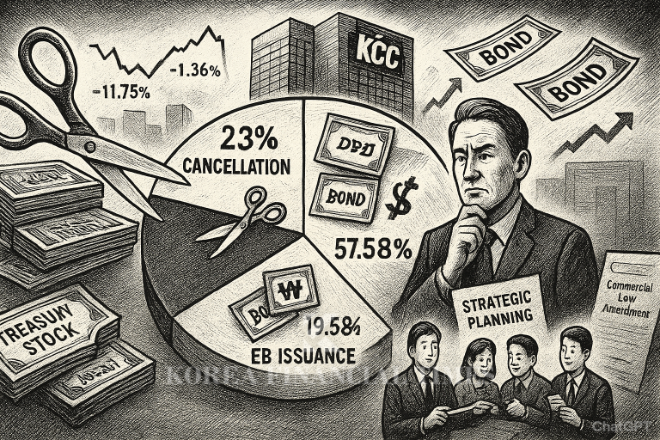
KCC holds 1,532,300 treasury shares, equivalent to 17.24 percent of total issued shares, which it plans to utilise across exchangeable bond (EB) issuance, cancellation, and contribution to the employee welfare fund. The allocation comprises 882,300 shares (57.58 percent) for EB issuance, 300,000 shares (19.58 percent) for employee welfare fund contribution, and 350,000 shares (22.84 percent) for treasury stock cancellation.
However, as the board resolution has not yet taken place, the plan will be finalised through future board meetings. EB issuance is expected in the fourth quarter of this year, while treasury stock cancellation and welfare fund contribution are anticipated between the fourth quarter of this year and the first quarter of next year.
Some observers view this decision as a measure to avoid complete treasury stock cancellation. The National Assembly is currently pursuing third commercial law amendments containing mandatory treasury stock cancellation provisions. Discussions also include allowing treasury stock retention for legitimate reasons such as employee compensation and employee stock ownership association contributions.
The employee welfare fund serves as welfare resources for employee housing loans, education funds, and medical expense support. While treasury shares purchased with company funds lack voting rights, these rights are restored when contributed to third parties such as welfare funds.
In particular, critics argue that KCC, given its substantial financial asset holdings, should have considered utilising its Samsung C&T shares (10.1 percent stake) this time. This follows a similar approach when the company issued KRW 882.8 billion worth of EBs backed by HD Korea Shipbuilding & Offshore Engineering shares in July to repay borrowings.
Jung Kyung-hee, analyst at LS Securities, noted: "Institutional investors' primary demand is liquidation of Samsung C&T shares purchased in 2012. Issuing KRW 430 billion worth of treasury stock EBs without utilising Samsung C&T shares, which offer only 1.34 percent dividend yield, represents an unusual decision from equity investors' perspective."
She evaluated this as "a move contrary to government and capital market efforts to escape the 'Korea Discount'."
Treasury stock cancellation is generally recognised as the most effective shareholder return method. Conversely, utilising shares for EB issuance makes it difficult to avoid criticism of weak shareholder return commitment. However, from a corporate perspective, issuing EBs backed by treasury shares offers the advantage of securing funds without diluting management control. Unlike rights offerings, no new shares are issued, maintaining existing shareholders' ownership ratios.
Currently, Chairman Chung Mong-jin is KCC's largest shareholder with a 20 percent stake. Including specially related parties, this reaches 35.61 percent. Adding treasury shares brings the ownership ratio above 50 percent, securing stable management control.
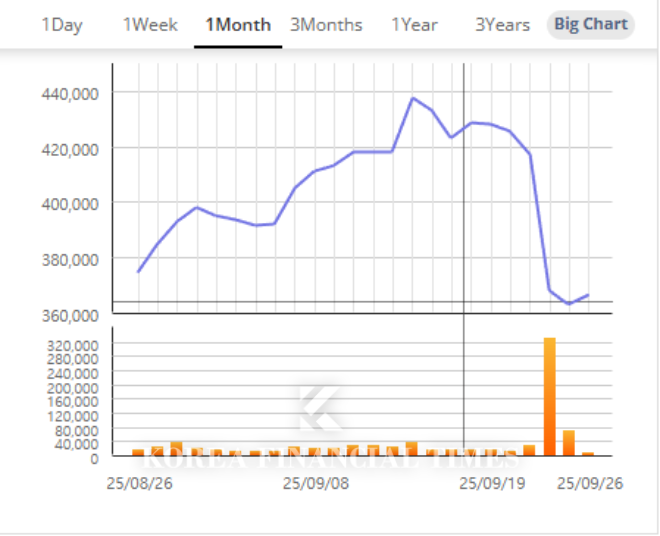
Following the treasury stock utilisation plan announcement, KCC shares closed at KRW 368,000 on the 24th, down 11.75 percent from the previous day. The closing price on the 25th recorded KRW 363,000, down 1.36 percent from the previous day.

Shin Haeju (hjs0509@fntimes.com)











![[그래픽 뉴스] ‘순대’가 경제용어라고? 순(純)대외자산, 한국의 진짜 해외자산은 얼마일까?](https://cfnimage.commutil.kr/phpwas/restmb_setimgmake.php?pp=006&w=298&h=298&m=1&simg=202609021356075202de68fcbb3512411124362_0.jpg&nmt=18)
![[그래픽 뉴스] ISA 대개편! 나에게 유리한 계좌는?](https://cfnimage.commutil.kr/phpwas/restmb_setimgmake.php?pp=006&w=298&h=298&m=1&simg=202608041713155615de68fcbb3512411124362_0.jpg&nmt=18)
![[그래픽 뉴스] 미국 증시 새로운 키워드 'MANGOS'](https://cfnimage.commutil.kr/phpwas/restmb_setimgmake.php?pp=006&w=298&h=298&m=1&simg=202607291740382069de68fcbb3512411124362_0.jpg&nmt=18)

![[그래픽 뉴스] 은퇴후 30년 부모님 세대의 생존전략](https://cfnimage.commutil.kr/phpwas/restmb_setimgmake.php?pp=006&w=298&h=298&m=1&simg=202606301704439153de68fcbb3512411124362_0.jpg&nmt=18)
![[신간]은퇴연옥…김경록의 은퇴 후 삶의 나침반](https://cfnimage.commutil.kr/phpwas/restmb_setimgmake.php?pp=006&w=81&h=123&m=5&simg=20260414140833047280f8caa4a5ce12411124362.jpg&nmt=18)
![[신간] 물처럼 흐르고 원칙으로 서다…김용환의 통찰을 담다](https://cfnimage.commutil.kr/phpwas/restmb_setimgmake.php?pp=006&w=81&h=123&m=5&simg=20260409114249027860f8caa4a5ce12411124362.jpg&nmt=18)
![[안현정 서평] 플랫폼의 영지에서 ‘미학적 주권’을 선포하라...'K가 죽어야 K가 산다' 장준환 著](https://cfnimage.commutil.kr/phpwas/restmb_setimgmake.php?pp=006&w=81&h=123&m=5&simg=20260527121426063220c1c16452b012411124362.jpg&nmt=18)
![[서평] 추세 매매의 대가들...추세추종 투자전략의 대가 14인 인터뷰](https://cfnimage.commutil.kr/phpwas/restmb_setimgmake.php?pp=006&w=81&h=123&m=5&simg=2023102410444004986c1c16452b0175114235199.jpg&nmt=18)


![[머니무브 2026] “지금 사도 될까?” 답이 안 보인다면…하반기 투자, 4명의 전문가에게 물어보세요](https://cfnimage.commutil.kr/phpwas/restmb_setimgmake.php?pp=006&w=89&h=45&m=1&simg=202609151044050355302a735e27af12411124362.jpg&nmt=18)
![[AD] ‘PBV 라인업 확장’ 기아, 9월 독일서 ‘PV7’ 첫 공개](https://cfnimage.commutil.kr/phpwas/restmb_setimgmake.php?pp=006&w=89&h=45&m=1&simg=2026083111010602815074925877361231180222.jpg&nmt=18)
![[AD] 제네시스, 럭셔리 경험 더한 ‘2027 GV70’‧‘GV70 그래파이트’ 출시](https://cfnimage.commutil.kr/phpwas/restmb_setimgmake.php?pp=006&w=89&h=45&m=1&simg=20260702143546085600749258773622211122717.jpg&nmt=18)