






Hotel Shilla focuses on duty-free and hotel businesses. Shinsegae operates department stores and operates duty-free, fashion, and furniture businesses. Although they operate somewhat different businesses in detail, we looked into the profitability of the two companies because they are led by female CEOs from the Samsung family.
The Korea Financial Times calculated the cumulative total shareholder return ratio (TSR) of Hotel Shilla under President Lee and Shinsegae under Chairman Jeong through the data platform ‘Deep Search.’ The period is from 2019, before the full-scale outbreak of COVID-19, to the end of October this year. TSR is the sum of the stock price return ratio and the dividend yield, and refers to the return that shareholders can receive from stock price gains and dividends over a certain period.
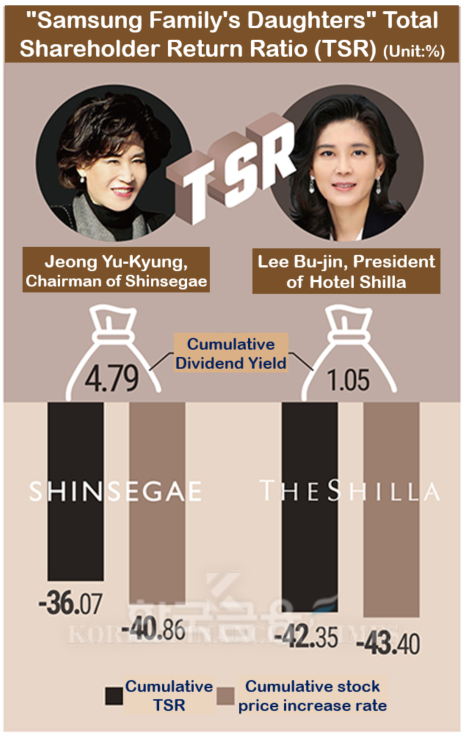
According to the Deep Search analysis results on the 25th, both companies showed negative returns. Of the two, Shinsegae's losses were less than Hotel Shilla's. Shinsegae had -36.07%, while Hotel Shilla had -42.35%. If two shareholders invested KRW 10 million each in Shinsegae and Hotel Shilla on January 2, 2019, it would have shrunk to KRW 6.39 million in Shinsegae and KRW 5.76 million in Hotel Shilla over 5 years and 10 months.
Hotel Shilla's massive losses are a reflection of industry conditions. Hotel Shilla’s duty-free shops account for more than 80% of its total sales. It was hit hard by the direct hit of COVID-19, the decrease in Chinese group tourists as the industry’s “big hand,” and the change in travel patterns to focus on FIT (individual tourists), and as the business slump continued, its difficulties expanded even further.
Hotel Shilla recorded its first-ever annual deficit in 2020, when COVID-19 was at its peak. At that time, the number of passengers entering and exiting Incheon International Airport plummeted by more than 90%, leading to a sharp decline in airport store sales, and profitability deteriorated as the dependence on Chinese peddlers soared to 90%.
The stock price also fell sharply. During the previous TSR calculation period, Hotel Shilla's stock price fell 41.7% from KRW 76,500 (based on the closing price) on December 28, the last trading day of 2018, to KRW 44,600 on October 31, 2024.
Shinsegae also suffered during the COVID-19 period. This is because the number of consumers who prefer online shopping over offline shopping has increased. However, as the so-called ‘revenge spending’ that compensates for the thirst for overseas travel with luxury goods has become popular, Shinsegae has benefited greatly from luxury goods. At least it had something to lean on compared to Hotel Shilla.
‘Three Chairmen Under One Roof...’ Under General Chairman Lee Myung-hee, Chung Yong-jin of ‘E-Mart’ and Chung Yoo-kyung of ‘Shinsegae’E-Mart Pursues Tender Offer for Shinsegae E&C ... Group 'laughs', shareholders 'cry'“Exynos, Trust only you”, Samsung Electronics to fight back"Crisis Surrounding Samsung... Will Lee Jae-yong Return as a Registered Director in His Second Year as Chairman?"'Special from the name' Samsung Electronics aims to take the top spot in foldables with 'Galaxy Z Fold SE'
However, this is not a laughing matter. Shinsegae’s stock price has also plummeted. During the same period, Shinsegae’s stock price fell 39.9% from KRW 256,000 to KRW 153,800.
Since then, Hotel Shilla and Shinsegae’s stock prices have continued to weaken, and as of the 22nd, Hotel Shilla has fallen 13.1% to KRW 38,750, and Shinsegae has fallen 15.5% to KRW 130,000.
Accordingly, voices are growing louder in the market that shareholder returns are needed for stock price reevaluation.
Hotel Shilla issued KRW 132.8 billion worth of convertible bonds using its own stock as collateral in July of this year. The exchange target was 2,135,000 Hotel Shilla common stocks. Hotel Shilla explained that this was a “decision to improve the financial structure by reducing financing costs.” It used its own stocks to repay corporate debt, not to increase shareholder value.
Hotel Shilla has never canceled any treasury shares for shareholder returns since its listing in 1991. Recently, amid growing calls for shareholder returns, Hotel Shilla announced that it was “reviewing the issue from various angles.”
What about Shinsegae? Demands for shareholder returns continue to grow for Shinsegae as well. The company announces its shareholder return policy every three years, and in November of last year, it expanded the level of dividends to shareholders through a public notice.
For fiscal years 2020-2022, 10% of annual operating profit based on separate financial statements will be used as a return resource, and if this return resource falls below KRW 1,500 per share, a minimum dividend of KRW 1,500 per share will be paid. For three years from 2023 to 2025, the return resource will be increased to 10-15% of annual operating profit based on separate financial statements, and if it falls below KRW 3,500 per share, a minimum dividend of KRW 3,500 per share will be paid.
Regarding this, Shinsegae stated, “The purpose of easing the dividend criteria is to increase the long-term predictability of shareholder returns while also ensuring stable dividends.”
According to Deep Search, the cumulative dividend yield from 2019 to the end of October this year is 1.05% for Hotel Shilla and 4.79% for Shinsegae.
Park seulgi (seulgi@fntimes.com)











![[THE COMPASS] 한미사이언스 경영권 분쟁, 신동국이 주도하는 ‘종식’ 게임](https://cfnimage.commutil.kr/phpwas/restmb_setimgmake.php?pp=006&w=69&h=45&m=5&simg=20261008122108000710a837df649412411124362.jpg&nmt=18)
![영업익 53% 뛴다는데…대웅제약 몸값 누르는 두 가지 변수 [5대 제약사 3Q 실적 ④]](https://cfnimage.commutil.kr/phpwas/restmb_setimgmake.php?pp=006&w=69&h=45&m=5&simg=202610081106100618007fd637f543112168227135.jpg&nmt=18)


![[그래픽 뉴스] ‘순대’가 경제용어라고? 순(純)대외자산, 한국의 진짜 해외자산은 얼마일까?](https://cfnimage.commutil.kr/phpwas/restmb_setimgmake.php?pp=006&w=298&h=298&m=1&simg=202609021356075202de68fcbb3512411124362_0.jpg&nmt=18)
![[그래픽 뉴스] ISA 대개편! 나에게 유리한 계좌는?](https://cfnimage.commutil.kr/phpwas/restmb_setimgmake.php?pp=006&w=298&h=298&m=1&simg=202608041713155615de68fcbb3512411124362_0.jpg&nmt=18)
![[그래픽 뉴스] 미국 증시 새로운 키워드 'MANGOS'](https://cfnimage.commutil.kr/phpwas/restmb_setimgmake.php?pp=006&w=298&h=298&m=1&simg=202607291740382069de68fcbb3512411124362_0.jpg&nmt=18)

![[그래픽 뉴스] 은퇴후 30년 부모님 세대의 생존전략](https://cfnimage.commutil.kr/phpwas/restmb_setimgmake.php?pp=006&w=298&h=298&m=1&simg=202606301704439153de68fcbb3512411124362_0.jpg&nmt=18)
![[신간]은퇴연옥…김경록의 은퇴 후 삶의 나침반](https://cfnimage.commutil.kr/phpwas/restmb_setimgmake.php?pp=006&w=81&h=123&m=5&simg=20260414140833047280f8caa4a5ce12411124362.jpg&nmt=18)
![[신간] 물처럼 흐르고 원칙으로 서다…김용환의 통찰을 담다](https://cfnimage.commutil.kr/phpwas/restmb_setimgmake.php?pp=006&w=81&h=123&m=5&simg=20260409114249027860f8caa4a5ce12411124362.jpg&nmt=18)
![[안현정 서평] 플랫폼의 영지에서 ‘미학적 주권’을 선포하라...'K가 죽어야 K가 산다' 장준환 著](https://cfnimage.commutil.kr/phpwas/restmb_setimgmake.php?pp=006&w=81&h=123&m=5&simg=20260527121426063220c1c16452b012411124362.jpg&nmt=18)
![[서평] 추세 매매의 대가들...추세추종 투자전략의 대가 14인 인터뷰](https://cfnimage.commutil.kr/phpwas/restmb_setimgmake.php?pp=006&w=81&h=123&m=5&simg=2023102410444004986c1c16452b0175114235199.jpg&nmt=18)


![[머니무브 2026] “지금 사도 될까?” 답이 안 보인다면…하반기 투자, 4명의 전문가에게 물어보세요](https://cfnimage.commutil.kr/phpwas/restmb_setimgmake.php?pp=006&w=89&h=45&m=1&simg=202609151044050355302a735e27af12411124362.jpg&nmt=18)
![[AD] ‘PBV 라인업 확장’ 기아, 9월 독일서 ‘PV7’ 첫 공개](https://cfnimage.commutil.kr/phpwas/restmb_setimgmake.php?pp=006&w=89&h=45&m=1&simg=2026083111010602815074925877361231180222.jpg&nmt=18)
![[AD] 제네시스, 럭셔리 경험 더한 ‘2027 GV70’‧‘GV70 그래파이트’ 출시](https://cfnimage.commutil.kr/phpwas/restmb_setimgmake.php?pp=006&w=89&h=45&m=1&simg=20260702143546085600749258773622211122717.jpg&nmt=18)