






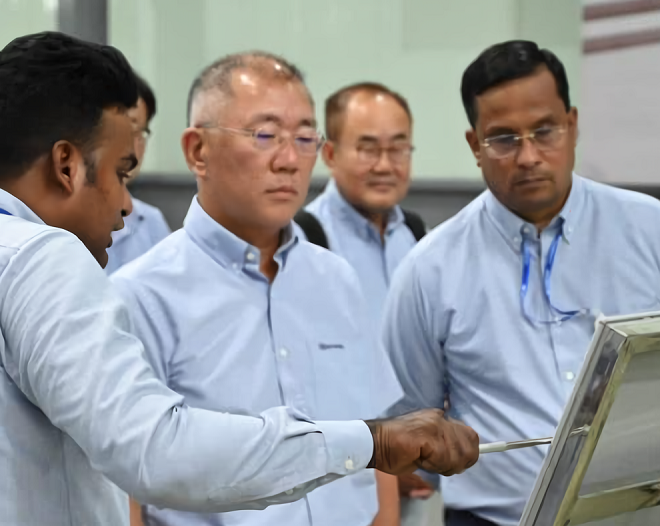
Hyundai Motor Group Chairman Chung Eui-sun (C) visits Hyundai Motor's Chennai plant in India on Aug. 8, 2023. Photo: Hyundai Motor
이미지 확대보기
India is Hyundai's second largest overseas market after the United States. It has become even more important since China's slowing growth and Russia's withdrawal. Hyundai Motor India (HMI) had sales of KRW 10.63 trillion last year. It is the third largest after the United States (HMA, KRW 40.82 trillion) and Europe (HME, KRW 17.66 trillion). HMI's net profit was KRW 921.1 billion, second only to the United States (KRW 2.78 trillion), and more than the combined net profit of its five overseas subsidiaries, excluding China (KRW 517 billion).
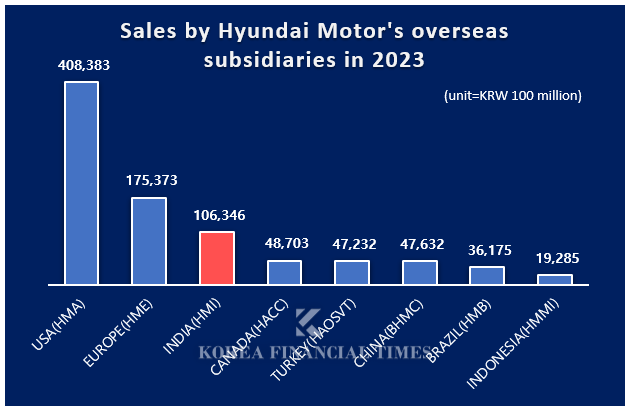
Chart prepared by = Korea Financial Times
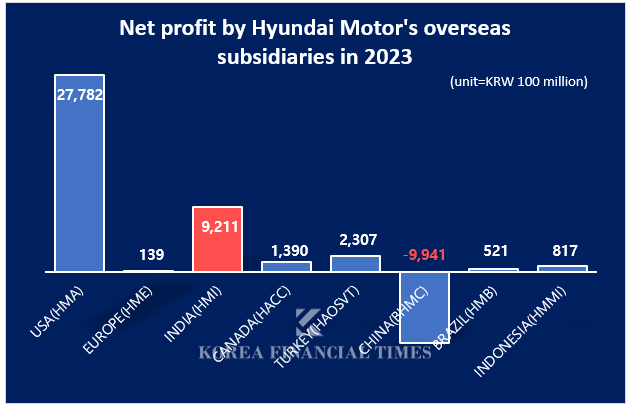
Chart prepared by = Korea Financial Times
Hyundai broke its annual sales record last year, selling 602,111 vehicles. Its market share was 14.6 %, ranking it second in the industry. The top spot went to Maruti Suzuki, an Indo-Japanese joint venture that first listed on the Indian stock market in 2003. Hyundai is the second automaker to list on the Indian stock market.
Hyundai aims to establish an annual production system of 1 million vehicles in India in the second half of next year. In addition to its existing Chennai plant (824,000 units), it will start up its Pune plant, which it acquired from GM last year.
In addition, the company has a blueprint to take the lead in the industry transition by introducing five EV models by 2030, including the strategic EV Creta EV. The strategy is not only to sell electric vehicles but also to lead the construction of an electrification ecosystem by expanding electric vehicle charging stations and collaborating with an Indian battery company (Exide Energy).
Hyundai Motor India's IPO last week was a success and is expected to raise around KRW 4.5 trillion. It is the largest IPO in the history of the Indian stock market. Hyundai Motor conducted the IPO by publicly selling 17.5% of its 100% stake in Indian subsidiaries, not issuing new shares. It prioritized raising cash that it could get its hands on immediately.
Some say that Hyundai Motor's preemptive entry into the Indian stock market is an adventurer. Despite India's growth potential, local political and labor risks are also a reason why global companies are reluctant to enter the country directly. GM's withdrawal from India was ostensibly due to poor profitability, but local policy uncertainty also played a role.
Gwak Horyung (horr@fntimes.com)












![LG 구광모의 선택 ‘AI와 실행력ʼ [2027 인사 풍향계]](https://cfnimage.commutil.kr/phpwas/restmb_setimgmake.php?pp=006&w=69&h=45&m=5&simg=20261023212104086660dd55077bc212411124362.jpg&nmt=18)

![12개월 최고 연 4.10%…JT친애저축은행 '비대면 정기예금'[이주의 저축은행 예금금리-10월 4주]](https://cfnimage.commutil.kr/phpwas/restmb_setimgmake.php?pp=006&w=69&h=45&m=5&simg=202610241728500877007c96e7978011215281239.jpg&nmt=18)
![24개월 최고 연 4.10%…OK저축은행 'OK e-안심정기예금'[이주의 저축은행 예금금리-10월 4주]](https://cfnimage.commutil.kr/phpwas/restmb_setimgmake.php?pp=006&w=69&h=45&m=5&simg=202610241739030963907c96e7978011215281239.jpg&nmt=18)


![[그래픽 뉴스] ‘순대’가 경제용어라고? 순(純)대외자산, 한국의 진짜 해외자산은 얼마일까?](https://cfnimage.commutil.kr/phpwas/restmb_setimgmake.php?pp=006&w=298&h=298&m=1&simg=202609021356075202de68fcbb3512411124362_0.jpg&nmt=18)
![[그래픽 뉴스] ISA 대개편! 나에게 유리한 계좌는?](https://cfnimage.commutil.kr/phpwas/restmb_setimgmake.php?pp=006&w=298&h=298&m=1&simg=202608041713155615de68fcbb3512411124362_0.jpg&nmt=18)
![[그래픽 뉴스] 미국 증시 새로운 키워드 'MANGOS'](https://cfnimage.commutil.kr/phpwas/restmb_setimgmake.php?pp=006&w=298&h=298&m=1&simg=202607291740382069de68fcbb3512411124362_0.jpg&nmt=18)

![[그래픽 뉴스] 은퇴후 30년 부모님 세대의 생존전략](https://cfnimage.commutil.kr/phpwas/restmb_setimgmake.php?pp=006&w=298&h=298&m=1&simg=202606301704439153de68fcbb3512411124362_0.jpg&nmt=18)
![[신간] 장애가 가르쳐준 삶의 의미...목진석 9단 아버지 목이균씨의 자서전](https://cfnimage.commutil.kr/phpwas/restmb_setimgmake.php?pp=006&w=81&h=123&m=5&simg=20261023093852062530f8caa4a5ce12411124362.jpg&nmt=18)
![[신간]은퇴연옥…김경록의 은퇴 후 삶의 나침반](https://cfnimage.commutil.kr/phpwas/restmb_setimgmake.php?pp=006&w=81&h=123&m=5&simg=20260414140833047280f8caa4a5ce12411124362.jpg&nmt=18)
![[안현정 서평] 플랫폼의 영지에서 ‘미학적 주권’을 선포하라...'K가 죽어야 K가 산다' 장준환 著](https://cfnimage.commutil.kr/phpwas/restmb_setimgmake.php?pp=006&w=81&h=123&m=5&simg=20260527121426063220c1c16452b012411124362.jpg&nmt=18)
![[서평] 추세 매매의 대가들...추세추종 투자전략의 대가 14인 인터뷰](https://cfnimage.commutil.kr/phpwas/restmb_setimgmake.php?pp=006&w=81&h=123&m=5&simg=2023102410444004986c1c16452b0175114235199.jpg&nmt=18)


![[머니무브 2026] “지금 사도 될까?” 답이 안 보인다면…하반기 투자, 4명의 전문가에게 물어보세요](https://cfnimage.commutil.kr/phpwas/restmb_setimgmake.php?pp=006&w=89&h=45&m=1&simg=202609151044050355302a735e27af12411124362.jpg&nmt=18)
![[AD] ‘PBV 라인업 확장’ 기아, 9월 독일서 ‘PV7’ 첫 공개](https://cfnimage.commutil.kr/phpwas/restmb_setimgmake.php?pp=006&w=89&h=45&m=1&simg=2026083111010602815074925877361231180222.jpg&nmt=18)
![[AD] 제네시스, 럭셔리 경험 더한 ‘2027 GV70’‧‘GV70 그래파이트’ 출시](https://cfnimage.commutil.kr/phpwas/restmb_setimgmake.php?pp=006&w=89&h=45&m=1&simg=20260702143546085600749258773622211122717.jpg&nmt=18)