






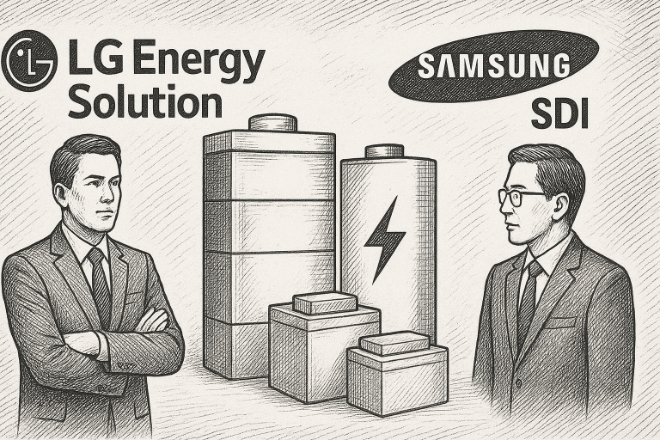
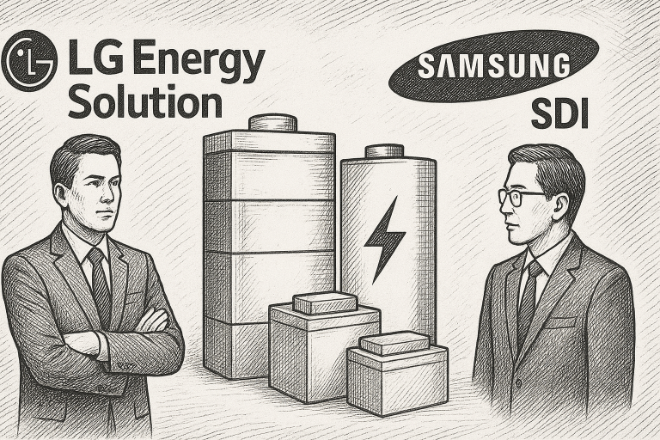
Through this strategy, both companies aim to aggressively secure orders, capitalizing on the weakened influence of Chinese ESS manufacturers in the U.S. due to tariffs and regulations.
According to Samsung SDI, on the 10th, the company is participating in 'RE+ (Renewable Energy Plus) 2025', North America's largest energy industry exhibition currently held in Las Vegas, where it has unveiled its locally optimized next-generation battery product lineup.
The highlight products showcased by Samsung SDI at this event are the next-generation Solid Battery Blocks (SBBs), namely 'SBB 1.7' and 'SBB 2.0'. These products, revealed for the first time at the exhibition, are slated for local production in the U.S. starting next year.
Among these, SBB 2.0 marks Samsung SDI's debut LFP battery product. Until now, Samsung SDI had primarily focused on ternary NCA (Nickel-Cobalt-Aluminum) batteries, unlike its competitors. While NCA batteries offer higher energy density and larger capacity than LFP, their higher manufacturing cost has posed challenges in price competitiveness.
SBB 2.0 features Samsung SDI's proprietary prismatic form factor, incorporating differentiated materials and electrode plate technology. This innovation overcomes the low energy density, a common drawback of existing LFP batteries, while maximizing advantages such as safety and cost-effectiveness. Samsung SDI plans to offer customized solutions to customers by leveraging both SBB 2.0 and SBB 1.7, which is equipped with ternary NCA batteries.
While Samsung SDI unveiled its first LFP battery product, LG Energy Solution introduced prismatic batteries, a segment where Samsung SDI has traditionally excelled. This marks LG Energy Solution's first presentation of prismatic ESS batteries.
SK, LG, LOTTE: 'Secure Cash!' — Restructuring, Liquidity Drive 'All-In'LG Chem’s Shin Hak-cheol Issues KRW 1.4T in Exchangeable Bonds Alongside Push to Sell Non-Core AssetsLG Energy Solution, Samsung SDI and SK-on Aim for 'K-Battery Comeback'LG Energy Solution, Samsung SDI, SK On Brace for Prolonged EV Battery SlumpKoo Kwang-mo, Chairman of LG Group: A Keen Eye for Technology Nurtured in Engineering School
To achieve this, LG Energy Solution began the full-scale local mass production of LFP batteries for ESS at its Michigan plant in the second quarter of this year, an industry first in the U.S. This initiative has established a 'Made-in-USA' foundation, ensuring stable supply to local customers and enabling customers to benefit from IRA (Inflation Reduction Act) incentives for ESS installations manufactured in North America.
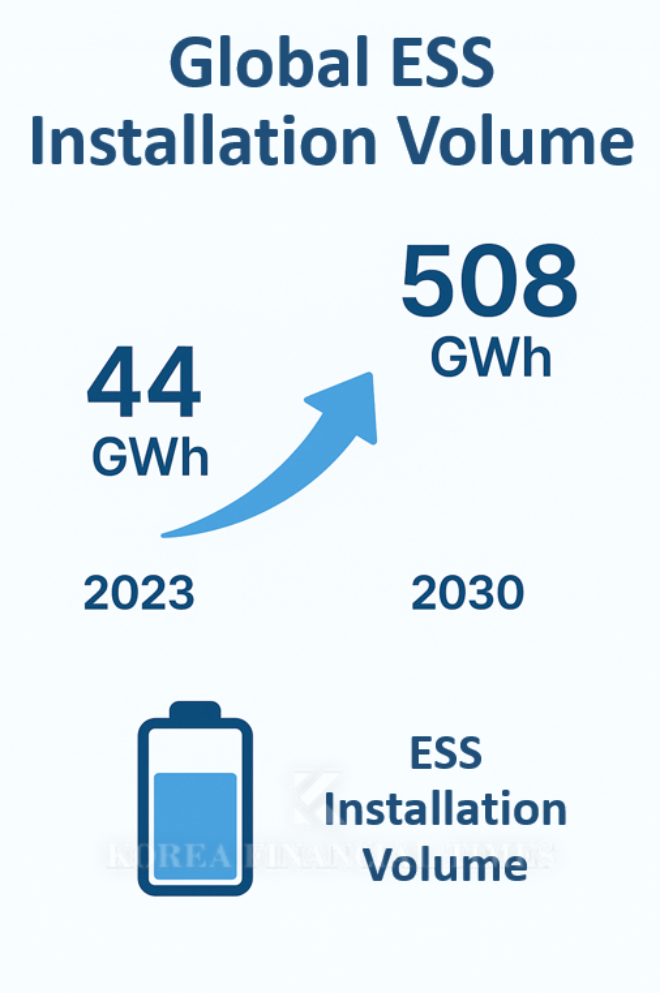
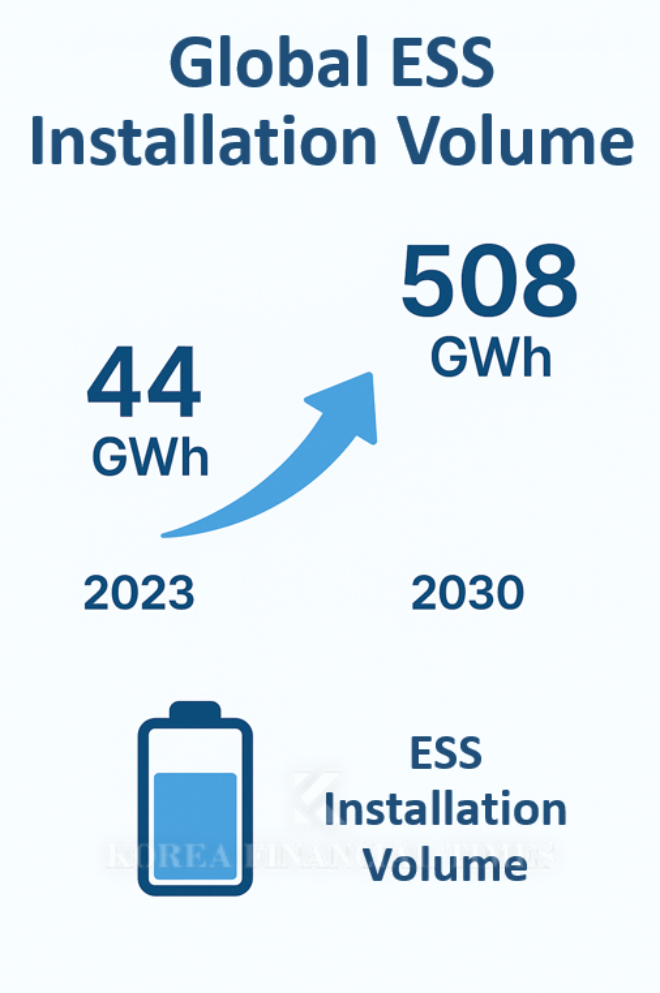
The primary reason both companies are publicly showcasing new battery products and technologies in the U.S. is the intense competition for orders. The Korea Energy Economics Institute projects that the global ESS installation capacity, which stood at only 44 gigawatt-hours (GWh) in 2023, will expand to 508 GWh by 2030. In particular, the U.S. ESS market is growing rapidly due to increasing electricity demand driven by the surging AI boom.
Furthermore, the diminished influence of Chinese ESS manufacturers in the U.S. market, due to tariff policies and regulations imposed by the Trump administration, presents an opportunity for Korean companies. Currently, the U.S. imposes a 40.9% tariff on Chinese-made ESS batteries, which is expected to increase to 58.4% next year.
Another factor driving Korean battery companies' vigorous pursuit of ESS orders is the accelerated discontinuation of electric vehicle subsidies in the U.S. Starting late this month, the maximum USD 7,500 electric vehicle tax credit will be abolished. The original scheduled date for the subsidy repeal was 2032, meaning it has been brought forward by approximately seven years.
Kim JaeHun (rlqm93@fntimes.com)











![[THE COMPASS] 한미사이언스 경영권 분쟁, 신동국이 주도하는 ‘종식’ 게임](https://cfnimage.commutil.kr/phpwas/restmb_setimgmake.php?pp=006&w=69&h=45&m=5&simg=20261008122108000710a837df649412411124362.jpg&nmt=18)

![영업익 53% 뛴다는데…대웅제약 몸값 누르는 두 가지 변수 [5대 제약사 3Q 실적 ④]](https://cfnimage.commutil.kr/phpwas/restmb_setimgmake.php?pp=006&w=69&h=45&m=5&simg=202610081106100618007fd637f543112168227135.jpg&nmt=18)

![[기고] 앞으로 10년 뒤, 당신의 예금 통장은 과연 안전할까](https://cfnimage.commutil.kr/phpwas/restmb_setimgmake.php?pp=006&w=69&h=45&m=5&simg=20261008135710064190c1c16452b012411124362.jpg&nmt=18)


![[그래픽 뉴스] ‘순대’가 경제용어라고? 순(純)대외자산, 한국의 진짜 해외자산은 얼마일까?](https://cfnimage.commutil.kr/phpwas/restmb_setimgmake.php?pp=006&w=298&h=298&m=1&simg=202609021356075202de68fcbb3512411124362_0.jpg&nmt=18)
![[그래픽 뉴스] ISA 대개편! 나에게 유리한 계좌는?](https://cfnimage.commutil.kr/phpwas/restmb_setimgmake.php?pp=006&w=298&h=298&m=1&simg=202608041713155615de68fcbb3512411124362_0.jpg&nmt=18)
![[그래픽 뉴스] 미국 증시 새로운 키워드 'MANGOS'](https://cfnimage.commutil.kr/phpwas/restmb_setimgmake.php?pp=006&w=298&h=298&m=1&simg=202607291740382069de68fcbb3512411124362_0.jpg&nmt=18)

![[그래픽 뉴스] 은퇴후 30년 부모님 세대의 생존전략](https://cfnimage.commutil.kr/phpwas/restmb_setimgmake.php?pp=006&w=298&h=298&m=1&simg=202606301704439153de68fcbb3512411124362_0.jpg&nmt=18)
![[신간]은퇴연옥…김경록의 은퇴 후 삶의 나침반](https://cfnimage.commutil.kr/phpwas/restmb_setimgmake.php?pp=006&w=81&h=123&m=5&simg=20260414140833047280f8caa4a5ce12411124362.jpg&nmt=18)
![[신간] 물처럼 흐르고 원칙으로 서다…김용환의 통찰을 담다](https://cfnimage.commutil.kr/phpwas/restmb_setimgmake.php?pp=006&w=81&h=123&m=5&simg=20260409114249027860f8caa4a5ce12411124362.jpg&nmt=18)
![[안현정 서평] 플랫폼의 영지에서 ‘미학적 주권’을 선포하라...'K가 죽어야 K가 산다' 장준환 著](https://cfnimage.commutil.kr/phpwas/restmb_setimgmake.php?pp=006&w=81&h=123&m=5&simg=20260527121426063220c1c16452b012411124362.jpg&nmt=18)
![[서평] 추세 매매의 대가들...추세추종 투자전략의 대가 14인 인터뷰](https://cfnimage.commutil.kr/phpwas/restmb_setimgmake.php?pp=006&w=81&h=123&m=5&simg=2023102410444004986c1c16452b0175114235199.jpg&nmt=18)


![[머니무브 2026] “지금 사도 될까?” 답이 안 보인다면…하반기 투자, 4명의 전문가에게 물어보세요](https://cfnimage.commutil.kr/phpwas/restmb_setimgmake.php?pp=006&w=89&h=45&m=1&simg=202609151044050355302a735e27af12411124362.jpg&nmt=18)
![[AD] ‘PBV 라인업 확장’ 기아, 9월 독일서 ‘PV7’ 첫 공개](https://cfnimage.commutil.kr/phpwas/restmb_setimgmake.php?pp=006&w=89&h=45&m=1&simg=2026083111010602815074925877361231180222.jpg&nmt=18)
![[AD] 제네시스, 럭셔리 경험 더한 ‘2027 GV70’‧‘GV70 그래파이트’ 출시](https://cfnimage.commutil.kr/phpwas/restmb_setimgmake.php?pp=006&w=89&h=45&m=1&simg=20260702143546085600749258773622211122717.jpg&nmt=18)