






The U.S. is expected to cut its benchmark interest rate in September due to a slowdown in the domestic economy caused by surging consumer prices and job insecurity. Wall Street analysts are highly speculating that the US will take this opportunity to make a 'big cut' of up to 0.5 percentage points.
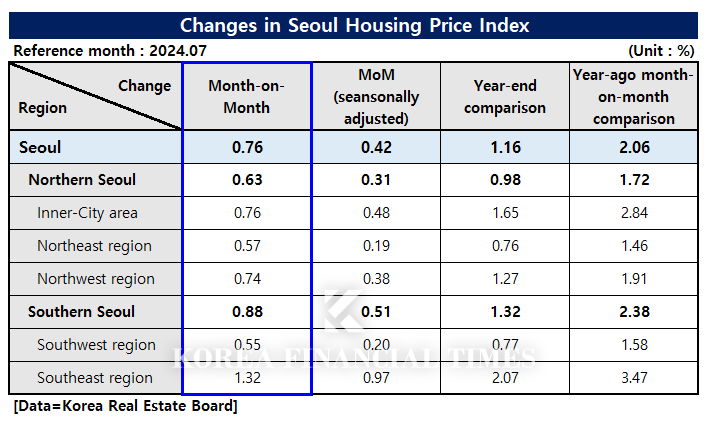
The problem is Korea's situation. According to the Korea Real Estate Board(REB), weekly apartment price trends nationwide for the second week of August 2024 (as of Aug. 12) showed a 0.08% increase in sales prices and a 0.07% increase in rental prices. On a monthly basis, the Seoul residential (apartment, townhouse, and detached house) price index for July was up 0.76% from June. This was the largest increase in four years and seven months since December 2019 (0.86%).
On top of that, experts say that the price of apartments in Seoul has been on the rise for more than 60 weeks, and the spark for the rise in apartment sales prices remains large. The prospect of a decrease in new occupancy next year also adds to concerns over soaring housing prices.
In response, experts believe that the Bank of Korea is likely not to cut its benchmark interest rate in September. Experts generally predict that if the U.S. Federal Reserve lowers its policy interest rate (basic interest rate) in September as expected, the Bank of Korea will only start lowering it in October or November after checking household loans and real estate stability following the implementation of the second stage of the stress total debt repayment ratio (DSR).
Only the five major commercial banks (KB Kookmin, Shinhan, Hana, Woori, and NH Nonghyup) had more household loans by 4.1795 trillion won by the middle of this month. Lee Chang-yong, governor of the Bank of Korea, said after freezing the benchmark interest rate for 12 consecutive months last month, "All members of the Monetary Policy Committee agreed that the Bank of Korea should not make a mistake in triggering a rise in housing prices by excessively supplying liquidity or giving a wrong signal about the timing of a rate cut."
The key is how much the second stage of stress DSR, which is scheduled to be implemented in September, will affect the market. Stress DSR is a system that calculates the loan limit by imposing a certain level of additional interest rate (stress rate) when calculating DSR in preparation for the possibility that borrowers using variable-rate loans will increase their burden of repayment of principal and interest due to rising interest rates during the loan period.
In February this year, the government introduced a first-stage measure to apply 25 percent of the basic stress rate to bank mortgage loans.
Starting from the second half of the year, the government was scheduled to implement a two-stage measure to apply 50 percent of the stress rate to bank mortgage loans, credit loans and second-tier mortgage loans, but it was pushed back by two months to September. The government said it will raise the weight applied to the basic stress rate of 1.5 percent to 50 percent from September 1, and apply the stress rate to 0.75%. In addition, the application will be expanded to include bank credit loans and second-tier mortgage loans, but credit loans will be limited to cases where the balance exceeds 100 million won.
“If the bomb of a rate cut is dropped while Seoul real estate is exploding like it is now, the house price explosion, which has been limited to Seoul, will spread from the metropolitan area to the provinces, causing tremendous chaos,” said a real estate expert. ”We have maintained interest rates in the 3% range without raising them to the 5% range while the U.S. raised interest rates to the 5% range, so even if the U.S. makes a big cut, it will not be easy for us to make such a cut because of the risks of decreasing foreign exchange reserves.”
Jang Hosung (hs6776@fntimes.com)














![[그래픽 뉴스] 은퇴후 30년 부모님 세대의 생존전략](https://cfnimage.commutil.kr/phpwas/restmb_setimgmake.php?pp=006&w=298&h=298&m=1&simg=202606301704439153de68fcbb3512411124362_0.jpg&nmt=18)
![[그래픽 뉴스] 퇴근 후 주차했는데 수익 발생? V2G의 정체](https://cfnimage.commutil.kr/phpwas/restmb_setimgmake.php?pp=006&w=298&h=298&m=1&simg=202605131656357745de68fcbb3512411124362_0.jpg&nmt=18)
![[그래픽 뉴스] “전쟁 신호를 읽는 가장 이상한 방법, 피자 주문량”](https://cfnimage.commutil.kr/phpwas/restmb_setimgmake.php?pp=006&w=298&h=298&m=1&simg=202604151704028482de68fcbb3512411124362_0.jpg&nmt=18)
![[그래픽 뉴스] 트럼프의 ‘타코 한 입’에 흔들린 시장의 비밀](https://cfnimage.commutil.kr/phpwas/restmb_setimgmake.php?pp=006&w=298&h=298&m=1&simg=202604031646576130de68fcbb3512411124362_0.jpg&nmt=18)
![[신간]은퇴연옥…김경록의 은퇴 후 삶의 나침반](https://cfnimage.commutil.kr/phpwas/restmb_setimgmake.php?pp=006&w=81&h=123&m=5&simg=20260414140833047280f8caa4a5ce12411124362.jpg&nmt=18)
![[신간] 물처럼 흐르고 원칙으로 서다…김용환의 통찰을 담다](https://cfnimage.commutil.kr/phpwas/restmb_setimgmake.php?pp=006&w=81&h=123&m=5&simg=20260409114249027860f8caa4a5ce12411124362.jpg&nmt=18)
![[안현정 서평] 플랫폼의 영지에서 ‘미학적 주권’을 선포하라...'K가 죽어야 K가 산다' 장준환 著](https://cfnimage.commutil.kr/phpwas/restmb_setimgmake.php?pp=006&w=81&h=123&m=5&simg=20260527121426063220c1c16452b012411124362.jpg&nmt=18)
![[서평] 추세 매매의 대가들...추세추종 투자전략의 대가 14인 인터뷰](https://cfnimage.commutil.kr/phpwas/restmb_setimgmake.php?pp=006&w=81&h=123&m=5&simg=2023102410444004986c1c16452b0175114235199.jpg&nmt=18)

![[AD] 제네시스, 럭셔리 경험 더한 ‘2027 GV70’‧‘GV70 그래파이트’ 출시](https://cfnimage.commutil.kr/phpwas/restmb_setimgmake.php?pp=006&w=89&h=45&m=1&simg=20260702143546085600749258773622211122717.jpg&nmt=18)
![[AD] 개소세 혜택 종료…현대차, ‘썸머 페스타’로 고객 부담 완화](https://cfnimage.commutil.kr/phpwas/restmb_setimgmake.php?pp=006&w=89&h=45&m=1&simg=20260702142355004830749258773622211122717.jpg&nmt=18)
![[AD] 기아 ‘디 올 뉴 셀토스’, 인도 타임스 드라이브 어워즈서 ‘올해의 SUV’ 선정](https://cfnimage.commutil.kr/phpwas/restmb_setimgmake.php?pp=006&w=89&h=45&m=1&simg=202605071156400590007492587736124111243152.jpg&nmt=18)
![[AD]‘그랜저 잡자’ 기아, 상품성 더한 ‘The 2027 K8’ 출시](https://cfnimage.commutil.kr/phpwas/restmb_setimgmake.php?pp=006&w=89&h=45&m=1&simg=2026042110193702730074925877361211627527.jpg&nmt=18)
![[카드뉴스] KT&G, ‘CDP’ 기후변화·수자원 관리 부문 우수기업 선정](https://cfnimage.commutil.kr/phpwas/restmb_setimgmake.php?pp=006&w=89&h=45&m=1&simg=202603241415423015de68fcbb3512411124362_0.png&nmt=18)