






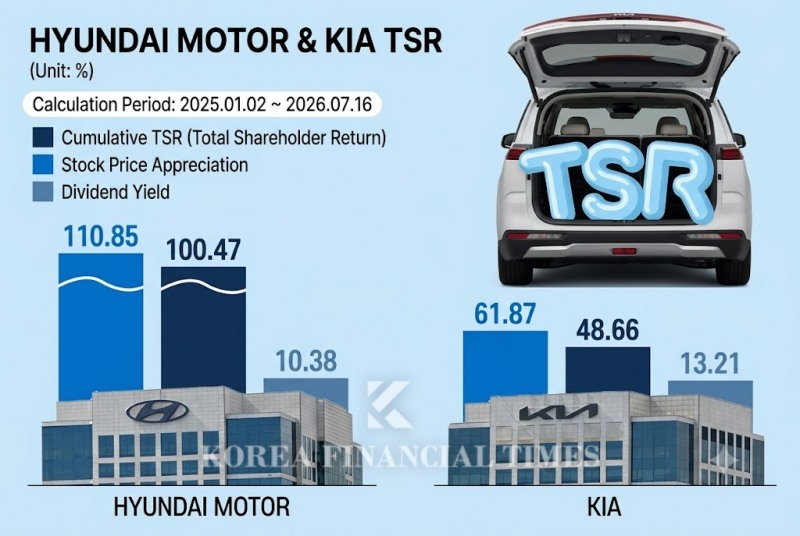
This infographic, originally published by Korea Financial Times, has been reconstructed using generative AI.
이미지 확대보기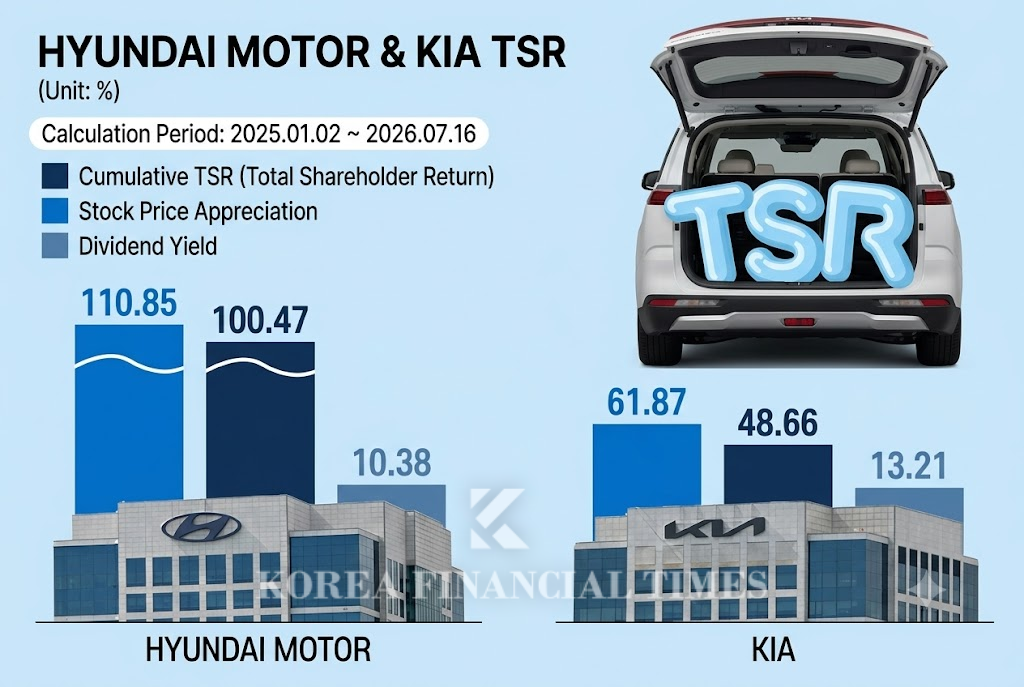
Yet a look at Total Shareholder Return (TSR) for the two companies raises questions. Despite Kia's stronger earnings, its TSR stood at just 60%, while Hyundai's reached 110% — nearly double. The gap reflects the added premium investors place on Hyundai as it leads future businesses such as robotics and AI (artificial intelligence), even though Kia's core operations performed better.
Market analysts view Kia as undervalued relative to its earnings when compared with Hyundai. Given Kia's solid core business performance, they expect the valuation gap with Hyundai to narrow as Kia's role in the group's robotics business expands going forward.
TSR: Hyundai 110%, Kia 61%
Korea Financial Times calculated the cumulative TSR of Hyundai Motor and Kia using the corporate data platform DeepSearch. TSR combines the rate of stock price change and dividend yield over a given period, representing the total return shareholders earn from investing in a company's stock.The calculation period spans roughly one year and seven months, from the first trading day of 2025 (January 2) to July 16 this year.
The results showed cumulative TSR of 110.85% for Hyundai and 61.87% for Kia. In other words, an initial investment of KRW 10 million by shareholders in each company would now be worth approximately KRW 21 million for Hyundai and KRW 16.1 million for Kia.
The divide between the two came down to stock price returns. Kia led in dividend yield at 13.21%, ahead of Hyundai's 10.38%. However, in stock price appreciation, Hyundai's 100.47% surge more than doubled Kia's 48.66%.
As affiliates of the same group, both companies faced a mix of headwinds and tailwinds last year — including global uncertainties such as U.S. tariffs and developments involving Boston Dynamics' humanoid robot "Atlas." In terms of operating profitability, however, Kia outperformed Hyundai. Even so, Hyundai's stock came out ahead.
Kia has maintained a double-digit operating margin over the past three years, while Hyundai has been unable to break out of single digits.
On a consolidated basis, Hyundai posted second-quarter revenue of KRW 49.2153 trillion and operating profit of KRW 2.8509 trillion this year. Revenue grew 1.9% year-on-year, but operating profit fell 20.8%. Kia posted second-quarter revenue of KRW 33.037 trillion and operating profit of KRW 2.6285 trillion, with revenue up 12.6% to a record quarterly high. While operating profit fell 4.9% over the same period, this was seen as a relatively strong showing compared with Hyundai.
In the first half of this year, Kia sold approximately 1.63 million vehicles at home and abroad, marking a record first-half sales volume. Hyundai sold approximately 1.97 million vehicles over the same period — more than Kia in absolute terms, but its first time falling below 2 million units in the first half since 2022, four years ago.
Kia lifted sales evenly across Europe, India, and the domestic market through an EV lineup spanning subcompact to large models. In North America, it expanded its high-value-added lineup with hybrid-equipped models such as the Telluride. In the commercial vehicle segment, Kia is also moving quickly to capture early electrification share with its PBV model, the "PV5."
Hyundai, by contrast, saw sales decline in most regions outside North America due to delayed new model launches and gaps in its EV lineup. Notably, in the domestic market, Hyundai trailed Kia in new car sales for the first time. According to Carisyou Data Research Institute, Kia's new passenger car registrations totaled 268,868 units from January to June this year, exceeding the combined total of 265,786 units for Hyundai and Genesis by 3,082 units.
Robotics and AI drive the 48% valuation discount
Why does Kia's stock price performance lag despite better operating results than Hyundai?Kia has long been treated as the "younger affiliate," ranking lower in investor preference. Despite strong profitability over the past three years, it has traded at roughly a 20% valuation discount to Hyundai — a gap that has recently widened further. Typically, Hyundai Motor Group's future-business investments are led by Hyundai, with Kia and Hyundai Mobis following. As a result, the premium tied to future businesses such as robotics and AI has been applied more heavily to Hyundai.
Hyundai also invested the most in Boston Dynamics, widely regarded as a key trigger for the group's stock price gains. In Boston Dynamics' KRW 1.3 trillion rights offering last August, Hyundai contributed the largest share at KRW 362.6 billion.
Kia followed with KRW 223.4 billion, and Hyundai Mobis with KRW 146.5 billion. Boston Dynamics' current ownership structure stands at Hyundai Motor (28% stake), Chairman Chung Eui-sun (22.6%), Kia (17.2%), and Hyundai Mobis (11.3%).
Market analysts are increasingly focused on the potential for Kia to be re-rated as its performance emerges from Hyundai's shadow. With solid core earnings as a foundation, they expect Kia's stock to rise as its role in the group's future businesses, including robotics, expands.
At its CEO Investor Day in April, Kia unveiled its vision for factory automation and electrification through expanded robotics operations. Notably, Kia plans to invest a total of KRW 49 trillion over five years, from this year through 2030 — KRW 7 trillion more than its previous plan — with KRW 21 trillion earmarked for future businesses including electrification, autonomous driving, and robotics.
Ha Neul, an analyst at NH Investment & Securities, noted in a recent report that Kia posts the highest profitability among global automakers, yet its recent stock performance runs counter to that solid trajectory. He added that Hyundai's valuation discount versus Kia, which averaged around 22% from 2021 to 2023, has widened to as much as 48%.
He further noted that Kia's expanding role in the rollout of new businesses — a key trigger for the group's stock performance — bears watching, and that the valuation discount could narrow depending on the equity structure to be announced for the robotics production entity.
Lee Jae-il, an analyst at Eugene Investment & Securities, similarly described Kia as a case of "earnings leading, stock price to follow." He said that despite rising sales and improving profitability, Kia's relative stock performance has lagged as its valuation gap with Hyundai widened, and that the gap is expected to narrow on the back of strong earnings.
Kim JaeHun (rlqm93@fntimes.com)












![24개월 최고 연 4.00%…제주은행 'J정기예금(만기지급식)' [이주의 은행 예금금리-10월 4주]](https://cfnimage.commutil.kr/phpwas/restmb_setimgmake.php?pp=006&w=69&h=45&m=5&simg=202610231018530270305e6e69892f222110224119.jpg&nmt=18)
![기관 '한화오션'·외인 '삼성전자'·개인 '삼성전기' 1위 [주간 코스피 순매수- 2026년 10월19일~10월23일]](https://cfnimage.commutil.kr/phpwas/restmb_setimgmake.php?pp=006&w=69&h=45&m=5&simg=20261024171622010220179ad4390711823574140.jpg&nmt=18)
![12개월 최고 연 7.00%…경남은행 '오면우대! 하면우대! 정기적금' [이주의 은행 적금금리-10월 4주]](https://cfnimage.commutil.kr/phpwas/restmb_setimgmake.php?pp=006&w=69&h=45&m=5&simg=202610231103420840305e6e69892f222110224119.jpg&nmt=18)
![12개월 최고 연 4.10%…경남은행 'The든든예금(시즌2)' [이주의 은행 예금금리-10월 4주]](https://cfnimage.commutil.kr/phpwas/restmb_setimgmake.php?pp=006&w=69&h=45&m=5&simg=202610231017430908005e6e69892f222110224119.jpg&nmt=18)
![24개월 최고 연 4.10%…OK저축은행 'OK e-안심정기예금'[이주의 저축은행 예금금리-10월 4주]](https://cfnimage.commutil.kr/phpwas/restmb_setimgmake.php?pp=006&w=69&h=45&m=5&simg=202610241739030963907c96e7978011215281239.jpg&nmt=18)


![[그래픽 뉴스] ‘순대’가 경제용어라고? 순(純)대외자산, 한국의 진짜 해외자산은 얼마일까?](https://cfnimage.commutil.kr/phpwas/restmb_setimgmake.php?pp=006&w=298&h=298&m=1&simg=202609021356075202de68fcbb3512411124362_0.jpg&nmt=18)
![[그래픽 뉴스] ISA 대개편! 나에게 유리한 계좌는?](https://cfnimage.commutil.kr/phpwas/restmb_setimgmake.php?pp=006&w=298&h=298&m=1&simg=202608041713155615de68fcbb3512411124362_0.jpg&nmt=18)
![[그래픽 뉴스] 미국 증시 새로운 키워드 'MANGOS'](https://cfnimage.commutil.kr/phpwas/restmb_setimgmake.php?pp=006&w=298&h=298&m=1&simg=202607291740382069de68fcbb3512411124362_0.jpg&nmt=18)

![[그래픽 뉴스] 은퇴후 30년 부모님 세대의 생존전략](https://cfnimage.commutil.kr/phpwas/restmb_setimgmake.php?pp=006&w=298&h=298&m=1&simg=202606301704439153de68fcbb3512411124362_0.jpg&nmt=18)
![[신간] 장애가 가르쳐준 삶의 의미...목진석 9단 아버지 목이균씨의 자서전](https://cfnimage.commutil.kr/phpwas/restmb_setimgmake.php?pp=006&w=81&h=123&m=5&simg=20261023093852062530f8caa4a5ce12411124362.jpg&nmt=18)
![[신간]은퇴연옥…김경록의 은퇴 후 삶의 나침반](https://cfnimage.commutil.kr/phpwas/restmb_setimgmake.php?pp=006&w=81&h=123&m=5&simg=20260414140833047280f8caa4a5ce12411124362.jpg&nmt=18)
![[안현정 서평] 플랫폼의 영지에서 ‘미학적 주권’을 선포하라...'K가 죽어야 K가 산다' 장준환 著](https://cfnimage.commutil.kr/phpwas/restmb_setimgmake.php?pp=006&w=81&h=123&m=5&simg=20260527121426063220c1c16452b012411124362.jpg&nmt=18)
![[서평] 추세 매매의 대가들...추세추종 투자전략의 대가 14인 인터뷰](https://cfnimage.commutil.kr/phpwas/restmb_setimgmake.php?pp=006&w=81&h=123&m=5&simg=2023102410444004986c1c16452b0175114235199.jpg&nmt=18)


![[머니무브 2026] “지금 사도 될까?” 답이 안 보인다면…하반기 투자, 4명의 전문가에게 물어보세요](https://cfnimage.commutil.kr/phpwas/restmb_setimgmake.php?pp=006&w=89&h=45&m=1&simg=202609151044050355302a735e27af12411124362.jpg&nmt=18)
![[AD] ‘PBV 라인업 확장’ 기아, 9월 독일서 ‘PV7’ 첫 공개](https://cfnimage.commutil.kr/phpwas/restmb_setimgmake.php?pp=006&w=89&h=45&m=1&simg=2026083111010602815074925877361231180222.jpg&nmt=18)
![[AD] 제네시스, 럭셔리 경험 더한 ‘2027 GV70’‧‘GV70 그래파이트’ 출시](https://cfnimage.commutil.kr/phpwas/restmb_setimgmake.php?pp=006&w=89&h=45&m=1&simg=20260702143546085600749258773622211122717.jpg&nmt=18)