






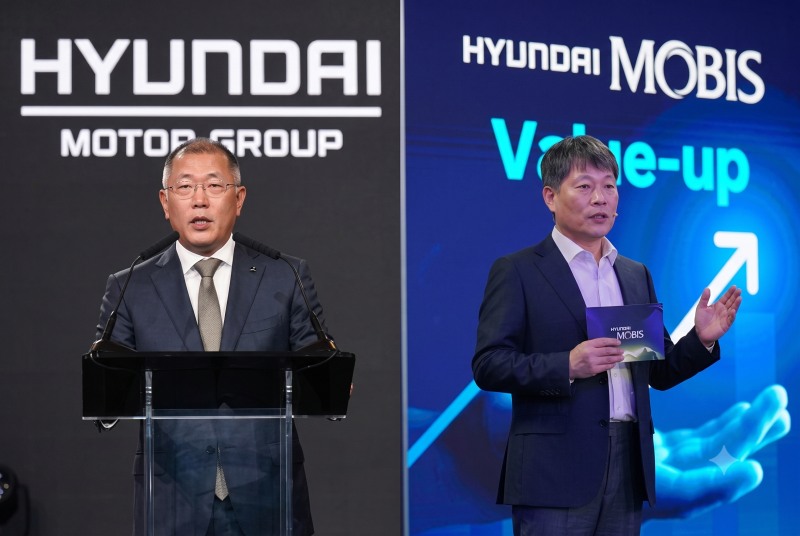
Chung Eui-sun, Chairman of Hyundai Motor Group (left), and Lee Kyu-seok, CEO of Hyundai Mobis. / Recomposed using AI based on photos provided by Hyundai Motor Group and Hyundai Mobis.
이미지 확대보기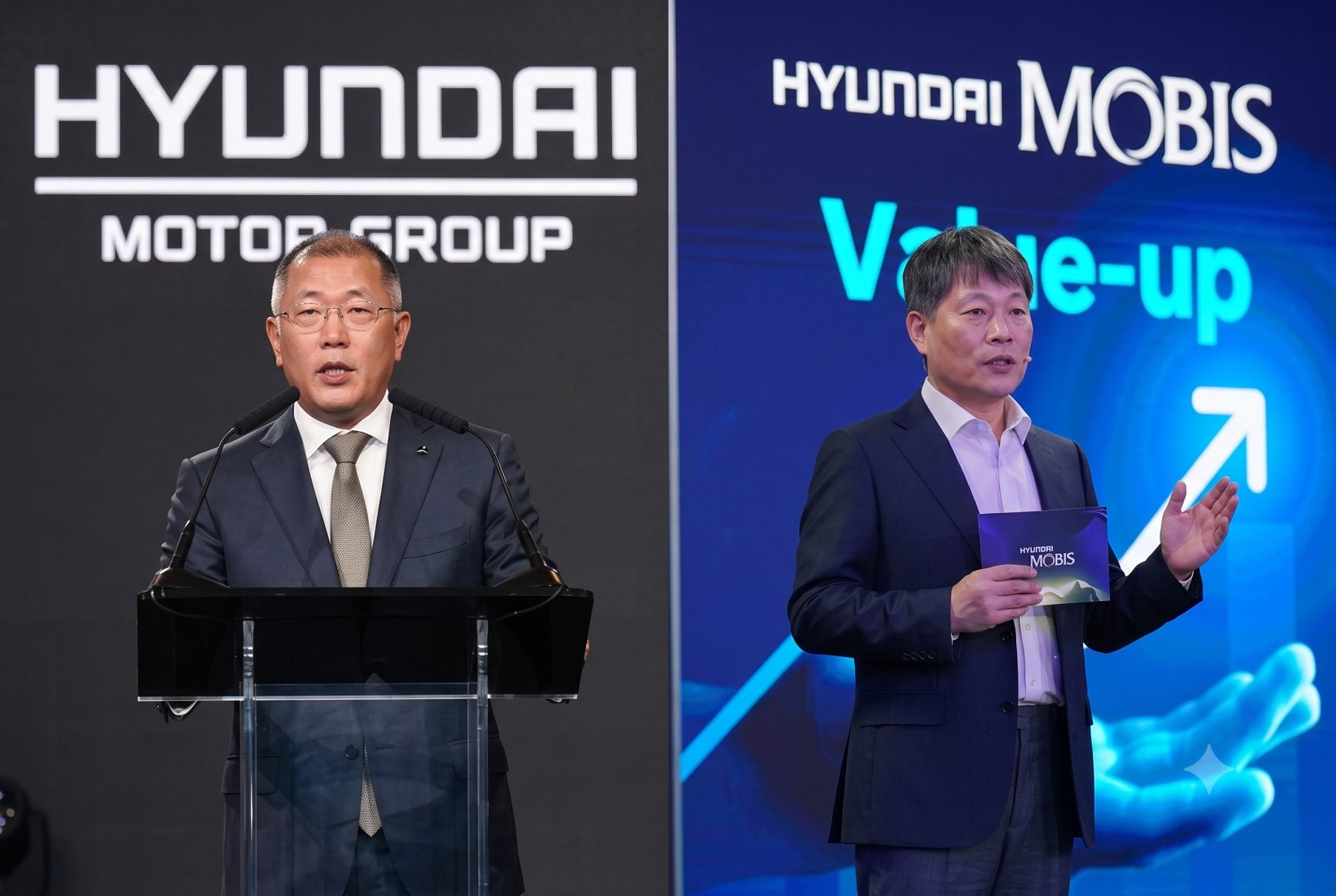
Now, even the robotics business that had been seen as a source of hope is facing a new challenge: price competition from Chinese manufacturers. Industry observers say that for Hyundai Mobis to earn a re-rating to a PBR above 1.0x, it will need to demonstrate process technology and mass-production reliability capable of overcoming China's low-cost offensive.
Hyundai Mobis Dons Robotics, But PBR Still Below 1x
According to the investment banking industry on September 10, Hyundai Mobis's PBR hit a 10-year low of 0.48x at the end of 2024. Since then, it has recovered to around 0.77x as of the end of the first half of this year, driven by an aggressive shareholder-return policy—including active share buybacks and cancellations to raise its total shareholder return (TSR)—along with expectations surrounding its entry into robotics components.Even so, this remains well below a PBR of 1.0x. The valuation discount looks especially deep compared with major global parts makers such as Denso and Continental, which trade above 1.0x PBR.
PBR is a metric that shows how a company's share price compares to its book value. A PBR below 1 means the stock is trading below its book value—which can make the shares an attractive target for investors.
Hyundai Mobis's market capitalization stands at KRW 37.5001 trillion, the largest among domestic auto parts makers. Within Hyundai Motor Group itself, it ranks third, behind core automakers Hyundai Motor (KRW 79.2413 trillion) and Kia (KRW 49.4653 trillion).
The company's first-half results this year were also solid. Hyundai Mobis posted first-half revenue of KRW 31.8852 trillion, up 3.9%, while operating profit rose 8.0% to KRW 1.7778 trillion.
Despite holding the industry's highest market cap and posting steady earnings, Hyundai Mobis has been unable to shake off its undervaluation. Its PBR came in at 0.66x in 2021, 0.49x in 2022, 0.53x in 2023, 0.46x in 2024, and 0.68x in 2025—never exceeding 1.0x over the past five years.
Stock Down 40% in a Month—Is Hyundai Mobis' 'Robot Fantasy' Falling Apart?Robot Joints, 80%-a-Year Growth: Hyundai Mobis, Samsung Electro-Mechanics Lead Korea's Actuator Rush [K-Humanoid Wars ④]Why Is Kia's Stock Lagging Despite Beating Hyundai on Earnings?Hyundai Poised to Buy Out SoftBank's Boston Dynamics Stake as Deadline LoomsHyundai's IPO-Ready Boston Dynamics Runs Into Dual-Listing Roadblock
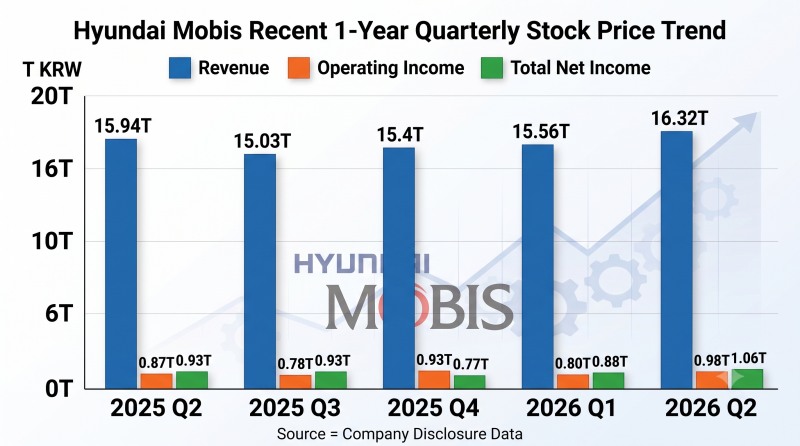
This infographic, originally published by Korea Financial Times, has been reconstructed using generative AI.
이미지 확대보기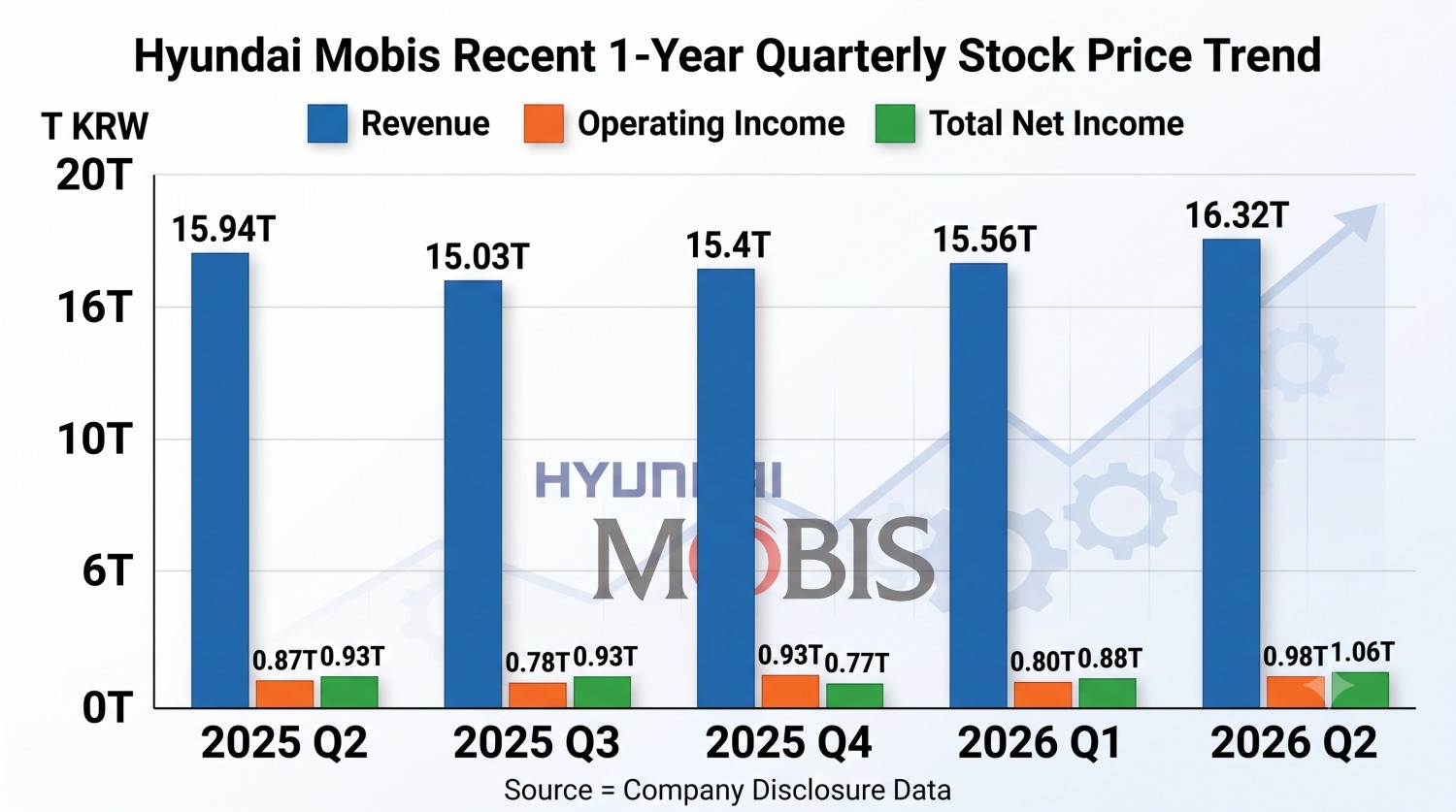
Governance Risk and Heavy Captive Sales Weigh It Down
Behind Hyundai Mobis's undervaluation lies a governance risk that has long drawn criticism. The company sits at the core of the group's circular shareholding chain, which runs from Hyundai Mobis to Hyundai Motor to Kia and back to Hyundai Mobis. Uncertainty stemming from delayed governance reform has persisted for years.The key risk is that if any single affiliate in this circular shareholding chain comes under attack from outside forces, the entire chain of control could collapse. The structure also allows the group's controlling family to exercise control over the whole conglomerate with a relatively small stake—but that same feature has drawn criticism for enabling the controlling family to evade accountability and for fostering inefficient decision-making.
For this reason, when the Lee Jae-myung administration emphasized advancing corporate governance reform last year, Hyundai Mobis drew attention on expectations that the move would accelerate the dismantling of Hyundai Motor Group's circular shareholding structure. Indeed, Hyundai Mobis shares rallied and, for the first time this year, closed above the KRW 300,000 mark on July 3, coinciding with the National Assembly's passage of the revised Commercial Act.
The company's dependence on group affiliates is another key factor behind its undervaluation. Hyundai Mobis grew alongside the expansion of Hyundai Motor and Kia's vehicle output, securing a stable stream of work in the process. But this growth model, built on internal (captive) transactions, carries a critical limitation: the parts maker's fate is entirely tied to the earnings trajectory of the finished-vehicle makers—constraining its ability to secure independent margins and to be evaluated on its global competitiveness.
According to Hyundai Mobis's business reports, the share of its captive sales to Hyundai Motor and Kia has trended upward over the past five years: 82.1% in 2021, 83.9% in 2022, 84.4% in 2023, and 88.7% in 2024. It edged down slightly to 88.2% in 2025—a 0.5 percentage point decline—and stood at around 81% in the second quarter of this year.
Robotics Onboard, But China's Offensive Is the Wild Card
To overcome these structural limitations, Hyundai Mobis has turned to robotics as its relief pitcher. While maintaining its traditional auto parts lineup (lamps, bumpers, etc.), the company is restructuring its business around high-value-added components central to robotics—chiefly actuators, the core drivetrain component, and hand modules.Actuators are the key components that function like human joints and muscles; they account for as much as 40–50% of the total manufacturing cost of a humanoid robot, giving them an outsized share of both cost and margin.
Hyundai Mobis supplies actuators for Atlas, the humanoid robot developed by Boston Dynamics, the group's robotics affiliate. Boston Dynamics plans to produce 30,000 units of Atlas annually starting in 2028, to be deployed at Hyundai Motor Group's major global production sites.
For Hyundai Mobis, which aspires to become a global robotics component supplier, this secures a solid anchor customer. The plan going forward is to expand its customer base to a wider range of robot manufacturers.
The problem is that just as the robotics components market enters a genuine growth phase, it is also entering a fierce game of chicken. Major Chinese auto parts makers such as Tuopu and Minth have already moved swiftly to build their own mass-production systems for robotics actuators, moving to claim an early lead in the global market. The overwhelming cost competitiveness and vertical integration characteristic of China's robotics value chain pose a significant threat to Hyundai Mobis.
In the short term, Hyundai Mobis is expected to benefit from U.S. government restrictions on imports of Chinese-made robots and components. But as it expands beyond captive demand to build a broader customer base among global robot manufacturers, fierce price-cutting competition with Chinese suppliers looms as an unavoidable challenge.
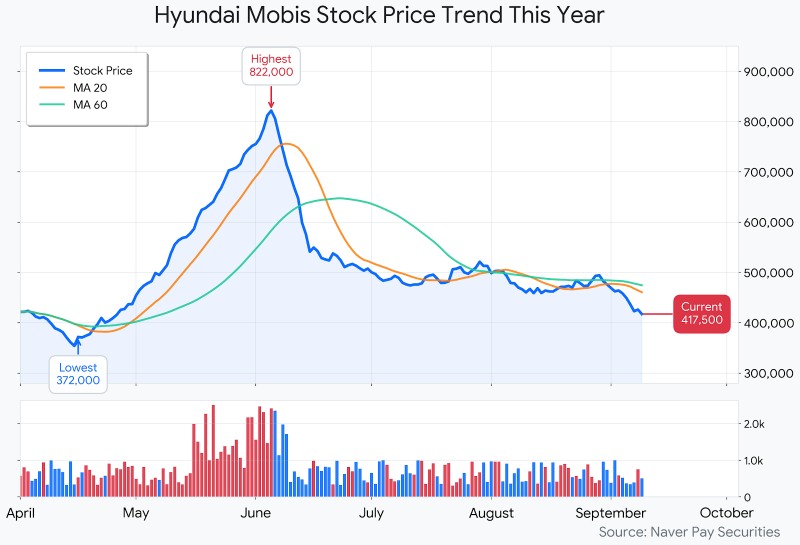
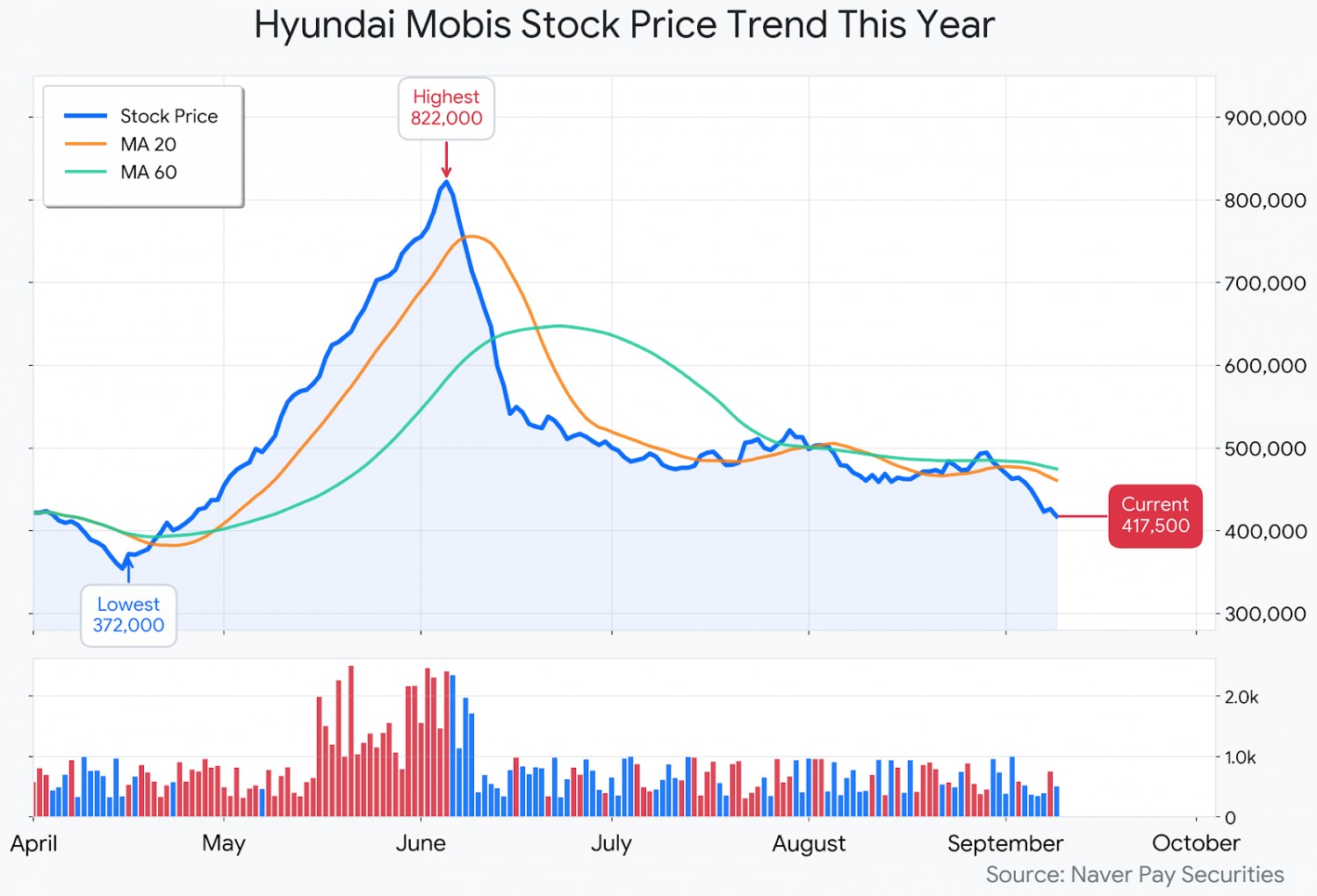
These concerns have already dimmed Hyundai Mobis's robotics premium. Its share price climbed to roughly KRW 820,000 by June, following the company's January announcement of its pivot to robotics. It has since fallen by about 50%, currently trading around the KRW 410,000 level.
An industry source in the securities sector said, "Securing volume with Boston Dynamics carries real significance, but for the market to recognize a re-rating above 1.0x PBR, [Hyundai Mobis] will need to prove process technology and mass-production reliability that can overcome China's low-cost offensive." The source added, "Only once the company presents a clear direction for governance reform, alongside a diversification of orders toward external automakers and robot manufacturers, will it finally be able to break free of the low-PBR trap."
Kim JaeHun (rlqm93@fntimes.com)











!['산 넘어 산' 현대모비스, 순환출자 넘기면 중국발 로봇 경쟁 [저PBR 숨은그림찾기]](https://cfnimage.commutil.kr/phpwas/restmb_setimgmake.php?pp=006&w=69&h=45&m=5&simg=2026090913502608604074925877361231180222.jpg&nmt=18)
![[머니무브 2026 주요 연사에게 미리 듣는다(2)] 김남웅 "토큰증권은 조각투자 아니다…핵심은 금융자산의 온체인 전환”](https://cfnimage.commutil.kr/phpwas/restmb_setimgmake.php?pp=006&w=69&h=45&m=5&simg=202609091620580074502a735e27af12411124362.jpg&nmt=18)


![[머니무브 2026 주요 연사에게 미리 듣는다(3)] 오동석(알상무) “시장 가격보다 돈의 방향 봐야…통화정책 전환 주목”](https://cfnimage.commutil.kr/phpwas/restmb_setimgmake.php?pp=006&w=69&h=45&m=5&simg=202609101136170581902a735e27af12411124362.jpg&nmt=18)


![[그래픽 뉴스] ‘순대’가 경제용어라고? 순(純)대외자산, 한국의 진짜 해외자산은 얼마일까?](https://cfnimage.commutil.kr/phpwas/restmb_setimgmake.php?pp=006&w=298&h=298&m=1&simg=202609021356075202de68fcbb3512411124362_0.jpg&nmt=18)
![[그래픽 뉴스] ISA 대개편! 나에게 유리한 계좌는?](https://cfnimage.commutil.kr/phpwas/restmb_setimgmake.php?pp=006&w=298&h=298&m=1&simg=202608041713155615de68fcbb3512411124362_0.jpg&nmt=18)
![[그래픽 뉴스] 미국 증시 새로운 키워드 'MANGOS'](https://cfnimage.commutil.kr/phpwas/restmb_setimgmake.php?pp=006&w=298&h=298&m=1&simg=202607291740382069de68fcbb3512411124362_0.jpg&nmt=18)

![[그래픽 뉴스] 은퇴후 30년 부모님 세대의 생존전략](https://cfnimage.commutil.kr/phpwas/restmb_setimgmake.php?pp=006&w=298&h=298&m=1&simg=202606301704439153de68fcbb3512411124362_0.jpg&nmt=18)
![[신간]은퇴연옥…김경록의 은퇴 후 삶의 나침반](https://cfnimage.commutil.kr/phpwas/restmb_setimgmake.php?pp=006&w=81&h=123&m=5&simg=20260414140833047280f8caa4a5ce12411124362.jpg&nmt=18)
![[신간] 물처럼 흐르고 원칙으로 서다…김용환의 통찰을 담다](https://cfnimage.commutil.kr/phpwas/restmb_setimgmake.php?pp=006&w=81&h=123&m=5&simg=20260409114249027860f8caa4a5ce12411124362.jpg&nmt=18)
![[안현정 서평] 플랫폼의 영지에서 ‘미학적 주권’을 선포하라...'K가 죽어야 K가 산다' 장준환 著](https://cfnimage.commutil.kr/phpwas/restmb_setimgmake.php?pp=006&w=81&h=123&m=5&simg=20260527121426063220c1c16452b012411124362.jpg&nmt=18)
![[서평] 추세 매매의 대가들...추세추종 투자전략의 대가 14인 인터뷰](https://cfnimage.commutil.kr/phpwas/restmb_setimgmake.php?pp=006&w=81&h=123&m=5&simg=2023102410444004986c1c16452b0175114235199.jpg&nmt=18)


![[AD] ‘PBV 라인업 확장’ 기아, 9월 독일서 ‘PV7’ 첫 공개](https://cfnimage.commutil.kr/phpwas/restmb_setimgmake.php?pp=006&w=89&h=45&m=1&simg=2026083111010602815074925877361231180222.jpg&nmt=18)
![[AD] 제네시스, 럭셔리 경험 더한 ‘2027 GV70’‧‘GV70 그래파이트’ 출시](https://cfnimage.commutil.kr/phpwas/restmb_setimgmake.php?pp=006&w=89&h=45&m=1&simg=20260702143546085600749258773622211122717.jpg&nmt=18)
![[AD] 개소세 혜택 종료…현대차, ‘썸머 페스타’로 고객 부담 완화](https://cfnimage.commutil.kr/phpwas/restmb_setimgmake.php?pp=006&w=89&h=45&m=1&simg=20260702142355004830749258773622211122717.jpg&nmt=18)
![[AD] 기아 ‘디 올 뉴 셀토스’, 인도 타임스 드라이브 어워즈서 ‘올해의 SUV’ 선정](https://cfnimage.commutil.kr/phpwas/restmb_setimgmake.php?pp=006&w=89&h=45&m=1&simg=202605071156400590007492587736124111243152.jpg&nmt=18)
![[AD]‘그랜저 잡자’ 기아, 상품성 더한 ‘The 2027 K8’ 출시](https://cfnimage.commutil.kr/phpwas/restmb_setimgmake.php?pp=006&w=89&h=45&m=1&simg=2026042110193702730074925877361211627527.jpg&nmt=18)