






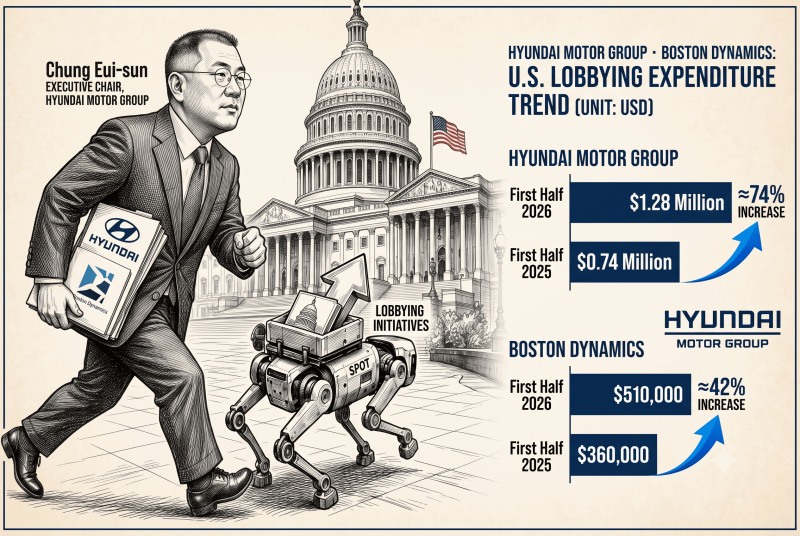
This infographic, originally published by Korea Financial Times, has been reconstructed using generative AI.
이미지 확대보기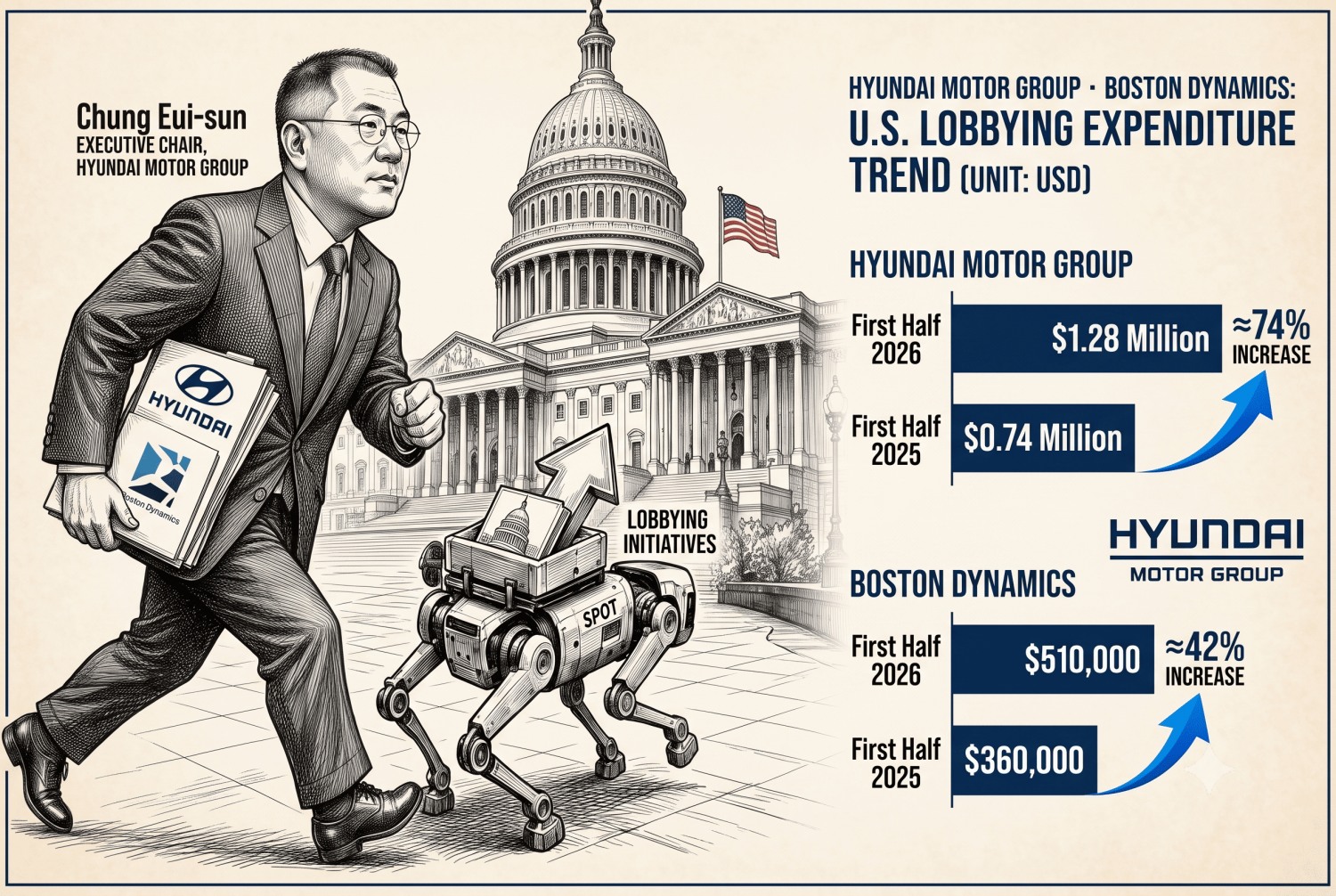
What stands out is that the robotics industry has newly emerged on the lobbying agenda, which had previously focused on automotive industry issues such as auto tariffs, trade, EV tax policy and autonomous driving. Even Boston Dynamics, which oversees the group's robotics business, has been actively engaging with the U.S. Congress and government on robot-related legislation and national strategy.
As the global humanoid robot market rapidly shifts from the R&D stage to a race for commercialization, Hyundai Motor Group's behind-the-scenes efforts to secure a foothold in the U.S. market and gain policy influence are gathering pace.
Furthermore, as competition between the U.S. and China intensifies following China's declared "robot rise" — including the listing of Chinese robotics firm Unitree — the move is also being read as a "policy preemption race" to secure an early advantageous position in the nascent global robotics market.
Hyundai Motor Group Ramps Up 'Robot Lobbying' in the US
According to disclosures under the U.S. Lobbying Disclosure Act (LDA) system, Hyundai Motor Group spent a total of USD 1.28 million on lobbying activities in the U.S. in the first half of this year. This represents an increase of roughly 73% compared to USD 740,000 in the same period last year.Unlike in Korea, lobbying itself is not illegal in the United States. It is legally conducted under a system requiring registration and public disclosure of activities.
What stands out about Hyundai Motor Group's lobbying activity is not just the increase in spending but the expanded scope. In the first half of last year, Hyundai's U.S. lobbying items were weighted toward policy issues directly tied to the automotive industry, including auto tariffs, trade policy, EV tax policy, autonomous driving and connected car security.
This year, however, a robotics-related lobbying agenda item — a "national framework for robotics development" — has been added alongside automotive issues. This is interpreted as Hyundai Motor Group beginning to engage in earnest with the U.S. government not merely as an automaker but as a robotics company.
Inefficient Capital Allocation Holds Back Hyundai Motor's Stock Despite Record ProfitHyundai Motor Group Chairman Mulls Deepening Boston Dynamics IPO DilemmaHyundai Motor Faces Massive Union Bonus Demand Exceeding Dividends Amid Heavy Tech InvestmentsShareholder Returns or Succession Strategy? The Dual Purpose Behind Hyundai Motor and Kia's Payout PoliciesWhy Is Kia's Stock Lagging Despite Beating Hyundai on Earnings?
This trend is also evident at Boston Dynamics, Hyundai Motor Group's robotics affiliate. Boston Dynamics' U.S. lobbying spending in the first half of this year came to USD 510,000, up roughly 42% from USD 360,000 in the same period last year.
Lobbying targets include not only the U.S. House and Senate but also agencies responsible for policy and legislation, such as the Department of Defense, the Department of Commerce, the State Department, the Department of Transportation and the Federal Communications Commission (FCC).
The bills targeted by the lobbying are also specific. They include federal policy and legislation on the robotics industry and the intersection of AI and robotics, the unmanned ground systems provisions of the fiscal year 2027 National Defense Authorization Act (NDAA), the National Commission on Robotics Act, the American Security Robotics Act, and the Humanoid ROBOT Act.
Boston Dynamics has also publicly spoken out on such legislation. The company's government and policy affairs division has publicly stated that establishing a National Commission on Robotics would be an important first step toward developing a U.S. national robotics strategy.
In June this year, Jason Fiorillo, Chief Legal Officer of Boston Dynamics, also testified as a witness at a hearing titled "Strengthening U.S. Global Competitiveness," held by a subcommittee under the U.S. House Energy and Commerce Committee. Fiorillo argued at the time that a national robotics strategy was needed to strengthen U.S. competitiveness in the robotics industry.
Positioning to Preempt the U.S. Robotics Market
This expansion of Hyundai Motor Group's robot lobbying is interpreted as a behind-the-scenes effort to secure an advantageous position in the U.S. — the largest robotics market — ahead of humanoid robot commercialization.Hyundai Motor Group is expanding its robotics business through Boston Dynamics, including its humanoid robot "Atlas." The new-generation Atlas unveiled at CES this year was announced for deployment at Hyundai Motor Group manufacturing sites. Future robot deployment is also being pursued at Hyundai's plant in Georgia, in the United States.
As Hyundai Motor Group considers building out a robot production and utilization ecosystem in the U.S., U.S. government robot-related policy is not merely a regulatory matter — it can directly affect future market entry, business costs, government procurement and R&D support.
Unlike the automotive industry, the robotics industry does not yet have an established market and regulatory framework. A range of issues are being discussed simultaneously, including humanoid robot safety standards and certification, personal data and communications security, workplace safety, labor market impact, government procurement, military applications, and market access for foreign companies.
An industry insider said, "Depending on what standards are set, companies' development costs, speed of market entry and product competitiveness could vary significantly," adding, "In the end, today's lobbying is less about responding to regulations that have already been made and more a competition over 'what rules will be made.'"
In particular, the U.S., as the largest robotics market, is treating robots not as simple industrial machinery but as a strategic technology that will determine national competitiveness, with various policies and bills under discussion to shape the early market.
This is also seen as the backdrop to Hyundai Motor Group's sharp increase in U.S. lobbying spending this year. As the U.S. moves to concretize a national robotics strategy, the move signals an intent to have a seat at the policy discussion table and a voice in shaping the market's future rules.
Boston Dynamics' moves make this strategy even clearer. The company has expanded its participation in U.S. robotics-related think tanks and policy networks, broadening its reach beyond government and Congress to academia and policy research institutions as well.
In February this year, the company also joined a public-private network calling for the establishment of a U.S. national robotics industry strategy. In addition to Boston Dynamics, major U.S. robotics companies such as Apptronik and Ghost Robotics also participate in the network.
A robotics industry insider said, "The expanded U.S. lobbying moves by Hyundai Motor Group and Boston Dynamics signal that competition for leadership in the U.S. robotics industry is expanding beyond corporate technology competition into policy competition," adding, "This reflects a move to secure an early advantage in policy as a first mover, including by voicing positions on early robotics-related policy proposals, in order to gain a favorable position for commercialization."
Countering China's 'Robot Rise'
Hyundai Motor Group's efforts to secure an early position in U.S. robotics are also interpreted as a hedge against China, its biggest rival, in addition to strengthening its own influence in the local market.China's robotics industry is in fact growing rapidly. According to the Korea Institute of Intellectual Property, Chinese firms produced 40 of the 66 robot models unveiled between 2022 and 2024, accounting for 61% of the total.
Unitree, China's leading humanoid robot maker, recently succeeded in listing on Shanghai's STAR Market and is pursuing full-scale business expansion. The company was recognized with a valuation of roughly USD 9 billion during its IPO process, heightening tensions in the global robotics market.
The U.S. also appears to be pushing back against the growth of China's robotics industry as the hegemonic rivalry intensifies. According to Reuters, new U.S. regulations on foreign-made humanoid and quadrupedal robots could affect future sales in connection with Unitree's listing. U.S. sales accounted for 13.3% of Unitree's revenue last year, making access to the U.S. market a key variable for its future growth.
Indeed, the American Security Robotics Act and the Humanoid ROBOT Act — both explicitly named by Boston Dynamics as lobbying targets — align with efforts to manage, through policy, the impact of robotics technology from foreign companies, including those from China, on U.S. industrial and security systems.
As U.S.-China technology competition over robotics intensifies, the direction of U.S. domestic policy is increasingly likely to determine entry barriers and the competitive landscape of the global robotics market going forward.
This is precisely where Hyundai Motor Group's focus lies. If regulations restricting Chinese companies' access to the U.S. market are strengthened, a relatively more favorable market environment could be created for companies with production bases and local networks already established in the U.S.
Hyundai Motor Group has already built a large-scale production base in the U.S. Its ownership of Boston Dynamics — a U.S. robotics company widely expected to pursue a Nasdaq listing — also serves as a differentiating factor.
This means the group has a foundation for developing and producing robots that meets U.S. supply chain and security standards, unlike Chinese companies.
A robotics industry insider said, "Rather than simply interpreting this expanded lobbying as 'conveying opinions on robot-related legislation,' it can also be read as a preemptive move to align Hyundai's own business with U.S. government policies aimed at fostering the robotics industry and checking China."
Kim JaeHun (rlqm93@fntimes.com)











![농협, MBK에 10년간 2조6000억 자금 집행…적절성 도마[2026 국감]](https://cfnimage.commutil.kr/phpwas/restmb_setimgmake.php?pp=006&w=69&h=45&m=5&simg=202610071439190033007de3572ddd124111243152.jpg&nmt=18)
![새도약기금 11.7조 매입에도 대부업권 난항…채무조정 실효성 도마 [2026 국감-캠코①]](https://cfnimage.commutil.kr/phpwas/restmb_setimgmake.php?pp=006&w=69&h=45&m=5&simg=202610151945430770201b5a2213792211381469.jpg&nmt=18)

![19일 금감원 국감, 금융권 해킹 사고 최대 현안…22일 금융 종감 [2026 국감]](https://cfnimage.commutil.kr/phpwas/restmb_setimgmake.php?pp=006&w=69&h=45&m=5&simg=20261013200336002420179ad439072211389183.jpg&nmt=18)


![[그래픽 뉴스] ‘순대’가 경제용어라고? 순(純)대외자산, 한국의 진짜 해외자산은 얼마일까?](https://cfnimage.commutil.kr/phpwas/restmb_setimgmake.php?pp=006&w=298&h=298&m=1&simg=202609021356075202de68fcbb3512411124362_0.jpg&nmt=18)
![[그래픽 뉴스] ISA 대개편! 나에게 유리한 계좌는?](https://cfnimage.commutil.kr/phpwas/restmb_setimgmake.php?pp=006&w=298&h=298&m=1&simg=202608041713155615de68fcbb3512411124362_0.jpg&nmt=18)
![[그래픽 뉴스] 미국 증시 새로운 키워드 'MANGOS'](https://cfnimage.commutil.kr/phpwas/restmb_setimgmake.php?pp=006&w=298&h=298&m=1&simg=202607291740382069de68fcbb3512411124362_0.jpg&nmt=18)

![[그래픽 뉴스] 은퇴후 30년 부모님 세대의 생존전략](https://cfnimage.commutil.kr/phpwas/restmb_setimgmake.php?pp=006&w=298&h=298&m=1&simg=202606301704439153de68fcbb3512411124362_0.jpg&nmt=18)
![[신간]은퇴연옥…김경록의 은퇴 후 삶의 나침반](https://cfnimage.commutil.kr/phpwas/restmb_setimgmake.php?pp=006&w=81&h=123&m=5&simg=20260414140833047280f8caa4a5ce12411124362.jpg&nmt=18)
![[신간] 물처럼 흐르고 원칙으로 서다…김용환의 통찰을 담다](https://cfnimage.commutil.kr/phpwas/restmb_setimgmake.php?pp=006&w=81&h=123&m=5&simg=20260409114249027860f8caa4a5ce12411124362.jpg&nmt=18)
![[안현정 서평] 플랫폼의 영지에서 ‘미학적 주권’을 선포하라...'K가 죽어야 K가 산다' 장준환 著](https://cfnimage.commutil.kr/phpwas/restmb_setimgmake.php?pp=006&w=81&h=123&m=5&simg=20260527121426063220c1c16452b012411124362.jpg&nmt=18)
![[서평] 추세 매매의 대가들...추세추종 투자전략의 대가 14인 인터뷰](https://cfnimage.commutil.kr/phpwas/restmb_setimgmake.php?pp=006&w=81&h=123&m=5&simg=2023102410444004986c1c16452b0175114235199.jpg&nmt=18)


![[머니무브 2026] “지금 사도 될까?” 답이 안 보인다면…하반기 투자, 4명의 전문가에게 물어보세요](https://cfnimage.commutil.kr/phpwas/restmb_setimgmake.php?pp=006&w=89&h=45&m=1&simg=202609151044050355302a735e27af12411124362.jpg&nmt=18)
![[AD] ‘PBV 라인업 확장’ 기아, 9월 독일서 ‘PV7’ 첫 공개](https://cfnimage.commutil.kr/phpwas/restmb_setimgmake.php?pp=006&w=89&h=45&m=1&simg=2026083111010602815074925877361231180222.jpg&nmt=18)
![[AD] 제네시스, 럭셔리 경험 더한 ‘2027 GV70’‧‘GV70 그래파이트’ 출시](https://cfnimage.commutil.kr/phpwas/restmb_setimgmake.php?pp=006&w=89&h=45&m=1&simg=20260702143546085600749258773622211122717.jpg&nmt=18)