






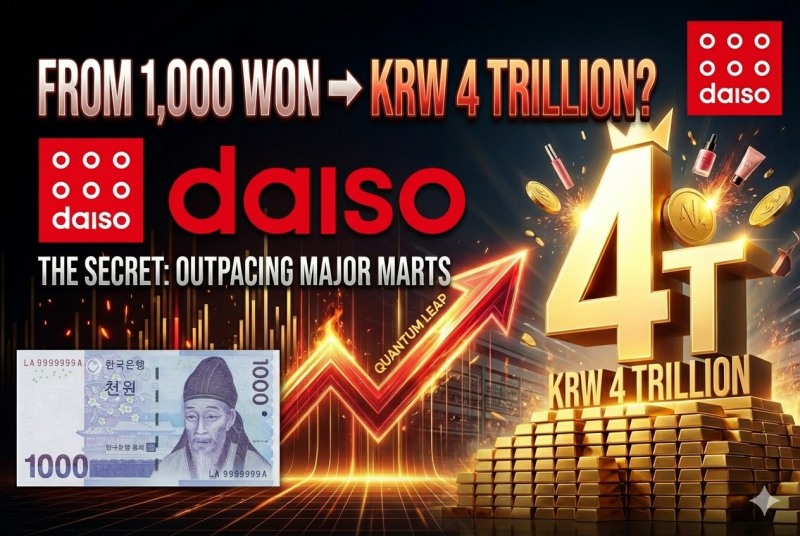
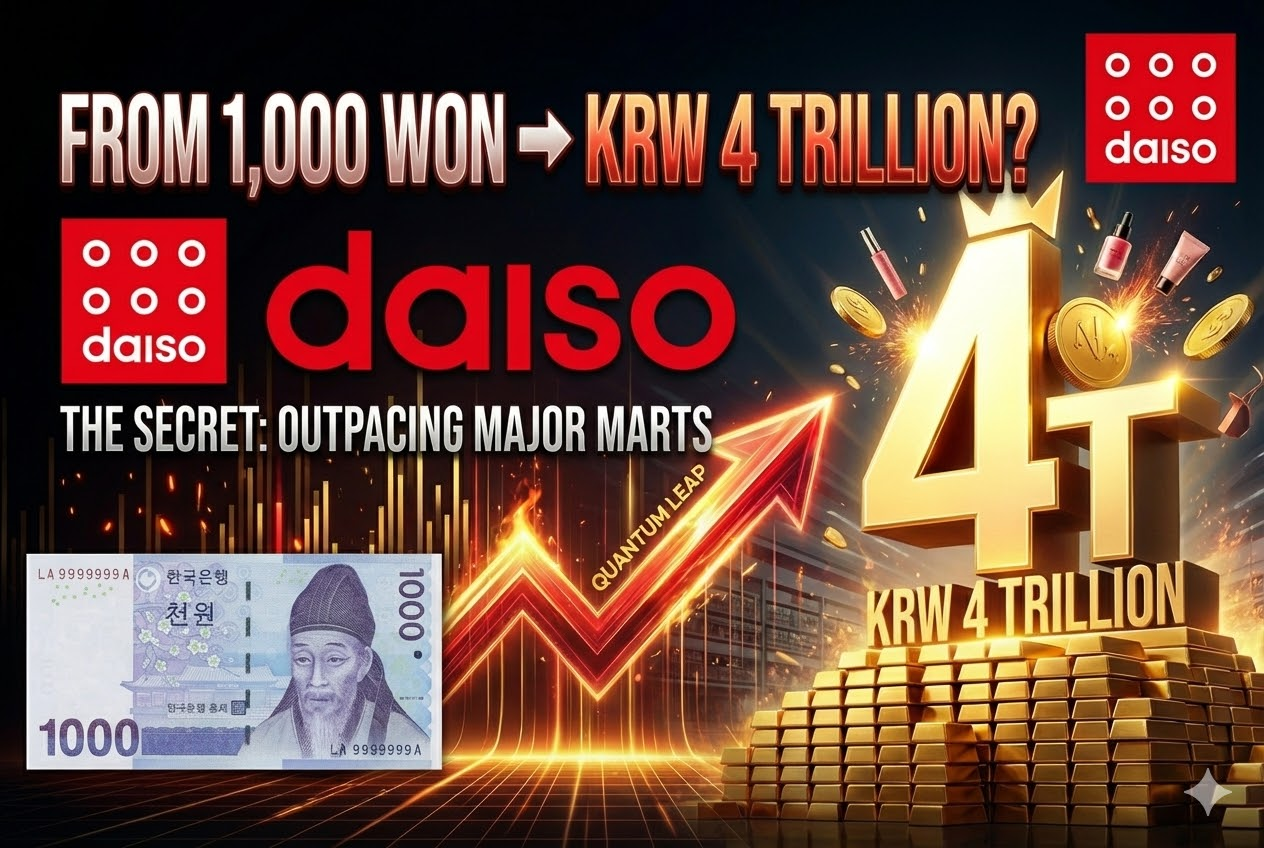
According to industry sources on the 24th, Daiso's 2025 financial results are set to be disclosed in an audit report expected in April. Industry insiders anticipate that Daiso's revenue for fiscal year 2025 will exceed the mid-KRW 4 trillion range. With the significant expansion into beauty and fashion categories over the past two to three years, the pace of revenue growth has also accelerated.
Daiso surpassed KRW 3 trillion in revenue in 2023 — eight years after crossing the KRW 1 trillion mark in 2015, and four years after exceeding KRW 2 trillion in 2019. Having launched in 1997 as a "KRW 1,000 shop," Daiso has steadily maintained its fixed-price household goods concept for nearly 30 years and now stands on the threshold of a new milestone: KRW 4 trillion in annual revenue in 2025.
A company spokesperson attributed this growth to "the spread of value-conscious consumption amid high inflation last year, which significantly boosted the popularity of our competitively priced fixed-price products and strategic merchandise."
Category Expansion into Beauty and Fashion Penetrates All Aspects of Daily Life
Daiso's rapid top-line growth is attributed not merely to store expansion, but primarily to its broadening product category strategy. Moving beyond its earlier sales base of kitchenware, stationery, and sundries, the company has swiftly expanded into beauty, fashion, and living over the past two to three years, widening its customer touchpoints considerably.Daiso currently operates approximately 30,000 product items across nine categories, including home décor, leisure and hobby, office and stationery, beauty and personal care, and food. More than approximately 600 new products are introduced each month.

Consumers browsing the beauty section at a Daiso store. / Photo by Park Seulgi
A company spokesperson noted that the company is "strengthening its product assortment so that customers can purchase everything from everyday essentials to the latest trend items in a single visit."
Also notable is the broadening of Daiso's customer base. While the chain was once primarily frequented by homemakers, it has since become a must-visit destination for people of all ages and genders, as well as foreign tourists. Affordable prices paired with quality merchandise have captivated a wide range of consumers.
The expansion of fashion and seasonal products has also contributed to revenue growth. The company strengthened its low-priced apparel lineup — including socks, innerwear, and homewear — and introduced season- and theme-based merchandise to drive higher inventory turnover. Additionally, the introduction of product lines targeting specific lifestyles, such as camping, pet care, and automotive accessories, has reinforced Daiso's positioning as a lifestyle-integrated retail platform.
Store opening strategy has likewise played a critical role in its outward growth. Daiso has enhanced accessibility through a tailored location strategy covering large roadside stores as well as shopping malls, transit hubs, and high-density residential areas. The company is credited with simultaneously improving per-store sales efficiency and building a dense nationwide retail network, reinforcing its competitiveness as a distribution channel.
Daiso currently operates 1,600 stores across the country. The store count, which stood at 1,000 in 2015, has grown by 60 percent over approximately a decade.
An industry official observed that "Daiso is evolving beyond simply selling low-cost products into a structure that covers the full spectrum of consumers' daily lives," adding that "the key to its growth has been simultaneously increasing visit frequency and dwell time through category expansion."
Operating Margin of 9% Despite Ultra-Low Prices — Growth Driven by 'High-Efficiency Structure'
No less notable than its top-line growth is Daiso's profitability. Conventional wisdom holds that an ultra-low price strategy tends to yield thin margins under a high-volume, low-margin business model. Daiso, however, has delivered results that defy this expectation. As of fiscal year 2024, the company's operating profit surpassed that of E-Mart, the top large-format retailer in South Korea.While E-Mart recorded an operating profit of KRW 121.8 billion (on a standalone basis) in 2024, Daiso posted an operating profit of KRW 371.1 billion over the same period — more than three times higher. Daiso's operating profit margin stands at approximately 9.35%, a figure that dwarfs the typical 1 to 3 percent margin range seen among large-format retailers.
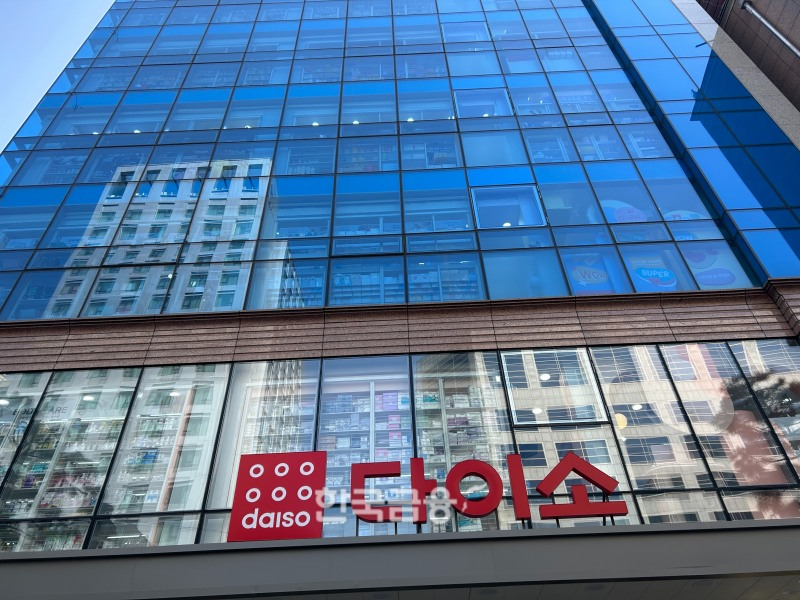
Asung Daiso acquired all remaining shares held by its Japanese partner in 2023. / Photo by Park Seulgi
이미지 확대보기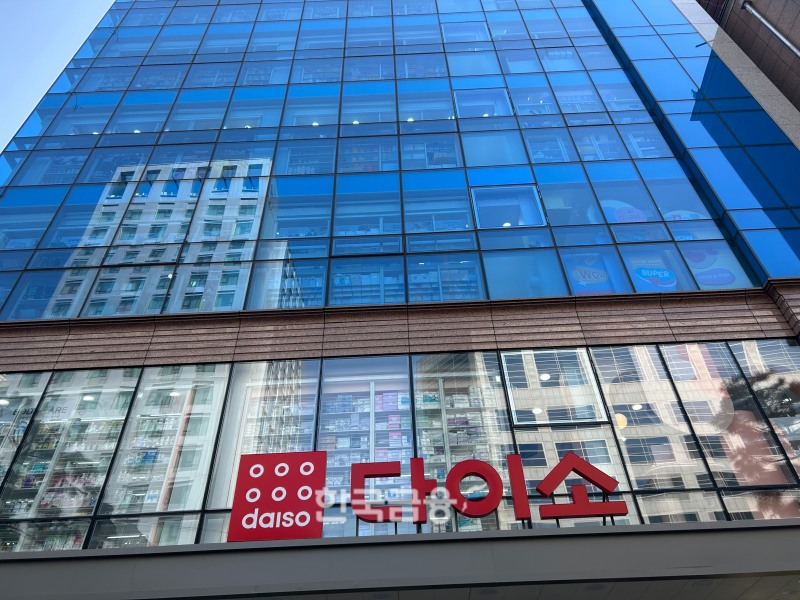
Analysts say the success stems from a high-volume strategy that goes beyond mere "ultra-low pricing" by prioritizing "high efficiency." Minimizing intermediate distribution layers and strengthening direct procurement with suppliers have been particularly effective in boosting profitability.
A fast product turnover rate has also contributed to margin improvement. With a short new-product replacement cycle, Daiso is able to manage inventory risk effectively. This has been reinforced by a strategy of deploying seasonal and planned merchandise at the right time to maximize sales efficiency.
This business model appears to gain even greater strength in an environment of heightened economic uncertainty. As high inflation has dampened consumer sentiment, growing demand for value-for-money spending has brought Daiso's competitive advantages into sharper relief. An increase in consumers seeking to purchase essential household goods at low prices has, in fact, sustained the company's sales growth momentum.
Industry observers expect Daiso's growth trajectory to continue for the foreseeable future. One retail industry insider remarked, "Daiso has a business model that simultaneously delivers price competitiveness, product variety, and operational efficiency," while noting that "as Daiso's influence expands, existing retailers are also racing to launch their own 'value-for-money' products."
Park seulgi (seulgi@fntimes.com)











![[르포] 1100평 한 층서 '협업', 보안데이터 하루 '10억 건'…하나금융의 진화](https://cfnimage.commutil.kr/phpwas/restmb_setimgmake.php?pp=006&w=69&h=45&m=5&simg=202609301743410358601b5a2213792211381469.jpg&nmt=18)


![[그래픽 뉴스] ‘순대’가 경제용어라고? 순(純)대외자산, 한국의 진짜 해외자산은 얼마일까?](https://cfnimage.commutil.kr/phpwas/restmb_setimgmake.php?pp=006&w=298&h=298&m=1&simg=202609021356075202de68fcbb3512411124362_0.jpg&nmt=18)
![[그래픽 뉴스] ISA 대개편! 나에게 유리한 계좌는?](https://cfnimage.commutil.kr/phpwas/restmb_setimgmake.php?pp=006&w=298&h=298&m=1&simg=202608041713155615de68fcbb3512411124362_0.jpg&nmt=18)
![[그래픽 뉴스] 미국 증시 새로운 키워드 'MANGOS'](https://cfnimage.commutil.kr/phpwas/restmb_setimgmake.php?pp=006&w=298&h=298&m=1&simg=202607291740382069de68fcbb3512411124362_0.jpg&nmt=18)

![[그래픽 뉴스] 은퇴후 30년 부모님 세대의 생존전략](https://cfnimage.commutil.kr/phpwas/restmb_setimgmake.php?pp=006&w=298&h=298&m=1&simg=202606301704439153de68fcbb3512411124362_0.jpg&nmt=18)
![[신간]은퇴연옥…김경록의 은퇴 후 삶의 나침반](https://cfnimage.commutil.kr/phpwas/restmb_setimgmake.php?pp=006&w=81&h=123&m=5&simg=20260414140833047280f8caa4a5ce12411124362.jpg&nmt=18)
![[신간] 물처럼 흐르고 원칙으로 서다…김용환의 통찰을 담다](https://cfnimage.commutil.kr/phpwas/restmb_setimgmake.php?pp=006&w=81&h=123&m=5&simg=20260409114249027860f8caa4a5ce12411124362.jpg&nmt=18)
![[안현정 서평] 플랫폼의 영지에서 ‘미학적 주권’을 선포하라...'K가 죽어야 K가 산다' 장준환 著](https://cfnimage.commutil.kr/phpwas/restmb_setimgmake.php?pp=006&w=81&h=123&m=5&simg=20260527121426063220c1c16452b012411124362.jpg&nmt=18)
![[서평] 추세 매매의 대가들...추세추종 투자전략의 대가 14인 인터뷰](https://cfnimage.commutil.kr/phpwas/restmb_setimgmake.php?pp=006&w=81&h=123&m=5&simg=2023102410444004986c1c16452b0175114235199.jpg&nmt=18)


![[머니무브 2026] “지금 사도 될까?” 답이 안 보인다면…하반기 투자, 4명의 전문가에게 물어보세요](https://cfnimage.commutil.kr/phpwas/restmb_setimgmake.php?pp=006&w=89&h=45&m=1&simg=202609151044050355302a735e27af12411124362.jpg&nmt=18)
![[AD] ‘PBV 라인업 확장’ 기아, 9월 독일서 ‘PV7’ 첫 공개](https://cfnimage.commutil.kr/phpwas/restmb_setimgmake.php?pp=006&w=89&h=45&m=1&simg=2026083111010602815074925877361231180222.jpg&nmt=18)
![[AD] 제네시스, 럭셔리 경험 더한 ‘2027 GV70’‧‘GV70 그래파이트’ 출시](https://cfnimage.commutil.kr/phpwas/restmb_setimgmake.php?pp=006&w=89&h=45&m=1&simg=20260702143546085600749258773622211122717.jpg&nmt=18)
![[AD] 개소세 혜택 종료…현대차, ‘썸머 페스타’로 고객 부담 완화](https://cfnimage.commutil.kr/phpwas/restmb_setimgmake.php?pp=006&w=89&h=45&m=1&simg=20260702142355004830749258773622211122717.jpg&nmt=18)