





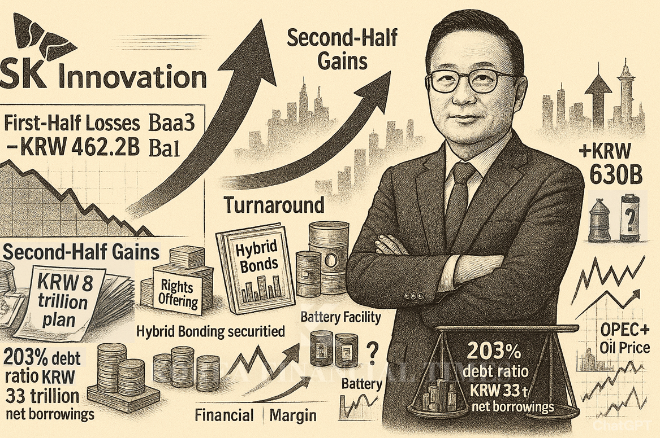
According to financial information company FnGuide's compilation on the 29th, the consensus (average estimate) for SK Innovation's second-half operating profit is KRW 368 billion. Securities firms that recently issued reports estimate this higher at KRW 600-630 billion. The refining division is particularly expected to lead the turnaround, buoyed by improved refining margins.
SK Innovation recorded an operating loss of KRW 462.2 billion in the first half of this year, turning to deficit from an operating profit of KRW 578.9 billion in the first half of last year.
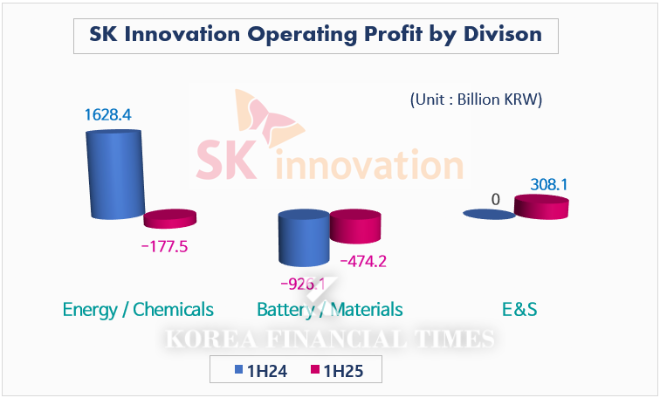
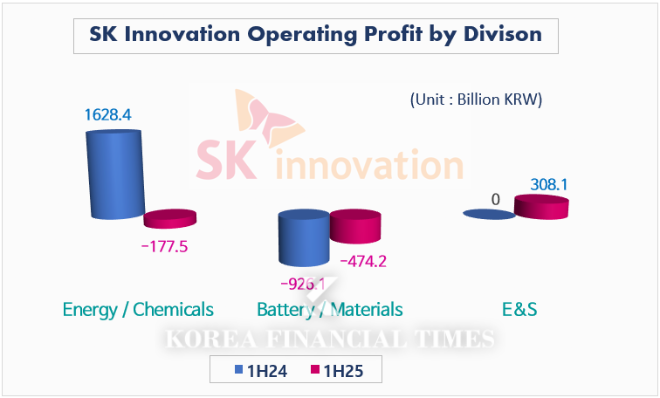
Losses in the battery and materials business divisions, including subsidiaries SK On and SKIET, were halved to KRW 474.2 billion compared to last year. There was also the effect of SK Innovation E&S, which merged in November last year (operating profit of KRW 308.1 billion).
However, the energy and chemicals division (refining, petrochemicals, lubricants, etc.) posted a loss of KRW 177.5 billion in the first half of this year from an operating profit of KRW 1.628 trillion in the first half of last year. In particular, the core refining business recorded a loss of KRW 466.3 billion in the second quarter, significantly deteriorating overall performance. US tariff threats and OPEC+ production increase stance pulled down international oil prices, which led to inventory losses for SK Innovation's refining operations.
Financial-related losses were KRW 685.6 billion, down KRW 320 billion from a year earlier. This was due to increased foreign exchange gains from won weakness, but interest expenses alone increased 21 percent to KRW 794.6 billion. Net borrowings surged from KRW 19 trillion at the end of the first half of last year to KRW 33 trillion at the end of the first half of this year, and the debt ratio increased 42 percentage points to 203 percent.
As the financial structure deteriorated, Moody's lowered SK Innovation's credit rating from 'Baa3' to 'Ba1' in March. In response, Jang Yong-ho, CEO of SK Inc., was appointed to concurrently serve as chief executive president of SK Innovation in May. Chief executive president Jang is an SK Group rebalancing expert, and this was a bold move of replacing the chief executive officer for financial improvement.
SK Safeguards Battery Business with Cash Cow Enmove, While LG Sells Non-Core Growth BusinessesFrom LOTTE and SK to LG and EcoPro… Battery and Petrochemical Firms Turn to Price Return Swap (PRS) for FundraisingPetrochemical Restructuring Underway… Will S-OIL’s ‘Time Bomb’ Go Off?Why Did Kakao and KT Fall Short Against Naver and SKT in Korea’s ‘National AI’ Selection?
However, the burden of SK On's accumulated losses remains a persistent challenge. The rebound timing continues to be postponed. SK On is expected to see expanded losses in the third quarter due to initial operating costs at the US Ford joint venture plant. Additionally, with the early termination of US electric vehicle purchase subsidies from the 30th, it is difficult to guarantee a return to profitability next year.
Chief executive president Jang also sees that SK On will need time. Along with the capital expansion plan, SK Innovation purchased all convertible preferred shares (CPS) held by SK On's financial investors (FI). This eliminated the obligation for SK On's initial public offering (IPO) promised for 2026. In November, SK On will be merged with lubricant subsidiary SK Enмove to improve the financial structure. Jang said "SK On needs to focus on maximising profitability and strengthening fundamental competitiveness for the time being. Currently, there are no IPO plans."
Gwak Horyung (horr@fntimes.com)










![서초구 '아크로리버파크' 34평, 10억 오른 74억원에 거래 [일일 신고가]](https://cfnimage.commutil.kr/phpwas/restmb_setimgmake.php?pp=006&w=69&h=45&m=5&simg=20260624115142011110dd55077bc212411124362.jpg&nmt=18)

![동대문구 '전농우성' 32평, 3.9억 떨어진 6.1억원에 거래 [일일 하락가]](https://cfnimage.commutil.kr/phpwas/restmb_setimgmake.php?pp=006&w=69&h=45&m=5&simg=20260727083903035290b372994c951245313551.jpg&nmt=18)


![[그래픽 뉴스] ‘순대’가 경제용어라고? 순(純)대외자산, 한국의 진짜 해외자산은 얼마일까?](https://cfnimage.commutil.kr/phpwas/restmb_setimgmake.php?pp=006&w=298&h=298&m=1&simg=202609021356075202de68fcbb3512411124362_0.jpg&nmt=18)
![[그래픽 뉴스] ISA 대개편! 나에게 유리한 계좌는?](https://cfnimage.commutil.kr/phpwas/restmb_setimgmake.php?pp=006&w=298&h=298&m=1&simg=202608041713155615de68fcbb3512411124362_0.jpg&nmt=18)
![[그래픽 뉴스] 미국 증시 새로운 키워드 'MANGOS'](https://cfnimage.commutil.kr/phpwas/restmb_setimgmake.php?pp=006&w=298&h=298&m=1&simg=202607291740382069de68fcbb3512411124362_0.jpg&nmt=18)

![[그래픽 뉴스] 은퇴후 30년 부모님 세대의 생존전략](https://cfnimage.commutil.kr/phpwas/restmb_setimgmake.php?pp=006&w=298&h=298&m=1&simg=202606301704439153de68fcbb3512411124362_0.jpg&nmt=18)
![[신간]은퇴연옥…김경록의 은퇴 후 삶의 나침반](https://cfnimage.commutil.kr/phpwas/restmb_setimgmake.php?pp=006&w=81&h=123&m=5&simg=20260414140833047280f8caa4a5ce12411124362.jpg&nmt=18)
![[신간] 물처럼 흐르고 원칙으로 서다…김용환의 통찰을 담다](https://cfnimage.commutil.kr/phpwas/restmb_setimgmake.php?pp=006&w=81&h=123&m=5&simg=20260409114249027860f8caa4a5ce12411124362.jpg&nmt=18)
![[안현정 서평] 플랫폼의 영지에서 ‘미학적 주권’을 선포하라...'K가 죽어야 K가 산다' 장준환 著](https://cfnimage.commutil.kr/phpwas/restmb_setimgmake.php?pp=006&w=81&h=123&m=5&simg=20260527121426063220c1c16452b012411124362.jpg&nmt=18)
![[서평] 추세 매매의 대가들...추세추종 투자전략의 대가 14인 인터뷰](https://cfnimage.commutil.kr/phpwas/restmb_setimgmake.php?pp=006&w=81&h=123&m=5&simg=2023102410444004986c1c16452b0175114235199.jpg&nmt=18)


![[머니무브 2026] “지금 사도 될까?” 답이 안 보인다면…하반기 투자, 4명의 전문가에게 물어보세요](https://cfnimage.commutil.kr/phpwas/restmb_setimgmake.php?pp=006&w=89&h=45&m=1&simg=202609151044050355302a735e27af12411124362.jpg&nmt=18)
![[AD] ‘PBV 라인업 확장’ 기아, 9월 독일서 ‘PV7’ 첫 공개](https://cfnimage.commutil.kr/phpwas/restmb_setimgmake.php?pp=006&w=89&h=45&m=1&simg=2026083111010602815074925877361231180222.jpg&nmt=18)
![[AD] 제네시스, 럭셔리 경험 더한 ‘2027 GV70’‧‘GV70 그래파이트’ 출시](https://cfnimage.commutil.kr/phpwas/restmb_setimgmake.php?pp=006&w=89&h=45&m=1&simg=20260702143546085600749258773622211122717.jpg&nmt=18)
![[AD] 개소세 혜택 종료…현대차, ‘썸머 페스타’로 고객 부담 완화](https://cfnimage.commutil.kr/phpwas/restmb_setimgmake.php?pp=006&w=89&h=45&m=1&simg=20260702142355004830749258773622211122717.jpg&nmt=18)
![[AD] 기아 ‘디 올 뉴 셀토스’, 인도 타임스 드라이브 어워즈서 ‘올해의 SUV’ 선정](https://cfnimage.commutil.kr/phpwas/restmb_setimgmake.php?pp=006&w=89&h=45&m=1&simg=202605071156400590007492587736124111243152.jpg&nmt=18)