






On the 6th, SK Innovation announced that its battery subsidiary, SK On, posted an operating loss of KRW 359.4 billion in Q4 2024. This represents a KRW 340 billion increase in losses compared to the KRW 18.6 billion deficit recorded in the same period of 2023. The company’s total annual losses for 2024 reached KRW 1.127 trillion.
LG Energy Solution, which had reported its earnings earlier, recorded an operating loss of KRW 225.5 billion, while Samsung SDI posted a deficit of KRW 256.7 billion. Both companies saw their losses increase by approximately KRW 560 billion year-over-year. The decline is attributed to sluggish EV sales in Europe and falling battery metal prices. The slowdown in EV growth, which began in the second half of 2023, appears to be persisting.
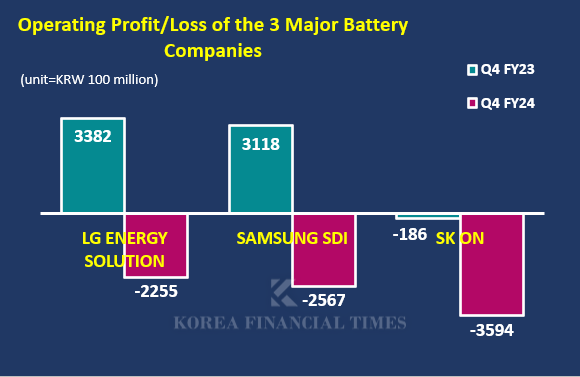
Graph=Korea Financial Times / Material source=Each company
Market Conditions Show No Signs of Recovery in 2025
Hopes for a dramatic market rebound this year remain slim. The second administration of U.S. President Donald Trump, who is known for his skepticism toward EVs, has now taken office. Upon inauguration last month, President Trump immediately repealed an executive order from the Biden administration that mandated EV adoption. He is also considering cutting EV subsidies, raising concerns across the industry.Battery companies, which had previously dismissed the "Trump risk" as having a low chance of materializing, are now growing increasingly uneasy.
During an earnings conference call on January 24, LG Energy Solution stated, "Policy uncertainty in North America is quite high." While the company believes there is little likelihood of changes to battery production subsidies under the Advanced Manufacturing Production Credit (AMPC), it sees a risk of EV purchase subsidies being reduced or eliminated. This uncertainty is leading automakers to adopt a more conservative approach to their EV plans, which in turn is affecting battery production rates.
Samsung SDI, which is set to begin full-scale operations at its first U.S. plant this year, acknowledged the challenges, stating, "Given the fluctuating market conditions and uncertainty, we are in discussions with our customer, Stellantis, regarding annual production volumes."
LG Energy Solution, Forecasts Q4 loss..."Worst since spin-off”'Semiconductor Variables Pour In'—Samsung Confident in Responding with Global Supply Chain Management CapabilitiesChairman Chey Tae-won of SK Group gives 'high praise at CES'... Who is he praising?'Full of uncertainty' batteries seek turnaround opportunities in Europe"Why SK On Pins Its Hopes on Hyundai and Kia's Performance in the U.S."
In Q4 2024, the financial benefits from the AMPC program amounted to KRW 377.3 billion for LG Energy Solution, KRW 81.3 billion for SK On, and KRW 24.9 billion for Samsung SDI. With an increasing portion of their earnings now tied to U.S. policies, any drastic changes could deal a severe blow to their financial performance.
Battery Companies to Cut Investments Amid Industry Slump
To cope with the prolonged downturn, all three companies plan to reduce capital expenditures this year.LG Energy Solution announced that it will cut its investment budget by 20–30% compared to last year’s KRW 13 trillion, meaning it will likely spend around KRW 10 trillion in 2025. SK On plans to slash its investments from KRW 7.5 trillion to KRW 3.5 trillion—roughly half. While Samsung SDI did not disclose a specific investment figure, it confirmed that spending will decrease compared to last year’s KRW 6.6 trillion.
Gwak Horyung (horr@fntimes.com)










![[기자수첩] 보험사 품는 사모펀드, 대주주 심사 재고해야](https://cfnimage.commutil.kr/phpwas/restmb_setimgmake.php?pp=006&w=69&h=45&m=5&simg=20260913173909069220ed56b8e1f814379898.jpg&nmt=18)


![[그래픽 뉴스] ‘순대’가 경제용어라고? 순(純)대외자산, 한국의 진짜 해외자산은 얼마일까?](https://cfnimage.commutil.kr/phpwas/restmb_setimgmake.php?pp=006&w=298&h=298&m=1&simg=202609021356075202de68fcbb3512411124362_0.jpg&nmt=18)
![[그래픽 뉴스] ISA 대개편! 나에게 유리한 계좌는?](https://cfnimage.commutil.kr/phpwas/restmb_setimgmake.php?pp=006&w=298&h=298&m=1&simg=202608041713155615de68fcbb3512411124362_0.jpg&nmt=18)
![[그래픽 뉴스] 미국 증시 새로운 키워드 'MANGOS'](https://cfnimage.commutil.kr/phpwas/restmb_setimgmake.php?pp=006&w=298&h=298&m=1&simg=202607291740382069de68fcbb3512411124362_0.jpg&nmt=18)

![[그래픽 뉴스] 은퇴후 30년 부모님 세대의 생존전략](https://cfnimage.commutil.kr/phpwas/restmb_setimgmake.php?pp=006&w=298&h=298&m=1&simg=202606301704439153de68fcbb3512411124362_0.jpg&nmt=18)
![[신간]은퇴연옥…김경록의 은퇴 후 삶의 나침반](https://cfnimage.commutil.kr/phpwas/restmb_setimgmake.php?pp=006&w=81&h=123&m=5&simg=20260414140833047280f8caa4a5ce12411124362.jpg&nmt=18)
![[신간] 물처럼 흐르고 원칙으로 서다…김용환의 통찰을 담다](https://cfnimage.commutil.kr/phpwas/restmb_setimgmake.php?pp=006&w=81&h=123&m=5&simg=20260409114249027860f8caa4a5ce12411124362.jpg&nmt=18)
![[안현정 서평] 플랫폼의 영지에서 ‘미학적 주권’을 선포하라...'K가 죽어야 K가 산다' 장준환 著](https://cfnimage.commutil.kr/phpwas/restmb_setimgmake.php?pp=006&w=81&h=123&m=5&simg=20260527121426063220c1c16452b012411124362.jpg&nmt=18)
![[서평] 추세 매매의 대가들...추세추종 투자전략의 대가 14인 인터뷰](https://cfnimage.commutil.kr/phpwas/restmb_setimgmake.php?pp=006&w=81&h=123&m=5&simg=2023102410444004986c1c16452b0175114235199.jpg&nmt=18)


![[머니무브 2026] “지금 사도 될까?” 답이 안 보인다면…하반기 투자, 4명의 전문가에게 물어보세요](https://cfnimage.commutil.kr/phpwas/restmb_setimgmake.php?pp=006&w=89&h=45&m=1&simg=202609151044050355302a735e27af12411124362.jpg&nmt=18)
![[AD] ‘PBV 라인업 확장’ 기아, 9월 독일서 ‘PV7’ 첫 공개](https://cfnimage.commutil.kr/phpwas/restmb_setimgmake.php?pp=006&w=89&h=45&m=1&simg=2026083111010602815074925877361231180222.jpg&nmt=18)
![[AD] 제네시스, 럭셔리 경험 더한 ‘2027 GV70’‧‘GV70 그래파이트’ 출시](https://cfnimage.commutil.kr/phpwas/restmb_setimgmake.php?pp=006&w=89&h=45&m=1&simg=20260702143546085600749258773622211122717.jpg&nmt=18)
![[AD] 개소세 혜택 종료…현대차, ‘썸머 페스타’로 고객 부담 완화](https://cfnimage.commutil.kr/phpwas/restmb_setimgmake.php?pp=006&w=89&h=45&m=1&simg=20260702142355004830749258773622211122717.jpg&nmt=18)
![[AD] 기아 ‘디 올 뉴 셀토스’, 인도 타임스 드라이브 어워즈서 ‘올해의 SUV’ 선정](https://cfnimage.commutil.kr/phpwas/restmb_setimgmake.php?pp=006&w=89&h=45&m=1&simg=202605071156400590007492587736124111243152.jpg&nmt=18)