






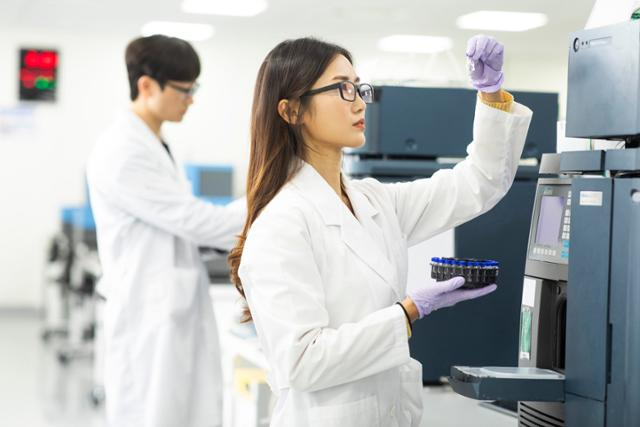
Researchers are conducting experiments related to biopharmaceuticals at Samsung Bioepis in Songdo, Yeonsu-gu, Incheon. / Photo = Samsung Bioepis
According to the relevant industry on the 10th, the 10th FDA-approved product in Korea is expected to be born in March next year. The main character is HLB's liver cancer new drug 'Riboceranib'. The company recently received a 'NAI (nothing to improve)' notice from the FDA during a clinical hospital on-site inspection. In May, the approval was denied due to the need for manufacturing facility improvement and BIMO inspection, but the possibility of FDA approval has been increased through this re-examination. The decision on whether to approve will be made by March 20 next year.
Han Yong-hae, Chief Technology Officer of HLB Group, said, "We have passed the important milestone for the approval of a new liver cancer drug, and Hangseo Pharmaceutical is making a company-wide effort for the final remaining CMC supplementary inspection."
If Riboceranib is approved, it will be the 10th FDA-approved new drug in Korea. The products approved by the FDA so far are ▲ LG Chem's 'Factive' in 2003, ▲ Dong-A ST's 'Sivextro' in 2014, ▲ SK Chemicals' 'Afstyla' in 2016, ▲ SK Biopharm's 'Sunosi' and 'Xcopri' in 2019, ▲ Hanmi Pharmaceutical's 'Rolontis' in 2022, ▲ Celltrion's 'Zimfentra' in 2023, and Yuhan Corporation's 'LECLAZA' in 2024.
It is not only 'Riboceranib' that is aiming for FDA approval. HK inno.N's 30th domestic new drug, 'K-CAB', a treatment for gastroesophageal reflux disease launched in 2019, is also considering FDA approval. 'K-CAB' is currently undergoing phase 3 clinical trials locally after successfully transferring technology to Braintree Laboratories in the US in 2021. The industry expects that 'K-CAB' will complete its FDA approval application by mid-next year at the latest.
Kolon TissueGene is also challenging the FDA with 'TG-C', a cell gene therapy for osteoarthritis. 'TG-C' completed phase 3 clinical trials in the US in July of this year.
There are also many new drug candidates that are expected to grow into blockbusters next year. The industry predicts that Yuhan Corporation's 'LECLAZA', Celltrion's 'Zimpentra', GC Green Cross's 'Aliglo', HK inno.N's 'K-CAB' and SK Biopharm's 'Xcopri' will generate annual sales of over KRW 1 trillion.
'LECLAZA' is a non-small cell lung cancer treatment that Yuhan Corporation exported its technology to Johnson & Johnson Innovative Medicine (Johnson & Johnson) in 2018 and received FDA approval this year. Anticancer new drugs are recognized as key technologies that change the paradigm of patient treatment and are considered one of the most important fields in the pharmaceutical market. If developed, the economic and industrial ripple effects will also be significant. Johnson & Johnson has set an annual sales target of 5 billion dollars (approximately KRW 7 trillion) for combination therapy. The industry expects Yuhan Corporation to become the first domestic pharmaceutical company to achieve KRW 2 trillion in sales through 'LECLAZA' royalties.
What is the strategy of Celltrion Chairman Seo Jung-jin, who created the '1 trillion blockbuster', to achieve 'KRW 10 trillion in sales within 3 years'?Overseas is the answer?... Yuhan Corp. · GC Bio, etc. Pharmabio industry, Q3 profits soar on 'global' ride'R&D myth' Hanmi Pharm couldn't avoid 'management dispute'
Celltrion's 'Zimfentra' is also a strong blockbuster candidate. Zimfentra's annual sales this year are around KRW 250 billion, but Celltrion Chairman Seo Jung-jin is confident that it will exceed 1 trillion won next year.Celltrion recently added Zympentra to all six public and private health plans operated by the top three U.S. prescription drug benefit managers (PBMs). The fact that it has been listed in six public and private insurance plans of the three major US PBMs in just seven months since its launch is considered unusual in the industry.
Also, GC Green Cross's 'Aliglo' is cruising since its entry into the US market in July. The company plans to generate sales of $50 million this year and grow by more than 50% annually. 'Aliglo' was listed on the formularies of three major US insurance companies in September and began full-scale patient administration. The company's sales target is also expected to be achieved in the second half of this year.
HK inno.N's 'K-CAB' recorded sales of KRW 88.9 billion in the first half of this year, up 67.3% from the same period last year. 'K-CAB' is a potassium-competitive acid secretion inhibitor (P-CAB) that complements the shortcomings of existing proton pump inhibitors (PPIs). The company is targeting annual sales of KRW 1 trillion by 2028.
SK Biopharm's epilepsy treatment 'Xcopri' is the first domestic new drug to receive FDA approval without technology transfer. Sales in the first half of this year were KRW 238.9 billion, up 77% from the same period last year. Since 'Xcopri' is currently undergoing clinical trials for generalized seizures and expanded indications for children, sales are expected to increase in the future.
The industry believes that next year could be a new momentum for the domestic pharmaceutical and biotechnology industry. An industry insider said, "In the early 2000s, many companies shifted their business models from focusing on generic drug sales to R&D-based ones," and "It seems that the results of this have recently come to the fore in the global market."
He continued, "Next year, domestic new drugs will leap forward to the stage of commercialization beyond development and production."
Kim Nayoung, Korea Finacial Times (steaming@fntimes.com)












![“3조 신화 넘어 4조 시대로”…박주형, 신세계 성장판 넓혔다 [CEO 임기보고서]](https://cfnimage.commutil.kr/phpwas/restmb_setimgmake.php?pp=006&w=69&h=45&m=5&simg=20261021155541058600dd55077bc212411124362.jpg&nmt=18)

![[현장] ‘1만원 에어프라이어’ 실화?…다이소 잡으러 나선 이마트 ‘와우샵’](https://cfnimage.commutil.kr/phpwas/restmb_setimgmake.php?pp=006&w=69&h=45&m=5&simg=20261022144754079030b5b890e35c211234199164.jpg&nmt=18)


![[그래픽 뉴스] ‘순대’가 경제용어라고? 순(純)대외자산, 한국의 진짜 해외자산은 얼마일까?](https://cfnimage.commutil.kr/phpwas/restmb_setimgmake.php?pp=006&w=298&h=298&m=1&simg=202609021356075202de68fcbb3512411124362_0.jpg&nmt=18)
![[그래픽 뉴스] ISA 대개편! 나에게 유리한 계좌는?](https://cfnimage.commutil.kr/phpwas/restmb_setimgmake.php?pp=006&w=298&h=298&m=1&simg=202608041713155615de68fcbb3512411124362_0.jpg&nmt=18)
![[그래픽 뉴스] 미국 증시 새로운 키워드 'MANGOS'](https://cfnimage.commutil.kr/phpwas/restmb_setimgmake.php?pp=006&w=298&h=298&m=1&simg=202607291740382069de68fcbb3512411124362_0.jpg&nmt=18)

![[그래픽 뉴스] 은퇴후 30년 부모님 세대의 생존전략](https://cfnimage.commutil.kr/phpwas/restmb_setimgmake.php?pp=006&w=298&h=298&m=1&simg=202606301704439153de68fcbb3512411124362_0.jpg&nmt=18)
![[신간]은퇴연옥…김경록의 은퇴 후 삶의 나침반](https://cfnimage.commutil.kr/phpwas/restmb_setimgmake.php?pp=006&w=81&h=123&m=5&simg=20260414140833047280f8caa4a5ce12411124362.jpg&nmt=18)
![[신간] 물처럼 흐르고 원칙으로 서다…김용환의 통찰을 담다](https://cfnimage.commutil.kr/phpwas/restmb_setimgmake.php?pp=006&w=81&h=123&m=5&simg=20260409114249027860f8caa4a5ce12411124362.jpg&nmt=18)
![[안현정 서평] 플랫폼의 영지에서 ‘미학적 주권’을 선포하라...'K가 죽어야 K가 산다' 장준환 著](https://cfnimage.commutil.kr/phpwas/restmb_setimgmake.php?pp=006&w=81&h=123&m=5&simg=20260527121426063220c1c16452b012411124362.jpg&nmt=18)
![[서평] 추세 매매의 대가들...추세추종 투자전략의 대가 14인 인터뷰](https://cfnimage.commutil.kr/phpwas/restmb_setimgmake.php?pp=006&w=81&h=123&m=5&simg=2023102410444004986c1c16452b0175114235199.jpg&nmt=18)


![[머니무브 2026] “지금 사도 될까?” 답이 안 보인다면…하반기 투자, 4명의 전문가에게 물어보세요](https://cfnimage.commutil.kr/phpwas/restmb_setimgmake.php?pp=006&w=89&h=45&m=1&simg=202609151044050355302a735e27af12411124362.jpg&nmt=18)
![[AD] ‘PBV 라인업 확장’ 기아, 9월 독일서 ‘PV7’ 첫 공개](https://cfnimage.commutil.kr/phpwas/restmb_setimgmake.php?pp=006&w=89&h=45&m=1&simg=2026083111010602815074925877361231180222.jpg&nmt=18)
![[AD] 제네시스, 럭셔리 경험 더한 ‘2027 GV70’‧‘GV70 그래파이트’ 출시](https://cfnimage.commutil.kr/phpwas/restmb_setimgmake.php?pp=006&w=89&h=45&m=1&simg=20260702143546085600749258773622211122717.jpg&nmt=18)