






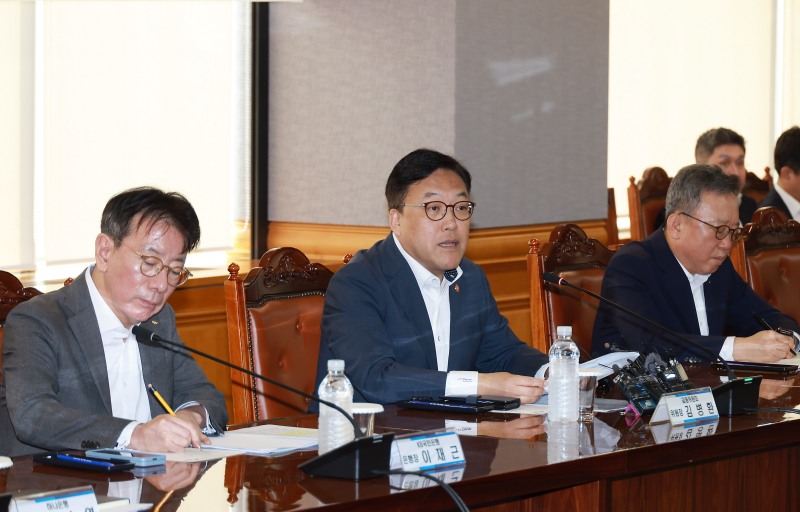
Kim Byung-hwan, chairman of the Financial Services Commission, held a meeting with the chairman of the Korea Federation of Banks and 19 bank presidents at the Bank Hall in Jung-gu, Seoul on the morning of the 20th and listened to various opinions from the banking sector on "risk management for financial stability" and "innovation in the banking sector for sustainable growth."/ Photo courtesy = FSC
이미지 확대보기
Chairman Kim Byung-hwan met with bank presidents at the Bank Hall in Jung-gu, Seoul earlier in the day to discuss risk management for financial stability and ways to innovate the banking sector for sustainable growth.
This meeting is the first event with the financial sector in about three weeks since Chairman Kim took office on the 31st of last month, and the first official meeting with bank presidents. CEOs of a total of 19 banks, including KB Kookmin, Shinhan, Hana, and NH Nonghyup Bank, local banks, foreign banks and Internet banks, and Cho Yong-byung, chairman of the Korea Federation of Banks, attended. Woori Bank President Cho Byung-kyu was absent due to overseas business trips, while Kakao Bank CEO Yoon Ho-young and SC First Bank President Park Jong-bok were absent due to the COVID-19 confirmation.
In his remarks, Kim said, “Since the second quarter of this year, household debt has turned to an upward trend, mainly due to rising house prices in Seoul and expectations of interest rate cuts.” “We need to be alert to the increase in household debt from the first half of the year and proactively manage it together with the banking sector and the government,” he said. “We will implement the second-stage stress DSR from September 1, but we will increase the stress rate to 1.2 percentage points instead of 0.75 percentage points for mortgage loans from banks in Seoul and the capital region, which have been increasing in recent years.”
Stress DSR is a system that calculates the loan limit by imposing a certain level of additional interest rate (stress rate) when calculating DSR, taking into account the possibility that borrowers who use variable-rate loans may increase their burden of repaying principal and interest due to rising interest rates during the loan period. When stress rates are reflected, annual interest costs will increase, raising DSR and calculated loan limits will be lower than before.
In February this year, the government introduced a first-stage measure that applies 25 percent of the basic stress rate to bank mortgage loans. From the 1st of next month, the government will implement a second-stage measure that applies 50 percent of the stress rate to bank mortgage loans, credit loans and second-tier mortgage loans. From July next year, the stress rate will be 100 percent applied to household loans in the entire financial sector.
In February this year, the government introduced a first-stage measure that applies 25 percent of the basic stress rate to bank mortgage loans. From the 1st of next month, the government will implement a second-stage measure that applies 50 percent of the stress rate to bank mortgage loans, credit loans and second-tier mortgage loans. From July next year, the stress rate will be 100 percent applied to household loans in the entire financial sector.
The stress rate is determined by comparing the weighted average monthly household loan rate (published by the BOK) at the highest level in the past five years to the current rate. However, a minimum of 1.5 percentage points and a maximum of 3 percentage points will be applied to compensate for the tendency of over- or underestimation during the interest rate fluctuation period. Until the end of this month, the stress rate was 0.38% (rounded to the third decimal place), which is 25% of the 1.5% floor rate, but it will increase to 0.75%, which is 50%, starting next month.
"From September, the banking sector should calculate DSRs for internal management purposes for all household loans, and from next year, each bank should establish and implement a DSR management plan based on them," Chairman Kim said. "We will closely examine household loan trends and consider additional measures such as expanding the scope of DSR application or increasing the proportion of mortgage risks in banks if necessary." He also ordered that "bank presidents have the ability to repay autonomously, that is, have a household debt management system based on DSR."
Regarding the debt of small business owners, he ordered that the bank's support method needs to be systemized as a debt management that considers repayment ability, not a one-time one. Chairman Kim said, "The balance of small business loans in the first half of this year increased by about 380 trillion won compared to the end of 2019, before the outbreak of COVID-19, and although the government has taken measures such as extending maturity, deferring repayment and starting a new fund in cooperation with the financial sector, the debt of small business owners can affect not only the Korean economy but also the soundness of banks."
"In order to ease the burden of repayment tailored to small business owners, the role of the bank that knows the repayment conditions of borrowers is important," he said. "Let's come up with a plan to internalize the banking sector's approach to supporting small business owners into a system called Debt Management Considering the ability to repay loans" rather than one-time support."
On this day, bank presidents shared the current status of support for small business owners by each bank and promised to actively cooperate in supporting small business owners in the future. "Easing the difficulties of small business owners is our most urgent task today," said Cho Yong-byeong, chairman of the Korea Federation of Banks. "The bank is also working on this through the new start fund and win-win measures for each bank as well as the 2.1 trillion won + α program." "In the future, the bank will continue to cooperate with related organizations so that the comprehensive measures for small business owners announced by the government in July can work quickly on the spot," he said. "We will discuss with financial authorities how to ease the difficulties of small business owners and continue our efforts to restore the ecosystem of small business owners."
The banking sector has come up with a plan to support people's livelihood finance worth 2.1 trillion won + α and has been implementing it since February. 1.5 trillion won will be spent on interest refunds (cashbacks) for private businesses such as self-employed and small business owners, and the remaining 600 billion won will be used as autonomous programs for other vulnerable groups. By the end of last month, the banking sector refunded about 1.4544 trillion won, or 96.7 percent of the expected interest refund (1.5035 trillion won) paid by individual business owners. Support for small business owners and small businesses was executed at about 109.1 billion won as of the end of June.
Han Aran (aran@fntimes.com)












![[DCM] 롯데지주 800억 차환…수익성 회복에도 레버리지 부담](https://cfnimage.commutil.kr/phpwas/restmb_setimgmake.php?pp=006&w=69&h=45&m=5&simg=20260824233409073110141825007d1224612522.jpg&nmt=18)


![[그래픽 뉴스] ISA 대개편! 나에게 유리한 계좌는?](https://cfnimage.commutil.kr/phpwas/restmb_setimgmake.php?pp=006&w=298&h=298&m=1&simg=202608041713155615de68fcbb3512411124362_0.jpg&nmt=18)
![[그래픽 뉴스] 미국 증시 새로운 키워드 'MANGOS'](https://cfnimage.commutil.kr/phpwas/restmb_setimgmake.php?pp=006&w=298&h=298&m=1&simg=202607291740382069de68fcbb3512411124362_0.jpg&nmt=18)

![[그래픽 뉴스] 은퇴후 30년 부모님 세대의 생존전략](https://cfnimage.commutil.kr/phpwas/restmb_setimgmake.php?pp=006&w=298&h=298&m=1&simg=202606301704439153de68fcbb3512411124362_0.jpg&nmt=18)
![[그래픽 뉴스] 퇴근 후 주차했는데 수익 발생? V2G의 정체](https://cfnimage.commutil.kr/phpwas/restmb_setimgmake.php?pp=006&w=298&h=298&m=1&simg=202605131656357745de68fcbb3512411124362_0.jpg&nmt=18)
![[신간]은퇴연옥…김경록의 은퇴 후 삶의 나침반](https://cfnimage.commutil.kr/phpwas/restmb_setimgmake.php?pp=006&w=81&h=123&m=5&simg=20260414140833047280f8caa4a5ce12411124362.jpg&nmt=18)
![[신간] 물처럼 흐르고 원칙으로 서다…김용환의 통찰을 담다](https://cfnimage.commutil.kr/phpwas/restmb_setimgmake.php?pp=006&w=81&h=123&m=5&simg=20260409114249027860f8caa4a5ce12411124362.jpg&nmt=18)
![[안현정 서평] 플랫폼의 영지에서 ‘미학적 주권’을 선포하라...'K가 죽어야 K가 산다' 장준환 著](https://cfnimage.commutil.kr/phpwas/restmb_setimgmake.php?pp=006&w=81&h=123&m=5&simg=20260527121426063220c1c16452b012411124362.jpg&nmt=18)
![[서평] 추세 매매의 대가들...추세추종 투자전략의 대가 14인 인터뷰](https://cfnimage.commutil.kr/phpwas/restmb_setimgmake.php?pp=006&w=81&h=123&m=5&simg=2023102410444004986c1c16452b0175114235199.jpg&nmt=18)


![[AD] 제네시스, 럭셔리 경험 더한 ‘2027 GV70’‧‘GV70 그래파이트’ 출시](https://cfnimage.commutil.kr/phpwas/restmb_setimgmake.php?pp=006&w=89&h=45&m=1&simg=20260702143546085600749258773622211122717.jpg&nmt=18)
![[AD] 개소세 혜택 종료…현대차, ‘썸머 페스타’로 고객 부담 완화](https://cfnimage.commutil.kr/phpwas/restmb_setimgmake.php?pp=006&w=89&h=45&m=1&simg=20260702142355004830749258773622211122717.jpg&nmt=18)
![[AD] 기아 ‘디 올 뉴 셀토스’, 인도 타임스 드라이브 어워즈서 ‘올해의 SUV’ 선정](https://cfnimage.commutil.kr/phpwas/restmb_setimgmake.php?pp=006&w=89&h=45&m=1&simg=202605071156400590007492587736124111243152.jpg&nmt=18)
![[AD]‘그랜저 잡자’ 기아, 상품성 더한 ‘The 2027 K8’ 출시](https://cfnimage.commutil.kr/phpwas/restmb_setimgmake.php?pp=006&w=89&h=45&m=1&simg=2026042110193702730074925877361211627527.jpg&nmt=18)
![[카드뉴스] KT&G, ‘CDP’ 기후변화·수자원 관리 부문 우수기업 선정](https://cfnimage.commutil.kr/phpwas/restmb_setimgmake.php?pp=006&w=89&h=45&m=1&simg=202603241415423015de68fcbb3512411124362_0.png&nmt=18)