





Contract Battle Heats Up Across Land and Sea
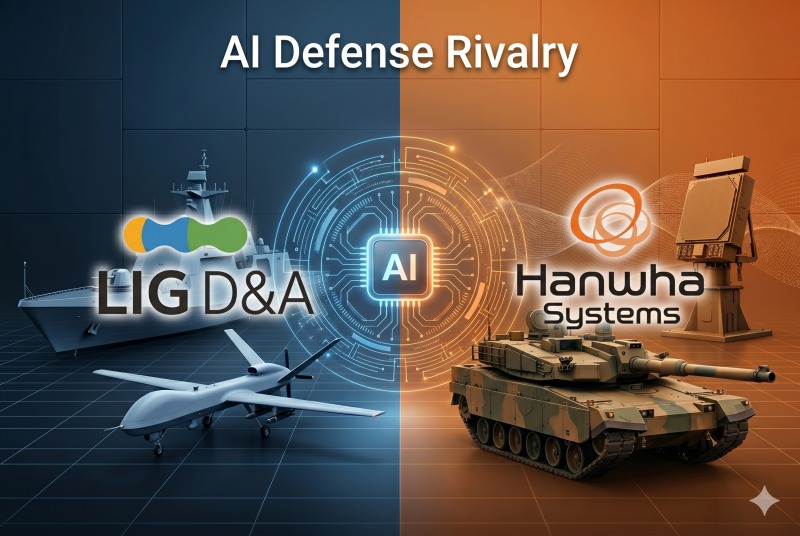
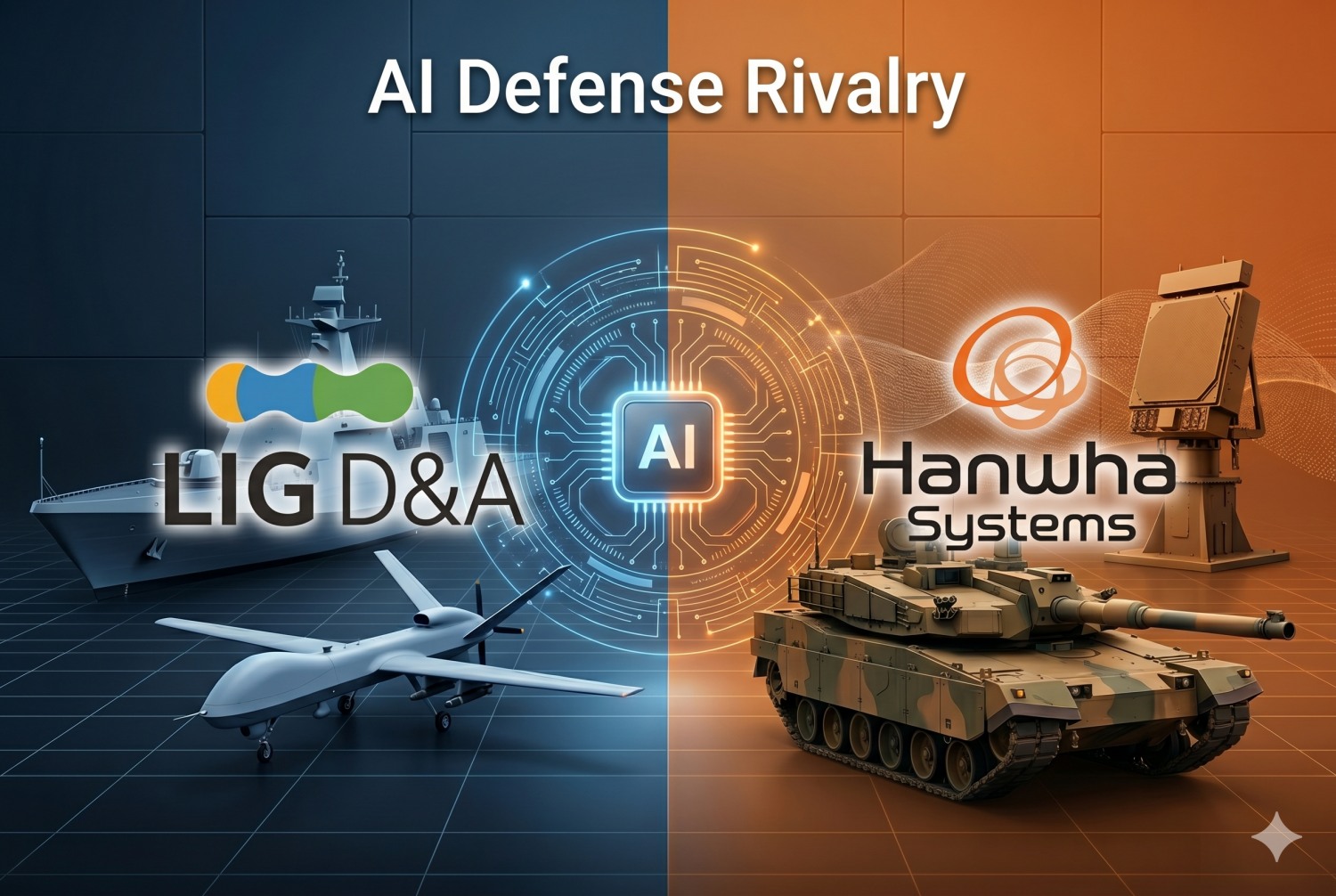
LIG D&A (CEO Shin Ik-hyeon) has recently been intensifying its capabilities in command, control, communications, computers, and intelligence (C4I) and intelligence, surveillance, and reconnaissance (ISR) — areas that have traditionally been Hanwha Systems' (CEO Son Jae-il) stronghold — causing the two companies' contract portfolios to increasingly overlap.Both companies operate in businesses that serve as the nervous system and command-and-control infrastructure of the defense sector, giving them a broadly similar character. Historically, LIG D&A had focused on precision guided munitions (PGM), including the Cheongung and Bigung surface-to-air missile systems, while Hanwha Systems concentrated on active electronically scanned array (AESA) radar and satellite systems, with each company carving out its own domain.
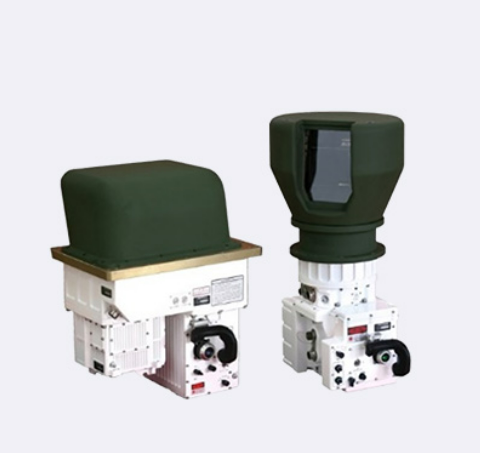
The K2 tank gun sight developed by Hanwha Systems. / Photo courtesy of Hanwha Systems website
That said, competition between the two is not without precedent. In 2016, Hanwha Systems — then known as Hanwha Thales — beat out LIG D&A to win the contract for the AESA radar, a core component of the KF-21 (Boramae), South Korea's domestically developed fighter jet. In 2024, however, the tables turned: in a Navy-commissioned project for the "development of an unmanned surface vessel (USV) system for reconnaissance," LIG D&A defeated Hanwha Systems' Haeryeong system with its Haegum series, securing the prime contractor role.
More recently, the contest has shifted to ground weapons systems. LIG D&A won contracts to supply the gun sight and battlefield visualization systems for the prototype of the next-generation K3 main battle tank, a program being jointly pursued by the Agency for Defense Development (ADD) and Hyundai Rotem. Previously, the K2 Black Panther — Hyundai Rotem's flagship tank — had been equipped with a cooling-type, high-performance gunner's sight and commander's sight developed and manufactured by Hanwha Systems.
A defense industry official expressed concern that "it is regrettable that the situation is being framed only as a conflict between the companies," adding that "it would be an overstatement to simply characterize LIG D&A's win of the K3 tank sight contract as poaching Hanwha Systems' market." The official further explained: "Since the required technical specifications vary depending on the platform's intended use, the outcome should be viewed as a reflection of each company's specialized competitiveness."
Building an 'AI Board' to Secure Future Technologies
From Autonomous Vehicles to Defense Tech: GenGenAI's Quest to Solve the Data Problem [Rising Stars of K-Defense]LIG Nex1 Stockpiles KRW 1 Trillion War Chest as Defense Boom AcceleratesNearthLab: The Drone Startup That Inspected Wind Turbines — Now Targeting the Global Battlefield [Rising Stars of K-Defense]Hanwha Systems Doubles in a Month: Defense Exports and Philly Shipyard Reversal Fuel Stunning RallyHanwha Eyes Jeju as Strategic Hub for Space, Defense, and Tourism
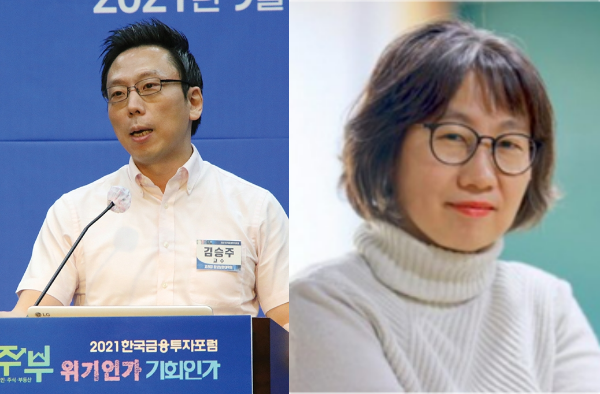
Kim Seung-ju, Professor at Korea University's Graduate School of Information Security (left) and Hwang Hyung-ju, Chair Professor in the Department of Mathematics and Professor at the Graduate School of Artificial Intelligence at POSTECH (Pohang University of Science and Technology). / Photos courtesy of Korea Financial Times DB, POSTECH website
The rivalry between the two companies has now extended to the recruitment of AI talent for their respective boards of directors.
At its recent annual general meeting of shareholders, LIG D&A appointed Kim Seung-ju, a professor at Korea University's Graduate School of Information Security, as a new outside director. Professor Kim fills the vacancy left by Lee Sang-jin, former dean of Korea University's Graduate School of Informatics, whose term expired this past March.
Professor Kim is a leading AI security expert in South Korea. He has served as a member of both the Presidential Committee on Artificial Intelligence and the Defense Innovation Committee, and currently chairs the Korea Defense Innovation Technology Security Association.
LIG D&A described Professor Kim as "an information security expert with both academic expertise and industrial insight," expressing confidence that his policy formulation and technology development capabilities — built through advisory activities for government agencies — will make a significant contribution to the company's growth. In practice, LIG D&A has been steadily deepening its human and technical ties with Korea University, having carried out joint industry-academia research projects on two separate occasions between November 2023 and February this year.
Hanwha Systems countered by reappointing Hwang Hyung-ju — a distinguished chair professor in the Department of Mathematics and a professor at the Graduate School of Artificial Intelligence at POSTECH — as an outside director. Professor Hwang is a leading authority in mathematical AI, the application of advanced mathematical modeling to artificial intelligence.
Professor Hwang is an expert in data science, big data, and deep learning, and also serves concurrently as CEO of AM Square, a company specializing in AI software. He received the 2022 Choi Suk-jung Prize of the Year for developing a temperature-prediction AI solution that applies mathematical modeling to steel manufacturing processes.
Hanwha Systems stated that "Professor Hwang made a sufficient contribution during his previous term to establishing strategic direction for the ICT business and advancing key projects such as the smart factory," citing this as the rationale for his reappointment.
Shin Haeju (hjs0509@fntimes.com)