






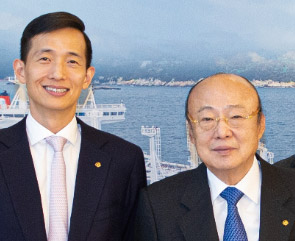
From Left: Kim Dong-kwan, Vice Chairman of Hanwha Group, and Kim Seung-youn, Chairman of Hanwha Group
Kim Dong-kwan, Vice Chairman of Hanwha Group, demonstrates leadership and decisiveness that closely resemble those of his father, Chairman Kim Seung-youn. In fact, Vice Chairman Kim is retracing the path his father walked 30 years ago.
The father-son duo, Kim Seung-youn and Kim Dong-kwan, both made pivotal moves at the age of 41. Despite living in different eras, their lives reflect a parallel theory of shared destiny.
Born in October 1983, Vice Chairman Kim Dong-kwan turned 41 this year. Last month, Hanwha Aerospace, under his leadership, announced plans for a capital increase through rights issuance. The move aims to expand overseas production bases and elevate the company to a top-tier position in global defense, shipbuilding, and aerospace industries.
Out of the KRW 3.6 trillion raised through the rights issuance, KRW 2.4 trillion will be allocated overseas. Specifically, KRW 1 trillion will be used to establish local factories for enhancing overseas defense production capabilities, KRW 600 billion for joint ventures (JVs) with foreign defense companies, and KRW 800 billion for acquiring stakes in overseas shipbuilding companies.
Among these allocations, approximately KRW 30 billion is required immediately this year to set up a JV with a Saudi Arabian defense company. Additional investments will follow sequentially: KRW 1.31 trillion in 2026, KRW 580 billion in 2027, and KRW 480 billion in 2028. It will take about three to four more years to fully utilize the funds raised through the rights issuance.
Chairman Kim Seung-youn also was reshaping Hanwha Group at the age of 41. In 1994, he declared a "second founding" of the group and diversified its business portfolio from explosives and heavy industries into petrochemicals and services. He acquired Hanyang Chemical (now Hanwha Solutions Chemical Division) and bought foreign stakes in Kyungin Energy (now Hanwha Energy), transforming Hanwha into one of Korea’s leading petrochemical companies.
Despite opposition from those around him, Chairman Kim boldly acquired Hanyang Chemical, which was struggling with Tens of billions of won in losses at the time. Within a year, he turned the company profitable.
‘Another K-Miracle’ Hanwha Aerospace, Hyundai Rotem, and LIG Nex1Why HD Hyundai Heavy Industries Focuses on 'Surface Ships' and Hanwha Ocean on 'Submarines'Hanwha Aerospace’s Kim Dong-kwan Partners with Coulter to Target the U.S. Defense MarketHanwha Aerospace, Nears Export of K9 Self-Propelled Howitzers to Vietnam
He also rebranded Korea Explosives Group as Hanwha Group and reorganized all affiliates by 1995. Hanwha’s assets grew from KRW 500 billion in 1981 to KRW 5 trillion in 1991 and further to KRW 8 trillion by 1995.
The dramatic transformation from explosives to petrochemicals over the past 30 years has continued, evolving into a global top-tier defense, shipbuilding, and aerospace powerhouse.
This is the background behind Hanwha Aerospace’s move to carry out the largest rights offering ever by a Korean company.
The "parallel theory" between Kim Seung-youn and Kim Dong-kwan appears to be nearing completion. In response to market speculation that Hanwha Aerospace's rights issuance might be linked to family succession plans, Chairman Kim Seung-youn last month transferred nearly half of his stake in Hanwha Corporation—the group’s holding company—to his three sons: Vice Chairman Kim Dong-kwan, President Kim Dong-won, and Executive Vice President Kim Dong-sun. With this transfer, the three brothers now collectively hold shares in Hanwha Corporation, effectively finalizing the group's succession process.
Hanwha Group clarified that "the stock transfer was intended to ensure that Hanwha Aerospace's rights issuance is not associated with succession plans," adding that "the acquisition of Hanwha Ocean shares by Hanwha Aerospace is also unrelated to succession but rather part of a strategic initiative for global land-sea-air defense package operations."
Shin Haeju (hjs0509@fntimes.com)











![서초구 '래미안원베일리' 44평, 9억 오른 94억원에 거래 [일일 신고가]](https://cfnimage.commutil.kr/phpwas/restmb_setimgmake.php?pp=006&w=69&h=45&m=5&simg=2025053017540607971e41d7fc6c2183101242202.jpg&nmt=18)


![[그래픽 뉴스] ‘순대’가 경제용어라고? 순(純)대외자산, 한국의 진짜 해외자산은 얼마일까?](https://cfnimage.commutil.kr/phpwas/restmb_setimgmake.php?pp=006&w=298&h=298&m=1&simg=202609021356075202de68fcbb3512411124362_0.jpg&nmt=18)
![[그래픽 뉴스] ISA 대개편! 나에게 유리한 계좌는?](https://cfnimage.commutil.kr/phpwas/restmb_setimgmake.php?pp=006&w=298&h=298&m=1&simg=202608041713155615de68fcbb3512411124362_0.jpg&nmt=18)
![[그래픽 뉴스] 미국 증시 새로운 키워드 'MANGOS'](https://cfnimage.commutil.kr/phpwas/restmb_setimgmake.php?pp=006&w=298&h=298&m=1&simg=202607291740382069de68fcbb3512411124362_0.jpg&nmt=18)

![[그래픽 뉴스] 은퇴후 30년 부모님 세대의 생존전략](https://cfnimage.commutil.kr/phpwas/restmb_setimgmake.php?pp=006&w=298&h=298&m=1&simg=202606301704439153de68fcbb3512411124362_0.jpg&nmt=18)
![[신간]은퇴연옥…김경록의 은퇴 후 삶의 나침반](https://cfnimage.commutil.kr/phpwas/restmb_setimgmake.php?pp=006&w=81&h=123&m=5&simg=20260414140833047280f8caa4a5ce12411124362.jpg&nmt=18)
![[신간] 물처럼 흐르고 원칙으로 서다…김용환의 통찰을 담다](https://cfnimage.commutil.kr/phpwas/restmb_setimgmake.php?pp=006&w=81&h=123&m=5&simg=20260409114249027860f8caa4a5ce12411124362.jpg&nmt=18)
![[안현정 서평] 플랫폼의 영지에서 ‘미학적 주권’을 선포하라...'K가 죽어야 K가 산다' 장준환 著](https://cfnimage.commutil.kr/phpwas/restmb_setimgmake.php?pp=006&w=81&h=123&m=5&simg=20260527121426063220c1c16452b012411124362.jpg&nmt=18)
![[서평] 추세 매매의 대가들...추세추종 투자전략의 대가 14인 인터뷰](https://cfnimage.commutil.kr/phpwas/restmb_setimgmake.php?pp=006&w=81&h=123&m=5&simg=2023102410444004986c1c16452b0175114235199.jpg&nmt=18)


![[머니무브 2026] “지금 사도 될까?” 답이 안 보인다면…하반기 투자, 4명의 전문가에게 물어보세요](https://cfnimage.commutil.kr/phpwas/restmb_setimgmake.php?pp=006&w=89&h=45&m=1&simg=202609151044050355302a735e27af12411124362.jpg&nmt=18)
![[AD] ‘PBV 라인업 확장’ 기아, 9월 독일서 ‘PV7’ 첫 공개](https://cfnimage.commutil.kr/phpwas/restmb_setimgmake.php?pp=006&w=89&h=45&m=1&simg=2026083111010602815074925877361231180222.jpg&nmt=18)
![[AD] 제네시스, 럭셔리 경험 더한 ‘2027 GV70’‧‘GV70 그래파이트’ 출시](https://cfnimage.commutil.kr/phpwas/restmb_setimgmake.php?pp=006&w=89&h=45&m=1&simg=20260702143546085600749258773622211122717.jpg&nmt=18)