






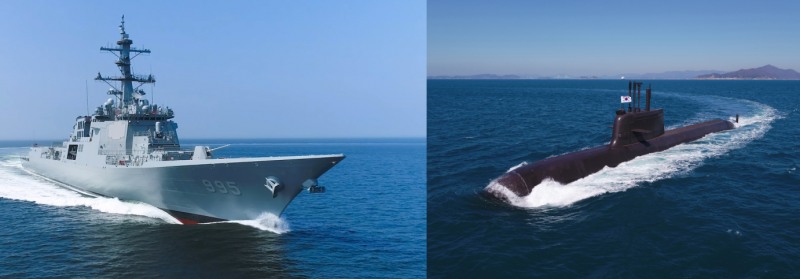
(From left) The ROKS Jeongjo the Great, the 1st ship of the KDX-III Batch-II destroyers built by HD Hyundai Heavy Industries, and the Changbogo-III submarine constructed by Hanwha Ocean. / Photo courtesy of each company
이미지 확대보기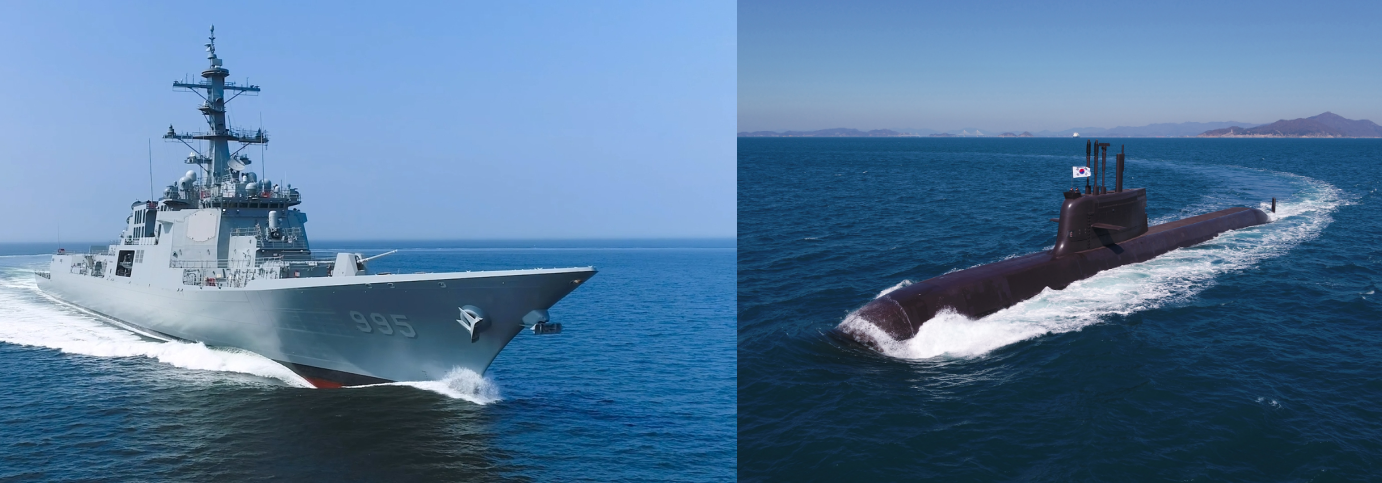
HD Hyundai Heavy Industries is the only company that has performed all basic designs for the Aegis destroyers, the most advanced destroyers currently in service in Korea. The company began research and development of combat ships 51 years ago. In 1976, it built the Ulsan-class frigate, the first domestically produced combat ship in South Korea.
In 2003, the company built the 4,400-ton (t) Chungmugong Lee Sun-sin class destroyer KDX-II, an Aegis destroyer known as the "Shield of Athena." The KDX-II is equipped with a 5-inch gun, long-range anti-submarine torpedoes, ship-to-ship and ship-to-air guided missiles, anti-ship missile defense missiles, light torpedoes, and a close-In Weapon System(CIWS). Notably, it was the first South Korean Navy vessel to apply stealth design, reducing radar reflectivity to make it difficult for enemy ships to detect.
In 2007, HD Hyundai Heavy Industries built the first 7,600-ton (Sejong the Great-class) Aegis destroyer, the KDX-III B-I. It became the third country in the world, after the United States and Japan, to independently construct an Aegis destroyer.
The company also built the 8,200-ton (Jeongjo the Great-class) next-generation Aegis destroyer KDX-III B-II, which was introduced by the Navy last year. This model enhanced ballistic missile interception capabilities, incorporated advanced radar, and applied domestic weapon systems compared to its predecessor.
HD Hyundai Heavy Industries has also built all versions of the Ulsan-class frigates, including Batch-I, II, and III. The latest frigate, the Ulsan-class Batch-III lead ship Chungnam, delivered to the Navy at the end of last year, is equipped with the Aegis combat system and missile defense capabilities.
Hanwha Ocean has participated in various next-generation submarine projects. The submarines it has built include the Chang Bogo-class, Son Won-il class, Type 214, and KSS-III.
The Chang Bogo-class submarine, the first domestically produced submarine built by Hanwha Ocean in 1990, is a diesel-electric propulsion submarine. It is capable of performing various missions including anti-submarine operations, anti-ship attacks, and intelligence gathering.
In 2007, the company produced the Son Won-il class submarine, a successor to the Chang Bogo-class. It is equipped with an Air Independent Propulsion (AIP) system, allowing for extended underwater operations, and features improved noise reduction technology for covert operations, evading enemy detection.
The Type 214 submarine, which can operate underwater without oxygen for longer periods than the Son Won-il class, was developed in technical cooperation with Germany's HDW. It has a more efficient AIP system compared to the Son Won-il class and is capable of high-speed submersion.
The 3,000-ton class KSS-III, a next-generation submarine delivered to the Navy in 2020, boasts higher performance compared to existing submarines. It has a larger displacement than the Type 214 and superior performance in terms of AIP and detection systems, as well as armaments.
Hanwha Ocean also participated in the Seoul-class destroyer projects KDX-I, KDX-II, and KDX-III. While HD Hyundai Heavy Industries focused on ship construction, Hanwha Ocean primarily contributed technical expertise. Hanwha Ocean was responsible for developing military systems related to weapon systems, electronic warfare and missile systems, and overall system integration for the entire KDX series.
Shin Haeju (hjs0509@fntimes.com)











![24개월 예금 최고 연 4.05%…명절 용돈 저축은행으로 불려볼까 [2026 추석 재테크]](https://cfnimage.commutil.kr/phpwas/restmb_setimgmake.php?pp=006&w=69&h=45&m=5&simg=202609260408220699407c96e797801121481643.jpg&nmt=18)
![12개월 최고 연 6.50%…애큐온저축은행 '처음만난적금'[이주의 저축은행 적금금리-9월 4주]](https://cfnimage.commutil.kr/phpwas/restmb_setimgmake.php?pp=006&w=69&h=45&m=5&simg=202609262342540218907c96e797801121481643.jpg&nmt=18)

![기관 '삼성전자'·외인 '삼성전자'·개인 '두산에너빌리티' 1위 [주간 코스피 순매수- 2026년 9월21일~9월23일]](https://cfnimage.commutil.kr/phpwas/restmb_setimgmake.php?pp=006&w=69&h=45&m=5&simg=20260924190458022110179ad439071182351041.jpg&nmt=18)


![[그래픽 뉴스] ‘순대’가 경제용어라고? 순(純)대외자산, 한국의 진짜 해외자산은 얼마일까?](https://cfnimage.commutil.kr/phpwas/restmb_setimgmake.php?pp=006&w=298&h=298&m=1&simg=202609021356075202de68fcbb3512411124362_0.jpg&nmt=18)
![[그래픽 뉴스] ISA 대개편! 나에게 유리한 계좌는?](https://cfnimage.commutil.kr/phpwas/restmb_setimgmake.php?pp=006&w=298&h=298&m=1&simg=202608041713155615de68fcbb3512411124362_0.jpg&nmt=18)
![[그래픽 뉴스] 미국 증시 새로운 키워드 'MANGOS'](https://cfnimage.commutil.kr/phpwas/restmb_setimgmake.php?pp=006&w=298&h=298&m=1&simg=202607291740382069de68fcbb3512411124362_0.jpg&nmt=18)

![[그래픽 뉴스] 은퇴후 30년 부모님 세대의 생존전략](https://cfnimage.commutil.kr/phpwas/restmb_setimgmake.php?pp=006&w=298&h=298&m=1&simg=202606301704439153de68fcbb3512411124362_0.jpg&nmt=18)
![[신간]은퇴연옥…김경록의 은퇴 후 삶의 나침반](https://cfnimage.commutil.kr/phpwas/restmb_setimgmake.php?pp=006&w=81&h=123&m=5&simg=20260414140833047280f8caa4a5ce12411124362.jpg&nmt=18)
![[신간] 물처럼 흐르고 원칙으로 서다…김용환의 통찰을 담다](https://cfnimage.commutil.kr/phpwas/restmb_setimgmake.php?pp=006&w=81&h=123&m=5&simg=20260409114249027860f8caa4a5ce12411124362.jpg&nmt=18)
![[안현정 서평] 플랫폼의 영지에서 ‘미학적 주권’을 선포하라...'K가 죽어야 K가 산다' 장준환 著](https://cfnimage.commutil.kr/phpwas/restmb_setimgmake.php?pp=006&w=81&h=123&m=5&simg=20260527121426063220c1c16452b012411124362.jpg&nmt=18)
![[서평] 추세 매매의 대가들...추세추종 투자전략의 대가 14인 인터뷰](https://cfnimage.commutil.kr/phpwas/restmb_setimgmake.php?pp=006&w=81&h=123&m=5&simg=2023102410444004986c1c16452b0175114235199.jpg&nmt=18)


![[머니무브 2026] “지금 사도 될까?” 답이 안 보인다면…하반기 투자, 4명의 전문가에게 물어보세요](https://cfnimage.commutil.kr/phpwas/restmb_setimgmake.php?pp=006&w=89&h=45&m=1&simg=202609151044050355302a735e27af12411124362.jpg&nmt=18)
![[AD] ‘PBV 라인업 확장’ 기아, 9월 독일서 ‘PV7’ 첫 공개](https://cfnimage.commutil.kr/phpwas/restmb_setimgmake.php?pp=006&w=89&h=45&m=1&simg=2026083111010602815074925877361231180222.jpg&nmt=18)
![[AD] 제네시스, 럭셔리 경험 더한 ‘2027 GV70’‧‘GV70 그래파이트’ 출시](https://cfnimage.commutil.kr/phpwas/restmb_setimgmake.php?pp=006&w=89&h=45&m=1&simg=20260702143546085600749258773622211122717.jpg&nmt=18)
![[AD] 개소세 혜택 종료…현대차, ‘썸머 페스타’로 고객 부담 완화](https://cfnimage.commutil.kr/phpwas/restmb_setimgmake.php?pp=006&w=89&h=45&m=1&simg=20260702142355004830749258773622211122717.jpg&nmt=18)