






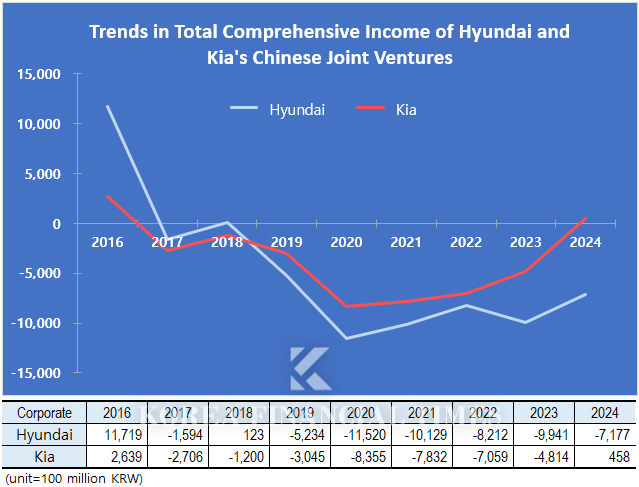
Beijing Hyundai Motor Company (BHMC), Hyundai's joint venture in China, recorded a comprehensive loss of KRW -717.7 billion last year. Although this marks an improvement of approximately KRW 300 billion compared to the KRW -1 trillion loss in 2023, the company has been incurring significant losses for six consecutive years. Due to these ongoing losses, Hyundai ceased equity method accounting for BHMC last year and reduced its book value to zero. Back in 2016, when Hyundai achieved its highest sales in China, BHMC’s book value stood at KRW 2.2258 trillion.
In contrast, Kia’s joint venture in China, Jiangsu Yueda Kia Motors Co. (KCN), reported a comprehensive income of KRW 45.8 billion last year, breaking a seven-year streak of losses since 2017.
The key factor differentiating the performance of Hyundai and Kia is exports. According to Kia's investor relations materials, the company exported 140,000 units from its Chinese factories last year—more than three times Hyundai's volume of 45,000 units. By Q3 of last year, Kia’s Chinese factory utilization rate exceeded 96%.
Kia began leveraging its Chinese factories as export bases two years earlier than Hyundai, starting in 2021. Its Yancheng plant in southeastern China strategically targets markets such as the Asia-Middle East (43%) and Latin America (30%). Although current sales volumes remain modest, Kia has also started exporting its EV5 electric vehicle model designed specifically for overseas markets from China. The company plans to increase exports from its Chinese plants to around 250,000 units this year.
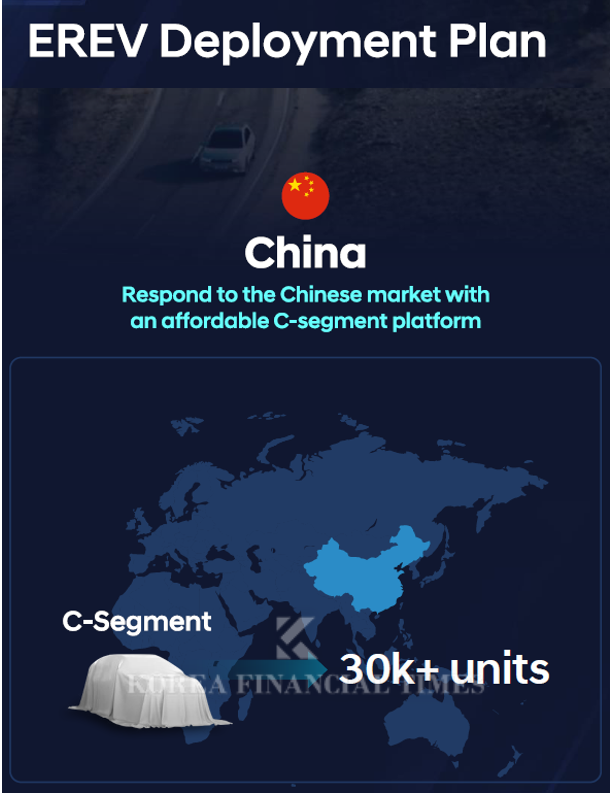
Hyundai Motor's EREV Development Plan. 2024 CEO Investor Day IR Materials
Gwak Horyung (horr@fntimes.com)
Hyundai Motor Group Chairman Chung Eui-sun to Receive Salary from Kia Starting This Year"Why SK On Pins Its Hopes on Hyundai and Kia's Performance in the U.S."'The CEO and the business haven't changed, but...' Hyundai Rotem's Transforms in 2 Years [The answer is TSR]Chung Eui-sun's confidence... 'New car lineup' with unprecedented full change starting next yearSonata, 'Power of Taxi', Succeeds in Rebounding Sales Despite Recession












![LG 구광모의 선택 ‘AI와 실행력ʼ [2027 인사 풍향계]](https://cfnimage.commutil.kr/phpwas/restmb_setimgmake.php?pp=006&w=69&h=45&m=5&simg=20261023212104086660dd55077bc212411124362.jpg&nmt=18)

![12개월 최고 연 4.10%…JT친애저축은행 '비대면 정기예금'[이주의 저축은행 예금금리-10월 4주]](https://cfnimage.commutil.kr/phpwas/restmb_setimgmake.php?pp=006&w=69&h=45&m=5&simg=202610241728500877007c96e7978011215281239.jpg&nmt=18)
![24개월 최고 연 4.10%…OK저축은행 'OK e-안심정기예금'[이주의 저축은행 예금금리-10월 4주]](https://cfnimage.commutil.kr/phpwas/restmb_setimgmake.php?pp=006&w=69&h=45&m=5&simg=202610241739030963907c96e7978011215281239.jpg&nmt=18)


![[그래픽 뉴스] ‘순대’가 경제용어라고? 순(純)대외자산, 한국의 진짜 해외자산은 얼마일까?](https://cfnimage.commutil.kr/phpwas/restmb_setimgmake.php?pp=006&w=298&h=298&m=1&simg=202609021356075202de68fcbb3512411124362_0.jpg&nmt=18)
![[그래픽 뉴스] ISA 대개편! 나에게 유리한 계좌는?](https://cfnimage.commutil.kr/phpwas/restmb_setimgmake.php?pp=006&w=298&h=298&m=1&simg=202608041713155615de68fcbb3512411124362_0.jpg&nmt=18)
![[그래픽 뉴스] 미국 증시 새로운 키워드 'MANGOS'](https://cfnimage.commutil.kr/phpwas/restmb_setimgmake.php?pp=006&w=298&h=298&m=1&simg=202607291740382069de68fcbb3512411124362_0.jpg&nmt=18)

![[그래픽 뉴스] 은퇴후 30년 부모님 세대의 생존전략](https://cfnimage.commutil.kr/phpwas/restmb_setimgmake.php?pp=006&w=298&h=298&m=1&simg=202606301704439153de68fcbb3512411124362_0.jpg&nmt=18)
![[신간] 장애가 가르쳐준 삶의 의미...목진석 9단 아버지 목이균씨의 자서전](https://cfnimage.commutil.kr/phpwas/restmb_setimgmake.php?pp=006&w=81&h=123&m=5&simg=20261023093852062530f8caa4a5ce12411124362.jpg&nmt=18)
![[신간]은퇴연옥…김경록의 은퇴 후 삶의 나침반](https://cfnimage.commutil.kr/phpwas/restmb_setimgmake.php?pp=006&w=81&h=123&m=5&simg=20260414140833047280f8caa4a5ce12411124362.jpg&nmt=18)
![[안현정 서평] 플랫폼의 영지에서 ‘미학적 주권’을 선포하라...'K가 죽어야 K가 산다' 장준환 著](https://cfnimage.commutil.kr/phpwas/restmb_setimgmake.php?pp=006&w=81&h=123&m=5&simg=20260527121426063220c1c16452b012411124362.jpg&nmt=18)
![[서평] 추세 매매의 대가들...추세추종 투자전략의 대가 14인 인터뷰](https://cfnimage.commutil.kr/phpwas/restmb_setimgmake.php?pp=006&w=81&h=123&m=5&simg=2023102410444004986c1c16452b0175114235199.jpg&nmt=18)


![[머니무브 2026] “지금 사도 될까?” 답이 안 보인다면…하반기 투자, 4명의 전문가에게 물어보세요](https://cfnimage.commutil.kr/phpwas/restmb_setimgmake.php?pp=006&w=89&h=45&m=1&simg=202609151044050355302a735e27af12411124362.jpg&nmt=18)
![[AD] ‘PBV 라인업 확장’ 기아, 9월 독일서 ‘PV7’ 첫 공개](https://cfnimage.commutil.kr/phpwas/restmb_setimgmake.php?pp=006&w=89&h=45&m=1&simg=2026083111010602815074925877361231180222.jpg&nmt=18)
![[AD] 제네시스, 럭셔리 경험 더한 ‘2027 GV70’‧‘GV70 그래파이트’ 출시](https://cfnimage.commutil.kr/phpwas/restmb_setimgmake.php?pp=006&w=89&h=45&m=1&simg=20260702143546085600749258773622211122717.jpg&nmt=18)