





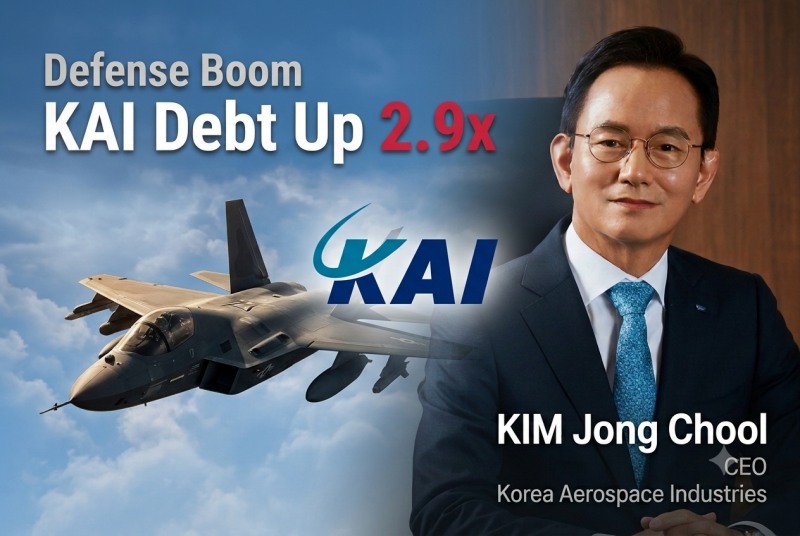
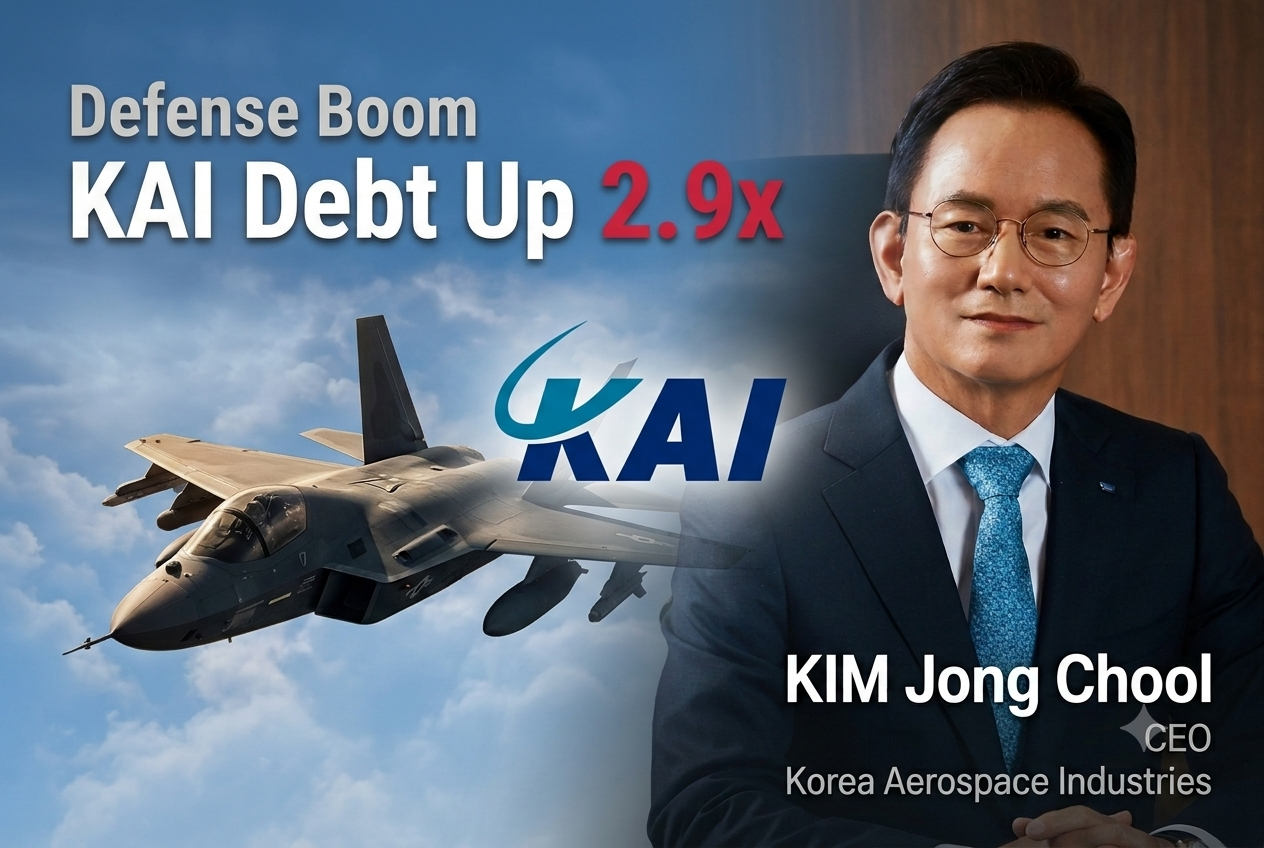
KAI is South Korea’s only prime contractor for complete aircraft systems, overseeing the entire development process, from aircraft design and integration of components such as engines and avionics to test and evaluation. It is the only company in the country capable of independently developing fighters, trainers and helicopters and carrying them through to mass production. It has long been regarded as a beneficiary of the defense export boom, but the numbers in its financial statements point in the opposite direction.
KRW 2.3319 trillion in cash drained over three years
Cash flow is the biggest burden. Operating cash flow shows how much cash a company actually earned or spent through its core business, and unlike book profit, it reveals whether money actually came in. KAI’s operating cash flow was negative KRW 700.4 billion in 2023, negative KRW 728.2 billion in 2024 and negative KRW 903.3 billion in 2025, a third consecutive year in the red. The cash that has drained out over the three years totals KRW 2.3319 trillion. In the first half of this year it was negative KRW 380.0 billion. The deficit narrowed from negative KRW 607.3 billion a year earlier, but the outflow has not stopped.The cause is inventory. Inventories rose 2.3-fold, from KRW 1.7365 trillion at the end of 2023 to KRW 3.9926 trillion at the end of June this year. Of that, work in progress, such as aircraft under construction, accounts for KRW 2.1557 trillion. Raw materials and production costs are tied up first, before mass-production units are delivered.
The gap was filled with borrowing. Gross borrowings (including bonds) rose from KRW 1.0357 trillion at the end of 2024 to KRW 2.1470 trillion at the end of last year and KRW 2.9801 trillion at the end of June this year, a 2.9-fold increase in a year and a half. That is KRW 210.1 billion more than the KRW 2.77 trillion at the end of the first quarter, a rise in just one quarter. Short-term borrowings increased from KRW 492.8 billion at the end of last year to KRW 732.8 billion at the end of June. The debt-to-equity ratio jumped 119.54 percentage points, from 364.66% at the end of 2024 to 484.20% at the end of June this year. The company attributed this to factors such as increased inventory investment for mass production of the KF-21 and the LAH (Light Armed Helicopter).
Brokerages also expect the borrowing burden to be hard to ease soon. Yuanta Securities estimated that year-end gross borrowings will reach KRW 3.2350 trillion, higher than at the end of June. Daol Investment & Securities forecast that operating cash flow will stay negative this year at negative KRW 1.5117 trillion and that the year-end debt-to-equity ratio will rise to 582.4%. It also projected that the interest coverage ratio, which shows how well operating profit can cover interest expenses, will fall from 4.4 times last year to 2.5 times this year.
Orders cover only 6% of target
Reversing the cash outflow requires new contracts, but order inflows have been slow. According to KAI’s second-quarter earnings materials released in July, new orders in the first half totaled KRW 629.5 billion, only 6.0% of the company’s full-year order guidance (target) of KRW 10.4383 trillion. Second-quarter orders alone were KRW 319.4 billion, down 89.9% from KRW 3.1622 trillion a year earlier. KAI explained at the time that this was a base effect from the remaining contract for initial mass production of the KF-21 and the Philippine FA-50 contract, both concentrated in the second quarter of last year. It added that major domestic and export orders would be signed in sequence during the second half.The order backlog has also shrunk. According to the half-year report, the backlog on a separate basis fell KRW 1.5935 trillion, from KRW 27.3437 trillion at the end of last year to KRW 25.7502 trillion at the end of June. Domestic defense declined from KRW 10.9868 trillion to KRW 10.2355 trillion, and complete-aircraft exports from KRW 5.5232 trillion to KRW 5.0257 trillion. Aircraft components fell from KRW 10.0500 trillion to KRW 9.8076 trillion, and the satellite business from KRW 783.7 billion to KRW 681.4 billion, so all four segments declined. This means existing backlog was being worked off faster than new work was coming in.
Behind KAI's KRW 26 Trillion Backlog: Three Years of Cash BurnWhy Hanwha Bought Back Into KAI After Seven YearsFrom Autonomous Vehicles to Defense Tech: GenGenAI's Quest to Solve the Data Problem [Rising Stars of K-Defense]Hanwha Systems Raises KRW 3.4 Trillion as It Winds Down ‘Bridge’ Role in Hanwha Ocean DealFrom Tanks to Rockets: Hyundai Rotem Bets K2 Export Cash on Aerospace Mass Production
KAI’s year-end backlog target is KRW 31.7357 trillion. Meeting it would require a net increase of nearly KRW 6 trillion in the second half alone. Mirae Asset Securities believes meeting the guidance this year will not be easy and estimates full-year new orders at KRW 8.5 trillion, about KRW 1.9 trillion below the company’s target.
Delivery schedules for export orders already secured are also slipping. For the 36 FA-50PL jets for Poland, initial delivery has reportedly been pushed to mid-2027 and full delivery to early 2029, owing to the schedule for integration testing of the AESA radar and AIM-9X missile.
Last year, KAI also lost out in a series of major competitive bids. In April, Korean Air was selected as the preferred bidder for the KRW 961.3 billion UH-60 helicopter performance improvement program. The same month, KAI also lost the preferred-bidder spot for the Cheollian-5 satellite development program to LIG D&A. KAI has objected to the evaluation results.
Last month, KAI, bidding with Hanwha Systems, lost the electronic warfare aircraft system development program to a consortium of LIG D&A and Korean Air. In the second phase of the airborne control aircraft program, for which KAI had partnered with Sweden’s Saab, the choice went to a model from U.S.-based L3Harris, with Korean Air as a partner. Observers say the order gap has widened as KAI, despite its capability to develop aircraft independently, has repeatedly lost in adjacent markets such as special-mission aircraft modification and satellites.
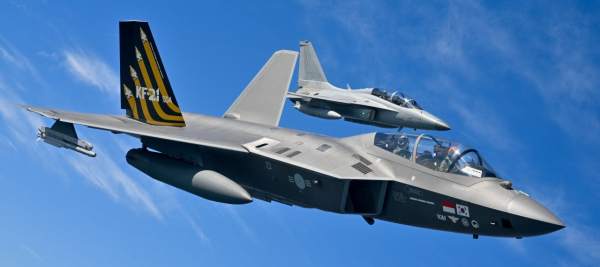
The Korean fighter jet KF-21 “Boramae” in flight. / Photo: Korea Aerospace Industries (KAI)
Revenue up, profit down
Profitability has also weakened. Consolidated revenue stayed in the KRW 3 trillion range for a third straight year: KRW 3.8193 trillion in 2023, KRW 3.6337 trillion in 2024 and KRW 3.6964 trillion in 2025. Growth last year was 1.7%.First-half revenue this year rose 48% from a year earlier to KRW 2.2606 trillion, as system development programs such as the KF-21, the amphibious assault helicopter and the minesweeping helicopter progressed. However, operating profit fell 12.5% to KRW 115.6 billion from KRW 132.0 billion, and operating margin dropped from 8.6% to 5.1%.
In the second quarter alone, operating profit fell 43.1% to KRW 48.4 billion, and operating margin declined 6.1 percentage points from 10.3% to 4.1%. Over the same period, gross margin fell 8.0 percentage points, from 18.7% to 10.7%, indicating that profitability was eroded at the cost level. KAI said that “adjustments to the delivery schedule of rotary-wing aircraft partly affected second-quarter results, and once domestic KF-21 deliveries begin in the second half, mass-production revenue will be fully reflected.”
Brokerages point to LAH delivery disruptions as the direct cause of the weak second-quarter results. According to Mirae Asset Securities, six LAH units were scheduled for delivery in the second quarter, but delivery was put on hold because of an engine defect, and only one unit was actually delivered. Hyundai Motor Securities estimated that there were no LAH deliveries at all in the third quarter because of disruptions in engine supply. Daishin Securities said LAH delivery delays would weigh on achieving this year’s revenue guidance of KRW 5.7306 trillion. Yuanta Securities said that, given the fighter business’s heavy dependence on overseas parts and demanding certification standards, further disruptions to results could occur.
Margins on export projects are also lower than before. Mirae Asset Securities noted that margins on the FA-50 programs for Poland and Malaysia are in the mid-to-high single digits, lower than on earlier export projects.
Need for ‘next growth driver’ after KF-21
Medium- to long-term challenges also remain. As KAI completes KF-21 system development and moves into mass production, it needs a follow-on large-scale program to carry forward the development personnel and technology it has built up. A long gap between development programs could lead to departures of skilled staff. KAI said it is “conducting research and development on a small unmanned combat aircraft and a manned-unmanned teaming system for rotary-wing aircraft.”Weaknesses have also been pointed out in the KF-21’s export competitiveness. Mirae Asset Securities cited the following weaknesses compared with competing aircraft: the lack of a combat operations record, dependence on the GE F414 engine, which is subject to U.S. arms export controls (ITAR), the absence of indigenous air-to-ground and air-to-air missiles, and an insufficient global follow-on logistics support network.
Management continuity is another task. After former CEO Kang Goo-young stepped down in July last year, KAI operated for about eight months without a formal CEO until Kim Jong-chool was elected at an extraordinary shareholders’ meeting on March 18 this year. At his inauguration the next day, Kim said he would secure future growth drivers through software such as AI pilots, manned-unmanned teaming (MUM-T) and unmanned aircraft, and would broaden the business portfolio to include guided weapon systems and space.
Brokerage expectations are also falling. This month, Yuanta Securities cut its target price for KAI from KRW 236,000 to KRW 182,000, Hyundai Motor Securities from KRW 202,000 to KRW 151,000, and Daol Investment & Securities from KRW 230,000 to KRW 210,000. Yuanta Securities lowered its operating profit estimate for this year by 19.1%, from KRW 485.2 billion to KRW 392.4 billion.
In the end, large contracts in the second half hold the key to both meeting the order target and improving cash flow. How well the new management handles the swollen inventory and debt until KF-21 mass-production revenue starts coming in will likely decide the report card for its first year.
Jung Jina (urzinnie@fntimes.com)