







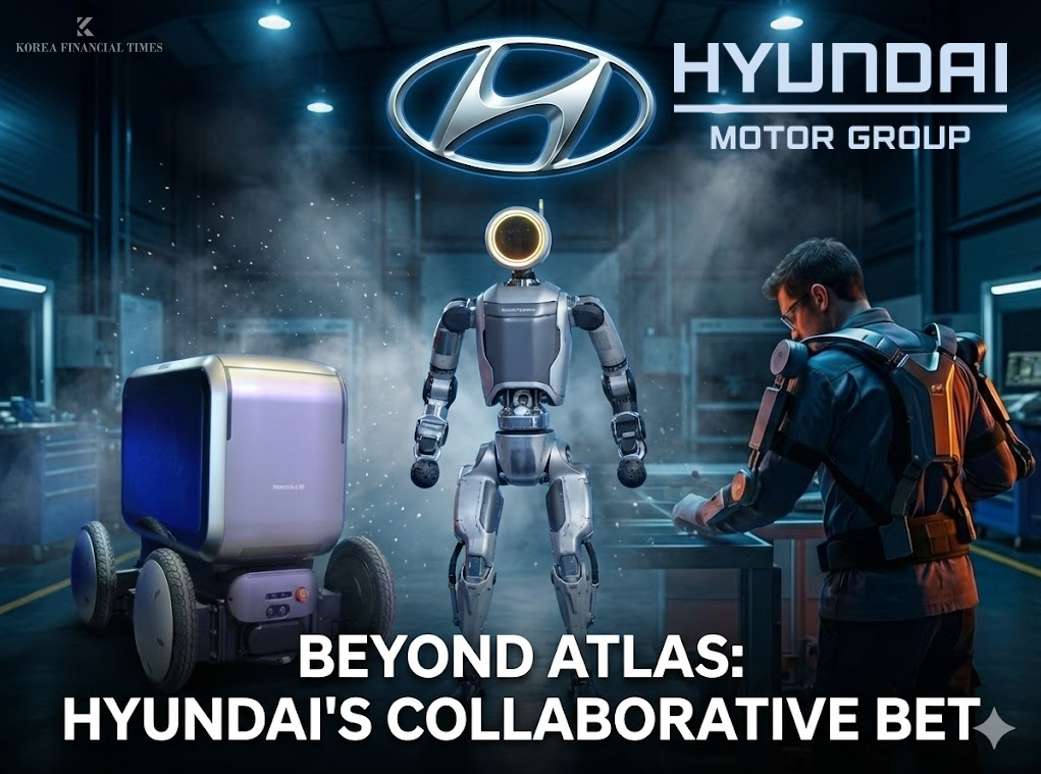
Furthermore, the group plans to leverage real-world operational data gathered from both robots in industrial settings to enhance the capabilities of Atlas, the humanoid robot developed by its robotics subsidiary Boston Dynamics.
MobED Clears Compliance Assessment, Sales to Begin in First Half
According to industry sources on the 26th, Hyundai Motor Group's mobile robot platform MobED received an "approved registration" determination from the National Radio Research Agency's conformity assessment on the 29th of last month, with sales slated to begin in the first half of this year. Typically, one to three months elapse between passing a conformity assessment and the commencement of official sales.Hyundai Motor Group first unveiled the production-ready MobED at the International Robot Exhibition in Tokyo, Japan, last year, and has since been working to secure customers.
On the 4th of next month, MobED will make its domestic debut at the "2026 Smart Factory + Automation World (AW 2026)" held at COEX in Samseong-dong, Seoul, where the group will also unveil future use cases.
Developed by Hyundai Motor and Kia's Robotics LAB, MobED is a robot platform designed for use across a variety of industrial environments, including delivery, logistics, and filming operations. Measuring 74 cm in width and 115 cm in length, MobED reaches a maximum speed of 10 km/h and can operate for more than four hours on a single charge. Maximum payload capacity ranges from 47 to 57 kg depending on the model lineup. A key feature is its modular design, allowing customers to select and configure modules according to their specific needs.
Driving stability is central to MobED's scalability. The platform employs an eccentric wheel-based DnL (Drive-and-Lift) module that allows the chassis to be adjusted to a desired angle even on uneven surfaces or inclines, enabling stable navigation.
MobED also features a user-friendly interface that allows anyone to operate it with ease. The dedicated controller runs on a 3D graphics-based touchscreen, providing an intuitive and convenient user experience accessible to all operators.
Tesla's Humanoid Rival Has Arrived — Boston Dynamics Eyes $70 Billion Valuation [K-Humanoid Wars, Part 1]'Chung Eui-sun Declares Robot Management Era'... Hyundai Motor Group to Lead Robotics Age with 'Physical AI' [KFT Topic]'We Can't Fall Behind in Robotics'... Hyundai Motor Group's Humanoid 'Atlas' Takes the StageHyundai Mobis Posts Record Results, Pivots to Robotics and Electrification [KFT Topic]'Samsung's Bet on the Future' — Rainbow Robotics, Korea's Humanoid Pioneer [K-Humanoid Wars, Part 2]

Hyundai Motor Group's autonomous mobile robot platform 'MobED (Mobile Eccentric Droid)'. / Photo = Hyundai Motor Group
이미지 확대보기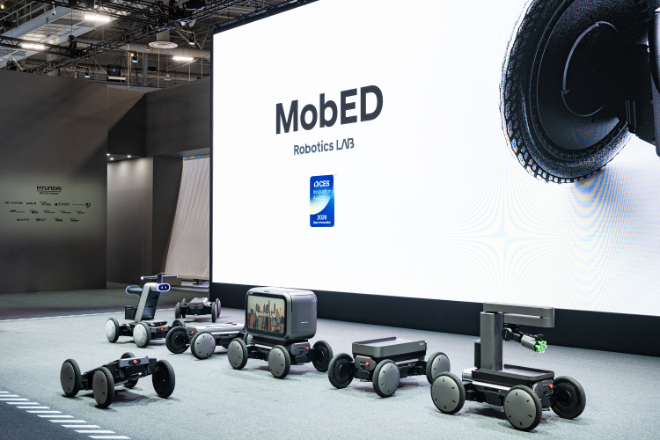
X-ble Shoulder Nears Final Stage of Field Deployment at Affiliates
In addition to the collaborative robot MobED, Hyundai Motor Group is also in the final stages of deploying its wearable robot, the X-ble Shoulder, in the field.Like MobED, the X-ble Shoulder was developed by Hyundai Motor and Kia's Robotics LAB. It is a wearable robot designed to assist workers' shoulder muscles in repetitive overhead work environments. Workers wearing the X-ble Shoulder can reduce shoulder joint load and anterior/lateral deltoid muscle activation by up to 60% and 30%, respectively.
Its most distinctive feature is a power-free torque generation structure, which makes the device lightweight and eliminates the need for separate charging, ensuring convenient maintenance and management.
Hyundai Motor Group officially launched sales of the X-ble Shoulder in July last year, delivering the first unit to Korean Air. Korean Air initially introduced the device at facilities within its Aerospace Division engaged in the assembly and maintenance of military aircraft, commercial aircraft, unmanned aerial vehicles (UAVs), urban air mobility (UAM) vehicles, space launch vehicles, and stealth aircraft.
Hyundai Motor Group has also been introducing the X-ble Shoulder at its own affiliate manufacturing sites since last year. Starting this year, the group plans to expand sales to domestic manufacturers as well as industries including construction, shipbuilding, and agriculture, while also pursuing entry into global markets.

A worker wearing the X-ble Shoulder demonstrates overhead work. / Photo = Hyundai Motor Group
이미지 확대보기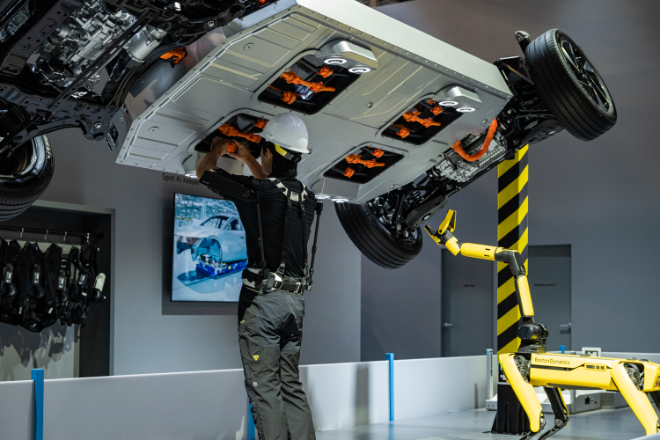
Phased Robot Adoption to Refine Atlas Operational Data
Industry observers note that Hyundai Motor Group is laying the foundation for its future robotics business by prioritizing the deployment of collaborative robots such as MobED and the X-ble Shoulder.Humanoid robots — which have recently emerged as a major topic of debate in both industry and labor circles — still face not only technical challenges but also unresolved social issues before they can be deployed on factory floors.
Indeed, when Boston Dynamics unveiled the humanoid Atlas and announced commercialization plans, the Hyundai Motor labor union pushed back. The union has maintained a firm stance that deployment of Atlas without prior agreement with the union is absolutely impermissible, citing concerns over workers' right to livelihood.
Hyundai Motor Group appears to be pursuing a phased integration of robots and manufacturing by centering its efforts on collaborative robots that can be deployed on production floors first — gradually familiarizing the industrial environment with robotic presence.
Beyond that, the group intends to use real-world data accumulated from collaborative robots in industrial settings to enhance Atlas's operational capabilities. Given that collaborative robots are specifically designed to work in direct cooperation with human workers, the data is expected to accelerate the advancement of Atlas.
A Hyundai Motor Group spokesperson said, "We are making efforts not only to introduce MobED and X-ble Shoulder to our own manufacturing sites, but also to secure external clients," adding, "We are focused on commercialization with the goal of building a future society centered on industrial sites where humans and robots coexist."
Kim JaeHun (rlqm93@fntimes.com)











![[Z-스코어 기업가치 바로 보기] 차입이냐 자기자본이냐…LG엔솔 vs 삼성SDI ‘명암ʼ](https://cfnimage.commutil.kr/phpwas/restmb_setimgmake.php?pp=006&w=69&h=45&m=5&simg=20260912004753014480dd55077bc212411124362.jpg&nmt=18)

![[기자수첩] 보험사 품는 사모펀드, 대주주 심사 재고해야](https://cfnimage.commutil.kr/phpwas/restmb_setimgmake.php?pp=006&w=69&h=45&m=5&simg=20260913173909069220ed56b8e1f814379898.jpg&nmt=18)


![[그래픽 뉴스] ‘순대’가 경제용어라고? 순(純)대외자산, 한국의 진짜 해외자산은 얼마일까?](https://cfnimage.commutil.kr/phpwas/restmb_setimgmake.php?pp=006&w=298&h=298&m=1&simg=202609021356075202de68fcbb3512411124362_0.jpg&nmt=18)
![[그래픽 뉴스] ISA 대개편! 나에게 유리한 계좌는?](https://cfnimage.commutil.kr/phpwas/restmb_setimgmake.php?pp=006&w=298&h=298&m=1&simg=202608041713155615de68fcbb3512411124362_0.jpg&nmt=18)
![[그래픽 뉴스] 미국 증시 새로운 키워드 'MANGOS'](https://cfnimage.commutil.kr/phpwas/restmb_setimgmake.php?pp=006&w=298&h=298&m=1&simg=202607291740382069de68fcbb3512411124362_0.jpg&nmt=18)

![[그래픽 뉴스] 은퇴후 30년 부모님 세대의 생존전략](https://cfnimage.commutil.kr/phpwas/restmb_setimgmake.php?pp=006&w=298&h=298&m=1&simg=202606301704439153de68fcbb3512411124362_0.jpg&nmt=18)
![[신간]은퇴연옥…김경록의 은퇴 후 삶의 나침반](https://cfnimage.commutil.kr/phpwas/restmb_setimgmake.php?pp=006&w=81&h=123&m=5&simg=20260414140833047280f8caa4a5ce12411124362.jpg&nmt=18)
![[신간] 물처럼 흐르고 원칙으로 서다…김용환의 통찰을 담다](https://cfnimage.commutil.kr/phpwas/restmb_setimgmake.php?pp=006&w=81&h=123&m=5&simg=20260409114249027860f8caa4a5ce12411124362.jpg&nmt=18)
![[안현정 서평] 플랫폼의 영지에서 ‘미학적 주권’을 선포하라...'K가 죽어야 K가 산다' 장준환 著](https://cfnimage.commutil.kr/phpwas/restmb_setimgmake.php?pp=006&w=81&h=123&m=5&simg=20260527121426063220c1c16452b012411124362.jpg&nmt=18)
![[서평] 추세 매매의 대가들...추세추종 투자전략의 대가 14인 인터뷰](https://cfnimage.commutil.kr/phpwas/restmb_setimgmake.php?pp=006&w=81&h=123&m=5&simg=2023102410444004986c1c16452b0175114235199.jpg&nmt=18)


![[AD] ‘PBV 라인업 확장’ 기아, 9월 독일서 ‘PV7’ 첫 공개](https://cfnimage.commutil.kr/phpwas/restmb_setimgmake.php?pp=006&w=89&h=45&m=1&simg=2026083111010602815074925877361231180222.jpg&nmt=18)
![[AD] 제네시스, 럭셔리 경험 더한 ‘2027 GV70’‧‘GV70 그래파이트’ 출시](https://cfnimage.commutil.kr/phpwas/restmb_setimgmake.php?pp=006&w=89&h=45&m=1&simg=20260702143546085600749258773622211122717.jpg&nmt=18)
![[AD] 개소세 혜택 종료…현대차, ‘썸머 페스타’로 고객 부담 완화](https://cfnimage.commutil.kr/phpwas/restmb_setimgmake.php?pp=006&w=89&h=45&m=1&simg=20260702142355004830749258773622211122717.jpg&nmt=18)
![[AD] 기아 ‘디 올 뉴 셀토스’, 인도 타임스 드라이브 어워즈서 ‘올해의 SUV’ 선정](https://cfnimage.commutil.kr/phpwas/restmb_setimgmake.php?pp=006&w=89&h=45&m=1&simg=202605071156400590007492587736124111243152.jpg&nmt=18)
![[AD]‘그랜저 잡자’ 기아, 상품성 더한 ‘The 2027 K8’ 출시](https://cfnimage.commutil.kr/phpwas/restmb_setimgmake.php?pp=006&w=89&h=45&m=1&simg=2026042110193702730074925877361211627527.jpg&nmt=18)