





Chung Eui-sun, Chairman of Hyundai Motor Group, marks the fifth anniversary of his appointment. Chairman Chung began the third-generation management era in the year marking the 20th anniversary of Hyundai Motor Group's founding in 2000, adding significance to the moment.
Born in 1970, Chairman Chung is the eldest son of Hyundai Motor Group Honorary Chairman Chung Mong-koo and grandson of the late founder of the broader Hyundai Group, Chung Ju-young. As the eldest grandson of the family, he was notably favoured by the late founder.
After graduating from Whimoon High School and Korea University, Chairman Chung worked briefly at Hyundai Precision Industry, the predecessor to Hyundai Mobis, before completing an MBA at University of San Francisco. Rather than joining Hyundai Motor Group immediately, he worked for two years at Japan's major general trading company Itochu Corporation.
Returning to Korea in 1999, Chairman Chung began his career at Hyundai Motor as purchasing executive director, progressing through roles as head of sales support operations, head of domestic sales headquarters, vice president of Hyundai-Kia, and president of Kia before becoming vice chairman of Hyundai Motor Group in 2009.
Before becoming chairman, Chairman Chung demonstrated management capability through bold initiatives. Notably, while serving as CEO of Kia, he recruited renowned Porsche-trained designer Peter Schreyer as senior vice president for Kia design, ushering in a golden era of Kia design exemplified by the 'Kia K5'. Simultaneously, through brand marketing campaigns such as 'DESIGN? KIA!', he successfully enhanced Kia's image, which had been overshadowed by Hyundai Motor.
During his tenure as vice chairman of Hyundai Motor Group, despite concerns both inside and outside the group, he launched luxury brand 'Genesis' and high-performance brand 'Hyundai N', removing the global stigma of being a 'low-cost product company'. Currently, both Genesis and Hyundai N are recognised for technology and product quality in global markets, contributing significantly to enhancing Hyundai Motor Group's image.
Chairman Chung's disruptive innovation became evident after his appointment. Notably, contrary to market expectations, he substantially dismantled the 'vice chairman group' known as former Honorary Chairman Chung Mong-koo's circle of advisers, establishing powerful central authority.
Hyundai Motor Group 'Chung Eui-sun era' 5 years ②: 'Bold strategist' Chung Eui-sun to break through with KRW 112 trillion investment over next 5 yearsHyundai Glovis · AutoEver rally boosts Chung succession bid'Tariff-Heavy US,' 'Uncertain China': Samsung, Hyundai Motor, LG, POSCO, Lotte Seek Breakthrough in IndiaChung Eui-sun's 10 Years of Passion for Hyundai N : High-Performance Brand Eyes the Electric Vehicle Era"Investing Despite Trillion-KRW Losses"... Chung Eui-sun's New Business '3 Picks'

In year-end personnel announcements in 2020, Chairman Chung appointed Kim Yong-hwan, vice chairman of Hyundai Steel, and Jung Jin-haeng, vice chairman of Hyundai Engineering and Construction, as advisers. In the 2021 year-end regular personnel reshuffle, he further appointed Yun Yeo-chul, Hyundai Motor's labour relations chief vice chairman, as an adviser. Subsequently, until former Hyundai Motor CEO Jang Jae-hoon was promoted to vice chairman last year, there was not a single vice chairman promotion in Hyundai Motor Group's year-end regular reshuffles. Additionally, most executives from the president tier who had surrounded Honorary Chairman Chung Mong-koo stepped down.
Into the vacant positions stepped generational change with management figures in their 40s. Chairman Chung particularly appointed many personnel from electrification, robotics, autonomous driving, and ICT fields he prioritised, accelerating transformation into a 'comprehensive mobility solutions company'. Notable examples include Hyun Dong-jin, director of the Robotics Lab leading Hyundai Motor's robot development, and Song Chang-hyun, CEO of Podi2dot, a key subsidiary in autonomous driving.
This personnel innovation under Chairman Chung is assessed as having led to flexible and forward-thinking strategy and results in the arrival of the electric vehicle era accompanying his appointment. Particularly in the early stages of his tenure amid heightened uncertainty from COVID-19, he achieved not only quantitative growth in performance but also qualitative growth as 'game changer' in the future electric vehicle era, exemplified by Hyundai's 'Ioniq' and Kia's 'EV' lineups.
Beyond electric vehicles, the group simultaneously pursued diverse powertrains including hybrid, plug-in hybrid, and hydrogen electric, leading a variety of markets with high-value-added eco-friendly vehicles. As a result, Hyundai Motor Group leapt to become a global 'Big Three' in complete vehicle manufacturing, standing shoulder to shoulder with Toyota Group and Volkswagen Group over five years.
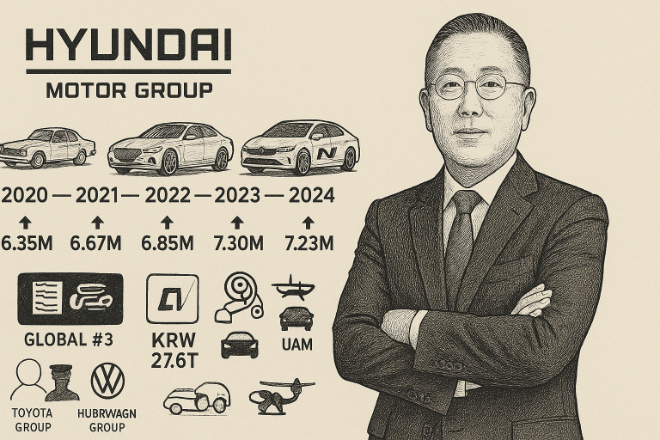
In 2020 when Chairman Chung took office, combined global sales of Hyundai Motor and Kia were approximately 6.35 million units, ranking fifth behind Toyota, Volkswagen, Ford, and Honda. In 2021, when the electric vehicle era began in earnest, sales rose to approximately 6.67 million units for fourth place, then reached approximately 6.85 million units in 2022 for third place. In 2023 and 2024, sales of approximately 7.30 million units and 7.23 million units respectively maintained third place. This year, Hyundai Motor Group aims for global sales of 7.39 million units.
During the same period, combined results of Hyundai Motor and Kia grew from KRW 163.2 trillion in sales and KRW 4.5 trillion in operating profit on a consolidated basis in 2020 to KRW 280 trillion in sales and KRW 27.6 trillion in operating profit at the end of last year. Notably, last year, the group surpassed second-place Volkswagen Group to reach second place in operating profit. Despite US tariff risks this year, the combined first-half operating profit of both companies maintained second place globally at approximately KRW 13 trillion.
Hyundai Motor and Kia are responding to US tariff risks this year by expanding local production and strengthening hybrid lineups, planning to invest approximately KRW 15 trillion locally in the United States. Additionally, the strategy focuses on strengthening European sales led by compact electric vehicles and developing emerging markets.
Meanwhile, Chairman Chung Eui-sun is not sparing investment in the future based on three pillars: robotics, autonomous driving, and UAM (urban air mobility), in addition to electric vehicles. Through this, the strategy accelerates momentum toward becoming a customer-centric comprehensive mobility company leading future society.
Kim JaeHun (rlqm93@fntimes.com)