






Investor attention on KT is growing following recent unauthorized microtransaction hacking incidents.
KT shares closed at KRW 49,850 on September 23. This represents approximately 15.8% below the year's intraday high of KRW 59,200 reached on July 15.
Behind this share price adjustment lies a mysterious unauthorized microtransaction incident. According to KT, unauthorized payments for mobile gift card purchases occurred during dawn hours from August 27 to September 6, targeting KT subscribers in Soha and Haan districts of Gwangmyeong, Gyeonggi Province, and Geumcheon and Yeongdeungpo districts of Seoul. Illegal ultra-small mobile base stations (femtocells) infiltrating communication networks were identified as the cause.
KT maintained its position that "there was no personal information leakage through femtocells" during the damage period, but faced criticism for delayed response after reporting the breach to the Ministry of Science and ICT and Korea Internet & Security Agency approximately 12 days after the first damage report.
According to the Ministry of Science and ICT, KT's unauthorized microtransaction damages totaled 362 cases worth KRW 240 million as of September 19.
관련기사
Which Korean Companies Are Partnering with Palantir, co‑founded by PayPal alumni?After Missing Out on State-Backed AI Project and Being Left Out of US Delegation, What’s Next for KT CEO Kim Young-shub?Why Did Kakao and KT Fall Short Against Naver and SKT in Korea’s ‘National AI’ Selection?KT Accelerates 'AX Accelerator' with Korean AI Services
A total of 20,000 customers received femtocell signals, and the number of customers suffering personal information leakage damage is expected to increase based on future investigations.
Industry observers point to this KT incident more seriously given that actual financial damage occurred. Under these circumstances, possibilities of expanded KT share price volatility and investment risks are being raised.
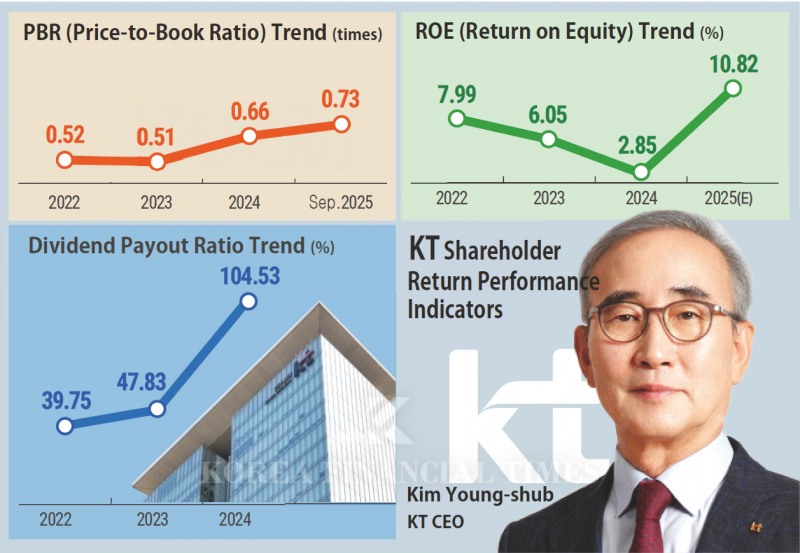
KT has maintained stable dividends and high dividend propensity while showing improved valuation trends compared to the past. The price-to-book ratio (PBR) recently stands at 0.73 times, continuing an upward trend from 0.52 times in 2022, 0.51 times in 2023, and 0.66 times last year. KT previously announced its corporate value enhancement strategy including mid-to-long-term financial targets and shareholder return plans in November last year.
According to this plan, KT set a target of achieving 9-10% return on equity (ROE) by 2028. To achieve this, the company will pursue cumulative KRW 1 trillion in share buybacks and cancellations, 9% operating margin achievement, triple growth in artificial intelligence (AI) and IT revenue compared to 2023, and liquidation of non-core assets.
With such shareholder return policies and mid-to-long-term profitability expectations, KT overtook SK Telecom to become the telecommunications sector "blue chip" for the first time in 22 years based on market capitalization at the end of January this year.
On January 24, KT shares closed trading at KRW 47,000, up 2.96% from the previous day, recording a market capitalization of KRW 11.845 trillion. SK Telecom closed at KRW 54,800 (-0.18% from the previous day) with a market capitalization of KRW 11.7704 trillion.
ROE, which KT emphasized for enhancing shareholder returns, is a key indicator showing how efficiently a company utilizes equity capital to generate profits. From shareholders' perspective, ROE becomes a criterion for investment decisions.
Securities firms project KT's year-end ROE at 10.8%. While it declined from 7.99% in 2022 to 2.85% last year, approximately triple growth is expected this year. The secret was stable dividends.
KT, which introduced quarterly dividends from last year, decided on a quarterly dividend per share of KRW 600 for the second quarter this year, a 20% increase from the same period last year. The total second-quarter dividend amount is KRW 144.7 billion.
Furthermore, KT applied the "dividend first, investment later" system, previously only used for settlement dividends, starting from the second quarter this year. Through this, investors can know dividend status and amounts in advance, receiving praise for enhancing predictability. From shareholders' perspective, stable cash flow is guaranteed without dividend uncertainty.
The second quarter earnings surprise also became the foundation for KT's shareholder return policies. Second-quarter consolidated operating profit surged 105.4% year-on-year to KRW 1 trillion. Revenue increased 13.5% to KRW 7.4 trillion.
KT's policy is to clean up low-profitability businesses and utilize improved cash flow not only for investment in new growth businesses like AI and IT but also as resources for shareholder returns.
Share buybacks and cancellations totaling KRW 1 trillion by 2028 are also being pursued. A KT official emphasized, "Announcing KRW 1 trillion in share buybacks and cancellations along with dividend-first, investment-later demonstrates strong shareholder return commitment."
However, a sudden bolt from the blue struck what seemed like a smooth path ahead. The view is that short-term impact from this unauthorized payment damage incident is inevitable. Given actual financial damage occurred, investigation results, additional responses, user trust recovery, and potential cost burdens have emerged as variables.
Securities firms are discussing possibilities of KT share price adjustments of up to 12% in the short term due to this incident's fallout. However, they also present "buying opportunity amid negative news" strategies based on prospects for expanded shareholder returns ahead.
Third-quarter earnings consensus expects revenue of KRW 6.8882 trillion and operating profit of KRW 548.1 billion with little change. Annual operating profit is also projected to grow significantly year-on-year to KRW 2.6581 trillion.
Kim Hong-sik, researcher at Hanwha Securities, diagnosed, "If this incident's impact expands, KT shares could fall to the KRW 45,000-48,000 range," but added, "A strategy of treating this negative news as a buying opportunity would also be good."
Jeong Chaeyun (chaeyun@fntimes.com)











!['첫 연임' 신학기 vs '新리더십' 이형주…차기 수협은행장 선임 D-Day [2027 은행장 선임 레이스]](https://cfnimage.commutil.kr/phpwas/restmb_setimgmake.php?pp=006&w=69&h=45&m=5&simg=202609211608140057701b5a2213792211381469.jpg&nmt=18)

![서초구 '아크로리버파크' 34평, 10억 오른 74억원에 거래 [일일 신고가]](https://cfnimage.commutil.kr/phpwas/restmb_setimgmake.php?pp=006&w=69&h=45&m=5&simg=20260624115142011110dd55077bc212411124362.jpg&nmt=18)


![[그래픽 뉴스] ‘순대’가 경제용어라고? 순(純)대외자산, 한국의 진짜 해외자산은 얼마일까?](https://cfnimage.commutil.kr/phpwas/restmb_setimgmake.php?pp=006&w=298&h=298&m=1&simg=202609021356075202de68fcbb3512411124362_0.jpg&nmt=18)
![[그래픽 뉴스] ISA 대개편! 나에게 유리한 계좌는?](https://cfnimage.commutil.kr/phpwas/restmb_setimgmake.php?pp=006&w=298&h=298&m=1&simg=202608041713155615de68fcbb3512411124362_0.jpg&nmt=18)
![[그래픽 뉴스] 미국 증시 새로운 키워드 'MANGOS'](https://cfnimage.commutil.kr/phpwas/restmb_setimgmake.php?pp=006&w=298&h=298&m=1&simg=202607291740382069de68fcbb3512411124362_0.jpg&nmt=18)

![[그래픽 뉴스] 은퇴후 30년 부모님 세대의 생존전략](https://cfnimage.commutil.kr/phpwas/restmb_setimgmake.php?pp=006&w=298&h=298&m=1&simg=202606301704439153de68fcbb3512411124362_0.jpg&nmt=18)
![[신간]은퇴연옥…김경록의 은퇴 후 삶의 나침반](https://cfnimage.commutil.kr/phpwas/restmb_setimgmake.php?pp=006&w=81&h=123&m=5&simg=20260414140833047280f8caa4a5ce12411124362.jpg&nmt=18)
![[신간] 물처럼 흐르고 원칙으로 서다…김용환의 통찰을 담다](https://cfnimage.commutil.kr/phpwas/restmb_setimgmake.php?pp=006&w=81&h=123&m=5&simg=20260409114249027860f8caa4a5ce12411124362.jpg&nmt=18)
![[안현정 서평] 플랫폼의 영지에서 ‘미학적 주권’을 선포하라...'K가 죽어야 K가 산다' 장준환 著](https://cfnimage.commutil.kr/phpwas/restmb_setimgmake.php?pp=006&w=81&h=123&m=5&simg=20260527121426063220c1c16452b012411124362.jpg&nmt=18)
![[서평] 추세 매매의 대가들...추세추종 투자전략의 대가 14인 인터뷰](https://cfnimage.commutil.kr/phpwas/restmb_setimgmake.php?pp=006&w=81&h=123&m=5&simg=2023102410444004986c1c16452b0175114235199.jpg&nmt=18)


![[머니무브 2026] “지금 사도 될까?” 답이 안 보인다면…하반기 투자, 4명의 전문가에게 물어보세요](https://cfnimage.commutil.kr/phpwas/restmb_setimgmake.php?pp=006&w=89&h=45&m=1&simg=202609151044050355302a735e27af12411124362.jpg&nmt=18)
![[AD] ‘PBV 라인업 확장’ 기아, 9월 독일서 ‘PV7’ 첫 공개](https://cfnimage.commutil.kr/phpwas/restmb_setimgmake.php?pp=006&w=89&h=45&m=1&simg=2026083111010602815074925877361231180222.jpg&nmt=18)
![[AD] 제네시스, 럭셔리 경험 더한 ‘2027 GV70’‧‘GV70 그래파이트’ 출시](https://cfnimage.commutil.kr/phpwas/restmb_setimgmake.php?pp=006&w=89&h=45&m=1&simg=20260702143546085600749258773622211122717.jpg&nmt=18)
![[AD] 개소세 혜택 종료…현대차, ‘썸머 페스타’로 고객 부담 완화](https://cfnimage.commutil.kr/phpwas/restmb_setimgmake.php?pp=006&w=89&h=45&m=1&simg=20260702142355004830749258773622211122717.jpg&nmt=18)
![[AD] 기아 ‘디 올 뉴 셀토스’, 인도 타임스 드라이브 어워즈서 ‘올해의 SUV’ 선정](https://cfnimage.commutil.kr/phpwas/restmb_setimgmake.php?pp=006&w=89&h=45&m=1&simg=202605071156400590007492587736124111243152.jpg&nmt=18)