





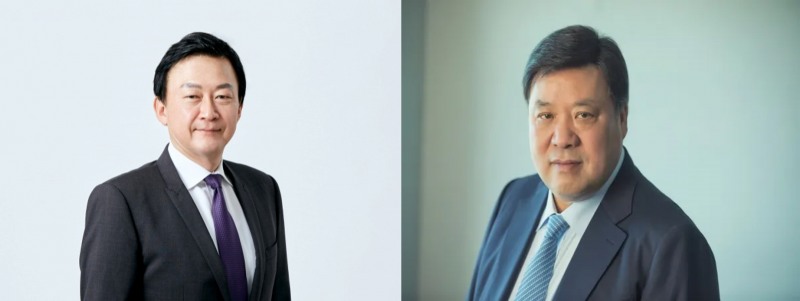
John Rim, CEO of Samsung Biologics (left), and Seo Jung-jin, Chairman of Celltrion. / Photos courtesy of each company
이미지 확대보기
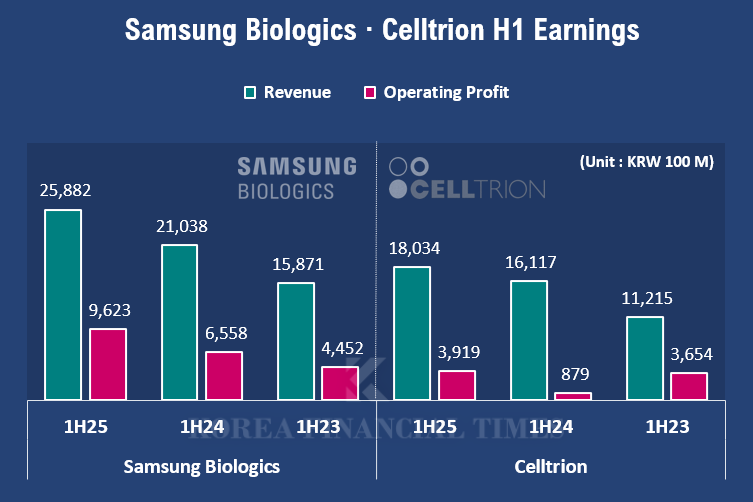
According to a disclosure on the 18th, Samsung Biologics’ consolidated revenue for the first half of this year came in at KRW 2.5882 trillion, up 23% from the same period a year earlier. It set another half-year record high, following last year. Operating profit rose 47% to KRW 962.3 billion over the period, with an operating margin of 37%.
Excluding its subsidiary Samsung Bioepis, the contract development and manufacturing (CDMO) business also posted record revenue. On a standalone basis, Samsung Biologics recorded revenue of KRW 2.0138 trillion, up 36%, and operating profit of KRW 907.1 billion, up 61%.
A Samsung Biologics official said, “Improved operational efficiency at Plants 1–3 and the ramp-up of the 240,000-liter Plant 4 underpinned the strong results.” The company’s total production capacity stands at 784,000 liters, one of the highest in the world. It is currently proceeding with permits and groundwork to break ground on Plant 6.
After bringing the 180,000-liter Plant 5 online last year in April, the company plans to add three more plants by 2032, targeting total production capacity of 1,324,000 liters. Buoyed by the robust performance, the company raised its full-year consolidated revenue growth guidance by 5 percentage points to 25–30%.
Graphic = Korea Financial Times / Source = Financial Supervisory Service (Consolidated Basis)
이미지 확대보기
During the same period, Celltrion reported revenue of KRW 1.8034 trillion and operating profit of KRW 391.9 billion, up 12% and 346% year-on-year, respectively. Its operating margin was 22%. A Celltrion official said, “Stable sales of existing products in global markets and expanded sales of high-margin new products drove the earnings growth.”
Celltrion’s first-half operating profit fell from KRW 365.4 billion in 2023 to KRW 87.9 billion last year before rebounding to KRW 391.9 billion this year. By contrast, Samsung Biologics’ figures have steadily increased—KRW 445.2 billion in 2023, KRW 655.8 billion in 2024, and KRW 962.3 billion in 2025.
‘Cash-Rich’ Samsung Biologics and SK Bioscience Accelerate Investments Amid Biotech Industry DownturnIntensified Competition, Trump Risk, and Oversupply... Samsung Biologics CEO John Rim Faces Mounting Challenges Amid UncertaintyJohn Rim’s 4 Years That Changed the Bio Landscape: From Latecomer to ‘Samsung’s Savior’Samsung Biologics Replaces CFO and R&D Head... Will It Find New Momentum This Year?K-PharmaBio’s First 'KRW 4 Trillion Club' Member – Samsung Biologics Eyes KRW 5 Trillion with Unmatched Excellence in Capacity
Cash flow from investing activities was negative KRW 790.5 billion, widening from KRW 267.9 billion last year due to increased spending on buildings and equipment. Cash flow from financing activities was negative KRW 72.4 billion, a smaller net outflow than last year’s KRW 234.7 billion, reflecting reduced short-term borrowings and repayments.
Celltrion’s cash flow from operating activities was KRW 301.5 billion, down KRW 29.0 billion from last year. While cash generated from operations increased by KRW 124.1 billion to KRW 514.0 billion, corporate tax payments rose by KRW 153.1 billion, resulting in cash outflows.
Cash flow from investing activities was negative KRW 170.3 billion, swinging to a net outflow from KRW 68.5 billion last year. Cash flow from financing activities was negative KRW 439.8 billion, with the net outflow widening from negative KRW 76.1 billion last year due to increases in short- and long-term financial liabilities.
Differences were also notable in employee benefits. Samsung Biologics’ parental leave usage rate was 34%, ahead of Celltrion’s 9%. Adjusted for total headcount, Samsung Biologics also ranked higher: 2.64% for Samsung Biologics (5,047 employees) versus 1.79% for Celltrion (2,680 employees).
The retention rate of employees who returned from leave and remained for at least 12 months was 60% at Samsung Biologics and 57% at Celltrion, a modest gap. The number of employees taking spousal paternity leave was 79 at Samsung Biologics and 33 at Celltrion, translating into 1.57% and 1.23% of total headcount, respectively, with Samsung Biologics again higher.
An industry official said, “A balanced management strategy that encompasses not only profit generation but also cash flows and employee welfare appears to be the key to sustainable corporate growth.”
Yang Hyunwoo (yhw@fntimes.com)












![“3조 신화 넘어 4조 시대로”…박주형, 신세계 성장판 넓혔다 [CEO 임기보고서]](https://cfnimage.commutil.kr/phpwas/restmb_setimgmake.php?pp=006&w=69&h=45&m=5&simg=20261021155541058600dd55077bc212411124362.jpg&nmt=18)


![서초구 '래미안원베일리' 41평, 14.5억 오른 120억원에 거래 [일일 신고가]](https://cfnimage.commutil.kr/phpwas/restmb_setimgmake.php?pp=006&w=69&h=45&m=5&simg=20260624115142011110dd55077bc212411124362.jpg&nmt=18)


![[그래픽 뉴스] ‘순대’가 경제용어라고? 순(純)대외자산, 한국의 진짜 해외자산은 얼마일까?](https://cfnimage.commutil.kr/phpwas/restmb_setimgmake.php?pp=006&w=298&h=298&m=1&simg=202609021356075202de68fcbb3512411124362_0.jpg&nmt=18)
![[그래픽 뉴스] ISA 대개편! 나에게 유리한 계좌는?](https://cfnimage.commutil.kr/phpwas/restmb_setimgmake.php?pp=006&w=298&h=298&m=1&simg=202608041713155615de68fcbb3512411124362_0.jpg&nmt=18)
![[그래픽 뉴스] 미국 증시 새로운 키워드 'MANGOS'](https://cfnimage.commutil.kr/phpwas/restmb_setimgmake.php?pp=006&w=298&h=298&m=1&simg=202607291740382069de68fcbb3512411124362_0.jpg&nmt=18)

![[그래픽 뉴스] 은퇴후 30년 부모님 세대의 생존전략](https://cfnimage.commutil.kr/phpwas/restmb_setimgmake.php?pp=006&w=298&h=298&m=1&simg=202606301704439153de68fcbb3512411124362_0.jpg&nmt=18)
![[신간]은퇴연옥…김경록의 은퇴 후 삶의 나침반](https://cfnimage.commutil.kr/phpwas/restmb_setimgmake.php?pp=006&w=81&h=123&m=5&simg=20260414140833047280f8caa4a5ce12411124362.jpg&nmt=18)
![[신간] 물처럼 흐르고 원칙으로 서다…김용환의 통찰을 담다](https://cfnimage.commutil.kr/phpwas/restmb_setimgmake.php?pp=006&w=81&h=123&m=5&simg=20260409114249027860f8caa4a5ce12411124362.jpg&nmt=18)
![[안현정 서평] 플랫폼의 영지에서 ‘미학적 주권’을 선포하라...'K가 죽어야 K가 산다' 장준환 著](https://cfnimage.commutil.kr/phpwas/restmb_setimgmake.php?pp=006&w=81&h=123&m=5&simg=20260527121426063220c1c16452b012411124362.jpg&nmt=18)
![[서평] 추세 매매의 대가들...추세추종 투자전략의 대가 14인 인터뷰](https://cfnimage.commutil.kr/phpwas/restmb_setimgmake.php?pp=006&w=81&h=123&m=5&simg=2023102410444004986c1c16452b0175114235199.jpg&nmt=18)


![[머니무브 2026] “지금 사도 될까?” 답이 안 보인다면…하반기 투자, 4명의 전문가에게 물어보세요](https://cfnimage.commutil.kr/phpwas/restmb_setimgmake.php?pp=006&w=89&h=45&m=1&simg=202609151044050355302a735e27af12411124362.jpg&nmt=18)
![[AD] ‘PBV 라인업 확장’ 기아, 9월 독일서 ‘PV7’ 첫 공개](https://cfnimage.commutil.kr/phpwas/restmb_setimgmake.php?pp=006&w=89&h=45&m=1&simg=2026083111010602815074925877361231180222.jpg&nmt=18)
![[AD] 제네시스, 럭셔리 경험 더한 ‘2027 GV70’‧‘GV70 그래파이트’ 출시](https://cfnimage.commutil.kr/phpwas/restmb_setimgmake.php?pp=006&w=89&h=45&m=1&simg=20260702143546085600749258773622211122717.jpg&nmt=18)