






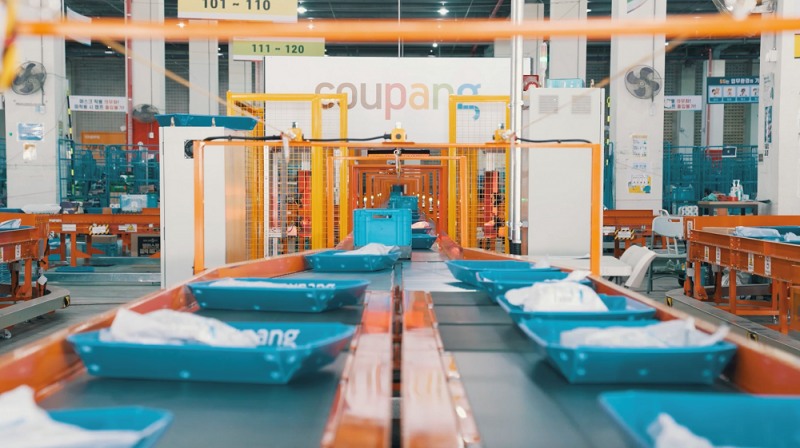
Coupang Logistics Service Surpasses CJ Logistics in Revenue Last Year/Photo courtesy of Coupang
이미지 확대보기
According to CLS’s audit report released on April 21, the company posted revenue of KRW3.8349 trillion last year, a 46.3% increase from the previous year. Operating profit rose by 110.1% to KRW 55.1 billion.
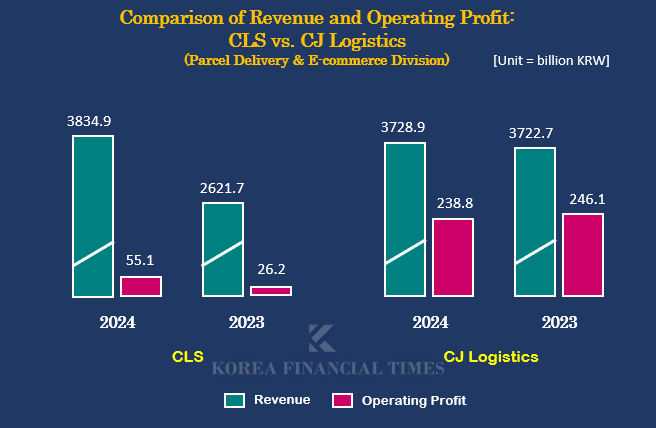
Graphic = Korea Financial Times
CLS’s growth mirrors Coupang’s overall performance. Coupang reported revenue of KRW 41.2901 trillion in 2024, a 29% year-on-year increase. Notably, the commerce division closely linked to CLS—which includes Rocket Delivery, Rocket Fresh, Rocket Growth, and Marketplace—recorded KRW 36.4093 trillion in revenue, an 18% rise.
A key driver of CLS’s growth was the surge in small business partners joining Coupang’s platform. The number of registered small merchants rose from about 47,000 in 2018 to over 200,000 in 2023—more than a fourfold increase.
Significant growth in “Rocket Growth”—Coupang’s service for small merchants that handles warehousing, packaging, shipping, and returns once products are stocked—has also drawn attention. In 2023, the service facilitated transactions worth several trillion KRW, with around 1 million different small business products available. CLS’s ability to absorb the rapidly increasing delivery volume contributed to its revenue growth.
The growth rate has been striking. According to the Korea Integrated Logistics Association, CLS’s market share jumped from 12.7% at the end of 2022 to 24.1% as of August last year—almost doubling within a year. CLS surpassed Lotte Global Logistics and Hanjin Express to become the industry’s second-largest player. Meanwhile, CJ Logistics, which had maintained around 50.1% market share since 2020, saw its share drop from 40% in 2022 to 33.6% by the end of September 2024 as CLS statistics were officially included.
The next battleground is expected to be the “3PL” (third-party logistics) market. Since last year, CJ Logistics has been aggressively expanding its reach by forming partnerships with major retailers including Shinsegae Group, Naver, and Kurly, and by launching “7-day-a-week delivery” services.
CLS, too, is ramping up its 3PL capabilities, continuing to rely on small businesses with competitive pricing. The company’s strategy is to secure logistics volume by investing in logistics infrastructure across the country, thereby attracting more small merchants.
In 2024 alone, Coupang began construction on logistics centers in Gimcheon (North Gyeongsang Province), Gangseo (Busan), and Icheon (Gyeonggi Province), while new facilities in Cheonan, Nam Daejeon, and the Gwangju Advanced Logistics Center became operational. A sub-hub in Chilgok (North Gyeongsang Province) began operations at the end of last year, and another in Ulsan is slated for completion this year. Additionally, the company has broken ground on a state-of-the-art AI-powered logistics center in Jecheon (North Chungcheong Province) with up to KRW 100 billion in planned investment.
If product inflows from small businesses and regional farms across the country continue to grow, CLS’s upward trajectory is likely to accelerate.
An industry insider remarked, “Coupang’s dominance built on 7-day delivery has been formidable. CJ Logistics’ counterattack with its own 7-day delivery system will be a major storyline to watch this year,” adding, “As logistics competition intensifies, the key differentiator will shift to the quality of delivery services.”
Park seulgi (seulgi@fntimes.com)











![‘삼전닉스ʼ에 가린 반도체주…주성엔지니어링 ‘질주ʼ·리노공업 ‘주춤ʼ [정답은 TSR]](https://cfnimage.commutil.kr/phpwas/restmb_setimgmake.php?pp=006&w=69&h=45&m=5&simg=20260918223152079000dd55077bc212411124362.jpg&nmt=18)
![12개월 최고 연 4.01%…동양저축은행 '정기예금'[이주의 저축은행 예금금리-9월 3주]](https://cfnimage.commutil.kr/phpwas/restmb_setimgmake.php?pp=006&w=69&h=45&m=5&simg=202609202303210200807c96e797801121481643.jpg&nmt=18)
![스틱벤처스 정보라, 네오사피엔스 IPO 잰걸음 ‘딥테크 투자 강화ʼ [VC 2026 하반기 프리뷰 (7)]](https://cfnimage.commutil.kr/phpwas/restmb_setimgmake.php?pp=006&w=69&h=45&m=5&simg=20260918221427079140dd55077bc212411124362.jpg&nmt=18)

![12개월 최고 연 6.50%…애큐온저축은행 '처음만난적금'[이주의 저축은행 적금금리-9월 3주]](https://cfnimage.commutil.kr/phpwas/restmb_setimgmake.php?pp=006&w=69&h=45&m=5&simg=202609202310220168307c96e797801121481643.jpg&nmt=18)


![[그래픽 뉴스] ‘순대’가 경제용어라고? 순(純)대외자산, 한국의 진짜 해외자산은 얼마일까?](https://cfnimage.commutil.kr/phpwas/restmb_setimgmake.php?pp=006&w=298&h=298&m=1&simg=202609021356075202de68fcbb3512411124362_0.jpg&nmt=18)
![[그래픽 뉴스] ISA 대개편! 나에게 유리한 계좌는?](https://cfnimage.commutil.kr/phpwas/restmb_setimgmake.php?pp=006&w=298&h=298&m=1&simg=202608041713155615de68fcbb3512411124362_0.jpg&nmt=18)
![[그래픽 뉴스] 미국 증시 새로운 키워드 'MANGOS'](https://cfnimage.commutil.kr/phpwas/restmb_setimgmake.php?pp=006&w=298&h=298&m=1&simg=202607291740382069de68fcbb3512411124362_0.jpg&nmt=18)

![[그래픽 뉴스] 은퇴후 30년 부모님 세대의 생존전략](https://cfnimage.commutil.kr/phpwas/restmb_setimgmake.php?pp=006&w=298&h=298&m=1&simg=202606301704439153de68fcbb3512411124362_0.jpg&nmt=18)
![[신간]은퇴연옥…김경록의 은퇴 후 삶의 나침반](https://cfnimage.commutil.kr/phpwas/restmb_setimgmake.php?pp=006&w=81&h=123&m=5&simg=20260414140833047280f8caa4a5ce12411124362.jpg&nmt=18)
![[신간] 물처럼 흐르고 원칙으로 서다…김용환의 통찰을 담다](https://cfnimage.commutil.kr/phpwas/restmb_setimgmake.php?pp=006&w=81&h=123&m=5&simg=20260409114249027860f8caa4a5ce12411124362.jpg&nmt=18)
![[안현정 서평] 플랫폼의 영지에서 ‘미학적 주권’을 선포하라...'K가 죽어야 K가 산다' 장준환 著](https://cfnimage.commutil.kr/phpwas/restmb_setimgmake.php?pp=006&w=81&h=123&m=5&simg=20260527121426063220c1c16452b012411124362.jpg&nmt=18)
![[서평] 추세 매매의 대가들...추세추종 투자전략의 대가 14인 인터뷰](https://cfnimage.commutil.kr/phpwas/restmb_setimgmake.php?pp=006&w=81&h=123&m=5&simg=2023102410444004986c1c16452b0175114235199.jpg&nmt=18)


![[머니무브 2026] “지금 사도 될까?” 답이 안 보인다면…하반기 투자, 4명의 전문가에게 물어보세요](https://cfnimage.commutil.kr/phpwas/restmb_setimgmake.php?pp=006&w=89&h=45&m=1&simg=202609151044050355302a735e27af12411124362.jpg&nmt=18)
![[AD] ‘PBV 라인업 확장’ 기아, 9월 독일서 ‘PV7’ 첫 공개](https://cfnimage.commutil.kr/phpwas/restmb_setimgmake.php?pp=006&w=89&h=45&m=1&simg=2026083111010602815074925877361231180222.jpg&nmt=18)
![[AD] 제네시스, 럭셔리 경험 더한 ‘2027 GV70’‧‘GV70 그래파이트’ 출시](https://cfnimage.commutil.kr/phpwas/restmb_setimgmake.php?pp=006&w=89&h=45&m=1&simg=20260702143546085600749258773622211122717.jpg&nmt=18)
![[AD] 개소세 혜택 종료…현대차, ‘썸머 페스타’로 고객 부담 완화](https://cfnimage.commutil.kr/phpwas/restmb_setimgmake.php?pp=006&w=89&h=45&m=1&simg=20260702142355004830749258773622211122717.jpg&nmt=18)
![[AD] 기아 ‘디 올 뉴 셀토스’, 인도 타임스 드라이브 어워즈서 ‘올해의 SUV’ 선정](https://cfnimage.commutil.kr/phpwas/restmb_setimgmake.php?pp=006&w=89&h=45&m=1&simg=202605071156400590007492587736124111243152.jpg&nmt=18)