





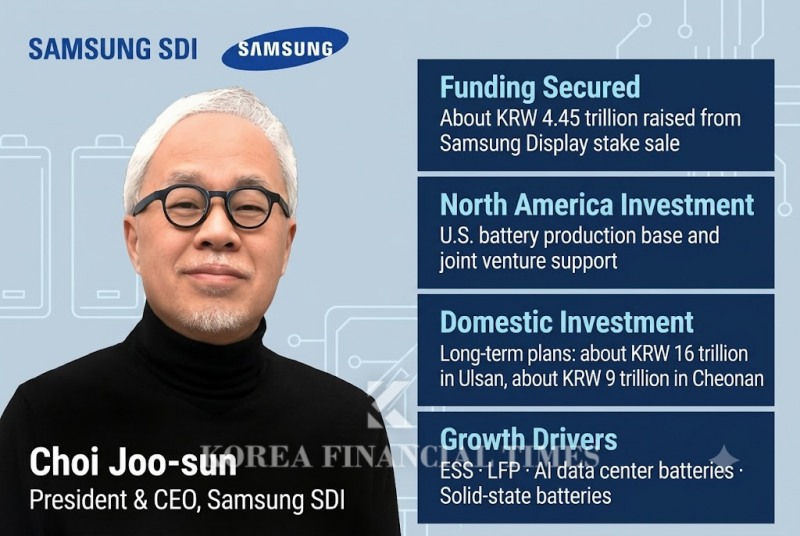
This infographic, originally published by Korea Financial Times, has been reconstructed using generative AI.
이미지 확대보기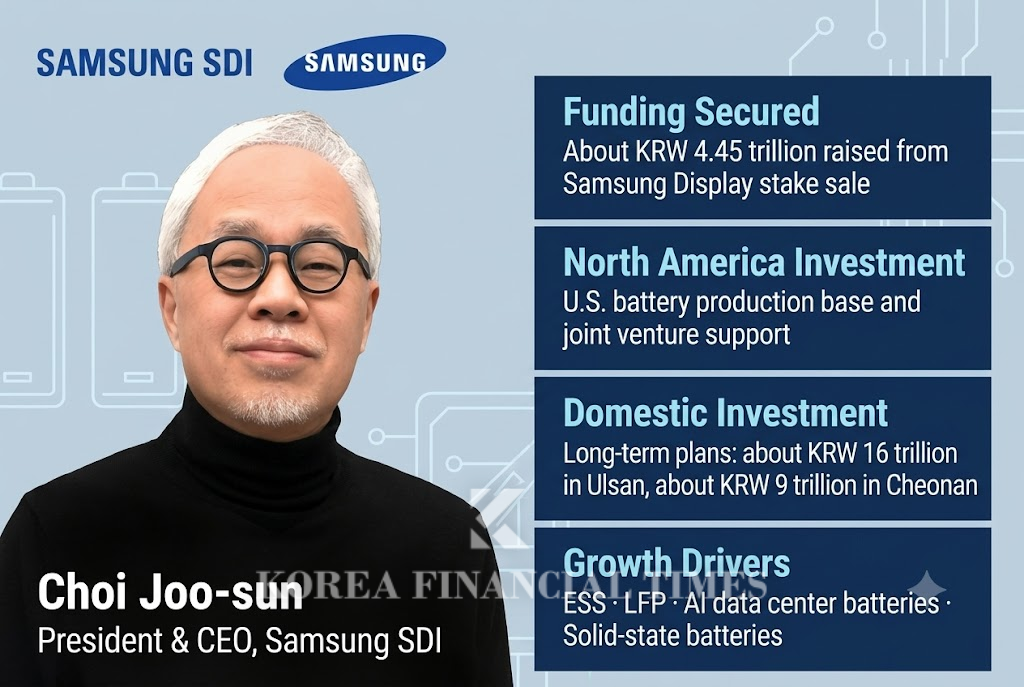
The company is also responding to the expanding energy storage system (ESS) market, strengthening supply chain cooperation with domestic battery materials companies, and working to secure future technologies such as solid-state batteries.
Choi’s strategy focuses on expanding businesses that can generate profit in the short term while securing mid- to long-term growth engines at the same time. The aim is to diversify a business structure that had been concentrated in EV batteries, and to respond to market changes by strengthening its North American production base and domestic research and development (R&D) capabilities.
KRW 4.45 Trillion Secured... Executing the Growth Strategy
The foundation for Choi’s investment expansion is the financial capacity he has secured. In August, Samsung SDI decided to transfer 13,088,235 shares of Samsung Display for about KRW 4.45 trillion.The shares for sale represent about 33% of its holding. Once the transaction is completed, Samsung SDI’s stake in Samsung Display will fall from 15.2% to 10.2%. The company cited raising investment funds to secure future growth engines as the purpose of the sale.
The stake sale is significant in that it creates investment capacity from existing assets amid continued uncertainty in the EV market. Unlike its competitors, Samsung SDI has so far valued financial stability over aggressive capacity expansion financed by borrowing.
Samsung SDI’s debt-to-equity ratio stood at about 77% as of the second quarter of this year. Compared with competitors such as LG Energy Solution and SK On, whose ratios range from about 150% to 200%, it is regarded as relatively well managed.
The move is interpreted as an effort to secure investment capacity by using existing assets rather than increasing the debt burden amid EV market uncertainty. In the battery industry, which requires massive capital expenditure, how a company raises investment funds and manages its financial burden matters as much as expanding production capacity.
Will Samsung Electronics Name Successors to DS, DX Division Heads’ Concurrent Memory, Mobile Posts?Samsung SDI Taps POSCO Future M for LFP, EcoPro BM for Solid-State MaterialsDebt vs. Equity: LG Energy Solution and Samsung SDI Take Diverging PathsSK On Builds Non-Chinese LFP Supply Chain With POSCO Future M, L&FDe-Risking From China: LG Energy Solution Secures US Lithium Supply Through 2039
The funds raised are expected to be used for expanding U.S. ESS production sites and other projects. In North America, including the United States, demand for batteries that ensure stable power supply is growing as AI data centers spread and power infrastructure investment increases. With the timing of an EV market recovery uncertain, the strategy is to develop ESS as a new growth pillar and reduce business volatility.
The ESS business has already grown to the point that the company is considering expanding its production capacity, which is cited as another reason for additional investment. In its second-quarter earnings announcement this year, the company said the volume secured for prismatic LFP batteries for ESS would fill a substantial portion of its production capacity through 2029. It is therefore reviewing a capacity expansion depending on the possibility of additional orders.
Choi is pursuing additional investment to expand ESS production in North America alongside diversification of its materials supply chain.
To this end, the company is also strengthening cooperation with domestic materials companies. Samsung SDI signed an LFP cathode material supply contract worth about KRW 1.6 trillion with L&F for three years starting in 2027. It has also expanded cooperation on battery material supply, including LFP cathode materials, with POSCO Future M. With domestic materials companies including EcoPro BM, it is maintaining its existing battery materials supply chain while pursuing cooperation to secure next-generation materials technology.
Strengthening the materials supply chain goes beyond securing a stable supply of raw materials. Linking U.S. local production with the supply capabilities of domestic materials companies improves supply stability and makes it easier to meet the requirements of each market.
“As U.S. supply chain regulations and local production requirements grow in importance, building a system that connects materials sourcing to battery production can become one pillar of business competitiveness,” said an official in the battery industry.
KRW 25 Trillion Domestic Investment... Securing Long-Term Competitiveness
Choi’s investment strategy does not end with broadening the short-term earnings base. Last month, Samsung SDI announced long-term investment plans through 2040 of about KRW 16 trillion in its Ulsan site and about KRW 9 trillion in its Cheonan site. Combined, the two sites total about KRW 25 trillion.The plan is to build next-generation battery production bases and R&D and technology verification infrastructure, strengthening a system that runs from technology development to mass production.
Ulsan will focus on building a next-generation battery production base, while Cheonan will focus on strengthening R&D and technology verification capabilities. The goal is a structure in which technology secured at the R&D stage is carried into mass production, and data accumulated during production is fed back into technology improvement.
Solid-state batteries are seen as the mid- to long-term growth engine. Samsung SDI is developing solid-state batteries with a target of starting mass production in the second half of 2027. Solid-state batteries replace liquid electrolytes with solid electrolytes, and they are drawing attention as a candidate for next-generation batteries in terms of safety and energy density. They could also expand beyond EVs into fields that require high-performance batteries, such as humanoid robots.
For Choi, solid-state batteries are an investment to secure technological leadership in future markets, separate from the current earnings recovery. However, to meet the mass production target, the company must secure not only technology verification but also customer evaluations, production yield and manufacturing cost competitiveness. The key question is whether the large-scale R&D investment can translate into actual market leadership and profit.
Challenges for the Remainder of His Term
Earnings that support Choi’s investment expansion are on an improving trend. Samsung SDI’s consolidated revenue in the second quarter of this year was KRW 3.7688 trillion, and operating profit was KRW 203.8 billion. It returned to an operating profit for the first time in seven quarters, since the third quarter of 2024, and cumulative first-half operating profit was KRW 48.2 billion, also a turnaround to profit.Notably, in the second quarter of this year, the company posted an operating profit of KRW 96.1 billion even excluding KRW 107.7 billion in U.S. Advanced Manufacturing Production Credit (AMPC). This is significant because it shows the battery business itself may be recovering profitability, beyond earnings supported by policy incentives. If sales of ESS batteries and high-output products continue to expand, the foundation for earnings improvement could also widen.
Brokerages also expect Samsung SDI’s strong earnings to continue in the third quarter of this year. According to securities information provider FnGuide and others, Samsung SDI is estimated to post third-quarter revenue of KRW 4.0135 trillion and operating profit of KRW 237.0 billion. Revenue would be up about 31% from a year earlier, and operating profit would mark a turnaround to profit.
Of course, a return to profit does not necessarily mean earnings have normalized. Profitability could vary depending on the utilization rate of local U.S. production facilities, the mass production schedule of new projects and the pace of recovery in EV battery demand.
Loans and debt guarantees extended to StarPlus Energy are also factors that require continuous monitoring of the joint venture’s business performance and the likelihood of recovering the funds.
Over the rest of his term, Choi must prove his expanded investment through tangible management results. He must build a short-term earnings base through expanded ESS and LFP battery production while pursuing the commercialization of solid-state batteries, and convert the funds put into domestic and overseas production facilities into orders and revenue growth.
Kim JaeHun (rlqm93@fntimes.com)