






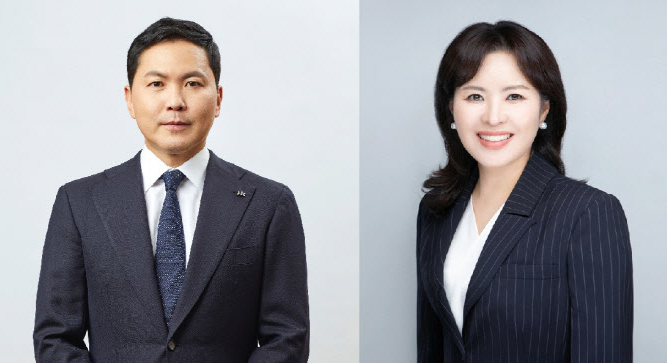
Yoon Sang-hyun, Vice Chairman of Kolmar Group (left), and Yoon Yeo-won, CEO of Kolmar BNH / Photo by Kolmar Holdings
이미지 확대보기
According to industry sources on May 13, Kolmar Holdings, the group’s holding company, submitted an application to the Daejeon District Court on May 2 to convene an extraordinary shareholders’ meeting for Kolmar BNH. The agenda includes appointing Vice Chairman Yoon Sang-hyun and former CJ CheilJedang Vice President Lee Seung-hwa as new inside directors of Kolmar BNH.
Currently, the inside directors on Kolmar BNH’s board are CEO Yoon Yeo-won and Cho Young-joo, Head of Management Planning at Kolmar BNH. CEO Yoon succeeded in being reappointed for a third consecutive term at the regular shareholders’ meeting in March last year. Her remaining term is about two years.
Vice Chairman Yoon Sang-hyun’s decision was prompted by Kolmar BNH’s poor performance and declining stock price. A Kolmar Holdings official explained, “Since 2021, Kolmar BNH has continued to struggle with poor performance and falling stock prices. The decision was made due to disappointing R&D results relative to investment and stagnant operating profit with no visible improvement.”
In fact, Kolmar BNH posted sales of KRW 615.6 billion and operating profit of KRW 24.6 billion last year. While sales reached an all-time high since the company’s founding, actual profits have dropped significantly compared to KRW 91.6 billion in 2021.
However, CEO Yoon Yeo-won’s side finds the board restructuring difficult to accept. The company believes Vice Chairman Yoon's side is attempting to remove CEO Yoon Yeo-won from her position through the board overhaul. In response, Kolmar BNH issued a statement on May 12, asserting, “Demanding changes to the CEO system and board structure is premature, as we are currently pursuing mid- to long-term strategies for a performance turnaround and enhancing corporate value.”
The statement continued, “Despite an overall slump in the health functional food industry over the past two years, we were the only company in the industry to achieve sales growth. While large-scale investments for sustainable growth have placed a considerable burden on short-term results, we have consistently maintained robust shareholder dividends and continued our shareholder return policy.”
Some observers point out that an imbalance in shareholdings between the siblings has fueled the conflict.
Currently, Vice Chairman Yoon Sang-hyun is responsible for Kolmar Holdings and the core affiliate Kolmar Korea, while CEO Yoon Yeo-won oversees Kolmar BNH, which produces health functional foods and related products. Kolmar Holdings holds a 44.6% stake in Kolmar BNH, while CEO Yoon owns only 7.8%. Vice Chairman Yoon is also the largest shareholder of Kolmar Holdings, with a 31.8% stake.
Given CEO Yoon Yeo-won’s significantly lower shareholding, the likelihood of the sibling dispute escalating into a full-fledged management rights battle is considered low. A Kolmar BNH official stated, “Given the shareholding structure, even if friendly shares are gathered, it is not a situation where a management dispute can occur. While legal action is being considered, the best outcome would be an amicable resolution. As we prepare for the extraordinary shareholders’ meeting, persuasion is our only option.”
The official added, “While current performance appears to have slowed due to an adverse base effect from the strong results in 2021–2022, it is unfair to judge CEO Yoon’s leadership based on just two years of performance,” and continued, “It’s far too hasty to push for a board reshuffle so soon after the regular general shareholders' meeting held just a month or two ago.”
Kim Nayoung, Korea Finacial Times (steaming@fntimes.com)