






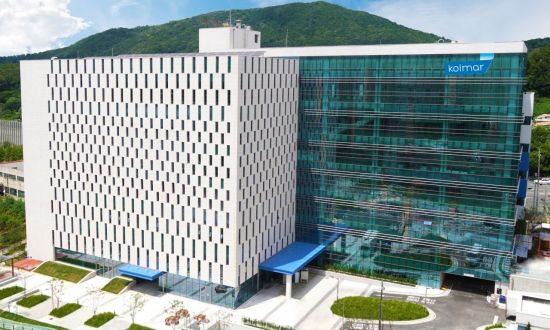
Panoramic view of Kolmar Korea headquarters. / Photo = Kolmar Korea
According to a disclosure by the Financial Supervisory Service on the 13th, Kolmar Korea's factory utilization rate was 120.3% as of the third quarter of last year, exceeding its capacity. This was due to a rush of orders as the company exported more K-beauty products.
A Kolmar Korea official emphasized, “Last year, the factory’s operating rate exceeded 100% due to increased exports,” and “We are currently focusing on increasing productivity by expanding our factory facilities domestically and internationally.”
As additional orders are hard to come by, Kolmar Korea is tightening the reins on expanding its capacity (CAPA). The company plans to put the newly expanded Sejong 1 plant into full operation in the first half of this year. The expansion is expected to increase the company's cosmetics production capacity by more than 20 percent.
Securities analysts expect the company's increased production capacity to drive sales this year. “The domestic CAPA will increase by more than 20 percent this year, adding to the effect of the expansion,” said Park Eun-jung, a researcher at Hana Securities. ”The company is expected to respond smoothly to the increase in orders this year as its production capacity is steadily expanding.”
“With the completion of the line expansion at the Sejong plant, the company has secured an annual CAPA of 5.3 billion units,” said Jeong Jeong-sol, a researcher at Daeshin Securities, adding, ”Growth is expected to continue this year.”
Overseas production facilities will also see significant improvements this year. Kolmar Korea plans to complete its second U.S. plant in the first half of this year, raising the capacity utilization rate of its North American production facilities from 180 million to 300 million. The recent influx of new customers in the North American market has spurred the company to expand its local production capacity.
The expansion of domestic and international CAPA is raising expectations for Korea Kolmar's performance even as distribution costs have increased this year due to Trump's second term tariff policy and high exchange rates.
As a cosmetics ODM, the recent rise in the exchange rate is weighing on the company. The company imports major ingredients for cosmetics, such as palm oil and glycerin, from overseas. As of the third quarter of last year, the consolidated cost of sales ratio was 71.4%, which is a high proportion of raw materials.
However, this year's increase in orders and production from overseas customers is expected to offset the exchange rate burden to some extent. “Hankook Kolmar's U.S. subsidiary is expected to post high sales growth (55% year-on-year) due to the influx of new local customers, and its U.S. Plant 1 is expected to turn profitable,” said Jeong Jeong-sol. He also forecasts that the company's consolidated sales will reach KRW 2.7 trillion this year, up 11% from last year, and operating profit will increase 30% to KRW 270 billion (10% operating margin).
An industry insider said, “The recent increase in the exchange rate has increased the burden on companies that are highly dependent on importing raw materials,” adding, “Overseas subsidiaries are strengthening their global market operations as they trade in dollars.”
Kim Nayoung, Korea Finacial Times (steaming@fntimes.com)











![24개월 예금 최고 연 4.05%…명절 용돈 저축은행으로 불려볼까 [2026 추석 재테크]](https://cfnimage.commutil.kr/phpwas/restmb_setimgmake.php?pp=006&w=69&h=45&m=5&simg=202609260408220699407c96e797801121481643.jpg&nmt=18)
![12개월 최고 연 6.50%…애큐온저축은행 '처음만난적금'[이주의 저축은행 적금금리-9월 4주]](https://cfnimage.commutil.kr/phpwas/restmb_setimgmake.php?pp=006&w=69&h=45&m=5&simg=202609262342540218907c96e797801121481643.jpg&nmt=18)
![기관 '삼성전자'·외인 '삼성전자'·개인 '두산에너빌리티' 1위 [주간 코스피 순매수- 2026년 9월21일~9월23일]](https://cfnimage.commutil.kr/phpwas/restmb_setimgmake.php?pp=006&w=69&h=45&m=5&simg=20260924190458022110179ad439071182351041.jpg&nmt=18)

![24개월 최고 연 4.05%…드림저축은행 '인터넷정기예금'[이주의 저축은행 예금금리-9월 4주]](https://cfnimage.commutil.kr/phpwas/restmb_setimgmake.php?pp=006&w=69&h=45&m=5&simg=202609262340300939607c96e797801121481643.jpg&nmt=18)


![[그래픽 뉴스] ‘순대’가 경제용어라고? 순(純)대외자산, 한국의 진짜 해외자산은 얼마일까?](https://cfnimage.commutil.kr/phpwas/restmb_setimgmake.php?pp=006&w=298&h=298&m=1&simg=202609021356075202de68fcbb3512411124362_0.jpg&nmt=18)
![[그래픽 뉴스] ISA 대개편! 나에게 유리한 계좌는?](https://cfnimage.commutil.kr/phpwas/restmb_setimgmake.php?pp=006&w=298&h=298&m=1&simg=202608041713155615de68fcbb3512411124362_0.jpg&nmt=18)
![[그래픽 뉴스] 미국 증시 새로운 키워드 'MANGOS'](https://cfnimage.commutil.kr/phpwas/restmb_setimgmake.php?pp=006&w=298&h=298&m=1&simg=202607291740382069de68fcbb3512411124362_0.jpg&nmt=18)

![[그래픽 뉴스] 은퇴후 30년 부모님 세대의 생존전략](https://cfnimage.commutil.kr/phpwas/restmb_setimgmake.php?pp=006&w=298&h=298&m=1&simg=202606301704439153de68fcbb3512411124362_0.jpg&nmt=18)
![[신간]은퇴연옥…김경록의 은퇴 후 삶의 나침반](https://cfnimage.commutil.kr/phpwas/restmb_setimgmake.php?pp=006&w=81&h=123&m=5&simg=20260414140833047280f8caa4a5ce12411124362.jpg&nmt=18)
![[신간] 물처럼 흐르고 원칙으로 서다…김용환의 통찰을 담다](https://cfnimage.commutil.kr/phpwas/restmb_setimgmake.php?pp=006&w=81&h=123&m=5&simg=20260409114249027860f8caa4a5ce12411124362.jpg&nmt=18)
![[안현정 서평] 플랫폼의 영지에서 ‘미학적 주권’을 선포하라...'K가 죽어야 K가 산다' 장준환 著](https://cfnimage.commutil.kr/phpwas/restmb_setimgmake.php?pp=006&w=81&h=123&m=5&simg=20260527121426063220c1c16452b012411124362.jpg&nmt=18)
![[서평] 추세 매매의 대가들...추세추종 투자전략의 대가 14인 인터뷰](https://cfnimage.commutil.kr/phpwas/restmb_setimgmake.php?pp=006&w=81&h=123&m=5&simg=2023102410444004986c1c16452b0175114235199.jpg&nmt=18)


![[머니무브 2026] “지금 사도 될까?” 답이 안 보인다면…하반기 투자, 4명의 전문가에게 물어보세요](https://cfnimage.commutil.kr/phpwas/restmb_setimgmake.php?pp=006&w=89&h=45&m=1&simg=202609151044050355302a735e27af12411124362.jpg&nmt=18)
![[AD] ‘PBV 라인업 확장’ 기아, 9월 독일서 ‘PV7’ 첫 공개](https://cfnimage.commutil.kr/phpwas/restmb_setimgmake.php?pp=006&w=89&h=45&m=1&simg=2026083111010602815074925877361231180222.jpg&nmt=18)
![[AD] 제네시스, 럭셔리 경험 더한 ‘2027 GV70’‧‘GV70 그래파이트’ 출시](https://cfnimage.commutil.kr/phpwas/restmb_setimgmake.php?pp=006&w=89&h=45&m=1&simg=20260702143546085600749258773622211122717.jpg&nmt=18)
![[AD] 개소세 혜택 종료…현대차, ‘썸머 페스타’로 고객 부담 완화](https://cfnimage.commutil.kr/phpwas/restmb_setimgmake.php?pp=006&w=89&h=45&m=1&simg=20260702142355004830749258773622211122717.jpg&nmt=18)