





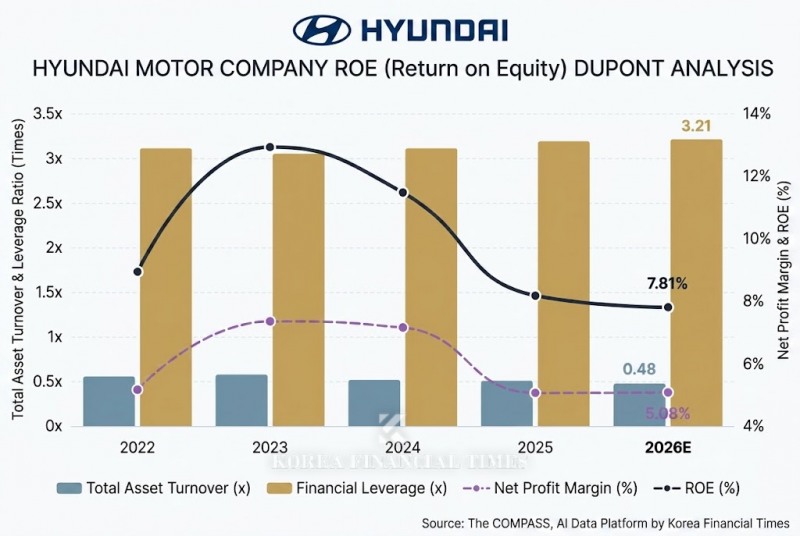
This image, originally published by Korea Financial Times, has been reconstructed using generative AI.
이미지 확대보기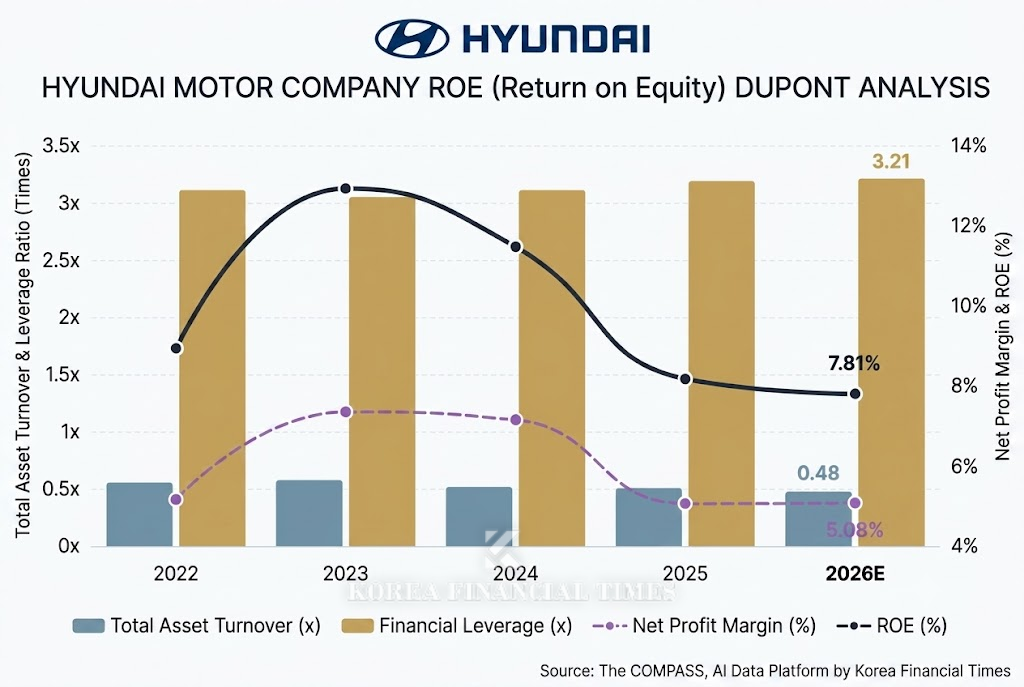
According to an electronic disclosure filed with the Financial Supervisory Service on the 22nd, Hyundai Motor's consolidated revenue last year reached KRW 186.2545 trillion, an all-time high.
First-quarter revenue this year came in at KRW 45.9389 trillion, up 3.5% from the same period last year. According to consensus estimates from domestic brokerages, full-year revenue is expected to continue rising to approximately KRW 193 trillion.
Operating profit, however, tells a different story. Hyundai Motor's operating profit last year came to just KRW 11.4679 trillion, down 19.5% year-on-year. First-quarter operating profit this year plunged 30.8% year-on-year to KRW 2.5147 trillion. Full-year operating profit is expected to be similar to last year's, raising concerns over stagnant profitability.
There is a degree of frustration on Hyundai Motor's part as well, as the fallout from U.S. tariffs is directly hitting its earnings. Since 2024, the burden of incentives needed to fund the shift to electrification and maintain global market share has also continued to grow. On top of that, costs stemming from currency fluctuations are squeezing operating profit.
Hyundai Motor's declining profitability can be attributed to a combination of internal and external factors. Of these, the external factors are problems the company cannot resolve on its own. Hyundai Motor must therefore explore every means and method available to it internally.
ROIC on a Steady Decline — Inefficient Capital Allocation Must Be Fixed
On the 21st, the Korea Corporate Governance Forum (KCGF) released a commentary proposing ways to address Hyundai Motor's undervaluation. It emphasized that the biggest structural problem is that massive amounts of capital are tied up in non-core assets rather than in the company's core mobility competitiveness.Hyundai Motor spent roughly KRW 10.5 trillion just to purchase the site for its Global Business Center (GBC) project. Including construction costs and public contribution fees, total spending is expected to exceed KRW 20 trillion — equivalent to about 10% of Hyundai Motor's shareholder equity. The KCGF likened this to the "skyscraper curse" (a reference to the theory that lavish, record-setting skyscraper projects often coincide with — or precede — a downturn for the company or economy behind them).
Hyundai Poised to Buy Out SoftBank's Boston Dynamics Stake as Deadline LoomsHyundai's IPO-Ready Boston Dynamics Runs Into Dual-Listing RoadblockHyundai Sales Slump at Home and Abroad... What's Causing the 'Sharp Decline'?Hyundai Motor Group Chairman Mulls Deepening Boston Dynamics IPO DilemmaHyundai Motor Faces Massive Union Bonus Demand Exceeding Dividends Amid Heavy Tech Investments
The forum also pointed to Hyundai Motor's holdings of non-core equity stakes, including approximately KRW 1 trillion in Korea Zinc (held through HMG Global LLC) and roughly KRW 700 billion in KT Corporation. It argued that these assets should be sold and converted to cash immediately, with the proceeds used for shareholder returns.
The urgency of reallocating Hyundai Motor's capital is also evident in various metrics. According to THE COMPASS, an AI-based data platform built in-house by the Korea Financial Times, Hyundai Motor's return on equity (ROE) fell from 12.93% in 2023 to 8.18% last year. On an annualized basis using first-quarter results this year, it stands at just 7.81%.
While the leverage ratio (total assets to total capital) is rising, declining profitability is weighing down ROE. In addition, total asset turnover (revenue to total assets) is also falling, indicating overall low asset utilization. This suggests that Hyundai Motor is structurally in need of capital reallocation.
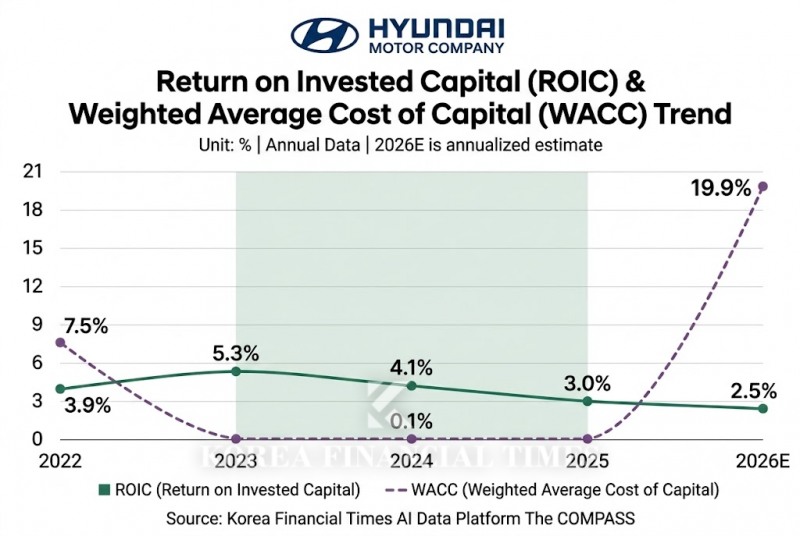
This image, originally published by Korea Financial Times, has been reconstructed using generative AI.
이미지 확대보기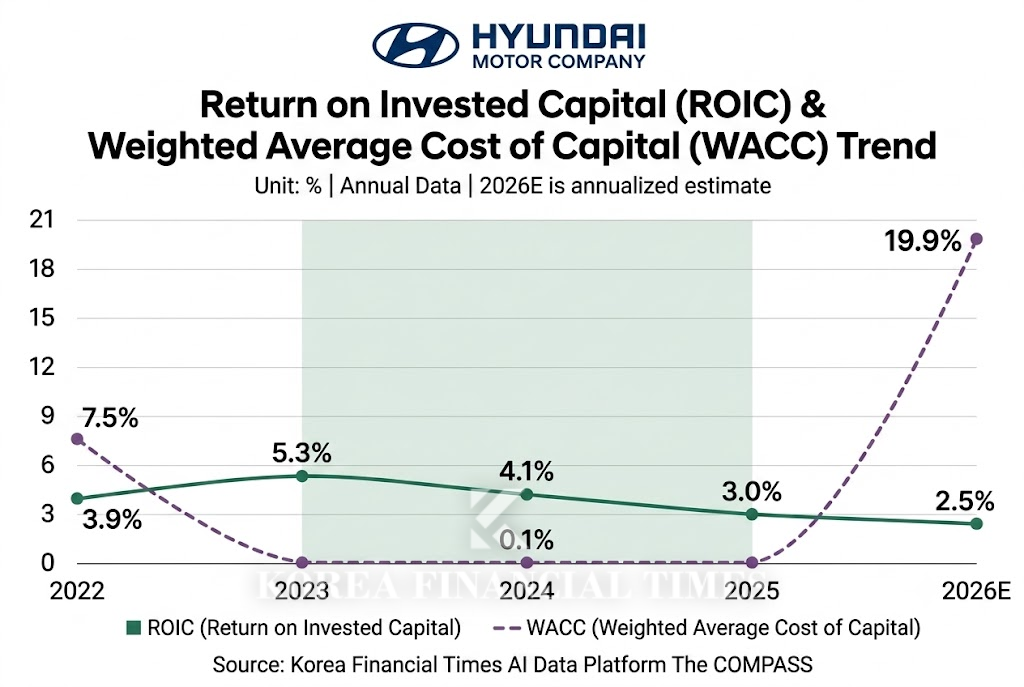
The picture looks even more serious when it comes to return on invested capital (ROIC), which measures profitability relative to capital deployed in business operations. Hyundai Motor's ROIC fell from 5.3% in 2023 to 3.0% last year.
ROIC typically tends to be higher than ROE. This is because, in the formula, ROIC's denominator (invested capital) is smaller in scale than ROE's denominator (total capital). ROIC's numerator also tends to be larger than that of ROE.
When calculating invested capital (IC), the denominator of ROIC, the Korea Financial Times deducts only cash and cash equivalents. This is because various investment assets are also regarded as an opportunity cost against generating operating profit. As a result, companies with a large amount of non-operating assets unrelated to their core business — like Hyundai Motor — see their ROIC drop to extremely low levels.
This aligns with the point raised by the KCGF. It means that the funds Hyundai Motor devotes to its core business — and the resulting operating profit and profitability — remain limited.
Cost of Equity Tops 55% — Hyundai Must Step Up Shareholder Returns
In August 2024, Hyundai Motor Group Vice Chairman Chang Jae-hoon announced at the "2024 CEO Investor Day" a plan to buy back a total of KRW 4 trillion worth of treasury shares over the following three years. He also emphasized that the discount on preferred shares would be taken into account when the shares are retired. However, Vice Chairman Chang has not kept this promise.Meanwhile, in a February 2024 commentary, the KCGF stressed the importance of retiring all preferred shares — which carry a high cost of capital — in order to lower the company's overall cost of capital. Hyundai Motor purchased KRW 366.8 billion worth of common shares in January this year and a combined KRW 32.1 billion across its three classes of preferred shares in April.
While the market capitalization of common and preferred shares stands at KRW 82 trillion and KRW 11 trillion, respectively, the proportion of preferred shares purchased remains markedly low, limiting the effect on lowering the company's overall cost of capital.
The reason Hyundai Motor needs to lower its cost of capital through shareholder returns and other measures is clear. According to THE COMPASS, Hyundai Motor's cost of equity stood at a striking 55.7% as of the 14th. It was 57.3% at the end of the first quarter this year, but has since eased as the stock price fell.
THE COMPASS does not use the CAPM model commonly used to calculate the cost of equity, since factors such as the time period and stock volatility (beta) used in the calculation are considered highly subjective. To ensure objectivity, it instead works backward, calculating the average annual growth rate that free cash flow (FCF) would need to sustain over the next 10 years to justify the company's current market capitalization — treated as the intrinsic value the market has agreed upon.
A cost of equity of 55.7% is a figure that cannot be achieved through organic growth alone. It could only be feasible through a combination of measures, such as securing new growth drivers through mergers and acquisitions (M&A) and expanding shareholder returns.
This unusually high cost of equity also reflects expectations surrounding Boston Dynamics. Indeed, most of the gains in Hyundai Motor's stock price this year have relied on the robotics business. This means that if the robotics division fails to demonstrate sufficient cash-generating capacity, the current stock price will be difficult to sustain.
One factor that could hold back further gains in Hyundai Motor's stock price is Chairman Chung Eui-sun's additional acquisition of a personal stake in Boston Dynamics. If Boston Dynamics grows, that additional stake would contribute to Chung's personal wealth rather than to enhancing the value of Hyundai Motor Group.
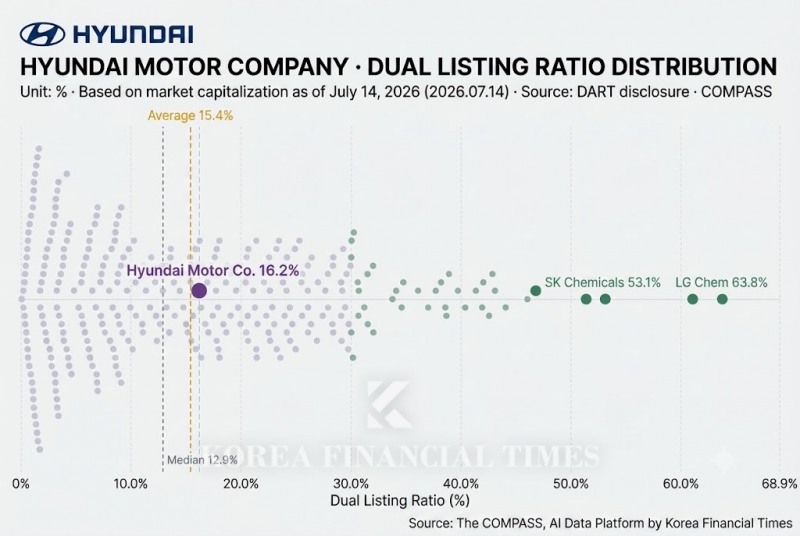
This image, originally published by Korea Financial Times, has been reconstructed using generative AI.
이미지 확대보기
Not only does this mean Hyundai Motor cannot fully capture the growth of the robotics business, but controversy over the legitimacy of Chung's acquisition of the Boston Dynamics stake may also persist. The "prohibition on the provision of business opportunities" under Korea's Fair Trade Act bars a company from directing promising business opportunities that could bring it significant profit toward related parties — such as the family of a controlling shareholder — or companies they control. The longer the controversy continues, the more governance concerns will function as a factor behind the company's undervaluation.
On this point, the KCGF recommended that the remaining 9.65% stake in Boston Dynamics be acquired by HMG Global LLC, the entity controlled by Hyundai Motor, rather than added to existing individual holdings.
An investment banking source said, "Hyundai Motor Group is the only conglomerate in Korea that still maintains a circular shareholding structure." The source added, "From Chairman Chung's perspective, he needs capital to secure control, and there is a tendency to link the growth and potential IPO of Boston Dynamics to that need, since it could be one way to untangle Hyundai Motor Group's complex governance structure." The source further noted, "If Chairman Chung were to resolve the circular shareholding structure, that alone would have a positive effect on enhancing Hyundai Motor's value, but the negative side is that it could also be perceived as an obsession with maintaining control."
Lee Sungkyu (lsk0603@fntimes.com)










!['첫 연임' 신학기 vs '新리더십' 이형주…차기 수협은행장 선임 D-Day [2027 은행장 선임 레이스]](https://cfnimage.commutil.kr/phpwas/restmb_setimgmake.php?pp=006&w=69&h=45&m=5&simg=202609211608140057701b5a2213792211381469.jpg&nmt=18)
![서초구 '아크로리버파크' 34평, 10억 오른 74억원에 거래 [일일 신고가]](https://cfnimage.commutil.kr/phpwas/restmb_setimgmake.php?pp=006&w=69&h=45&m=5&simg=20260624115142011110dd55077bc212411124362.jpg&nmt=18)


![[그래픽 뉴스] ‘순대’가 경제용어라고? 순(純)대외자산, 한국의 진짜 해외자산은 얼마일까?](https://cfnimage.commutil.kr/phpwas/restmb_setimgmake.php?pp=006&w=298&h=298&m=1&simg=202609021356075202de68fcbb3512411124362_0.jpg&nmt=18)
![[그래픽 뉴스] ISA 대개편! 나에게 유리한 계좌는?](https://cfnimage.commutil.kr/phpwas/restmb_setimgmake.php?pp=006&w=298&h=298&m=1&simg=202608041713155615de68fcbb3512411124362_0.jpg&nmt=18)
![[그래픽 뉴스] 미국 증시 새로운 키워드 'MANGOS'](https://cfnimage.commutil.kr/phpwas/restmb_setimgmake.php?pp=006&w=298&h=298&m=1&simg=202607291740382069de68fcbb3512411124362_0.jpg&nmt=18)

![[그래픽 뉴스] 은퇴후 30년 부모님 세대의 생존전략](https://cfnimage.commutil.kr/phpwas/restmb_setimgmake.php?pp=006&w=298&h=298&m=1&simg=202606301704439153de68fcbb3512411124362_0.jpg&nmt=18)
![[신간]은퇴연옥…김경록의 은퇴 후 삶의 나침반](https://cfnimage.commutil.kr/phpwas/restmb_setimgmake.php?pp=006&w=81&h=123&m=5&simg=20260414140833047280f8caa4a5ce12411124362.jpg&nmt=18)
![[신간] 물처럼 흐르고 원칙으로 서다…김용환의 통찰을 담다](https://cfnimage.commutil.kr/phpwas/restmb_setimgmake.php?pp=006&w=81&h=123&m=5&simg=20260409114249027860f8caa4a5ce12411124362.jpg&nmt=18)
![[안현정 서평] 플랫폼의 영지에서 ‘미학적 주권’을 선포하라...'K가 죽어야 K가 산다' 장준환 著](https://cfnimage.commutil.kr/phpwas/restmb_setimgmake.php?pp=006&w=81&h=123&m=5&simg=20260527121426063220c1c16452b012411124362.jpg&nmt=18)
![[서평] 추세 매매의 대가들...추세추종 투자전략의 대가 14인 인터뷰](https://cfnimage.commutil.kr/phpwas/restmb_setimgmake.php?pp=006&w=81&h=123&m=5&simg=2023102410444004986c1c16452b0175114235199.jpg&nmt=18)


![[머니무브 2026] “지금 사도 될까?” 답이 안 보인다면…하반기 투자, 4명의 전문가에게 물어보세요](https://cfnimage.commutil.kr/phpwas/restmb_setimgmake.php?pp=006&w=89&h=45&m=1&simg=202609151044050355302a735e27af12411124362.jpg&nmt=18)
![[AD] ‘PBV 라인업 확장’ 기아, 9월 독일서 ‘PV7’ 첫 공개](https://cfnimage.commutil.kr/phpwas/restmb_setimgmake.php?pp=006&w=89&h=45&m=1&simg=2026083111010602815074925877361231180222.jpg&nmt=18)
![[AD] 제네시스, 럭셔리 경험 더한 ‘2027 GV70’‧‘GV70 그래파이트’ 출시](https://cfnimage.commutil.kr/phpwas/restmb_setimgmake.php?pp=006&w=89&h=45&m=1&simg=20260702143546085600749258773622211122717.jpg&nmt=18)
![[AD] 개소세 혜택 종료…현대차, ‘썸머 페스타’로 고객 부담 완화](https://cfnimage.commutil.kr/phpwas/restmb_setimgmake.php?pp=006&w=89&h=45&m=1&simg=20260702142355004830749258773622211122717.jpg&nmt=18)
![[AD] 기아 ‘디 올 뉴 셀토스’, 인도 타임스 드라이브 어워즈서 ‘올해의 SUV’ 선정](https://cfnimage.commutil.kr/phpwas/restmb_setimgmake.php?pp=006&w=89&h=45&m=1&simg=202605071156400590007492587736124111243152.jpg&nmt=18)