






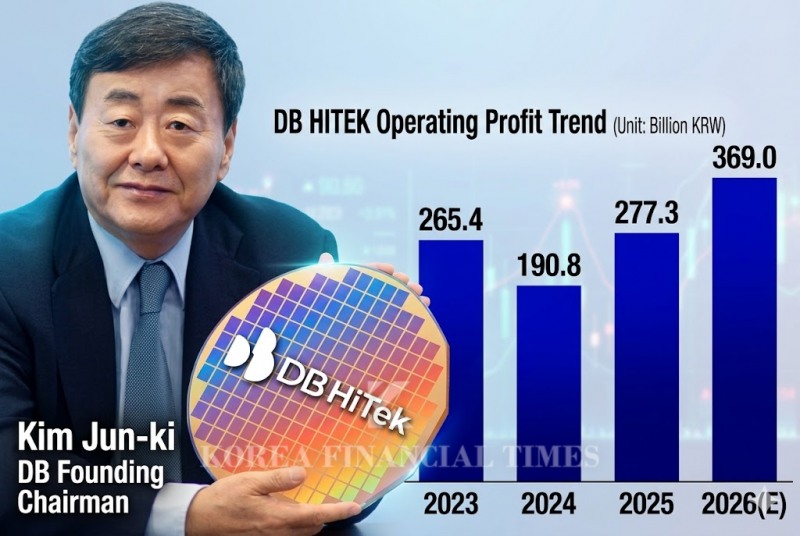
This infographic, originally published by Korea Financial Times, has been reconstructed using generative AI (Gemini).
이미지 확대보기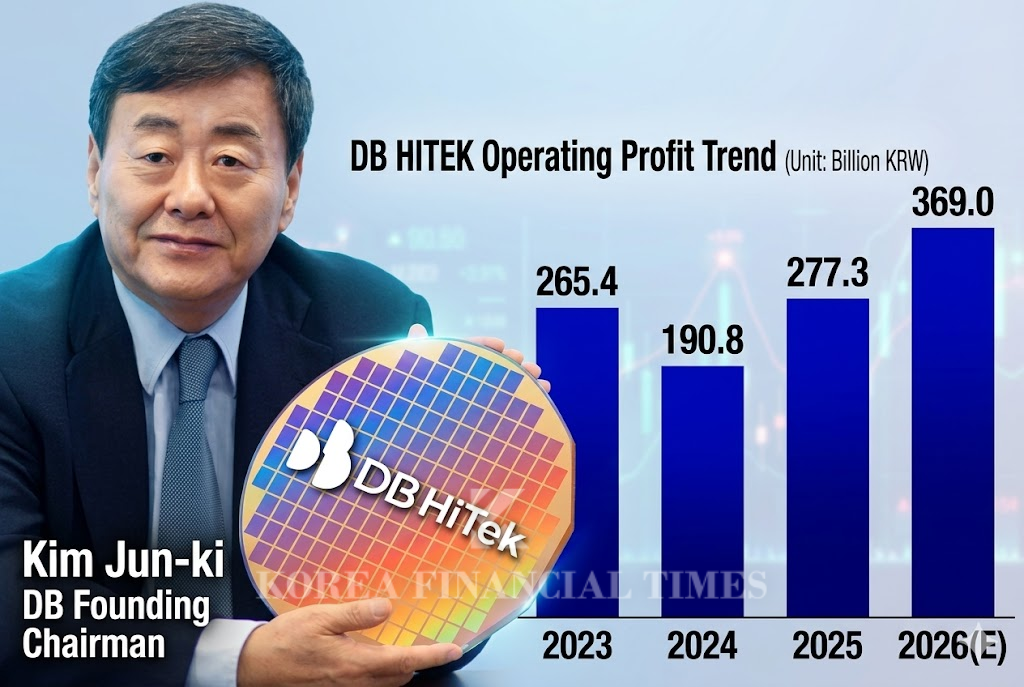
DB HiTek (CEO Cho Ki-suk) recorded a consolidated revenue of KRW 374.6 billion and an operating profit of KRW 63.7 billion (an operating profit margin of 17%) for the first quarter of this year. These figures represent an increase of 26% and 21%, respectively, compared to the same period last year. In particular, the operating profit delivered an "earning surprise," exceeding the market forecast of KRW 53 billion by 20%.
The company explained that this quarter's results reflected a one-off expense of KRW 22.1 billion for the contribution of treasury shares to the employee welfare fund. Excluding such one-off expenses and the performance of its subsidiaries, the separate operating profit margin reached 29.2%, demonstrating high profitability.
DB HiTek expects its earnings growth to accelerate further after the second quarter, when the price hikes for power semiconductors, driven primarily by China, will be fully reflected.
Analysis indicates that the market is also reflecting these high expectations. The stock price, which started at KRW 78,500 early last month, surged to as high as KRW 186,700 on May 11, skyrocketing 2.4 times in just one month.
This is interpreted as a result of the AI "frenzy" expanding to legacy foundry companies like DB HiTek. DB HiTek produces power semiconductors, image sensors, and display driver ICs (DDIs) used in home appliances, smartphones, TVs, and automobiles based on 8-inch wafers. Compared to the 12-inch process used to manufacture high-performance semiconductors such as CPUs, GPUs, and APs, the 8-inch process has a lower production difficulty, leading to frequent criticisms in the past regarding limits on profitability.
However, large foundry companies like TSMC and Samsung Electronics have reduced their 8-inch capacity to focus on the 12-inch process since the second half of last year to cope with the exploding demand for AI. This market shift has cast a bright light on DB HiTek.
As a result, analysts say DB HiTek, a company specializing in 8-inch wafers, is reaping windfall benefits. According to market research firm Omdia, the global 8-inch industry's monthly production capacity reached 3,036,000 sheets this year but is projected to gradually shrink to 3,022,000 sheets by 2028. Consequently, the effect of rising selling prices is expected to become fully visible starting from the second half of this year.
Exynos Reborn: How Samsung Is Betting Its Chip Future on On-Device AISamsung Foundry Eyes Turnaround After Years of LossesBeyond Hynix: SK's Three-Company AI Alliance Eyes Full-Stack JackpotSamsung Electronics and SK Hynix Engage in High-Stakes AI Chip War [KFT Topic]Samsung's 'Last Chance': Lee Jae-yong Pushes HBM4 as Make-or-Break Moment [KFT Topic]
DB HiTek is widely evaluated as a company built by DB Group Founder Kim Jun-ki through his sheer determination. Founder Kim entered the semiconductor business in 1983 by establishing Corsin (currently SK Siltron), a silicon wafer manufacturer, but handed over management control to LG seven years later to secure liquidity.
Nevertheless, Founder Kim re-entered the semiconductor industry in 1997 by establishing Dongbu Electronics, the predecessor of DB HiTek. While he initially planned to enter the memory sector, he reportedly pivoted to the non-memory business due to the Asian financial crisis. Subsequently, even amid the global economic crisis in 2002, Founder Kim took a strategic gamble to expand the business by successfully acquiring Anam Semiconductor.
However, DB HiTek was once treated as the "ugly duckling" of the group. It posted losses for 13 consecutive years starting from 2001, being blamed as the main culprit behind the deterioration of the group's financial structure. Founder Kim protected DB HiTek through various crises, including injecting KRW 350 billion of his personal wealth in 2009. Afterward, through continuous technological development and the growth of the IT device market like smartphones, the company succeeded in a dramatic turnaround.
Founder Kim, born in 1944 and turning 81 this year, reportedly maintains a powerful influence within the company. His eldest son, Honorary Chairman Kim Nam-ho, stepped down from the chairmanship last year at the young age of 50, which is known to be due to a conflict with Founder Kim over a push to sell DB HiTek.
Although Founder Kim stepped down from the front lines of management in 2017, he still serves as a business advisor in his capacity as a full-time, non-registered executive for the holding company DB Inc. and DB HiTek. In particular, Founder Kim received KRW 3.4 billion in salary from DB HiTek last year, making him the highest-paid individual, surpassing CEO Cho Ki-suk, who received KRW 541 million.
Gwak Horyung (horr@fntimes.com)











![서초구 '아크로리버파크' 34평, 10억 오른 74억원에 거래 [일일 신고가]](https://cfnimage.commutil.kr/phpwas/restmb_setimgmake.php?pp=006&w=69&h=45&m=5&simg=20260624115142011110dd55077bc212411124362.jpg&nmt=18)
!['첫 연임' 신학기 vs '新리더십' 이형주…차기 수협은행장 선임 D-Day [2027 은행장 선임 레이스]](https://cfnimage.commutil.kr/phpwas/restmb_setimgmake.php?pp=006&w=69&h=45&m=5&simg=202609211608140057701b5a2213792211381469.jpg&nmt=18)


![[그래픽 뉴스] ‘순대’가 경제용어라고? 순(純)대외자산, 한국의 진짜 해외자산은 얼마일까?](https://cfnimage.commutil.kr/phpwas/restmb_setimgmake.php?pp=006&w=298&h=298&m=1&simg=202609021356075202de68fcbb3512411124362_0.jpg&nmt=18)
![[그래픽 뉴스] ISA 대개편! 나에게 유리한 계좌는?](https://cfnimage.commutil.kr/phpwas/restmb_setimgmake.php?pp=006&w=298&h=298&m=1&simg=202608041713155615de68fcbb3512411124362_0.jpg&nmt=18)
![[그래픽 뉴스] 미국 증시 새로운 키워드 'MANGOS'](https://cfnimage.commutil.kr/phpwas/restmb_setimgmake.php?pp=006&w=298&h=298&m=1&simg=202607291740382069de68fcbb3512411124362_0.jpg&nmt=18)

![[그래픽 뉴스] 은퇴후 30년 부모님 세대의 생존전략](https://cfnimage.commutil.kr/phpwas/restmb_setimgmake.php?pp=006&w=298&h=298&m=1&simg=202606301704439153de68fcbb3512411124362_0.jpg&nmt=18)
![[신간]은퇴연옥…김경록의 은퇴 후 삶의 나침반](https://cfnimage.commutil.kr/phpwas/restmb_setimgmake.php?pp=006&w=81&h=123&m=5&simg=20260414140833047280f8caa4a5ce12411124362.jpg&nmt=18)
![[신간] 물처럼 흐르고 원칙으로 서다…김용환의 통찰을 담다](https://cfnimage.commutil.kr/phpwas/restmb_setimgmake.php?pp=006&w=81&h=123&m=5&simg=20260409114249027860f8caa4a5ce12411124362.jpg&nmt=18)
![[안현정 서평] 플랫폼의 영지에서 ‘미학적 주권’을 선포하라...'K가 죽어야 K가 산다' 장준환 著](https://cfnimage.commutil.kr/phpwas/restmb_setimgmake.php?pp=006&w=81&h=123&m=5&simg=20260527121426063220c1c16452b012411124362.jpg&nmt=18)
![[서평] 추세 매매의 대가들...추세추종 투자전략의 대가 14인 인터뷰](https://cfnimage.commutil.kr/phpwas/restmb_setimgmake.php?pp=006&w=81&h=123&m=5&simg=2023102410444004986c1c16452b0175114235199.jpg&nmt=18)


![[머니무브 2026] “지금 사도 될까?” 답이 안 보인다면…하반기 투자, 4명의 전문가에게 물어보세요](https://cfnimage.commutil.kr/phpwas/restmb_setimgmake.php?pp=006&w=89&h=45&m=1&simg=202609151044050355302a735e27af12411124362.jpg&nmt=18)
![[AD] ‘PBV 라인업 확장’ 기아, 9월 독일서 ‘PV7’ 첫 공개](https://cfnimage.commutil.kr/phpwas/restmb_setimgmake.php?pp=006&w=89&h=45&m=1&simg=2026083111010602815074925877361231180222.jpg&nmt=18)
![[AD] 제네시스, 럭셔리 경험 더한 ‘2027 GV70’‧‘GV70 그래파이트’ 출시](https://cfnimage.commutil.kr/phpwas/restmb_setimgmake.php?pp=006&w=89&h=45&m=1&simg=20260702143546085600749258773622211122717.jpg&nmt=18)
![[AD] 개소세 혜택 종료…현대차, ‘썸머 페스타’로 고객 부담 완화](https://cfnimage.commutil.kr/phpwas/restmb_setimgmake.php?pp=006&w=89&h=45&m=1&simg=20260702142355004830749258773622211122717.jpg&nmt=18)
![[AD] 기아 ‘디 올 뉴 셀토스’, 인도 타임스 드라이브 어워즈서 ‘올해의 SUV’ 선정](https://cfnimage.commutil.kr/phpwas/restmb_setimgmake.php?pp=006&w=89&h=45&m=1&simg=202605071156400590007492587736124111243152.jpg&nmt=18)