







Choi Won-hyuk, CEO of HMM. /Photo provided by HMM
On June 22 (KST), Iran’s parliament approved a resolution to close the Strait of Hormuz. In response, tanker freight rates soared 30.55% week-on-week to $30,745 (about KRW 42.44 million).
In particular, the TD3C, which is the Middle East regional index within the Baltic Dirty Tanker Index (BDTI)—the leading freight rate index for crude oil tankers—has also shown an upward trend. TD3C refers to the route from the Middle East Gulf region, including the Persian Gulf, to China, based on a 270,000-ton crude oil tanker. Major oil-producing countries in this area include Iran, Saudi Arabia, Kuwait, Iraq, and the United Arab Emirates (UAE).
In contrast, the Shanghai Containerized Freight Index (SCFI) dropped sharply, falling 10.5 percentage points week-on-week to 1,870 points as rates for North American routes declined for a second consecutive week. The Middle East is dominated by tanker traffic rather than container ships, so the SCFI is not heavily influenced by this market.
As the SCFI’s drop suggests, concerns over a Hormuz closure are not expected to have a direct impact on HMM, which mainly operates container vessels. HMM currently has only one container route passing through the Strait of Hormuz. The vessel on this route is reportedly operating on schedule. Container ships run on fixed schedules and routes.
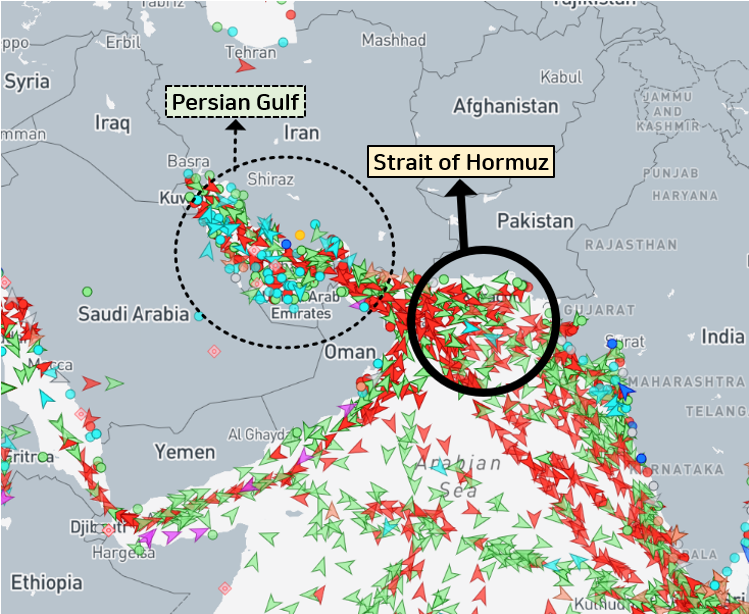
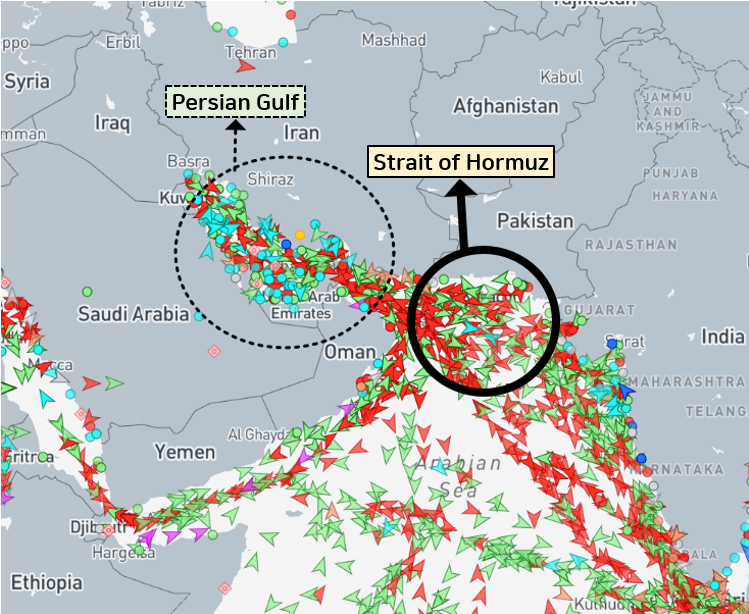
The industry’s main concern is what happens if the Strait is actually closed. Unlike the Suez Canal, which can be bypassed by rounding the Cape of Good Hope, there is no alternative sea route for the Strait of Hormuz. If blocked, vessel movement would be impossible until the strait reopens.
However, this scenario is still somewhat removed from HMM’s core business. An industry insider noted, “It’s impossible to move 300,000 tons of crude oil by land, but for container ships, it is theoretically possible to unload standardized containers at ports and transport them by truck or rail.”
An HMM spokesperson stated, “Our container route through the Strait of Hormuz is still operating normally. If any issues arise, we are reviewing various contingency measures, including alternative ports.”
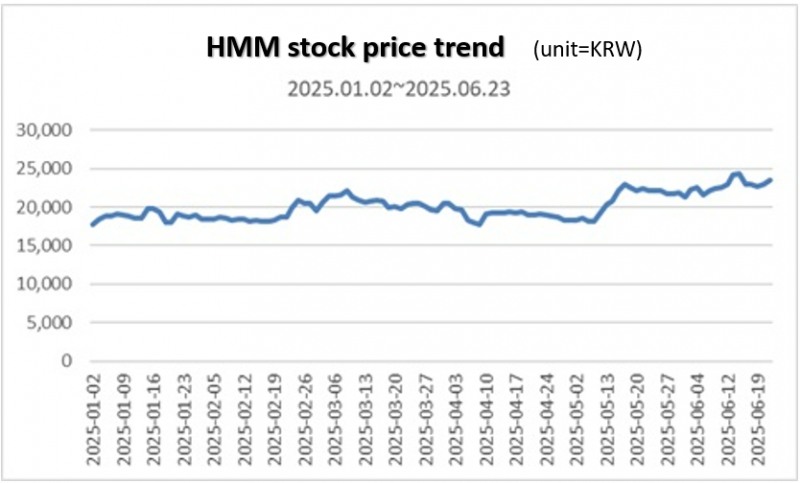
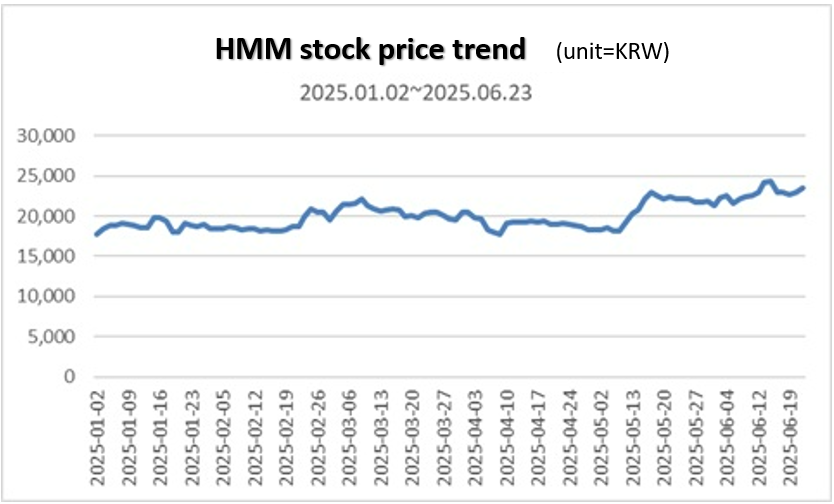
Meanwhile, HMM shares closed up 2.17% at KRW 23,500 on the day, reflecting heightened market interest in shipping stocks amid the crisis.
Shin Haeju (hjs0509@fntimes.com)











![‘삼전닉스ʼ에 가린 반도체주…주성엔지니어링 ‘질주ʼ·리노공업 ‘주춤ʼ [정답은 TSR]](https://cfnimage.commutil.kr/phpwas/restmb_setimgmake.php?pp=006&w=69&h=45&m=5&simg=20260918223152079000dd55077bc212411124362.jpg&nmt=18)
![스틱벤처스 정보라, 네오사피엔스 IPO 잰걸음 ‘딥테크 투자 강화ʼ [VC 2026 하반기 프리뷰 (7)]](https://cfnimage.commutil.kr/phpwas/restmb_setimgmake.php?pp=006&w=69&h=45&m=5&simg=20260918221427079140dd55077bc212411124362.jpg&nmt=18)


![[그래픽 뉴스] ‘순대’가 경제용어라고? 순(純)대외자산, 한국의 진짜 해외자산은 얼마일까?](https://cfnimage.commutil.kr/phpwas/restmb_setimgmake.php?pp=006&w=298&h=298&m=1&simg=202609021356075202de68fcbb3512411124362_0.jpg&nmt=18)
![[그래픽 뉴스] ISA 대개편! 나에게 유리한 계좌는?](https://cfnimage.commutil.kr/phpwas/restmb_setimgmake.php?pp=006&w=298&h=298&m=1&simg=202608041713155615de68fcbb3512411124362_0.jpg&nmt=18)
![[그래픽 뉴스] 미국 증시 새로운 키워드 'MANGOS'](https://cfnimage.commutil.kr/phpwas/restmb_setimgmake.php?pp=006&w=298&h=298&m=1&simg=202607291740382069de68fcbb3512411124362_0.jpg&nmt=18)

![[그래픽 뉴스] 은퇴후 30년 부모님 세대의 생존전략](https://cfnimage.commutil.kr/phpwas/restmb_setimgmake.php?pp=006&w=298&h=298&m=1&simg=202606301704439153de68fcbb3512411124362_0.jpg&nmt=18)
![[신간]은퇴연옥…김경록의 은퇴 후 삶의 나침반](https://cfnimage.commutil.kr/phpwas/restmb_setimgmake.php?pp=006&w=81&h=123&m=5&simg=20260414140833047280f8caa4a5ce12411124362.jpg&nmt=18)
![[신간] 물처럼 흐르고 원칙으로 서다…김용환의 통찰을 담다](https://cfnimage.commutil.kr/phpwas/restmb_setimgmake.php?pp=006&w=81&h=123&m=5&simg=20260409114249027860f8caa4a5ce12411124362.jpg&nmt=18)
![[안현정 서평] 플랫폼의 영지에서 ‘미학적 주권’을 선포하라...'K가 죽어야 K가 산다' 장준환 著](https://cfnimage.commutil.kr/phpwas/restmb_setimgmake.php?pp=006&w=81&h=123&m=5&simg=20260527121426063220c1c16452b012411124362.jpg&nmt=18)
![[서평] 추세 매매의 대가들...추세추종 투자전략의 대가 14인 인터뷰](https://cfnimage.commutil.kr/phpwas/restmb_setimgmake.php?pp=006&w=81&h=123&m=5&simg=2023102410444004986c1c16452b0175114235199.jpg&nmt=18)


![[머니무브 2026] “지금 사도 될까?” 답이 안 보인다면…하반기 투자, 4명의 전문가에게 물어보세요](https://cfnimage.commutil.kr/phpwas/restmb_setimgmake.php?pp=006&w=89&h=45&m=1&simg=202609151044050355302a735e27af12411124362.jpg&nmt=18)
![[AD] ‘PBV 라인업 확장’ 기아, 9월 독일서 ‘PV7’ 첫 공개](https://cfnimage.commutil.kr/phpwas/restmb_setimgmake.php?pp=006&w=89&h=45&m=1&simg=2026083111010602815074925877361231180222.jpg&nmt=18)
![[AD] 제네시스, 럭셔리 경험 더한 ‘2027 GV70’‧‘GV70 그래파이트’ 출시](https://cfnimage.commutil.kr/phpwas/restmb_setimgmake.php?pp=006&w=89&h=45&m=1&simg=20260702143546085600749258773622211122717.jpg&nmt=18)
![[AD] 개소세 혜택 종료…현대차, ‘썸머 페스타’로 고객 부담 완화](https://cfnimage.commutil.kr/phpwas/restmb_setimgmake.php?pp=006&w=89&h=45&m=1&simg=20260702142355004830749258773622211122717.jpg&nmt=18)
![[AD] 기아 ‘디 올 뉴 셀토스’, 인도 타임스 드라이브 어워즈서 ‘올해의 SUV’ 선정](https://cfnimage.commutil.kr/phpwas/restmb_setimgmake.php?pp=006&w=89&h=45&m=1&simg=202605071156400590007492587736124111243152.jpg&nmt=18)